
Article by ICG member Lindsey Annable, Free Spirit Consulting Ltd.

Businesses need a different focus when automating their Customer Complaint process. They should start with the question of how to automate not only for efficiency but also for empathy.
How a complaints procedure is structured really matters. It is an important customer touchpoint to avoid straining a potentially already fraught relationship and yet not every brand gets it right.
I recently submitted a complaint to a major airline. They have completely revamped their complaints procedure so that the customer has to submit their grievance via a series of structured multiple choice options. Somewhat like a survey ironically.
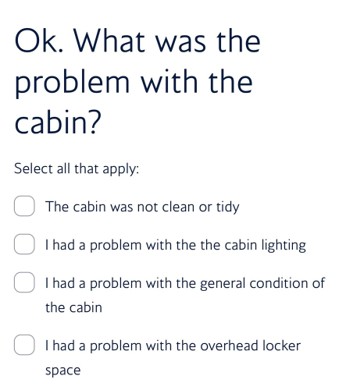
A few of the multiple choice options
On the upside, communication around resolution timelines was immediate and very clear once the complaint had been submitted. The resolution was prompt; in fact the following day. Box ticked for clear communication and speed of resolution. The language used throughout was very simple and clear.
However the survey style approach felt totally inadequate. It was almost as if the airline saw complaints as an annoyance to purge off agenda as quickly as possible. It seemed that the process had been designed with efficiency for the business in mind.
Undoubtedly customer complaints take up considerable financial resource on the corporate balance sheet. The more efficient the resolution process, the less costly. Airlines also take the rap for a fair number of issues caused by problems beyond their control such as weather and airport operational difficulties.
But it’s worth thinking about what this airline approach misses. Robert Biswas-Diener wrote about The Three Types of Complaining in Psychology Today and identified the need to ‘vent as an expression of emotional dissatisfaction.’ There is validation in receiving attention and sympathy he writes. This is where the airline complaint process fell short. None of the options quite matched my complaint. Given there were a number of issues on the flight, the multiple choice process was repeated for each topic.
The end result was that rather than appease my frustration about the flight it heightened my annoyance. The options enforced a sense of unwonted control over my own voice. In essence it felt like I wasn’t complaining but being forced to say something I didn’t want to. It was just ‘tick box listening’.
The approach surely has far wider reaching implications in the business. It undermines a valuable feedback loop, making the insights derived from this customer touchpoint far less rich and less authentic. This will have consequences down the line in terms of actionability and outcomes.
It also left me questioning why the multiple choice approach in our AI enabled world. AI might have offered an efficient solution to analyse complaints at speed. Perhaps not perfect but nor is the multiple choice option.
This reveals some important lessons in designing or reshaping a complaints process. Design for both empathy and efficiency i.e. don’t forget the importance of making the customer feel heard, however that is achieved. Consider a more qualitative approach – free form text, voice, video combined with structured responses. I once had a smaller company ring me directly to understand the complaint first, then put it through the defined complaints process. I only received email updates subsequently but that initial call ensured the process perfectly balanced my emotional and functional needs.
I would argue that is increasingly relevant in a world where automation risks creating emotional distance between customers and corporations. How are you ensuring there is space for empathy in your complaints process whilst remaining as efficient as possible?
(The Three Types of Complaining Robert Biswas-Diener Psychology Today June 2017 https://www.psychologytoday.com/gb/blog/significant-results/201706/the-three-types-of-complaining)