
Article by ICG member Viviana Codemo_ Marea Research Qualitative Thinking_ ITALY
Some good news! We can give AI a run for its money with our creativity and the unimaginable resources of our unconscious.
A few years ago, I enjoyed writing an abstract that I then sent to the Esomar Call for Contribution, and to my great surprise and excitement, it was accepted as a speech at the Esomar Qualitative Congress,. The topic was very fascinating to me: how to use fairy tale archetypes to imagine a qualitative research tool to be used in focus groups.
The inspiration came from Bruno Bettelheim’s magnificent book, The Uses of Enchantment: The Meaning and Importance of Fairy Tales. What was new, and exciting, was the warmth, humane and urgent, with which Bettelheim expounded fairy tales as aids to the child’s growth, which he understand as growth through
conflicts, the chief conflict being Oedipal. The wicked stepmothers and fairy godmothers he translated as, all, Mother, and the kings and hunters as, simply, Father. It is the essence of the fairy tale to objectify differing facets of the child’s emotional experience; by showing the underlying identity of polarized and duplicated symbolizations, Bettelheim’s readings make sense of much that seems nonsensical, and relieve the tales of much of the cruelty that has turned many parents and educators to tamer, but thinner, narratives for children.
An adult, in telling a story, though encouraged to yield, like the countless tellers before him, to “his conscious and unconscious feelings for the story,”is strictly admonished never to “explain” the meaning. Bettelheim’s explications of two dozen or so best-known tales convince us, indeed, that we may not know the meaning, or that the child of four or five knows it better. That the child does not “catch”all the symbolization Is the opposite of an objection; these tales’ merit is that the little listener takes what he can, responding to the unspoken significances unconsciously, mastering anxieties bodied forth for him by these venerable fantasies, being led through Oedipal and sibling conflicts toward an eventual happy union with an “agecorrect” partner.
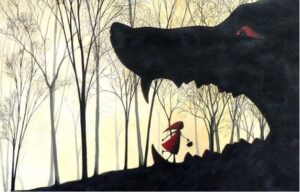
What struck me when analysing Bettelheim’s theories was the universality that could be found in their meaning: those archetypes of the maternal and the paternal, of hunger that devours from within (expressed by the wolf) spanned entire generations, remaining unchanged and continuing to “speak” to our unconscious. Therefore, I started from a premise that seemed almost obvious: each of us was once a child (yes, it’s true!) and each of us came into contact with fairy tale characters (the fairy, the king, the wolf) during our childhood, at least until classic fairy tales became part of our imagination. We may soon have to update these reflections if we realise that today’s children have been deprived of this precious emotional treasure chest, leaving them alone in front of a screen.
Returning to methodology, I discovered that I could use fairy tale archetypes to work with both adults and teenagers on the relationship they establish with a certain product or brand, and monitor its evolution over time.
For example, through the transition from the “good fairy” to the King, it emerged that the more distinctly maternal nature of some brands had gradually become institutionalised, losing that intimate role of mothering and shifting towards the normative and authoritative system typically associated with fatherhood and
represented by the King. None of this had been mentioned by the interviewees, so it had not been brought
to a conscious level, but it was clearly evident from the cards they had chosen and the imagery suggested by those choices. Moreover, after collecting interviews, diaries or narratives, you can:
• Analyse the stories by looking for archetypal structures (e.g. a participant who
describes themselves as “travelling”, “struggling”, “guided by someone” →
hero’s journey).
• Interpret the transformative passages in the stories according to fairy tale
models (crisis → trial → rebirth).
When I presented my paper to the Esomar delegates, I invited colleagues from cultures other than Western ones (I am thinking of the African continent, but also India, China, etc.) to look for characters in their traditional fairy tales that could represent the same archetypes identified by Bettelheim. I do not know if anyone did so. Yet it would be an interesting challenge (which AI has not yet imagined!!), because everyone, wherever they come from, has their own inner child, which guides their emotional world.
Useful references
§ B. Bettelheim – The Uses of Enchantment: The Meaning and Importance of
Fairy Tales
§ J. Campbell – The Hero with a Thousand Faces
§ C. G. Jung – Man and His Symbols
§ V. Propp – Morphology of the Folktale