
Article by ICG Advertiser, Tiger Finder
A client brings you a question about their category. Something has shifted in high-protein food. Cottage cheese sales are climbing, recipes for it are everywhere, and nobody is sure whether this is a short TikTok joke or a deeper change in how people think about protein and what counts as healthy comfort.
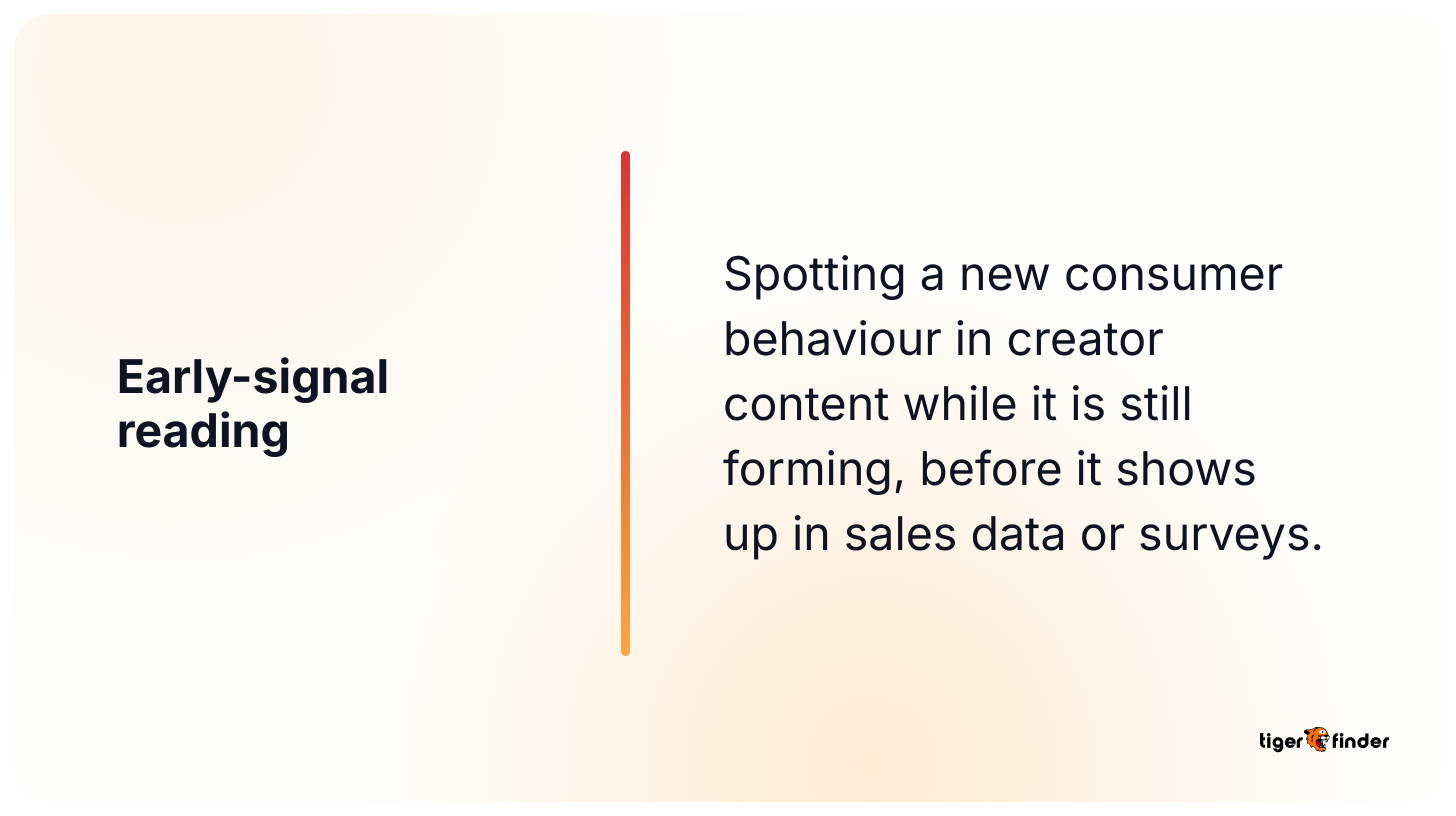
This is a research question. Answering it means reading the category where the change is visible, and for many consumer categories that place is now TikTok. Creators there show a new habit forming while it is still finding its language, often before it appears in sales data or survey results.
The method below walks through how to do that reading properly, step by step.
Where TikTok works as an early signal
TikTok is not a reliable early indicator everywhere. It works best in categories where behaviour is easy to show on camera, like food, beauty, fitness, and the home. In those categories, a new habit often appears in creator content while it is still forming, before it has a name in the wider market.
A note of caution belongs here. You do not get a forecast out of this. You get an early view of which behaviours and stories are starting to take shape, ahead of the point where they reach your usual trackers. Some of what you see stays niche. Some of it is noise. Telling the difference is part of the judgment the method asks for.
Here is how the method works, step by step.
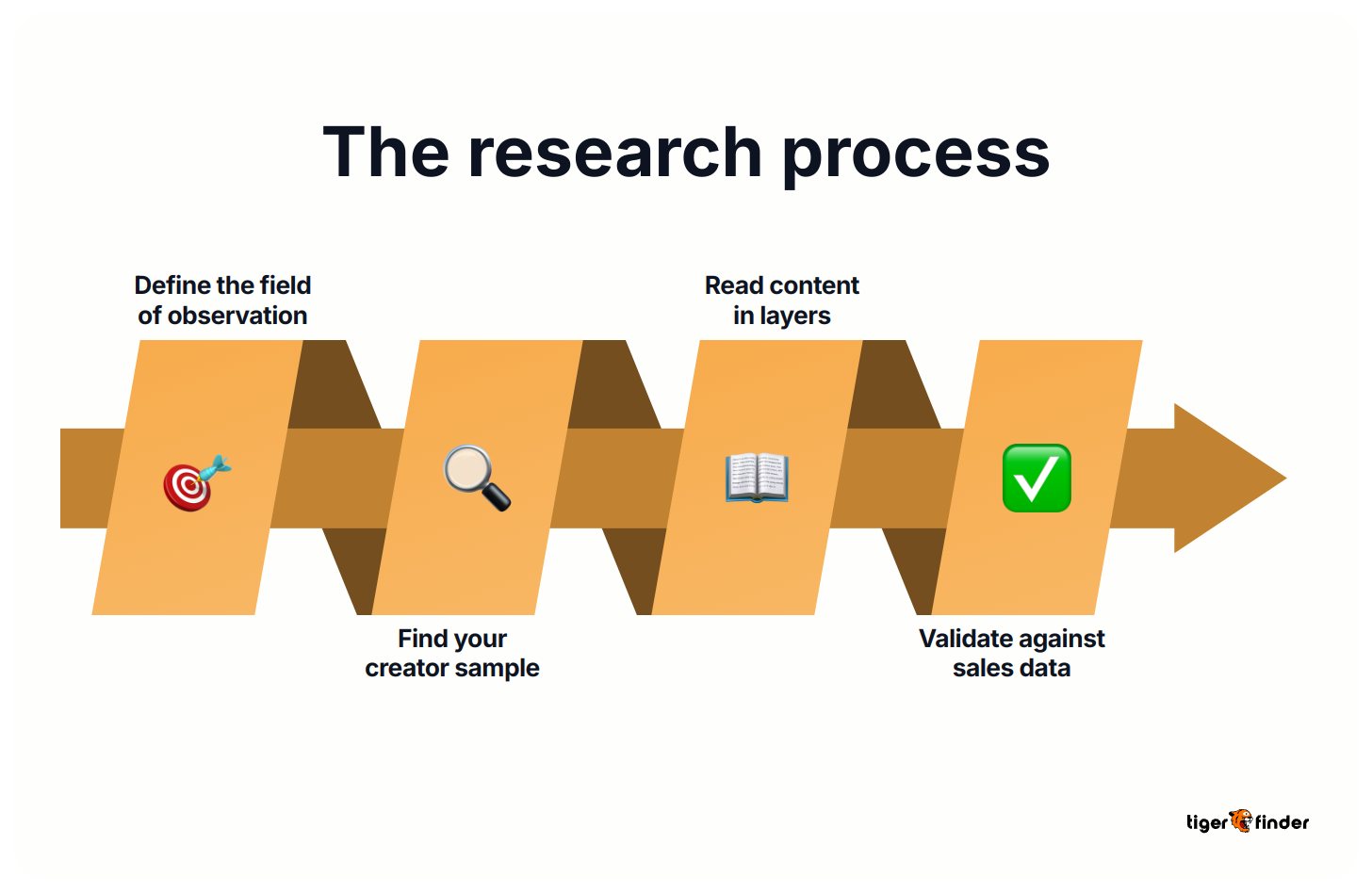
1. The researcher defines the field of observation
Before you look at anyone, you set the frame. This is the researcher’s step, and it is where the rigor comes from:
- The behaviour you are studying.
- The markets and the time period.
- Which creators belong in the field, and which sit outside it.
- The audience size that matters for the question.
For an early-signal study you usually want smaller creators, in the 10,000 to 100,000 follower range, where a niche audience is engaged and a new habit tends to surface first. Write down what counts as a relevant signal, so you can tell later whether you found one.
Setting the frame is what makes this qualitative research rather than scrolling with a purpose. The frame decides what your study is able to claim.
2. A tool finds your starting sample
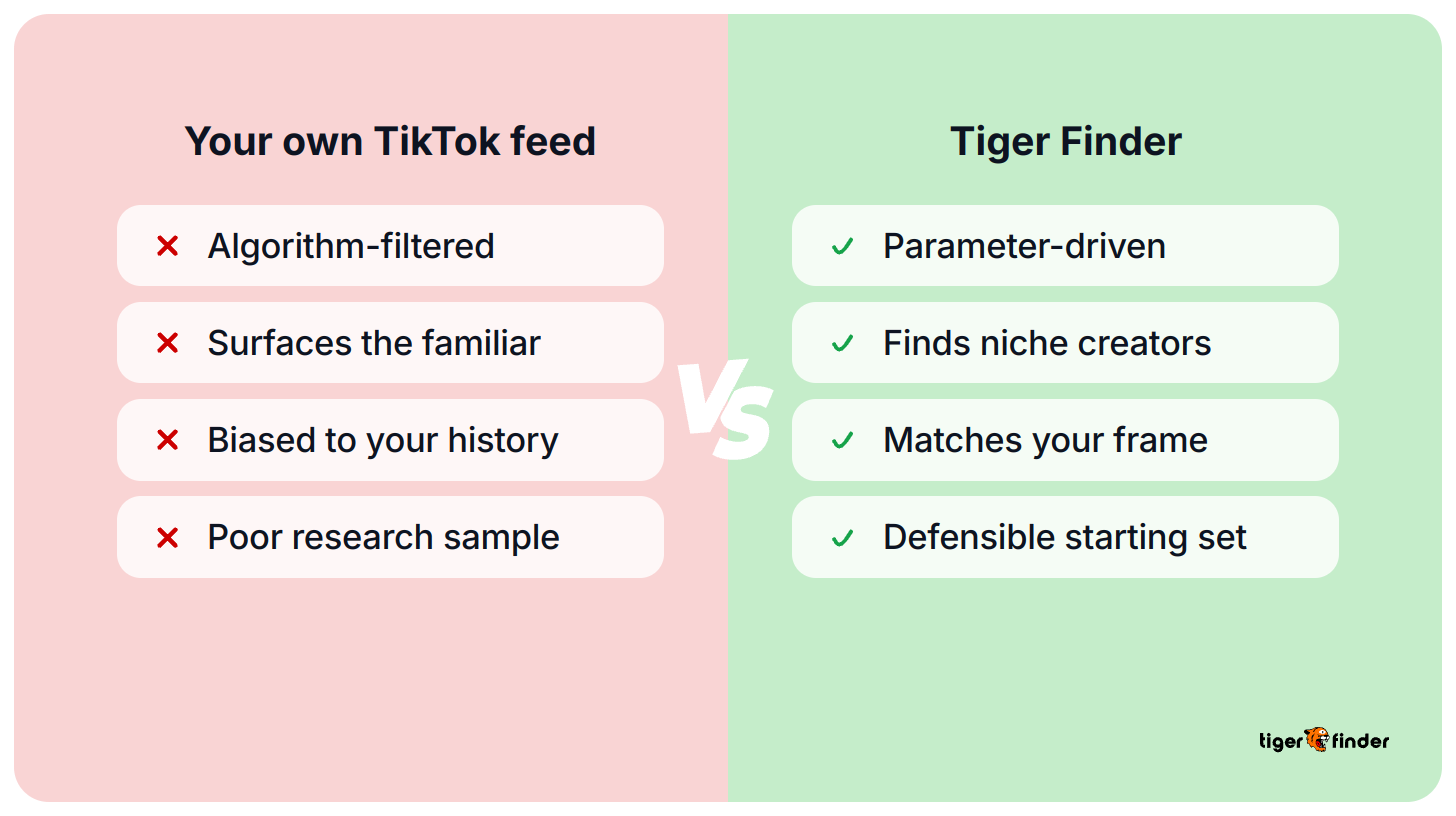
When you search TikTok yourself, the feed shows you what the algorithm has already learned you like. It is tuned to your history, so it surfaces the loud and the familiar and quietly buries everything outside your habits. That makes your own feed a poor sampling instrument for research.
An AI tool called Tiger Finder helps here. It lets you step outside your own feed and find creators by the parameters you set, the niche, the market, the audience size, and the content type. It assembles a starting sample that matches your frame, which gives you a defensible group of creators to study.
3. The researcher reads the content
This is the heart of the work, and it is entirely human. Take the cottage cheese case and read it in layers:
- Format. Look at what repeats across the videos. The same shapes come up again and again: the bowl, the blender, the macros written into the caption, the recipe filmed as part of a daily routine.
- Language. Look at the words and numbers people use to describe the food. High protein. 40 grams of protein. 500 calories. Creamy. Easy. These are the terms that make the choice feel allowed.
- Tension. Look at the conflict the content is quietly resolving. People want comfort food, and they want to feel that the food is doing something good for them. The recipes hold both at once.
- Insight. Read what the pattern adds up to. The protein number is doing a job. It lets people choose comfort food and feel the choice makes sense. That permission is the real change in the category.
What the reading turns up
Put the layers together and the pattern resolves. The same food keeps getting filmed as a treat, then captioned with its protein count. Cottage cheese blended into ice cream, posted as dessert, labelled 40 grams of protein. The protein number is what lets people post the treat as a health choice. That pairing of indulgent food and high protein count repeats across the videos, and it points to permission as the thing that moved the category.
The behaviour shows up in the numbers. US retail sales of cottage cheese rose 20% in the 52 weeks to mid-June 2025, according to Circana data reported by CNN, after annual growth near 17% in 2023 and 2024. Some producers reported struggling to keep up with demand.
The growth came from several forces, including the wider protein boom and GLP-1 diets. TikTok made the new permission visible early, before it was easy to describe in standard category language.
The same logic shows up in newer brands entering the space. Alterego, a UK cottage cheese brand founded by Rose Hancock, builds on the same tension, health-conscious food that still feels like a treat. The brand launched in April 2025 and moved into Sainsbury’s the same year.
Its quick move onto shelves shows how fast the signal becomes commercially legible once the behaviour has a clear language around it.
A conventional survey would struggle to reach this on its own. Ask people why they buy high-protein snacks and they report health and fitness goals, because that is the acceptable answer to give.
Their content shows the comfort motive on its own, in what they cook and how they caption it. The gap between the stated reason and the visible behaviour is the finding a brand pays for.
The TikTok read is a starting hypothesis with cultural texture. You then check it against sales data, search behaviour, reviews, and follow-up qualitative work. The platform shows you the shape of the change early. Validation tells you whether it holds.
What you give the client
What you hand over is a clear picture of a new behaviour while it is still forming, before it reaches the usual data. You can show the client who is driving it, the words people use to make it feel normal, and what that shift means for the category.
Tiger Finder does the part that is hard to do by hand. It reaches past your own feed and assembles a sample of creators that matches the frame you set, so you start from a defensible group rather than whatever the algorithm decided to show you. That is real time saved, and it is time saved on the work that adds the least value, the sorting and the searching.
The reading is where the value sits, and that stays with the researcher. You are the one who sees the same recipe filmed as a treat and captioned by its protein count, names the tension underneath it, and works out that the protein number is granting permission.
The tool gathers the field so you can spend your time turning it into a finding the client can act on.