Topic: GDPR, Data Protection, Cyber Security

  • Data Protection Compliance – Hints and Tips

    Data Protection Compliance – Hints and Tips

    Inreasingly we are being asked by (larger) clients to complete various data compliance questionnaires, or supply details of our policies. 

    Following a recent egroup exchange, Tanya Squires put together an outline of the types of information that you may want to include in your response … and some other members also made some suggestions.  We have collated the responses here.

    Bascially, you need to show that you are ensuring that any data is held/transferred securely and compliantly.  You need to show that you are aware, that you have thought about it, and that you act in accordance with GDPR.  YOu may want to consider including the following information;

    • A link to your Privacy Notice (should already be a copy on your website)
    • That you have Data Processing Agreements in place with any third parties you use e.g. recruiters
    • Data security – your PC/laptop is fully encrypted e.g. with BitLocker
    • How long you keep files for after completion of a project and how you dispose of files (e.g. electronic shredder)
    • Data integrity – your PC is backed up e.g. Backblaze (or there are data backup systems in the EEA)
    • Data transfer
      • Does your data leave the EEA? E.g. if you use Google Drive, Dropbox, a computer backup system, data transfer systems such as WeTransfer (which is in the EEA)
      • Are the data transfer systems you use encrypted? End-to-end encryption better for sensitive info
      • Or your client may have their own system they like to use, e.g. encrypted email or an FTP server
      • If data leaves the EEA, do the companies you use have the EU-US Privacy Shield in place (I could be out of date on this though, at one point they were looking at phasing out the Privacy Shield…)
      • (Also, someone moved their servers to the EEA – might have been Google in which case Google Drive is now fine. Gmail stopped scanning emails for advertising targeting too, making Gmail a better option now)

    Other resoursec include the ICG webinars which are still available to watch, and also a simple Goggle search for 'Data Protection Complience Statement' which will bring up various bits of boilerplate which may give you some more ideas.  Also, look at the websites of the large research agencies for their response/ documents – they will probably be too complex for a small agency, but will give you some idea of how to go about it.

    Note:  this list was put together in Feb 2019.  It is not exhaustive, nor is it meant to constitute formal 'advice' or 'guidance' in any way – it is purely a starting point for your thinking.

  • ICO GDPR Updates and Resources

    ICO GDPR Updates and Resources

    February 2019 update

    Thanks to member Muriel Esposito who alerted us to the Brexit Hub on the MRS, which tackles the thorny topic of data transfers from the EEA to the UK in case of no-deal Brexit. https://www.mrs.org.uk/standards/brexit-hubc

    It has the merits of being clear with access to further resources, such as the ICO's contract builder from controller to processor, including standard contractual clauses: https://ico.org.uk/for-organisations/data-protection-and-brexit/controller-to-processor-contract-builder/controller-to-processor-contract/

    Other resources

    The ICG recently ran a webinar on this topic – to view, click here.

    The Information Commissioner's Office has published more information and resources to help companies prepare for GDPR.

    They are also working on some 'resources' which will help organisations' efforts to reach their customers and service users about changes brought about by GDPR.  It is not clear what these resources will be, but they are hoping to have them ready by the beginning of March – we will update you on these as they are published.

    Other resources include:

    • Chime Insight & Engagement CEO, Crispin Beale, looks at the fundamentals that researchers need to know

    • GDPR Advisor's (Lesley)resource pack designed specificially for market research
    • The extremely useful Future Learn course – which we published last year and which they are now rerunning…
    • Marketing Week 'setting the scene' webinar –  If you register with Marketing Week you can watch the replay
    • Marketing Week webinar tackling the specific topic of legitimate interest 
    • ICO guidance on legitimate Interest
    • Facebook group: It is being run by someone who used to work in Richard Branson's legal team.  It is aimed mainly at online businesses and entrepreneurs, but a lot of the principles apply to companies like ours, as they are small businesses and consultancies.  Suzanne posts a video every day, answers questions on the site and has templates and advice available to purchase
    • GDPR notice from Research Now – see download on the right

    Contracts

    We are increasingly being asked to review and sign contracts which have been updated with GDPR clauses.  One member kindly shared some recent advice recevied from a lawyer on this issue…

    This clause in some form seems to be fairly standard:  "In the event that a third party makes a claim against xxx (client) which relates to the processing activities of service provider or which relates to a service provider¹s breach of this clause 3, the service provider shall indemnify xxx (Client) in full and on demand in respect of any losses, liabilities, costs or expenses of xxx (client) relating to such third party claim"

    Advice from lawyer said:  there are two problems here.  The first is that this potentially makes you liable to xxx (client) in circumstances where  you have not been at fault, e.g. because there was a failure to obtain data subject consent where it was necessary.  The second is that you are not covered yourself if xxx (client) cause you damage.  I would suggest you add words to the end of this clause reading ³The Service Provider shall not be liable to xxx (client) under this clause where the third party¹s claim arose as a result of any failure by xxx (client) to obtain any necessary consent from a data subject, or as a result of any breach by xxx (client) of Data Protection Legislation. Xxx (client) shall also indemnify the Service Provider in full and on demand in respect of any losses, liabilities, costs or expenses of the Service Provider relating to any claim which a third party may make against the Service Provider which arises as a result of any failure by xxx (client) to obtain any necessary consent from a data subject, or as a result of any breach by xxx (client) of Data Protection Legislation.²


  • Protect Your SME from Cyber-Attacks

    Protect Your SME from Cyber-Attacks

    How to Protect your Small Business from Cyber-Attacks?

    Small businesses need to be aware that despite the size of the business, almost 60 percent of UK SMEs have been a victim of an attack. Cyber-attacks on SMEs have been increased year on year. In 2015, 50% of cyber-attacks on businesses in the UK were targeted at smaller firms.

    No one is too small to go untargeted.


    Lucidica, an IT support consultancy, has written this article to help protect your business today. Full article here. 


  • Talking About Brands and Personal Data

    Talking About Brands and Personal Data

    Talking about brands, and do we really care about our data?

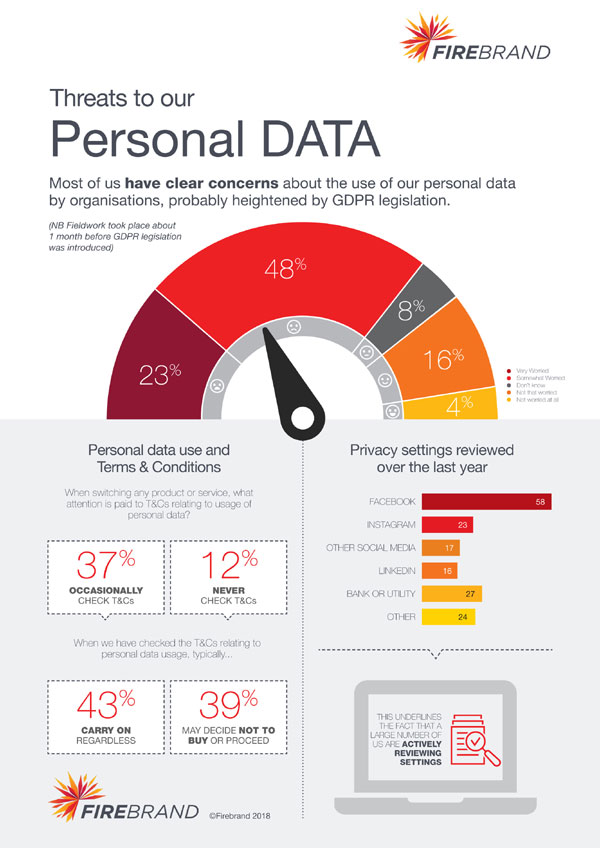
    ICG member Andrew Smith launched Customers in Britain, an annual snapshot of consumer behaviour and attitudes, back in 2005. The survey polls 1,000 adults in Britain. Data partner was ICG online company Survey Mechanics. For a free 2018 survey summary or full report price see www.firebrandinsight.co.uk

    Below we highlight two topics covered on the 2018 survey, recently published.

    Brand conversations and advocacy today

    The traditional British stiff upper lip in the face of poor service is very much history: today, both bad and good experience of products and services gets discussed – a lot!

    Most major brands know this and invest considerably in social media listening services within their wider customer service function. Our survey reveals:

    1. A consistent 8 in 10 talked about both positive and negative brand/product experiences over the last year – mostly via word of mouth, email or phone
    2. In the last year 45% have left negative feedback or comments on any website or blog, but 61% have left positive comments – underlining how great experiences can indeed promote strong brand advocacy
    3. A steadily increasing 3 in 10 are at least occasionally involved in direct social media discussions with brands or companies. This varies from 39% of the 18-34 age group to only 5% of those aged 65 plus

    In the face of GDPR legislation, do consumers care about their personal data?

    With new EU wide legislation taking effect in late May, our fieldwork in April coincided with significant coverage of data issues in the media.

    Perhaps it comes as no surprise that 7 in 10 say they have some concerns about how their data is used. Added coverage also seems to have inspired more of us to pay attention to online privacy: almost 6 in 10 saying they had checked Facebook settings in the last year. But when we buy products or services only a third ‘occasionally check T&Cs relating to personal data use’.

    Without doubt we are more aware of our data than ever before, with so many online transactions. But there seems relatively high trust (or apathy?) in the companies we deal with and how they will use our data: perhaps GDPR legislation simply helps us believe that we live in a more secure, accountable society?

  • Respondent Permissions – Example Wordings

    Respondent Permissions – Example Wordings

    It is important to make sure that respondents understand what will happen to their information and what they are agreeing to – and also for you to get the right permissions in writing.

    Here we are collating some examples of wordings/ permissions used by members – if anyone has any others that can be added to the resources list, please email them to editor@theicg.co.uk.

    The rules

    Here are the guidelines that we should follow;

    BHBIA guidelines:  To secure a respondent’s fully informed consent, he/she must be told:

    • The nature of the sponsoring organisation;
    • Subject and purpose of the MR discussion;
    • Methodology and approach;
    • Location, duration of fieldwork;
    • Date and time of fieldwork;
    • Reimbursement offered – both the nature and the rate of remuneration;
    • If, and how, viewing or recording will take place;
    • The name of the agency and/or researcher conducting the discussion;
    • What will happen to personal data collected at recruitment;

    IF naming the end client before the interview would undermine the integrity of the work, this may be done at the end of the interview BUT respondents must be made aware at recruitment that:

    • the client will be named at the end of the interview
    • they can withdraw their consent at any point
    • If the end client is receiving personal data they must be named before any transfer takes place
    • The justification for this should be documented

    Forms and sheets:  Generally understood that the incentive sheet should be kept separate from the consent sheet (not all are taking this approach, and it may not be a strict requirement)

    • Incentive sheets need to be kept for 7 years as part of accounting records
      • Keeping incentive sheets and consent forms separate = no need to store as much
    • Incentives – these can be one sheet for all to sign
      • OK to leave off details of the client? No consensus here
    • Consent – individual sheets due to the amount of information you need to collect
      • Need to include details of the client here

    Incentive sheets should include the amount paid

    Consent forms should include:

    • Participating in research
    • Audio recording
    • Filming
    • Permission to recontact
    • Inform them about anonymised quotes (but no need for permission as not personal data?)

    Consent for video for marketing purposes should be treated entirely separately.

    Example 1

    This is to confirm that:

    1. I have received £XXX as a thank-you from XXX for participating in a research discussion on the date above.
    2. I understand audio recordings, photographs and/or video footage may be taken of me as part of this research. This content will only be used for research purposes within XXXX. For example, to demonstrate a point made in the research as part of a report or presentation. It will not be used outside XXXX.

    Example 2

    AUDIO AND VIDEO RECORDING OF MARKET RESEARCH – RESPONDENT AGREEMENT

    The group discussion you are about to take part in will be video and audio recorded.  Copies of the video and/or audio recording may be seen/listened to by people working for the Client Company i.e. the company that has commissioned the research.

    All those in the Client Company who watch/listen to the recording sign an undertaking that they will respect the anonymity of you, the respondents.  Thus, if anyone watching/listening to the recordings recognises any of the respondents, then he/she must immediately stop listening/watching.

    • The recordings will only be listened to/viewed for research purposes and only to pursue the aims of the research study
    • The recordings will not be used for non-research purposes such as promotion, direct sales, social media or broadcasted in any way

    This example then has the client signature/ agreement, followed by those of the respondents


    Many thanks to all contributors to this article who have generously shared their knowledge

  • Example Non Disclosure Agreement

    Example Non Disclosure Agreement

    Following a recent e-group request, Martin Hollis has very kindly allowed us to publish a Non Disclosure Agreement template for use by ICG members.  

    Note:  Whilst this is a good starting point, it is the responsibility of each individual member to ensure that this meets their needs and is up to date. 

    Disclaimer:  The ICG takes no responsibility for this NDA or how it is used.  These examples were posted prior to GDPR so will need to be updated…

    Potential respondent NDAs

    You will be paid $XX.00 for your participation today; you agree this is sufficient compensation for participation, which includes your agreement to abide by this Confidentiality Agreement.

    Example 2

    Prior to beginning the Study, please read and acknowledge your adherence to the following confidentiality agreement 

    I acknowledge by signing below and accepting the offered incentive payment, to keep all information about the interview and ideas presented and discussed, completely confidential and agree not to disclose such information to any other party. As to members of my household, I agree that they are also under this same obligation of confidentiality.

    Example 3

    You have agreed to take part in an interview and to see and evaluate a new  product idea.  The ideas and information in the interview are confidential and you agree that you will not communicate to anyone, including family members and close friends, any details about what you saw or heard in the session. 

    By signing below and accepting the incentive, you acknowledge that you are agreeing to keep everything you will see and hear during the interview strictly confidential.