Resource Type: Article

  • GenZ Research Participants – What You Need to Know

    GenZ Research Participants – What You Need to Know

    The term Generation Z refers to those born in 1995 or later – making them the generation that are coming of age now. In fact, Gen Z are expected to account for 2.56 billion of the global population by 2020, making them the influencers of tomorrow. That means they are a really important demographic for qualitative market research because we need to understand their habits, behaviours and what makes them tick as their spending power and influence continues to rise. But it’s not just about us understanding them – there’s also some really important things we can learn from Gen Z too…


    Read more here 

  • 6 Reasons Why I Still Love This Job After 30 Years

    6 Reasons Why I Still Love This Job After 30 Years

    In 1987 I jumped ship from my job as an account supervisor in advertising to become a qualitative researcher.  It was much more a case of escaping from a problem than running to a solution.  But qual turned out to be much more than a refuge, rapidly becoming a happy home.  I found my place, and 30 years on, I still love this job.

    The very nature of qualitative research is to ask ‘why?’, so I’ve been thinking about why I like this job so much.  I think it can be distilled down to six reasons.

    1. You get paid to think

    In how many jobs is this true?  The value-add in qualitative research lies in your analysis, interpretation and, ultimately, your opinion; which, if you do a good job, is listened to, respected, and acted upon.  In the world of work, this is a rare and rather remarkable privilege.

    Of course, this is no God-given right.  If you are going to pursue a successful career in qual, your clients have to trust your thinking – trust that your interpretation is accurate and that your judgment is sound.

    To misquote Oscar Wilde, “I have nothing to declare but my interpretation”.  In qual there are no facts.  Instead, there is a huge volume of soft and malleable raw material that you have to carefully analyse to find the links and the patterns in order to derive meaning and extrapolate the implications.  This is all down to interpretation.  As it happens, quantitativedata is not objective fact either and is still open to interpretation, but there can be no question that qual ‘data’ is intrinsically more amorphous and fluid than quant.  So, while a client always has to place their trust in the interpretation of any researcher, quallies operate with much less visible, tangible support than quanties.  This means qualitative researchers have to work even harder to ensure they weave their understanding into a clear, compelling narrative that creates credible meaning for clients.

    Ultimately, not even this is enough to sustain a career in this business, because the recommendations you make based upon your thinking and interpretation come to be tested in the market.  You can only sustain a career in this business if the actions you recommend deliver results.  This puts huge pressure on your ability to combine analytical and creative thinking to define the best route forward.

    Bring it on.

    2. You keep learning

    You get paid to think but you also get paid to learn.  Fast.  And in-depth. If you have a genuinely curious mind (an absolute pre-requisite for a quallie), this is a great job.

    With every project, you have to gain a deep understanding of what drives behaviour and attitudes in relation to the market and the brands within it, and you rarely have more than two or three weeks in which to do it.  Last week: malt whisky; this week: mortgages; next week: condoms.  It’s an intense, immersive experience and, by the end of the project, you will likely know more about consumer motivation in relation to a brand than do most of the brand team.

    Having spent intense periods exploring and thinking about consumer behaviour in specific markets, in great depth, many times, experienced researchers become an extraordinary repository of knowledge and insights just waiting to be tapped.  Very often, a qual researcher will have worked longer on a brand than anyone in Marketing. Coca-Cola was my client for 20 years and I never worked with anyone there who had been at the company for this long. No-one had the depth of understanding that comes from 20 years of talking to consumers about Coca-Cola and Diet Coke, which is why I was eventually asked to distil two decades of learning into definitive reference manuals for the brand and insight teams.

    In 30 years, there’s scarcely a category in which I haven’t worked, from HIV infection in the 80s to social media in the Teenies.  All of that knowledge accumulates and builds over the years to give you a massive head start when it comes to tackling any project.

    Of course, in every job you (hopefully) continue to learn the skills of your trade.  But it’s not easy to think of another in which you learn so much about so many different things in such a short space of time.

    3. Every project is different

    I calculate I must have worked on over 600 qual projects, and I honestly do not recall having found a single one boring.  Even the most apparently mundane categories or brands have their own points of interest when you start to delve into consumers’ perception and motivations, be it custard or lawn seed.

    Even the projects that are superficially similar are unique: this comms idea will be different in some way to any other you have ever looked at, even for the same brand; the relationship this given set of consumers has with this category will differ from the relationship they had with the other category you explored with them last year.  Plus, it’s not just the market, brands, consumers and marketing ideas that differ; so too do the clients and their challenges.  The brief might resemble others you have received but, when you start to dig into the brand and market context, the marketing objectives and, indeed, the broader business issues and company culture, no two briefs are ever the same.

    Rather wonderfully, this equips you with an incredibly rich experience base. While no two projects are the same, you have a fantastic reserve of experience that can inform your approach to any challenge.

    Additionally, working across so many categories and brands inevitably means frequent exposure to the inner workings of a diverse range of companies.  Being able to gain this level of business insight is also an unusual privilege, giving you wonderful sense of the breadth of corporate cultures.  That said, there are some clear common themes, many of which are none too positive. But that’s a subject for another post!

    4. You find out what real people are like!

    You don’t have to work in an agency to live in an ivory tower.  Frankly, all of us who are fortunate enough to have an interesting job with prospects, own a property, go on skiing holidays, be a member of a gym or eat at independent restaurants are living in a different world from most people in this country.  Our social groups overwhelmingly consist of people from the same very narrow horizontal slice of society, a segment of people with similar incomes and perspectives.

    One of the great joys of this job is getting out and talking to ‘consumers’ all over the country and learning first-hand what ‘real people’ are like.  When you talk to them about how they relate to a market or a brand, or when they respond to a brand positioning or a communications concept, they do so against the background of their upbringing, lifestyle and values.  So, despite the fact that the subject matter is some aspect of marketing, you incidentally absorb a sense of the nature of people far beyond the topic at hand.   In so doing, one becomes armed against the lazy generalisations about ‘ordinary’ people one encounters in the media, and sensitised to the implicit elitism that can be found amongst one’s peers.

    I genuinely think it’s a huge privilege to be able to talk to 'ordinary' people, day in and day out.  It keeps you grounded.  When I worked in advertising, I was always fascinated to find out what the people our work was ‘targeted’ at actually did with it, how it fared in the real world.  This was a key part of what attracted me to qualitative research when I was looking to escape from being an account man.  Little did I know that the experience of talking to ‘respondents’ would help me understand people and society in a much broader context.

    It also acts as a sanity check against the BS of modern marketing that would have us believe different consumer segments, corralled together on the basis of marginal data differences, possess significantly distinct characteristics, be they ‘Millennials’, ‘Generation Z’ or ‘Affluent Anythings’ (yes, really), failing to represent the inconvenient truth that people are both simpler and more complex than these misleading groupings would have you believe.

    Fortunately, the marketing world seems slowly and reluctantly to be waking up to the reality that Big Data only tells us so much; if we want the kind of real understanding that can inform marketing activity, we have to look at the kind of Small Data that only in depth qual can provide.

    Try talking to some real people. Then you might learn something. Something real.

    5. You can say ‘I did this’

    My 6 years in advertising were spent as an account man.  I learnt a huge amount and acquired a range of skills and a depth of understanding of creative communications that I put into practice constantly in what I do now.  However, one of the the reasons I jumped ship was that I could never point to anything and say “I did that”.  There was never any tangible product of my labours – something that would not have existed had it not been for me.  Don’t get me wrong; I think account management is a great job for the right person and it takes a very particular set of talents to do it well.  But it’s mainly about oiling the wheels, making it possible for other people to achieve things.

    Every single project I handle has an end product that is a unique result of my experience, understanding and vision.  The ‘same’ project, exploring the same issues amongst the same target for the same client would look different if someone else had done it.  That might be a bit scary for clients, but it’s wonderfully empowering for the researcher.  If I get recommissioned, it’s because I did a good job and my client trusts me to do another.  There’s nowhere to hide, but it’s also incredibly fulfilling.

    6. You get to work with bright people

    Having said that I would keep my perspectives on corporate culture for another post, one overall observation I will make here is that many (if not most) companies do a great job of compromising the ability of bright people do a great job.

    Nonetheless, whatever the constraints, and however handicapped they may be by corporate culture, they remain bright people.  I have found my clients almost invariably a pleasure to work with.  Almost by definition, good people who work with brands and in agencies are interested in the world around them, in human behaviour and in ideas, and how to bring them together.  As we well know, one of the main qualities of interestingpeople is that they are interested.

    I have sensed sometimes that insight managers feel they are the only sane people in a business gone mad!  They feel they work in companies that have lost track of the realities of their markets and behave in a way that betrays a lack of understanding of the people that ultimately pay their wages: customers.  Sometimes there is an almost palpable sense of relief when the findings from research support a perspective that they had been unable previously to get the business to listen to.

    I am fortunate enough to work a lot with agencies too, where I have encountered some of the brightest and most creative people it has been my good fortune to meet.  The relationships I have built here have probably been helped by working in advertising at the start of my career, giving me an understanding of creative ideas and a very clear sense of the struggles involved in trying to get good work out of the door.

    30 years in, I’m happy to say I like my clients more than ever!  If it is true that you get the clients you deserve, then I am a doubly happy man.

    As I reviewed this article, I noticed how many times I had described aspects of what I do as a ‘privilege’.  I may not have become the Formula 1 driver or architect my 12 year old self had in mind, but if I still regard so many elements of my work as a privilege, I guess I would have to conclude that things haven’t worked out too badly.


  • Protect Your SME from Cyber-Attacks

    Protect Your SME from Cyber-Attacks

    How to Protect your Small Business from Cyber-Attacks?

    Small businesses need to be aware that despite the size of the business, almost 60 percent of UK SMEs have been a victim of an attack. Cyber-attacks on SMEs have been increased year on year. In 2015, 50% of cyber-attacks on businesses in the UK were targeted at smaller firms.

    No one is too small to go untargeted.


    Lucidica, an IT support consultancy, has written this article to help protect your business today. Full article here. 


  • Talking About Brands and Personal Data

    Talking About Brands and Personal Data

    Talking about brands, and do we really care about our data?

    ICG member Andrew Smith launched Customers in Britain, an annual snapshot of consumer behaviour and attitudes, back in 2005. The survey polls 1,000 adults in Britain. Data partner was ICG online company Survey Mechanics. For a free 2018 survey summary or full report price see www.firebrandinsight.co.uk

    Below we highlight two topics covered on the 2018 survey, recently published.

    Brand conversations and advocacy today

    The traditional British stiff upper lip in the face of poor service is very much history: today, both bad and good experience of products and services gets discussed – a lot!

    Most major brands know this and invest considerably in social media listening services within their wider customer service function. Our survey reveals:

    1. A consistent 8 in 10 talked about both positive and negative brand/product experiences over the last year – mostly via word of mouth, email or phone
    2. In the last year 45% have left negative feedback or comments on any website or blog, but 61% have left positive comments – underlining how great experiences can indeed promote strong brand advocacy
    3. A steadily increasing 3 in 10 are at least occasionally involved in direct social media discussions with brands or companies. This varies from 39% of the 18-34 age group to only 5% of those aged 65 plus

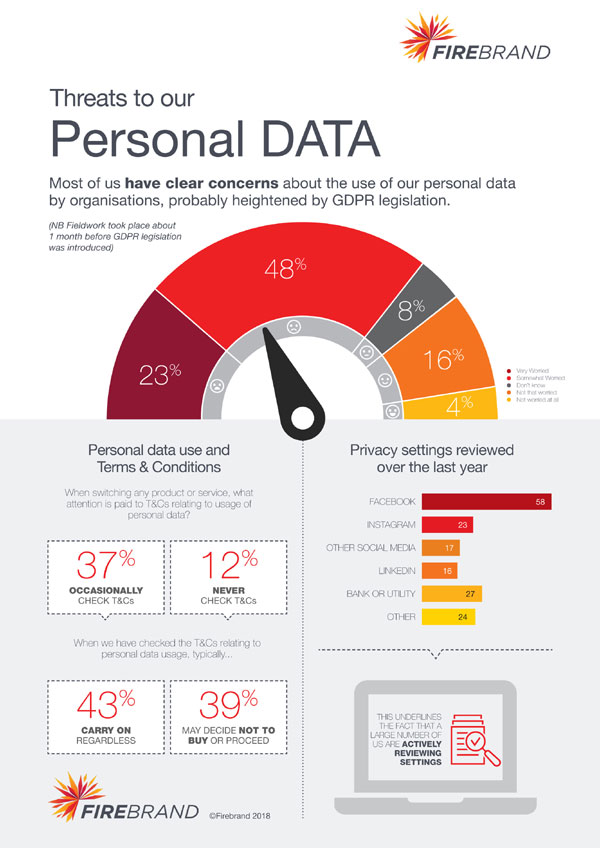
    In the face of GDPR legislation, do consumers care about their personal data?

    With new EU wide legislation taking effect in late May, our fieldwork in April coincided with significant coverage of data issues in the media.

    Perhaps it comes as no surprise that 7 in 10 say they have some concerns about how their data is used. Added coverage also seems to have inspired more of us to pay attention to online privacy: almost 6 in 10 saying they had checked Facebook settings in the last year. But when we buy products or services only a third ‘occasionally check T&Cs relating to personal data use’.

    Without doubt we are more aware of our data than ever before, with so many online transactions. But there seems relatively high trust (or apathy?) in the companies we deal with and how they will use our data: perhaps GDPR legislation simply helps us believe that we live in a more secure, accountable society?

  • Creative Screening – Hints and Tips

    Creative Screening – Hints and Tips

    A question on the egroup generated many ideas as to potenital creative screening questions and we have amalagamated responses below…

    • The questions around the ‘creative’ questions are also important to guage whether someone fits the bill.  You might want to think about including;
      • Various statments about an individual and ask them an agree/disagree scale.  Statements could include ideas like ‘I am experimental and up for new challenges/ experiences’, ‘try new products’, ‘confident and not afraid to express my opinion’, ‘enjoy craft or customising clothes/ furniture/ products’, ‘creative with an active interest in music, art, design’ etc.
      • List of hobbies that are generally associated with creativity and see which they do (play in instrument, act, write music, drawing/ painting, photography, writing, completing puzzle games, clothes making etc)
      • a ‘how would people describe you’ question, with options including the more creative descriptions – e.g. experimental, inquisitive, open minded, team worker, creative, adventurous, opinionated, chatty, vibrant etc.  You may wish to contrast these with the opposites – reserved, timid, quiet, shy, follow the crowd etc.
    • If you are phone recruiting for an Online Bulletin Board, include a written creative as well (and vice versa if you’re screening online for an in person group) – people who are creative when speaking may not be able to write creatively (and vice versa!)
    • You could use a “complete the image” or “complete the sentence” kind of approach depending on how long you have to administer screening questions, and by what channel.
    • Complete the image:  give people some random shapes and lines and ask them to complete the drawing. You are looking for creative interpretation so if someone just draws a dartboard where there is a circle that’s not too creative, but if someone turns a circle into a flying saucer complete with fancy plants it would be
    • Complete the sentence:  more stereotypical but could be more focused on the topic you are researching or be much more open

    Potential questions:

    • If you were paid to develop an app that could improve the quality of your life, what type of app would you develop and why?
    • If you were to design your own Canadian flag, what would it look like and why?
    • If you could invite three people from history to dinner/an evening of drinks, who would you invite and why?
    • What are 10 things that you can do with a paper clip/ coat hanger/ house brick/ drinking straw
    • What are 10 ways to describe a peach?
    • Imagine you were chosen to be on the cover of lifestyle magazine. What would your cover story be?  What would you be most excited to share about your life?  And what is ONE thing you would NOT include in your story?
    • Imagine there was a game called ‘Cutting Edge’, whether or not one actually exists.  How would you describe this game to a new player?  What are the rules?  How do you win?
    • What would be the first thing you would do, if you had just won one million dollars?
    • If you were a book in a library, what book would you be and WHY?  
    • If you could invent a totally new car, what features would it have?
    • What would be your perfect vacation and why?
    • Imagine you could create a national holiday – what would you be celebrating and why?


  • Grow Your Customer Base

    Grow Your Customer Base

    Businesses face so many challenges today, but one of the most pressing issues troubling CEOs is growth.

    Customer growth is a critical ingredient of an organisation’s success – how do we acquire more customers? How do we encourage existing customers to buy more? How do we migrate customers to higher margin offerings?

    The importance of customers helps explain why so many organisations develop mission statements talking about ‘becoming more customer centric’ or ‘putting the customer at the heart of everything they do’.

    But how well do organisations really know their customers? In a recent meta-analysis that compared what organisations thought was important to their customers, with what customers really value, the average alignment rate was only 48 per cent. In other words, in more than half of all situations, the organisation’s view of what is important to customers was out of sync with what customers wanted.

    Whether your organisation is big or small, there are five simple steps you can take to help your organisation speak with one voice that the customer wants to hear, to grow your customer base.

    1) Be clear and simple about your growth goal. What ‘unit’ are you seeking to grow? By how much? Over what time frame? Write it down and get all stakeholders to agree to it.

    2) Define the audience most likely to deliver this growth goal. What do you know about them? How can you best reach them? Be specific and detailed.

    3) Identify your competitive set. This may not always be obvious. Think about it from the customer’s viewpoint. What need do they have? Who else can satisfy that need?

    3) Identify your competitive set. This may not always be obvious. Think about it from the customer’s viewpoint. What need do they have? Who else can satisfy that need?

    4) Develop a list of ‘choice factors’ you feel could possibly influence customer decision making. List them all. Again, be specific. Seek input from across the business in developing this list.

    5) Seek customer feedback. This can be done in various ways from informal phone calls to more robust research surveys. The aim is the same though – firstly, to establish how important each choice factor is to your customers and secondly, to assess how highly they rate your organisation and your competitors on those criteria.

    Repeat the latter stage with a set of internal stakeholders too for comparison and you will have all the data you need to identify some (potentially surprising) new growth opportunities and better align your organisation towards achieving your growth goal.

    Sean Adams, founder of The Seed Consulting, is leading a Brighton Chamber Bite-sized Learning session on how to grow your customer base on June 19. For more information visit: {https://www.businessinbrighton.org.uk/events|www.businessinbrighton.org.uk/events   


  • Running workshops – Tips & Techniques

    Running workshops – Tips & Techniques

    These days, I enjoy running both groups and workshops.  But when I did my first workshop, I assumed that having learnt to moderate qual groups quite well would mean that running a workshop was a breeze.  It wasn’t!

    With the benefit of a lot more attempts, here are some thoughts on how to avoid that fate …..

    Top tips

    Be clear on the goal

    Often the team says they want a ‘brainstorming/idea generation session’ when actually it’s more about bringing a strategy (or some research insights) to life and the real goal is getting buy-in to a strategic direction not coming up with a new one.  Other goals might be team-building or coming up with different propositions for a brand. Developing an awesome workshop agenda that does not address the real objectives will leave you trying to adjust things on the day.  Not a fun experience.

    As with a research project it’s also very helpful to know what the expected outputs are at the end of the session (also the format of those outputs, check to see if they expect something written up and cost for that)

    Clearly set up the 'rules of engagement'

    Once you’ve run through these rules, it can be nice to put a copy up on the wall for the rest of the day.  The rules will be things like

    • Green light session
    • No right or wrong answers
    • Be nice to each other
    • Say 'yes .. and' instead of 'no, but …'

    Bring lots of post its

    They allow you to improvise a new task on the fly.  You can get big ones that are easier to read from a distance (good for putting up around the room).  You can even get post it note flipchart paper which is great (although not cheap)

    Visit the room before

    Not always possible.  But more important than for when running research groups (in my view).  Some of your techniques may not work in certain room configurations.  Eg ‘Break-out sessions’ need extra rooms to send each break-out group to (or at least different corners of a large room). 

    I did a 60 person workshop for a soft drinks client where we had printed 15 very large sheets to bring to life different ‘moments’.  The idea being to stick the sheets to the walls to create different workstations for each moment.  When I got to see the room for the first time (in Johannesburg), three out of the four walls were windows with blinds you couldn’t stick anything to.  Not ideal!

    Allow more time than you think you will need (but have back-up things to do)

    Build in enough coffee breaks and time for lunch for networking or team-building or cross-fertilization of ideas.  Plus this makes for a nicer day!

    If you are running a workshop with a larger group then inevitably you will need to split them into smaller groups for sessions.  And then it’s useful for each group to present back key findings.  This almost always takes longer than you think/than you hoped.  But arguably is the most important bit.  So allow time for this.  A good trick is to schedule these feedbacks before a coffee break, so you can run into the coffee break if you absolutely need to. 

    Pre-plan anything you can to save time on the day

    If you know you are splitting people into groups, then pinning a sheet to the wall (that everyone crowds around), or putting up a slide or reading out names can eat into precious time. Put coloured dots on their name badges so there is a blue group, green group etc.  If you want them in different groups at different times then do a number or a shape as well as the coloured dot.   Or a page in their welcome pack also works well.

    Give them worksheets for tasks even when the task is blindingly obvious

    If you know the attendees already and know they don’t need this, then less handholding may be necessary. If the group is small enough for you to be facilitating everyone when they do a task – again, you can skip this.  But generally, when you put people into pairs or smaller groups they can lose time faffing as they sort out who is in charge or how they ‘should’ do it.  Something as simple as a one-pager with eg 3 boxes ‘positives’ ‘negatives’ ‘most important thing to remember’ can keep things moving forwards.  And some of the groups won’t need it – but some will.

    Techniques that have been road tested

    My background is brands, advertising, positioning – so I have done more workshops in those areas than, say, team leadership.  With that in mind, here are some of the techniques that I have found most useful:

    Icebreakers are a good way to start

    For a simple icebreaker, get them into pairs and ask them to interview each other and find out two truths and a lie.  They then report back to the rest of the group who have to guess the lie. 

    Or – if you want something a bit more focussed on the day itself – then using the 'Wishing Well'.  Bring a bowl, box or plastic bag (or use the wastepaper bin) for the 'Well'.  Everyone gets one piece of paper – and anonymously writes out three sentences "I wish …."  "I hope ……"  "I fear ….".  Fold the paper and put it in the wishing well.  Then you read them out one at a time – and ideally get three flipcharts with a person on each flipchart. Your flipchart scribes then create a list for wishe or hopes or fears.  

    Attendees need a bit of context so you could set it up as “What do you wish/hope/fear for the workshop itself?”  Or it may be more useful to explore “What do you wish/hope/fear for the brand? or the company? or the school?” or whatever makes sense for your client.  It sets a context for the day – gets any negative thinking voiced (and parked for later) – and it's great to come back to at the end of the day because usually a lot of the fears have gone away and the wishes/hopes have been sorted.  To make it shorter just do two sentences – “I wish ….”  and “I fear ….”

    Bringing a brand personality or a customer portrait to life

    Perhaps you want them to get really clear on what the brand stands for.  Or get inside the mindspace of their key customer.  A campfire works well for this.  It’s also fun so can be used towards the beginning of the day to get the group dynamics going.  Or after lunch to avoid that post-lunch dip.  It also generates useful information in its own right.  The instructions are:

    • Imagine that you are sitting around a campfire.  You are remembering an absent “friend”
    • You want to develop a full picture of this person: what they looked like, what their past was, what are they doing now – lots of rich detail
    • Take turns around the circle, each person offering a memory in turn
    • Each memory must include the person speaking; and indicate the relationship between the two of you, not just state facts about the character
    • It is good to let the circle just move on its own.  Go around the circle once, a few times, whatever
    • You can nominate the next person’s relationship to the character if you want to.

    The absent friend can either be the-brand-come-to-life.  Or the company’s core customer (or lapsed customer or whatever is useful for your objectives)

    Jumpstarting their creativity for New Product Development/Innovation workshops

    For getting people to think laterally – you could use the SCAMPER technique.  The letters stand for: Substitute, Combine, Adapt, Modify (Maximise/Minimise), Put to another use, Eliminate, Rearrange (or Reverse).  Each letter suggests a way to be innovative.  It gives people a systematic way of being creative.  Giving them examples helps ….

    • Substitute – Diet Coke where sugar was substituted by sweetener
    • Combine – Keyboards combined with solar panels, Andrex toilet tissue with aloe vera
    • Adapt – ATM machines were adapted from vending machines
    • Modify – KitKat Chunky (they made it bigger)
    • Put to another use – WD40 stops guitar strings from going rusty

    There are a whole load of ‘helper questions’ that give your attendees ideas on how to ‘Substitute’ etc.  This website is a good resource:https://www.mindtools.com/pages/article/newCT_02.htm


    The DISNEY strategy is another technique that can be useful. The basic idea is that you have three hats (ie three roles).  And you are the Dreamer, the Realist or the Critic.   Teams start by being the Dreamer (think up lots of ideas – some may be a bit crazy), then the Realist (who works out how to make the ideas happen/build the thing) and then the Critic (who criticises the idea).  You can go through the cycle more than once – so after being a critic – go back to dreamer mode to see if that helps fix things.  People can either stay in their group for all three roles.  Or a nice way to cross fertilise ideas is to have one or two people stay at the table while everyone else moves on to the next group.  The people who stay at the table then tell the new people what ideas they dreamt up.  Or what ideas they were criticising.

    This website gives a bit more detail

    https://hatrabbits.com/en/disney-method/

  • Respondent Permissions – Example Wordings

    Respondent Permissions – Example Wordings

    It is important to make sure that respondents understand what will happen to their information and what they are agreeing to – and also for you to get the right permissions in writing.

    Here we are collating some examples of wordings/ permissions used by members – if anyone has any others that can be added to the resources list, please email them to editor@theicg.co.uk.

    The rules

    Here are the guidelines that we should follow;

    BHBIA guidelines:  To secure a respondent’s fully informed consent, he/she must be told:

    • The nature of the sponsoring organisation;
    • Subject and purpose of the MR discussion;
    • Methodology and approach;
    • Location, duration of fieldwork;
    • Date and time of fieldwork;
    • Reimbursement offered – both the nature and the rate of remuneration;
    • If, and how, viewing or recording will take place;
    • The name of the agency and/or researcher conducting the discussion;
    • What will happen to personal data collected at recruitment;

    IF naming the end client before the interview would undermine the integrity of the work, this may be done at the end of the interview BUT respondents must be made aware at recruitment that:

    • the client will be named at the end of the interview
    • they can withdraw their consent at any point
    • If the end client is receiving personal data they must be named before any transfer takes place
    • The justification for this should be documented

    Forms and sheets:  Generally understood that the incentive sheet should be kept separate from the consent sheet (not all are taking this approach, and it may not be a strict requirement)

    • Incentive sheets need to be kept for 7 years as part of accounting records
      • Keeping incentive sheets and consent forms separate = no need to store as much
    • Incentives – these can be one sheet for all to sign
      • OK to leave off details of the client? No consensus here
    • Consent – individual sheets due to the amount of information you need to collect
      • Need to include details of the client here

    Incentive sheets should include the amount paid

    Consent forms should include:

    • Participating in research
    • Audio recording
    • Filming
    • Permission to recontact
    • Inform them about anonymised quotes (but no need for permission as not personal data?)

    Consent for video for marketing purposes should be treated entirely separately.

    Example 1

    This is to confirm that:

    1. I have received £XXX as a thank-you from XXX for participating in a research discussion on the date above.
    2. I understand audio recordings, photographs and/or video footage may be taken of me as part of this research. This content will only be used for research purposes within XXXX. For example, to demonstrate a point made in the research as part of a report or presentation. It will not be used outside XXXX.

    Example 2

    AUDIO AND VIDEO RECORDING OF MARKET RESEARCH – RESPONDENT AGREEMENT

    The group discussion you are about to take part in will be video and audio recorded.  Copies of the video and/or audio recording may be seen/listened to by people working for the Client Company i.e. the company that has commissioned the research.

    All those in the Client Company who watch/listen to the recording sign an undertaking that they will respect the anonymity of you, the respondents.  Thus, if anyone watching/listening to the recordings recognises any of the respondents, then he/she must immediately stop listening/watching.

    • The recordings will only be listened to/viewed for research purposes and only to pursue the aims of the research study
    • The recordings will not be used for non-research purposes such as promotion, direct sales, social media or broadcasted in any way

    This example then has the client signature/ agreement, followed by those of the respondents


    Many thanks to all contributors to this article who have generously shared their knowledge

  • Example Non Disclosure Agreement

    Example Non Disclosure Agreement

    Following a recent e-group request, Martin Hollis has very kindly allowed us to publish a Non Disclosure Agreement template for use by ICG members.  

    Note:  Whilst this is a good starting point, it is the responsibility of each individual member to ensure that this meets their needs and is up to date. 

    Disclaimer:  The ICG takes no responsibility for this NDA or how it is used.  These examples were posted prior to GDPR so will need to be updated…

    Potential respondent NDAs

    You will be paid $XX.00 for your participation today; you agree this is sufficient compensation for participation, which includes your agreement to abide by this Confidentiality Agreement.

    Example 2

    Prior to beginning the Study, please read and acknowledge your adherence to the following confidentiality agreement 

    I acknowledge by signing below and accepting the offered incentive payment, to keep all information about the interview and ideas presented and discussed, completely confidential and agree not to disclose such information to any other party. As to members of my household, I agree that they are also under this same obligation of confidentiality.

    Example 3

    You have agreed to take part in an interview and to see and evaluate a new  product idea.  The ideas and information in the interview are confidential and you agree that you will not communicate to anyone, including family members and close friends, any details about what you saw or heard in the session. 

    By signing below and accepting the incentive, you acknowledge that you are agreeing to keep everything you will see and hear during the interview strictly confidential.

  • When not to conduct Market Research

    Once again, The Language Factory has produced an extremely useful month-by-month infographic which collates and summarises key national holidays and 'dates to avoid' across 11 countries.

    Invaluable for planning international work, you simply hover over a date and the infographic tells you whether it is a national or local holiday.  The infographic shows what day of the week the holiday will fall on, along with information about the holiday itself and whether a bridging holiday is likely to be taken by those who celebrate it.  This should give you an indication of when services are likely to be reduced and when it might be more difficult to conduct market research in these countries.