Resource Type: Article

  • Real Insight in an Increasingly AI World

    Real Insight in an Increasingly AI World

    Article by ICG member Kevin Simmonds

    AI is transforming market research, making it faster, cheaper and more scalable. But could greater automation leave us less connected with real customers? This article explores the balance between AI and human insight, and why researcher experience, curiosity, cultural understanding and commercial judgement remain vital for turning customer research into meaningful insight and competitive advantage.

    LinkedIn post here 

    Full article here

  • Doing Business in Latin America in 2026: Culture Still Matters

    Doing Business in Latin America in 2026: Culture Still Matters

    Article by ICG member Iris Griffiths, Across Research

    Latin America has changed enormously in the past decade. Businesses are more digital, consumers more connected and entrepreneurs more comfortable working across borders. Yet the companies that perform best still understand the people and culture behind the market—not simply the numbers in a market-size slide.

    If you are entering, growing or repositioning a business in the region, these five principles remain central.

    1. Latin America is not one market

    Brazil is not Mexico. Mexico is not Colombia. And national borders are only the start: a strategy that works in São Paulo may need meaningful adaptation in Recife, Salvador or Manaus. Doing business in Latin America means choosing priority markets carefully, then learning the local commercial, regulatory and consumer context.

    2. Build trust, not just transactions

    Technology has made business faster; it has not made relationships irrelevant. Trust is built through consistency, responsiveness, personal contact and a genuine interest in the people you work with. A video call or WhatsApp message may replace a lunch, but credibility still has a human dimension.

    3. Adapt the model locally

    Pricing, distribution, payment behaviour, communications and purchasing decisions can vary sharply across the region. The useful question is not “How do we introduce our way of doing things?” but “How can what we offer work well in this market?” Latin America market entry is an exercise in curiosity, not copy-and-paste expansion.

    4. Communicate with context

    Language matters, but communication is more than vocabulary. Meetings may open with a personal conversation; decisions may need explicit follow-up. Avoid stereotypes and learn how communication works in the particular country, organisation and situation. Strong partnerships combine relationship-building with clear documentation.

    5. Speak the language—and understand what sits behind it

    Spanish opens doors across much of the region; Portuguese is essential for Brazil. English can be common in multinational settings, yet local-language research and communication give a company deeper access to humour, social cues, consumer language and the meaning behind a response. Cultural intelligence turns translation into insight.

    The opportunity in 2026

    Latin America is more mobile, connected and digitally capable than many international businesses assume. But technology does not guarantee that a company will be understood, trusted or wanted. The organisations that succeed pair speed with local learning. 

    About Across Research

    Across Research helps organisations understand international markets through qualitative research and culturally grounded insight, with particular expertise in Brazil, Latin America and Latin American consumers worldwide.

    Iris Griffiths | LinkedIn

  • Your competitor just got the same insight

    Your competitor just got the same insight

    Blogpost by ICG member Wim Buedts, Independent Minds.

    Your competitor just got the same insight.

    Large research networks now deliver standard work with AI-driven tools. The output is predictable and comparable. Handy, until you realise your competitor is reading a report that looks quite a lot like yours.

    It is a new kind of one-size-fits-all, nicely masked by fancy AI language, but uniform at its core. And look-alike insights quietly flatten the field: they slow a brand’s creativity and loosen its connection with the people it serves.
    For now, speed and low prices are winning over quality and true relevance. With this template research, clients are mostly pulling the wool over their own eyes. But they are starting to see through it.

    This is where boutique agencies come into their own. They have already made the shift: speed and efficiency, without losing connection, humanity or drive. They give AI the place that fits what it is. Not an autonomous super-intelligence, but an assistant to human intelligence, there to support and strengthen it.

    Because the moment your insight looks like everyone else’s, it stops being an advantage.

    #QualitativeResearch #ConsumerInsight #BoutiqueAgencies #HumanInsight #AI

  • What Becomes Scarce When Insights Are Abundant?

    What Becomes Scarce When Insights Are Abundant?

    Article by ICG member Jay Zaltzman, Bureau West

    As AI makes customer insights easier to generate, judgment becomes more valuable.

    AI may be about to give marketers a new problem: not too little customer information, but too much.

    I came away from Esomar Congress 2026 wondering whether we’re beginning to see the early signs of this. A recurring theme across many of the conversations and presentations was just how much easier AI is making it to work with customer information. Interviews that once required hours of manual review can be searched and synthesized quickly. Large numbers of open-ended responses can be analyzed in minutes. Customer reviews, call-center conversations, CRM records, social media, previous research and other sources can increasingly be brought together and interrogated at the same time.

    But AI isn’t only making existing information easier to analyze. It is also making some kinds of customer information cheaper and easier to collect. Automated interviewing, adaptive surveys, rapid concept exploration, synthetic respondents and other emerging approaches can dramatically reduce the time and cost required to investigate a question.

    • In other words: more customer evidence × easier collection × easier analysis × cheaper questioning = dramatically more plausible insights.

    That made me think about an earlier technological shift. When personal computers became widespread, many people assumed they would simply allow organizations to do the same work with fewer people. But productivity improvements don’t always work that way. When something becomes dramatically easier or cheaper, organizations often start doing more of it.

    Something similar could happen with research. Imagine a marketer has a relatively modest question about customers. Today, they might decide it isn’t worth spending $30,000 and six weeks to investigate. But what if an AI-enabled approach can provide a useful first answer in a few hours? Suddenly, that question gets asked. And then another one. And another.

    Competitors begin doing the same thing. Eventually, being able to investigate questions that once would have been considered too small or too expensive may stop being an extraordinary capability and become table stakes.

    So perhaps the biggest effect of AI on research won’t be that companies need fewer answers. It may be that they start asking vastly more questions.

    And that creates a different problem. When getting an answer becomes easy, the harder questions become:

    • Which evidence should we trust?
    • Which findings actually matter?
    • And, ultimately, what should we do?

    That suggests a useful discipline for anyone working with AI-generated insight. Before accepting an answer simply because it arrives quickly and sounds convincing, ask three more questions:

    • What is this conclusion based on?
    • What evidence would make me question it?
    • What decision would change if it were true?

    Those questions may matter more as AI gets better, not less.

    For years, researchers have worried about information scarcity – not enough data, respondents, time or budget. AI may begin to reverse that equation. If customer information becomes abundant, the scarce resource may become judgment – deciding what deserves our attention, what deserves our trust, and what it means for the business. Need help deciding which customer inputs matter – and what they mean for your business? Contact me at info at bureauwest.com.

    Jay Zaltzman | LinkedIn

    Bureau West | Facilitating Growth

  • Synthetic Data in Research: A Plain Briefing

    Synthetic Data in Research: A Plain Briefing

    Article by ICG member John Habershon PhD, Momemtum Research.

    Why does ‘synthetic data’ need a briefing at all?

    You’ve probably heard the phrase in a pitch by now — an instant panel, no recruitment, no fieldwork, answers back in minutes. It sounds like one clear idea. It isn’t. Under the hood, ‘synthetic data’ covers two genuinely different techniques, aimed at different jobs. It’s worth knowing which one you’re actually being sold before you compare it to anything else — Digital Conversation Analysis (DCA) included.

    No survey gets run when you ask it a question

    The kind you’ll meet most often is a full synthetic panel. You write your questionnaire, submit it, and get answers back in minutes — not from real people answering today, but from an AI model trained on a large library of past survey responses. Ask it about a new topic and it isn’t hunting through its records for someone who’s spoken about that exact thing before. It’s working out what a person with those demographics would probably say, based on patterns in whatever it already knows about people like them. For well-worn topics this can be a reasonable guess. For anything genuinely new, or anything that depends on how someone actually feels rather than what they’d tick on a form, it’s extrapolating — and extrapolation drifts towards the average, not towards a real answer.

    The big number on the homepage usually isn’t the number that matters

    Vendors like to lead with the size of their overall library — a million profiles, and so on. That’s the total pool, not what’s actually available on your topic, for your audience, in your market. Ask about attitudes to electric vehicles, for instance, and the model may well have learnt from a real EV survey — genuinely real people, just surveyed however long ago that particular study ran. The honest question for any vendor is how much of that million actually said anything about the subject you care about, and how recently. Below a certain amount of real data on a topic, the answer stops being a calibrated read and starts being a guess dressed up as one.

    The answers are dated — you just can’t see the date

    Whatever real opinion the model did learn from was collected whenever that underlying survey happened to be fielded — a year ago, three years ago, nobody outside the vendor really knows. The model doesn’t flag this. It hands you a confident-sounding answer with no timestamp attached, and there’s no way to tell whether it’s reflecting this year’s attitudes or an opinion that’s since moved on.

    Where this genuinely earns its place

    None of this makes synthetic panels a bad idea. Used for the right job, they’re a fair one. Pressure-testing question wording, screening a shortlist of concepts down to one, or getting a quick directional read before committing budget to proper fieldwork are all sensible uses. The trouble starts when a directional tool gets sold, or bought, as if it were a decision-grade one.

    Digital Conversation Analysis starts from a different place entirely

    A survey captures what someone tells a researcher when asked. DCA captures what they say when nobody’s asking. That’s the gap between claimed behaviour and actual behaviour, and it’s the reason the two aren’t really substitutes for each other.

    It’s built the same privacy-conscious way a synthetic panel is — the dataset reflects real conversation patterns, with nothing tied back to an identifiable person — but the resemblance stops there. A synthetic panel models a synthetic population. DCA is closer to a synthetic survey: it takes conversation that already existed and structures it so you can size it, without ever inventing an opinion nobody held.

    And because there’s no panel to recruit and no fieldwork to commission, there’s no cost-per-respondent standing between you and the next question. Once a client has done the depth work — a focus group, a set of interviews — a DCA dataset is often the fastest way to put numbers behind what came out of it: sizing the themes, testing the messaging, watching sentiment shift over time, in days rather than weeks.

    Show it a picture, and the guesswork doubles

    Testing advertising concepts — a key visual, a proposed campaign look, a piece of creative — is one of the sharpest places the difference between the two approaches shows up. Most full synthetic panels will happily take an image and hand back a paragraph of feedback: ‘I love the modern design, it feels aligned with my values’, that sort of thing. It reads like a real reaction. But there was never a real one behind it. The model’s text-based guesswork is at least built on real survey answers, however dated or thinly matched to your topic — with an image, there’s usually no equivalent to draw on at all, because every piece of creative is new by definition. So it isn’t recalling how people felt about anything. It’s improvising a plausible-sounding description of how someone probably would, based on the sort of language people use about images that look a bit like it. That’s a guess stacked on a guess, and it’s exactly the territory where a model with no eyes and no gut struggles hardest — a felt, visceral reaction is a much harder thing to reconstruct convincingly than a stated opinion.

    DCA doesn’t pretend to show a real person your unreleased concept and report back their reaction either — nobody’s seen it yet, so there’s nothing honest to claim there. What it does instead is ground the creative in what’s already real: how people in your target market have actually talked about comparable campaigns, category conventions, and past executions from you or your competitors — which visual and tonal choices have previously landed well, and which haven’t. That’s genuine evidence to work from before a concept is finalised, not a simulated verdict on the exact image.

    Closing Thought

    Treat any synthetic dataset — ours included — as directional rather than definitive. The honest difference between the two approaches isn’t really a claim about accuracy percentages. It’s a claim about where the words came from: a model’s best guess at what someone would say, or something a real person actually said, dated to the day they said it. Once you know which one you’re looking at, the rest of the comparison takes care of itself.

    John Habershon PhD | LinkedIn

  • Build Translation into Your Project From the Start

    Build Translation into Your Project From the Start

    Article from The Language Factory, one of the ICG’s Advertisers.


    It’s easy to think of translation as the last piece of a puzzle, something to be slotted in at the end. After all, without all the work that goes into writing and curating your materials, there’d be no need for translation. The danger is that you can end up cutting corners to meet your budget and deadline, potentially risking the success of your project, campaign or research project.

    But by building translation into your project, both in terms of the budget and timeline, you can avoid the all-too-frequent pitfalls of brand inconsistencies, misrepresentation of facts and incorrect survey data.

    Translation isn’t a finishing touch. It should be a crucial part of the planning process for a smoother project and better outcomes.


    Why include translation from the start?

    • Protect timelines: by considering translation from the start, you’re building it into the schedule, ensuring you have the time and expertise in place to do it properly. Good translation takes time, so don’t leave it until the last minute.
    • Shape your content: an experienced linguist involved at an early stage can highlight concerns before they become an issue, such as cultural references that may not resonate or layouts that can’t accommodate a language running 30% longer. Accounting for these in the initial draft rather than fixing them at the end will save time in the long run.
    • Build consistency: expert translators who understand the project from its early stages, including tone, terminology and target audience, provide consistency and continuity throughout.


    Top tips for building translation into the process

    • Plan it from the start: add translation to your project brief to make sure you have the time and budget for it.
    • Treat it as non-negotiable: by making it a fixed milestone with its own timeline, it won’t just be a buffer that shrinks when other stages run over.
    • Provide context: who is it for, what is its purpose and what does success look like? This helps linguists make better judgment calls during the translation process.
    • Use a glossary: include key terms, branding guidelines and any phrases you don’t want translated.
    • Involve translators in reviews: have them flag issues in early drafts as well as final proofing, so changes are made at the right stage.
    • Keep the same translators throughout: this provides a consistent voice across your content.
    • Review format and structure early: text length, layout and design choices are all affected by the translation; reviewing them from the start can avoid a later redesign.

    Expert human translation services from TLF

    TLF combines a team of mother-tongue translators with expert Project Managers to ensure your project runs smoothly from start to finish. All our linguists have at least five years of professional experience in their chosen field, hold a Diploma, BA or MA in translation and have professional membership of a recognised translation body.

    Talk to the TLF team about how we can help you with your next translation project.


  • Why Businesses Need to Think About Empathy as Well as Efficiency in Their Customer Complaints Process

    Why Businesses Need to Think About Empathy as Well as Efficiency in Their Customer Complaints Process

    Article by ICG member Lindsey Annable, Free Spirit Consulting Ltd. 


    Businesses need a different focus when automating their Customer Complaint process.  They should start with the question of how to automate not only for efficiency but also for empathy.

    How a complaints procedure is structured really matters. It is an important customer touchpoint to avoid straining a potentially already fraught relationship and yet not every brand gets it right.

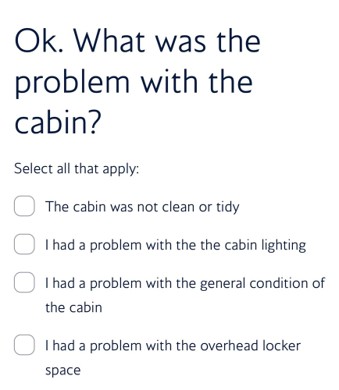
    I recently submitted a complaint to a major airline.  They have completely revamped their complaints procedure so that the customer has to submit their grievance via a series of structured multiple choice options.  Somewhat like a survey ironically.


    A few of the multiple choice options

    On the upside, communication around resolution timelines was immediate and very clear once the complaint had been submitted.  The resolution was prompt; in fact the following day. Box ticked for clear communication and speed of resolution.  The language used throughout was very simple and clear.

    However the survey style approach felt totally inadequate.  It was almost as if the airline saw complaints as an annoyance to purge off agenda as quickly as possible.  It seemed that the process had been designed with efficiency for the business in mind.

    Undoubtedly customer complaints take up considerable financial resource on the corporate balance sheet.  The more efficient the resolution process, the less costly.  Airlines also take the rap for a fair number of issues caused by problems beyond their control such as weather and airport operational difficulties.

    But it’s worth thinking about what this airline approach misses. Robert Biswas-Diener wrote about The Three Types of Complaining in Psychology Today and identified the need to ‘vent as an expression of emotional dissatisfaction.’  There is validation in receiving attention and sympathy he writes. This is where the airline complaint process fell short.  None of the options quite matched my complaint.  Given there were a number of issues on the flight, the multiple choice process was repeated for each topic.

    The end result was that rather than appease my frustration about the flight it heightened my annoyance.  The options enforced a sense of unwonted control over my own voice.  In essence it felt like I wasn’t complaining but being forced to say something I didn’t want to. It was just ‘tick box listening’.

    The approach surely has far wider reaching implications in the business. It undermines a valuable feedback loop, making the insights derived from this customer touchpoint far less rich and less authentic.   This will have consequences down the line in terms of actionability and outcomes.

    It also left me questioning why the multiple choice approach in our AI enabled world.   AI might have offered an efficient solution to analyse complaints at speed.  Perhaps not perfect but nor is the multiple choice option.

    This reveals some important lessons in designing or reshaping a complaints process.  Design for both empathy and efficiency i.e. don’t forget the importance of making the customer feel heard, however that is achieved.  Consider a more qualitative approach – free form text, voice, video combined with structured responses. I once had a smaller company ring me directly to understand the complaint first, then put it through the defined complaints process. I only received email updates subsequently but that initial call ensured the process perfectly balanced my emotional and functional needs.

    I would argue that is increasingly relevant in a world where automation risks creating emotional distance between customers and corporations.  How are you ensuring there is space for empathy in your complaints process whilst remaining as efficient as possible?

    (The Three Types of Complaining Robert Biswas-Diener Psychology Today June 2017 https://www.psychologytoday.com/gb/blog/significant-results/201706/the-three-types-of-complaining)

    Lindsey Annable | LinkedIn

  • When AI Sounds Right but the Research Feels Wrong

    When AI Sounds Right but the Research Feels Wrong

    Why cultural relevance still depends on human judgement

    By Iris Griffiths, ACROSS Research (and ICG member)



    AI can produce a questionnaire that is perfectly translated into Portuguese and still asks the wrong questions. When research moves between Asian markets and Brazil, the challenge is not simply moving between languages, but between cultural systems.

    Lately, more of my work has involved an Asian–Latin American crossover. I find this as exciting as when I moved to the UK decades ago and began conducting qualitative research in Latin America from a British and European perspective. I am again learning to see Latin American markets and behaviour; now, through the perspectives of clients and colleagues in Asia.

    It feels like a professional renaissance—a renewed opportunity to learn and share as artificial intelligence transforms both our industry and our individual roles.

    AI has transformed market research. Translation, transcription, summarisation, discussion-guide drafting and initial analysis are increasingly automated. The efficiencies are valuable. Yet language—already an important and often overlooked dimension of international research—can become a greater weakness when AI output is accepted without sufficient linguistic and cultural scrutiny.

    Fluent-looking research materials can hide rather than solve a problem. A sentence may be grammatically correct yet feel unnatural to a Brazilian participant; a response scale may be clear but culturally awkward; and words such as “premium”, “natural” or “good value” may carry associations quite different from those intended in the original brief.

    Language is not a production task to complete after the research design. Translation and interpreting shape how questions are understood, participants express themselves and international teams interpret findings. Without linguistic, research and cultural scrutiny, automation can strip away tone, context, purpose and meaning.

    A growing share of my work is for Asian end-clients, often in partnership with researchers across Asia. In recent projects, I have increasingly received research materials translated or drafted with AI, sometimes without clear evidence of human linguistic or cultural review. This is not an issue confined to Asia, but it is through this work that the risks have become especially visible to me.

    This has sharpened my interest in how insight travels between Asia and Latin America. China, Japan and South Korea are distinct markets in which I would like to deepen relationships and develop more work. Projects moving between these countries and Brazil must work naturally in both cultural contexts.

    The task requires double localisation: research materials must make sense to Brazilian participants, and Brazilian findings must make sense to decision-makers in the brand’s home market.

    With this in mind, I suggest three principles for using AI more intelligently.

    1. Examine the assumptions hidden inside the brief

    Research briefs are never culturally neutral. They carry assumptions about who decides, what convenience means, why people trust a product and whether a category solves the same problem as in the home market.

    Before fieldwork, the local researcher should turn those assumptions into questions. Is the intended user also the buyer? Does the proposed benefit have emotional relevance? Would consumers genuinely encounter the product in the situation shown? A visible assumption can be tested; an invisible one can quietly distort the whole project.

    2. Translate meanings, not merely words

    Brazilian Portuguese—or any other research language—is not simply a delivery mechanism. Vocabulary, rhythm, register and tone affect how participants understand both the question and the person asking it. Literal translation—or overreliance on AI-translated materials—can make a moderator sound remote, excessively formal or unlike someone a participant would normally speak to.

    This is where linguistic and research expertise must meet. AI output should be reviewed not only for accuracy but for research function: Will the wording prompt the intended thought? Does the scale distinguish responses naturally? Are the examples recognisable? Translation is complete only when the material helps achieve the research objectives.

    3. Design for human rapport—not just culturally fluent wording

    AI can help draft discussion guides and suggest culturally appropriate wording. But material that sounds relevant on the page may not feel natural in the research room. Cultural relevance is not something AI can certify: it is revealed through tone, timing, humour, hesitation and what remains unsaid.

    Brazilian conversations often benefit from warmth and connection. Enthusiasm may reflect interest, but also friendliness or reluctance to disappoint. Skilled moderators read these nuances and probe beyond the first “yes” through concrete occasions, trade-offs and recent behaviour. Human conversation may be less polished than AI-generated language, but its imperfections carry meaning.

    The human work between the words

    AI will continue to improve, and market researchers should use it intelligently. But speed and fluency are not the same as understanding. The more effortless automation becomes, the more important it is to examine the cultural assumptions, research purpose and meaning behind the words.

    Bringing qualitative research together with language and intercultural expertise helps international research move beyond technically correct translation towards genuine insight. It is the difference between hearing Portuguese answers and understanding Brazilian consumers.

    I am keen to connect with colleagues and clients interested in the evolving links between Asia and Latin America. If this crossover is part of your work, I would be delighted to continue the conversation and explore what we might learn together.

    Over several decades, I have built two distinctive and complementary professional paths: one as a qualitative market researcher and the other as a conference interpreter, translator and intercultural trainer. Together, they give me a distinctive perspective on what international research can lose between languages, cultures and markets—and on how to preserve the meaning that turns responses into genuine insight.

    Iris Griffiths | The ICG

    Iris Griffiths | LinkedIn

  • We Haven’t Forgotten How to Connect

    We Haven’t Forgotten How to Connect

    Article by Sabine Rats, business colleague of ICG member Wim Buedts, Independent Minds. 


    Somewhere along the way, talking to a stranger started to feel risky, not relaxed. Better to say nothing than to bother someone who probably isn’t interested anyway.

    In my work, I watch that fear dissolve, nearly every time.

    Put people together in a room, on- or off-line, and ask them what they really think.

    Within an hour they open up, faster and more warmly than everything we’re told about a disconnected world would predict. With me, as the researcher. And, more strikingly and even better, with each other.

    Two things seem to pull them in. The simple pleasure of hearing how someone else sees it, and learning something you hadn’t thought of. And the quiet relief of being recognised, of someone nodding and saying: yes, I think that too.

    Here’s what strikes me most. The thing that holds us back is almost always a misread.

    Psychologists have measured it. We expect a conversation with a stranger to be awkward, so much so that we would often rather sit in silence. And afterwards we underestimate how much the other person actually enjoyed us.

    We assume nobody wants to hear what we have to say. They almost always do. And sometimes the thing we are most sure nobody wants to hear is exactly what sets everyone else free.

    One moment I still think about. A room of mothers, talking about public transport. Most complained cheerfully. Toddler screaming on the bus, buggy with lots of shopping bags, the whole carriage sighing. An anecdote. Something to laugh about at the school gate.

    One of them went quiet.

    She had five children and the bags to match. On that bus, she takes up room, and she feels every glance that says so. Then she said it. When her child screams and the bags are everywhere and the whole carriage has to move around her, it is not an anecdote.

    It is a verdict. Not on her children. On her.

    So she walks. Forty minutes, five children and full bags, rather than fifteen minutes of being looked at. She had never said that out loud. She said it because she heard a stranger tell the same story without shame.

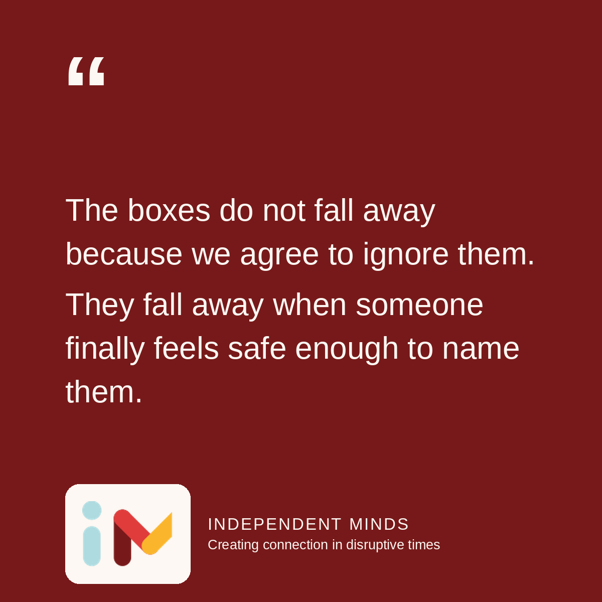
    The boxes do not fall away because we agree to ignore them. They fall away when someone finally feels safe enough to name them.

    How much room we take up, how visible we feel, how sure we are that we belong. The things we assume divide us turn out to be remarkably thin, once we are actually listening to each other.

    Which makes me wonder whether we have the story wrong. Maybe connection was never something we lost. Maybe it is a muscle we have stopped using, in a world that keeps handing us reasons not to start.

    The appetite is still there.

    Give people the room, and they will still reach for each other.

    Wim Buedts | LinkedIn

  • QR Provides Practical Wisdom

    QR Provides Practical Wisdom

    Article written by ICG member Kevin McLean, first published on LinkedIn.

    More and more data, but less and less time

    More and more data but less and less time

    Marketers are surrounded by more and more data, with less and less time to deal with it. To adapt Coleridge’s famous poem, “Data, data, everywhere, / Nor any stop to think.”

    Given the increasing prevalence and sophistication of ‘qual (data) at scale’, what role should qualitative research have? Where does its real value lie?

    I presented a paper at the recent AQR World Conference to suggest an answer: practical wisdom. This is not a completely new concept* but it has particular relevance today.

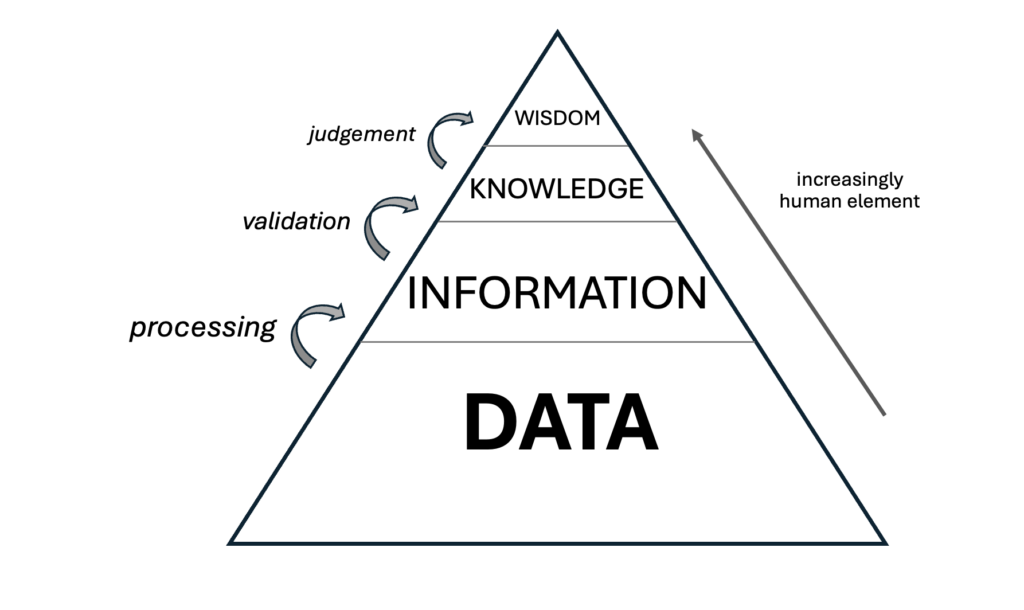
    By wisdom I mean a ‘higher order’ benefit than is afforded by data/information alone, as shown in this informational hierarchy chart.

    the ‘DIKW’ pyramid

    In the literature, the ‘wisdom’ part of this pyramid is less discussed than the other levels and some have questioned its relevance. Wisdom can sound rather abstract or lofty.

    So what do I mean by practical wisdom in the context of marketing and qualitative research?

    I argue that practical wisdom means the following five things:

    • standing in another’s perspective, not your own – ‘you are not your customer’
    • a deeper rooted understanding, not a superficial view
    • critical thinking, healthy scepticism, not taking things as they may first appear
    • flexibility/reflexivity, being able to adapt as or if things change
    • knowing how as much as knowing that, ie knowing what to do next and how to do it

    Seen in this way, qualitative research complements AI-based or automated forms of research, which are very cost efficient at providing information and analysing existing data. To quote Mohit B, VP, InsightAssist:

                  “The real value of research is not generating (data); it’s asking the right questions,      challenging assumptions and interpreting context. AI should amplify researchers, not    replace their judgement.”

    * When I said this idea is not brand new, it’s at least 2,500 years old. Socrates, practised ‘phronesis’, usually translated as practical wisdom, applied know-how, derived from experience.

    Socrates, the OG researcher?

    Socrates, the OG researcher?

    Red Bull may give you wiiings, but qualitative research gives you wisdom. Literally.

    Kevin McLean (FMRS) | LinkedIn