Resource Type: Article

  • “MADE IN” Wave 2: Understanding Country-of-Origin Associations in Argentina, Mexico, Spain

    “MADE IN” Wave 2: Understanding Country-of-Origin Associations in Argentina, Mexico, Spain

    Article by ICG member Jeff Deighton, Insight Engineers.


    The second wave of our conversational AI moderated tracker in three Spanish speaking countries – Argentina, Mexico, Spain – ran at the end of May 2026, asking consumers in each country about their associations and feelings of products and goods made in each of those three countries.

    We utilised a consistent set of questions to Wave 1 (EU3) administered by our trained AI Avatar (Izabella) to probe & ladder participants in each country about: –

    • Their perceptions of products & goods made in each country.
    • What is a typical product in that country and what makes it unique to that country.
    • How they feel in general about goods made in that country (very positive to very negative) and why?
    • Which country has the best reputation for making cars nowadays (W1 – Electronic Goods), out of these 3 countries and 9 other main economies.


    Full article here 


  • What “Q” Reveals About Texture in Asia

    What “Q” Reveals About Texture in Asia

    Image @ Eating with Kirby


    Article by |ICG member Felicia Schwartz, China Insight 

    I still remember that “Aha” moment.

    I’d been living in China for a while, working on food projects and eating my way through markets and restaurants. And I kept noticing something distinctive. It wasn’t just about flavour or ingredients. It was about how food felt:

    The cartilaginous crunch of a chicken foot, the silky slip of a preserved egg, the precise resistance of a well-made noodle between the teeth…Texture wasn’t secondary. It was central to enjoyment.

    That realisation comes back to me in every food project I’ve worked on in the region since- most recently across whisky, biscuits and savoury foods in Greater China. I find myself once again reaching for a concept that has no adequate translation in English.

    The Chinese call it 口感 (kougan) – mouthfeel. But that barely scratches the surface. The language contains dozens of nuanced terms to describe textural sensations that Western food vocabulary doesn’t quite match.

    So what is it about texture?

    In Chinese and many Asian food cultures:

    • Texture (especially chewiness) extends and amplifies flavour perception
    • Eating is understood as a holistic sensory experience, where the physical, almost “mechanical” interaction with food is essential
    • Texture operates not just at dish level, but as a structural principle of the meal

    It also carries cultural meaning ; for instance, long, firm noodles symbolise longevity.

    And crucially – from snacks to beverages- texture is often the decisive factor in product success across China and wider APAC.

    A few examples:

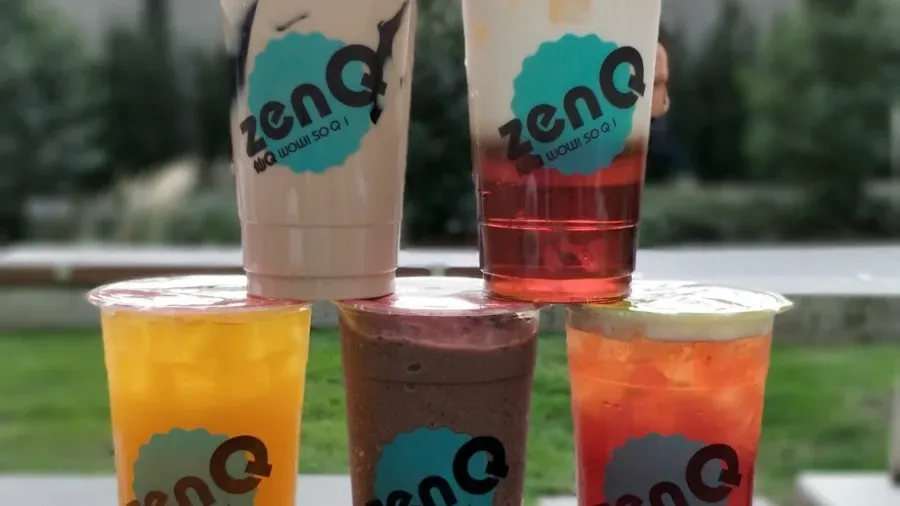
    • Bubble tea chains recently serve cheese foam or cream-topped teas because the contrast between creamy foam and lighter teaadds indulgence
    • Chinese milk bread uses tangzhong (a pre-cooked starch paste) to achieve a signature softness and elasticity, a similar light and airy feel sought after in the cake category
    • Mochi ice cream balls deliver the now highly sought-after “Q” factor -a springy, bouncy chewiness of the rice-dough combined with creamy ice cream centers.

    “Q” itself, as a term for a texture, has become a trend – visible across social media, packaging and retail language in Greater China. In a recent savoury project, it was the word consumers repeatedly used to describe what they valued texture-wise- from fish balls to tapioca pearls.

    What this means for brands:

    • Texture is non-negotiable: consumers will not trade it off-even for health or nutrition claims
    • It shapes perception subconsciously: a slightly gritty functional drink can erode trust before a consumer can articulate why
    • It’s a powerful innovation lever: to highly texture -articulate consumers in APAC, the right texture combinations like crunchy & creamy or smooth & chewy drive perceptions of freshness, indulgence and fun
    • It’s culturally specific: from delicate smoothness in East Asia to richer creaminess in Southeast Asia -one-size-fits-all doesn’t work

    Ultimately, it comes down to the questions we ask.

    In cultural consumer research, the issue is rarely a lack of rigour – it’s asking the wrong questions. When it comes to food, Western frameworks tend to focus on flavour profiles and ingredients. But in China, consumers aren’t just asking what it tastes like. They’re asking: “Does it have the right mouthfeel?” -or more simply – “Does it have Q?”

    Felicia Schwartz | LinkedIn

  • Understanding the Impact and Opportunities of the EU-India FTA

    Understanding the Impact and Opportunities of the EU-India FTA

    Article by ICG member Priti Verma

    • The EU-India FTA creates the world’s largest free trade zone. The deal covers 92 percent of EU exports to India and nearly all trade volume of Indian exports to the EU
    • Estimates have the EU saving nearly USD5 billion in duties annually while exports to India could more than double by 2032
    • Europe’s automotive, machinery and services sectors are among those that stand to benefit greatly from the trade deal

    India was once known for its relatively protectionist approach, which weighed on the economy. The situation has changed rapidly since 2014 with the country having reached 10 free trade agreements. However, the recently agreed upon EU-India FTA is one of never-before-seen size and scope. Priti Verma shares insights on what the deal means for European businesses and examines potential opportunities now available.

    Upon the conclusion of negotiations, European Commission President Ursula von der Leyen hailed the bloc’s free trade agreement with India as the mother of all deals. This was not the usual hyperbole or bluster that surrounds the conclusion of these pacts.

    Instead, it was a realisation of the EU-India FTA’s true size and scope as well as the positive impact the deal brings to both sides. The coupling of the second and fourth-biggest global economies creates the world’s largest free trade zone.

    It’s also further proof that global partnerships are in flux. As the influence of existing trade partners wanes, a strengthening of different relationships, such as the FTA between Europe and India, is requiring businesses to re-evaluate their strategies.

    The deal has been hailed as a victory for both sides. In terms of Indian exports to the EU, 97 percent of tariff lines covering more than 99 percent of current trade value is covered in the FTA. More than 70 percent of these are eligible for immediate duty elimination while a further 20 percent are slated for zero-duty access in the next three to five years depending on type.

    Conversely, about 92 percent of EU exports to India, accounting for 97.5 percent of trade value, have been included in the pact. Almost half of existing tariff lines will receive immediate duty elimination. Another 40 percent will see a phased elimination of duties over a period spanning five to 10 years.

    For European companies considering entry into India, the FTA helps level the playing field and ensures much-needed stability. Key points in the agreement include:

    • Lower or no tariffs and most goods
    • A clearer framework on both legal and competitive matters, including intellectual property rights
    • An increased number of opportunities for partnerships and investment in India
    • More streamlined market access
    What will the impact of the EU-India FTA be?

    Given the sheer size of the two economies involved, the impact of the EU-India FTA will be massive. Some of the early details highlight this reality. According to the European Commission, the EU could achieve nearly USD5 billion in annual duty savings as exports surge.

    Approximately USD220 billion in goods and services is now traded between the two annually. The volume of EU goods exported to India is projected to double by 2032. That is huge, considering the latter’s current position as the world’s fourth-largest economy and the future growth it is likely to experience. Projections for the 2027 fiscal year alone indicate the economy will expand by upwards of seven percent.

    Equally important, deeper economic integration between the two sides will not only support growth but also improve the stability of global supply chains at a time when other trading partners have become less reliable.

    Understanding opportunities of the FTA

    In order to gain widespread access to European markets, India was willing to grant several major concessions that provide companies with significant opportunities moving forward. In particular, the automotive, machinery and services sectors appear likely to benefit.

    Automotive

    India is set to reduce tariffs on European carmakers to 10 percent over the next five years. There will also be a quota-based access system in place for up to 250,000 EU vehicles each year.

    Electric Vehicles could be a potential boon given Europe’s expertise in the field and India’s state plans to reduce emissions and shift away from internal combustion engine cars, trucks and buses. EV components and infrastructure stand to benefit under the FTA.

    Machinery

    Currently, machinery and electrical equipment account for the largest share of EU exports to India. The majority of tariffs in this category will eventually fall to zero in the coming years. Key products include medical devices, chemicals and construction equipment.

    This comes at a crucial time for India. The country is scaling efforts in infrastructure, construction and healthcare which could all benefit from European machinery and equipment.

    Supply-chain diversification

    The FTA now provides a foundation for European organisations to integrate India into their supply chains as part of widespread diversification efforts.

    Nuances of a deal

    The FTA between India and the EU has been almost 20 years in the making. Discussion took place in 2007 but failed to get over the line due to various disagreements. Talks resumed in 2022, and a consensus was reached regarding several key points. Yet a few items are worth highlighting.

    For instance, the EU’s Carbon Border Adjustment Mechanism, which sees a fee levied on EU imports of steel, cement and other high-carbon goods, remains in place on Indian steel despite the FTA. Instead, Europe has committed to investing roughly USD600 million to help India reduce emissions caused by steel and aluminium producers.

    Beyond that, a few sectors in India have been protected in the FTA, including agriculture. A few items, such as apples, pears and peaches, are eligible for phased tariff reductions. Other products like spirits will be lowered slightly but remain at relatively high levels. While expected, it does highlight the need for companies to explore the nuances of the deal.

    Nowhere is that more evident than in the rules of origin, product-specific rules and other potential challenges related to supply chains. The FTA does make it easier for European companies to set up manufacturing hubs in India, but high logistics costs and some problematic customs regulations must now be addressed by the government.

    Final thoughts on Indian market entry

    The EU-India FTA will allow European companies to access opportunities in a large, rapidly growing economy. Tariff eliminations or reductions are the headline, but the deal also provides a framework for other key areas to reduce risk.


    Priti Verma | LinkedIn

  • Qual at Scale: Optimisation…or Oxymoron?

    Qual at Scale: Optimisation…or Oxymoron?

    Article by ICG member Simon Shaw

    We’ve all been there: the qual findings being questioned by client stakeholders on the basis of sample size.  “But you only spoke to thirty people!” is a sadly familiar refrain for many qualitative researchers.

    It’s well-intentioned, and to some extent it’s understandable: why should client stakeholders ‘trust’ findings that have been derived from thirty people, when just last week they saw data from a sample of a thousand?

    The platforms selling ‘qual at scale’ have heard that question too.  And to their credit, they’ve answered it brilliantly.  Eighty thousand interviews.  One hundred and fifty-nine countries.  Results back in a week.  You can hardly blame a procurement team for being impressed.

    And superficially, it makes sense.  The trouble is, it fundamentally misunderstands what qualitative research is, and what it is for.  It’s the right answer to the wrong question.

    Qual at scale is an oxymoron

    Qualitative research was never designed to be run at volume, and it doesn’t benefit from being.

    Its value has never lain in the number of people you speak to. Rather, it lies in taking a tightly defined, carefully chosen group of people and delving deep with them as individuals: exploring their feelings, their attitudes, their behaviour, and the motivations that lie behind them.

    It is built for narrowness and depth, not breadth and scale, which is not a weakness but the whole point.

    It takes the essence of qual out of the research

    A good qualitative researcher sits with recordings, transcripts and notes.  They wrestle with responses that don’t fit the emerging framework.  They are alert to the thing that was almost said but wasn’t.  They recognise that one person’s off-the-cuff remark, while seeming peripheral at the time, can turn out to be the golden nugget that unlocks the whole brief.

    This process requires immersion, judgement and, crucially, time.  It simply cannot be done properly if the feedback the researcher is wrestling with is too voluminous.  The depth of exploration that makes qual so powerful gets crowded out by the need to absorb masses of information.

    There is also something important about the researcher’s own interpretive journey through the data.  Qualitative research is a subjective discipline in which the researcher is part of the method.  Their curiosity, their empathy, their willingness to be surprised and to change their mind are not inefficiencies, but rather the mechanism through which qualitative research produces its particular kind of knowledge.

    The law of diminishing returns

    Every qualitative researcher is familiar with the feeling of going into that nth interview or group, knowing they are unlikely to learn much that is genuinely new.  By the twentieth depth interview with a garage mechanic, you’ve probably learned everything you’re going to learn about engine oil.  The cost of running the twenty-first is no longer justified by what it adds.

    This reflects something real about how qualitative insight works.  Within a tightly defined sample, recruited by attitude or behaviour rather than demographic quota, findings converge and patterns emerge surprisingly quickly.

    Beyond that point of convergence, additional interviews are not adding much.  Instead, they are confirming what has already been established.

    So why is ‘qual at scale’ becoming a thing then?

    Whether qualitative researchers like it or not, client-side pressures do exist.  Procurement teams do measure cost per interview, and stakeholders do feel more comfortable presenting findings derived from large samples to their boards.  Platforms have invested heavily, they are well-funded, and they are making inroads.

    I have heard first-hand accounts of clients removing human-moderated qual entirely from projects that historically would have depended on it.  They do so not because the output is better, but because it is faster, cheaper, and easier to sell internally.

    Unlike law, accounting, or compliance, qual is not subject to external statutory requirements, making it an easy place to start when clients are looking for ‘efficiencies’.

    And its impact is hard to measure.  How do you quantify the impact of the insight that unlocks the brief, the recommendation that changes the direction of an innovation funnel?  When it comes to quant, as well as being more at ease with results expressed as percentages and samples at scale, large organisations have KPI infrastructure that protects quant: few ads get made without a positive Link Test result, while brand tracking studies are used to measure the success or failure of brand teams.  Quant is ‘baked in’ to their systems in a way that qual never has been.

    There may also be a broader cultural shift at play.  Some believe that US-led framing of qualitative research, driven partly by VC-backed MRTech investment, is redefining what the discipline is expected to deliver.  Speed, multi-market consistency, and numerical ‘validity’ are the new priorities.  The language of ‘scaling qual’ is becoming normalised, particularly among clients who are newer to the discipline and have no prior experience of what genuine qualitative inquiry looks like.  And once this understanding takes hold, it will be hard to shift.

    The right relationship

    None of this is an argument against quant.  Or against technology.  Or even against the kind of hybrid AI-mediated interviewing that even the ‘traditional’ market research firms are now developing.  On the contrary, these approaches produce something distinctive and useful, even if it isn’t qual.

    It is instead an argument for clarity about what each discipline is actually for.  Qualitative research works best when used alongside quantitative research, either before it, to develop hypotheses, or after it, to dive deep into headline findings.

    The right approach is to do the qual well, do the quant well, and then synthesise the outputs into holistic insight.  It is not to use quant techniques to try to get ‘qual’ insights, or to count hands in a qual group, or to run eighty thousand AI interviews and call it the largest qualitative study ever conducted.

    What next for qual?

    Qualitative research does not seek to measure.  It seeks to describe and explain how people behave, what they think, and crucially why.  Done well, it produces truths that can be linked up with everything else the client knows, to arrive at something richer and deeper than either discipline could produce alone.

    This is worth defending, not just for our own sake, but for the sake of our clients too. We must make the case for what qual genuinely offers, and keep making it, clearly and confidently.

    To every client who has ever asked ‘but you only spoke to thirty people,’ the answer isn’t more people.  It’s better questions, deeper immersion, and the profound, human approach to moderation and analysis that no algorithm, however powerful, can yet replicate.

    —

    This article originally appeared on Linkedin in April 2026

    https://www.linkedin.com/pulse/qual-scale-optimisationor-oxymoron-simon-shaw-igfne/?trackingId=iYdB3s9NT3Wj6da0Hgb1Og%3D%3D

    Ignite exists to help global brands get qualitative research right in China and beyond.

    https://www.linkedin.com/in/simon-shaw-ignite/


    —

    Ignite exists to help global brands get qualitative research right in China and beyond.

    https://www.linkedin.com/in/simon-shaw-ignite/

    —

  • Customers Aren’t as Irrational as They Seem

    Customers Aren’t as Irrational as They Seem

    Article by ICG member Jay Zaltzman


    A core idea in behavioural economics is that customers don’t always behave rationally. From Dan Ariely’s Predictably Irrational onward, we’ve had a language for the ways decisions deviate from purely logical models.

    That lens has been useful, but it may also have led us, subtly, in the wrong direction. What if many of the decisions we describe as “irrational” aren’t irrational at all? What if they’re meaningful – but we’re missing the context that makes them make sense?

    In my work, I’ve found that what often sits underneath these decisions is tension. Not random inconsistency, but a structured set of competing forces that people are trying to navigate in their lives. Some of those tensions show up again and again:

    • People want to feel independent, but modern life makes them dependent on systems.
    • People want to feel disciplined, but their days are chaotic.
    • People want to express their individuality, but they also want to feel a sense of belonging.
    • People want to become a better version of themselves, but change is difficult.

    When we only look at the customer’s specific decision, it can seem inconsistent or even contradictory. But when we look at the tension the decision is helping resolve, a different kind of logic appears.

    Take a familiar example: the pickup truck. Drive through almost any suburban neighborhood in the U.S., and you’ll see them – large pickup trucks parked in driveways, often spotless, their beds empty. For many of these owners, the truck is rarely used for hauling or towing. Day to day, it’s used for commuting, errands, and school drop-offs. From a purely functional standpoint, it’s more vehicle than most people need. It’s harder to park, more expensive to run, and less efficient than many alternatives.

    And yet, it’s a remarkably common choice. If we look at that through a purely logical lens, it’s easy to see the decision as inefficient, or even irrational. But look at it through the lens of tension, and something else comes into view.

    For many buyers, the pickup truck sits at the intersection of independence and dependence. Even if daily life rarely demands it, the truck carries the possibility of self-sufficiency – the sense that “I could handle it if I needed to.” In a world where so much of life depends on systems, services, and other people, that feeling has real value.

    At the same time, the truck often navigates a tension between individuality and belonging. It signals a certain identity – capable, practical, grounded – while also connecting the driver to a broader cultural narrative that feels familiar and shared.

    Seen this way, the choice isn’t irrational. It’s helping the customer navigate tensions that aren’t visible if we only focus on features, price, or stated needs.

    Once you start looking at customer behaviour through this lens, patterns begin to emerge. Decisions that once felt inconsistent start to feel structured. What looked unpredictable starts to feel, in many cases, surprisingly coherent.

    I explore this lens more fully in my new book, The American Customer: The Hidden Forces That Shape Choice, which is now available. The book looks at how culture and identity shape the way people interpret their choices – and why those choices carry meaning that isn’t always immediately visible. It offers a way to move beyond describing behaviour to actually decoding it.

    Jay Zaltzman, Author at The ICG

    Jay Zaltzman | LinkedIn


  • Using AI Agents with Survey Data: Six Principles for Getting It Right

    Using AI Agents with Survey Data: Six Principles for Getting It Right

    Article by ICG member Matt Gibbs

    A practical guide for insights leaders evaluating agentic AI solutions

    We’re increasingly hearing the question: can’t I just drop survey and insights data into ChatGPT, Claude, or Copilot?  The short answer: Yes, you can. But you’ll encounter serious problems with data security, numerical accuracy, and analytical consistency.  Having spent the past few years building agentic systems specifically for market research, I’ve learned what works and what doesn’t. Here are six principles that should guide any implementation.

    1. Keep Your Data Out of Public Endpoints

    As soon as you paste data into a public model endpoint, you lose control. You cannot govern what it may be used to train, who may access it, where it’s stored, or for how long. This is likely to breach data processing agreements and industry codes of conduct.  Quant or Qual, the answer is the same.

    The right approach: Any implementation must use isolated model instances within a controlled cloud environment, ideally inheriting enterprise security architecture from one of the big providers like Microsoft or AWS. Data should remain within defined boundaries, with demonstrable compliance.

    2. Never Let the Model “See” Raw Numbers

    When you paste data into a chat model, everything becomes tokens. The model doesn’t compute statistics. It predicts what plausible-looking numbers might be.  This leads to percentages that don’t sum correctly, fabricated base sizes, “insights” that contradict the actual data, and no provenance. You simply cannot verify where a number came from.

    The right approach: The model should never consume raw data as tokens. Instead, give it access to tabulation engines and insights tools tested in the real-world of market research for decades.   That way the model can compute exact figures on demand. When an agent reports “32% of prospects are aware of Brand X,” that number should come from a validated statistical computation, not a language model estimate. Every insight must trace back to a reproducible run, auditable by design.

    3. Preserve Your Curated Table Libraries

    Research teams invest significant effort building validated table specifications: the correct variables, consistent filtering, proper weighting, meaningful labels. Dropping raw data into a generic chat model discards all that intellectual property.

    The right approach: Build systems where the agent can search and run from a library of pre-built, validated table specs. Any data point should be traceable to source. Better yet, enable the system to discover what analysis has been done before through conversation history at the organisational level. This institutional knowledge compounds over time.

    4. Demand Statistical Rigour

    Survey analysis requires demographic weighting, subgroup filters, and significance testing. Chat models have no native capacity for applying weighting schemes consistently, filtering to target populations, calculating statistical significance between groups, or warning when base sizes are too small to report. These are language models, not statistical engines. They cannot reliably execute the same analysis twice.

    The right approach: Combine dynamic spec generation by models with a proper cross-tabulation engine producing the numbers. Users should be able to instruct in conversational English, with models generating the coding syntax and passing it to a validated engine. The statistical computation must be deterministic and reproducible.

    5. Embed Sector-Specific Expertise

    Generic chat models know nothing about your organisation, your sector, or your projects. Every conversation starts from zero.

    The right approach: Build contextual understanding into the system. The agent should know your organisation, your projects, your data structure, and your previous analyses. Embed sector-specific expertise that creates organisational “common sense.”  Pre-built workflows should exist for common research tasks: segmentation, TURF analysis, correspondence mapping, brand tracking, verbatim coding, strategic reports. These encode lessons from years of practice. Multiple team members should receive consistent analysis approaches, not whatever the model happens to generate that day.

    6. Optimise for Speed to Insight

    Using a raw model for survey analysis requires extensive prompt engineering, data formatting, and manual verification. Not every stakeholder who needs insight has time to coach a model into usefulness, repeatedly, across every conversation.

    The right approach: Eliminate ramp-up time. Analysts shouldn’t need to re-explain data structures, variable names, or project context. Pre-built table libraries should mean common questions resolve in seconds, not hours. Outputs should be client-ready: branded presentations, interactive dashboards, and web visualisations, not chat text that needs reformatting.  Most importantly, implement MR-grade guardrails. The system should refuse to fabricate quotes, validate numbers against source tables, use hedged language appropriately, and separate technical statistics from executive summaries.

    Beyond Pre-Built Workflows

    The most powerful implementations give the model access to a full coding environment within a secure, isolated workspace. Users can request bespoke analyses, custom visualisations, or entirely new tools simply by describing what they need in plain English. The agent writes and executes code on the user’s behalf. This means an insights director can say “build me an interactive dashboard showing brand health over time with drill-down by region” and receive a working application, not a description of how one might be built. The same applies to statistical analyses that don’t fit pre-packaged workflows, custom data transformations, or one-off client deliverables.

    This is the emerging capability of agentic software: code generation orchestrated by conversation, constrained by guardrails, and delivered within a controlled environment. The opportunity is to provide this capability to research teams without requiring them to become programmers.

    Summary

    Raw AI gives you a conversation. A properly architected agentic system gives you a research capability.  The model is the easy part. The tooling around it is where value is created. The questions that serious insights directors should be asking of any solution are:

    1. Where does my data go, and who controls it?
    2. How are numbers computed, and can I trace them to source?
    3. Does the system understand my existing analysis, or do I start fresh each time?
    4. What safeguards prevent fabricated insights reaching stakeholders?

    Any solution worth considering should answer these questions with confidence.

    Market research has built its reputation on transparent methodology and data governance over decades. If a significant portion of our sector begins using public AI models without safeguards, we don’t just risk individual credibility, we risk the trust that underpins the entire industry.  There are tools that can help.  Tools that are designed to serve our professions. Please use them.

    Matthew Gibbs | LinkedIn

  • The Value of Human-Led Research

    The Value of Human-Led Research

    ICG member Mark Hadfield recently wrote a couple of newsletters about a project that he conducted with the account planning group, looking at the value of human-led research.

    Essentially, it aims to ensure that qual research is still in the mix when it comes to writing the best brand strategies.

    You can read these articles here:

    Part 1: https://meetthe85.substack.com/p/how-to-unearth-strategy-magic?r=oupm3

    Part 2: https://meetthe85.substack.com/p/how-to-unearth-strategy-magic-the?r=oupm3

    Mark Hadfield | LinkedIn

  • How Are Rising Oil Prices Affecting Your Clients?

    How Are Rising Oil Prices Affecting Your Clients?

    Full report by ICG member Kevin Simmonds, Advantage Market Intelligence Ltd


    We’ve put together a short report to help unpack the impact across the UK economy and key industries.

    It provides a clear, high-level view of where different sectors are most exposed, what it means in practice, and how businesses are likely to respond.

    While all industries are feeling the effects, the level of impact varies — with sectors like airlines, logistics, and manufacturing facing immediate cost pressure, while others such as energy and renewables see more positive momentum.

    The report also highlights the bigger picture trends shaping client challenges, including inflation, changing demand, supply chain shifts, and the move toward energy transition.

    Download the report to quickly understand where your clients may be most exposed — and what to watch next.


  • What Do Women Want?

    What Do Women Want?

    Article written by ICG members Hanna Chalmers and Kym Loeb – first published in Research Live Feb 2026


    Brands must re-dimensionalise women beyond the flattened identities presented in mainstream culture. Hanna Chalmers and Kym Loeb discuss how research can better reflect this complexity.

    Since the cultural watershed moment of #MeToo, the backlash against women’s voices has been intensifying.

    We have seen increasing levels of physical violence against women and girls, described by Keir Starmer as a ‘national emergency’ as he launched a national strategy1 to focus on the issue. This sits alongside an alarming growth in what has been described as “recreational misogyny”2 on social media: harassment en masse designed to silence, coerce and limit women’s aspirations in public life3.

    It’s not hard to see, and feel, this recreational misogyny in everyday life:

    • The explosion of AI deepfake tools such as Grok and AI girlfriends as a replacement for dating real women.
    • Views previously confined to misogynistic subcultures are now mainstream (see Steve Bartlett and Chris Williamson blaming “women’s socio-economic emancipation” for population decline on Diary of a CEO).
    • The rise of the ‘trad wife’ influencer, rejecting the achievements made towards gender equality.
    • The so-called ‘pornification’ of women’s empowerment which celebrates Only Fans as a route to wealth and entrepreneurship.
    • The aestheticisation of self-care which reduces wellbeing to consumption rituals and performance.
    • The medicalisation of beauty which celebrates ever more extreme efforts to meet narrow and impossible standards (see ‘morning sheds’, celebrity Ozempic, Skims’ ‘face wrap’).

    All of this threatens to shrink women in public life both figuratively and quite literally.

    It’s a mainstream culture that seems to have flattened down so-called women’s empowerment into individual, aesthetic, sexualised and consumption-led lifestyle choices over an emphasis or celebration of systemic and organisational progress.

    It can seem like an unfathomable landscape – hard to chart and difficult to find the right points of entrance.

    How should brands make sense of it all in order to successfully engage women?

    We must first emphasise that social media feeds are not reliable barometers of women’s wants, needs, aspirations and desires. Alongside powerful algorithmic design, that certainly doesn’t prioritise female joy, there must also be a factoring in of ideological influence. As far right political strategist Steve Bannon said, ‘politics runs downstream of culture’ – and social media is evidently the key battleground for ideas,4 where seemingly anodyne social content is underpinned by political motivation.

    In sharp contrast, data demonstrates the degree to which women are getting on with making choices that challenge the representations of women we are seeing and feeling in popular culture – both explicitly and implicitly.

    “Social media feeds are not reliable barometers of women’s wants, needs, aspirations and desires.”

    Women are rejecting the pushback against equality by voting more progressively than their male counterparts.5 More young women are choosing stem (Science, Technology, Engineering, and Mathematics) A-levels, traditionally dominated by boys, than ever before in the UK.6 More women are buying property on their own7, going on holiday on their own8 and increasingly investing in friendships and communities, rather than romantic relationships9.

    Brands must re-dimensionalise women beyond the flattened digital, hyper sexualised identities we are presented with in mainstream culture. Rather, we see that women want and need to be engaged more effectively around solidarity, autonomy, community and the power of female friendship. The question isn’t just about what women want, it’s about how women are responding to the world they’re navigating, and research must reflect this complexity:

    • Triangulate research: Social media analysis, while great for scale and speed, can be misleading. Use it alongside other research tools to build a richer, deeper and more nuanced view of women’s lives.
    • Go deeper: Ethnography remains a key tool in gaining an understanding of how women feel. Use research to enable women to tell their own stories and observe how they commune with other women in private, informal spaces.
    • Listen for what’s unsaid: Women are under constant pressure to perform control, empowerment and aesthetic perfection. Create a space for women to express their fears, uncertainties and exhaustion without judgement.

    Rather than seeing women’s representation in popular culture as a reflection of women’s needs, explore what impact that representation is having on women and girls, then ask how your brand or organisation can more accurately represent the wider world of women’s and girls’ needs and interests today.

    Addressing these questions can supersize marketing impact: effectively engaging women while simultaneously challenging the deleterious effect that current representations of women in culture are having on all of us. This should be a topline priority.

    Hanna Chalmers is founder of The Culture Studio and and Kym Loeb is an insight and strategy consultant

    Reference:

    [ 1 ] https://www.gov.uk/government/news/vawg-strategy-to-better-protect-children-from-misogyny-and-abuse

    [ 2 ] Sophie Gilbert Girl on Girl: How Pop Culture Turned a Generation of Women Against Themselves

    [ 3 ] https://www.theguardian.com/media/2024/feb/06/social-media-algorithms-amplifying-misogynistic-content

    [ 4 ] https://www.wired.com/story/the-most-powerful-politics-influencers-barely-post-about-politics/

    [ 5 ] https://www.newstatesman.com/politics/uk-politics/2026/01/young-women-are-radicalising

    [ 6 ] https://www.theiet.org/media/press-releases/press-releases-2025/press-releases-2025-july-september/14-august-2025-a-level-uptake-in-stem-grows-but-calls-for-greater-gender-equity

    [ 7 ] https://www.embracefs.co.uk/blog/more-women-are-buying-solo-and-the-market-needs-to-catch-up#

    [ 8 ] https://www.theguardian.com/travel/2025/nov/24/are-you-one-of-women-solo-holiday

    [ 9 ] https://www.pewsocialtrends.org/wp-content/uploads/sites/3/2020/08/PSDT_08.20.20.dating-relationships.final_.pdf


  • The Value of Consumer Connection

    The Value of Consumer Connection

    Article by ICG member Morgan Arnell, Co-Founder of Mingle Connections 


    Most organisations don’t have a data problem.

    They have a distance problem.

    Despite more dashboards, trackers and reports than ever before, many businesses feel strangely unsure when it comes to the decisions that matter most. Teams debate. Alignment meetings multiply. Consumer or customer insight is referenced, but rarely felt. Somewhere along the way, the humans that buy your products or services become an abstraction and are rarely top of mind when decisions are being made.

    Ask yourself this:

    When was the last time your leadership team spent meaningful time with a real consumer — in their world, on their terms?

    For many organisations, the honest answer is rarely — or never.

    This distance has consequences. Brands lose relevance. Innovation misses the mark. Decisions slow down or default to what feels safe internally rather than what works externally. Consumer-centricity becomes something organisations talk about, not something they practice.

    Consumer Closeness is about closing that gap

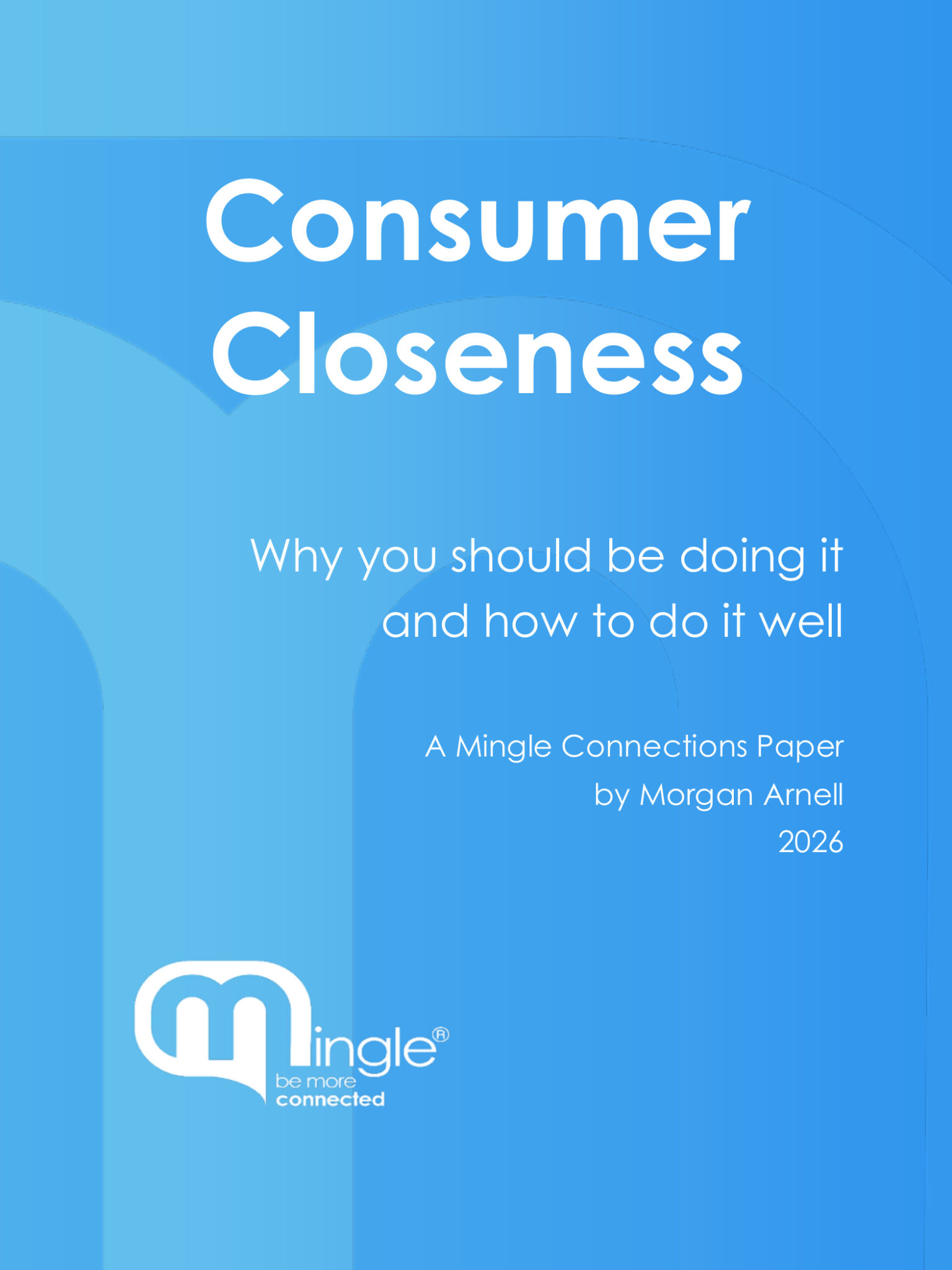
    At Mingle Connections that is all we do! In 30 years of leading it in organisations of all shapes and sizes our Co-Founder, Morgan Arnell, thought he’d put his thoughts into a short guide.

    If you work in the world of brands we’re sure the topic of consumer closeness has probably come up. Maybe it’s got pushed down the list of priorities or you haven’t felt confident enough to drive such activity in your business. We hope this paper can give you the confidence to make a clear business case for making time for consumer closeness and a draw from some of the tools and tips to do it brilliantly.

    Download this free paper to learn:

    • What consumer closeness actually is (and isn’t)
    • Why consumer closeness is more important now than ever
    • The tangible value it adds – not just to the process of insight generation but also to your culture and its impact on decision making
    • A framework for doing consumer closeness like a pro
    • Our top tips to make it stick in your organisation, shifting consumer closeness from a buzz word to something your business just does.

    It will give you the language and frameworks you need to make a real case for consumer closeness in your organisation. To bring the voice of the consumer into everyone’s mind and increase the impact those humans that buy your products and services have on the decisions you make. Because when consumer closeness is led well, owned proudly and linked to real business challenges, it creates impact that goes far beyond the moments of connection themselves

    Mingle Conssumer Closeness Paper


    e: morgan@mingleconnections.com

    w: www.mingleconnections.com