Topic: Qualitative Research

  • Recording: Taking Qualitative Research to the Next Level with Oppi

    Recording: Taking Qualitative Research to the Next Level with Oppi

    Introducing OPPI, the platform for market researchers seeking to enhance their qualitative and quantitative studies through opinion crowdsourcing and audience insights. Using state-of-the-art data analytics, OPPI captures the nuances of human conversation through crowd-sourced opinions, providing real-time, actionable insights. Imagine integrating these rich, qualitative insights into your current quantitative data sets seamlessly. With OPPI, you can offer your clients a complete understanding of their target audience by blending numbers with narratives.

    Adrian Liew, FounderAdrian is a digital strategist, communications consultant and marketing technologist who has advised corporate leaders, government officials and foreign embassies for the past ten years. As a technologist, Adrian’s passion is analysing and using data to reveal the insightful, profound stories that make a difference to people, companies and governments.

    Website: www.oppi.live

    LinkedIn: www.linkedin.com/in/adsg84

    Watch this Lunch&Learn here

  • What Do You Think Britain Was like in 1956 (Less than a Decade After WW2)? Story by @GeoffWicken

    What Do You Think Britain Was like in 1956 (Less than a Decade After WW2)? Story by @GeoffWicken

    For anyone researching specific topics, the reports AMSR – The Archive of Market and Social Research –  provide insight into a huge range of subject-matter. Additionally some of the documents offer fascinating portraits of Britain at given points in time.

    One example is the 1956 #Hulton Readership Survey report, which recently appeared on eBay. (Bidding was not hotly contested )

    The report itself is lovely, still smelling faintly of leatherette, and offering an intriguing picture of Britain in 1956, via its reading habits study.

    ✓ WW2 was still a fairly recent memory in 1956.

    ✓ Food rationing had finally concluded just two years earlier

    ✓Car ownership stood at 11%, whereas 24% of people were categorised as cyclists.

    ✓ Media:

    ✓ TV sets were present in 42% of homes

    ✓ ITV had been launched as the first commercial channel in September 1955

    ✓ Print was the major advertising medium and this survey existed to support it

    It’s a fascinating read, to get the full story, and to access the Hulton report, click on the below to continue

    https://www.amsr.org.uk/a-picture-of-britain-in-the-1950s/


    AMSR: Making History

  • Data Visualisation & Storytelling – 5 tips!

    Data Visualisation & Storytelling – 5 tips!

    ICG member Elliot Fern, Fern Insight, shares his top tips for data visualisation and storytelling. These include;

    • Understanding the context
    • Choosing an effective visual
    • Eliminating clutter
    • Focusing attention with colour, shapes & font
    • Telling your story with a focus on a call to action.

    Full article here 


  • Recording: A Love Letter from AI to the Qualitative Researcher

    Recording: A Love Letter from AI to the Qualitative Researcher

    This webinar has been generously sponsored by OPPI – the platform for market researchers seeking to enhance their qualitative and quantitative studies through opinion crowdsourcing and audience insights. Using state-of-the-art data analytics, OPPI captures the nuances of human conversation through crowd-sourced opinions, providing real-time, actionable insights. Imagine integrating these rich, qualitative insights into your current quantitative data sets seamlessly. With OPPI, you can offer your clients a complete understanding of their target audience by blending numbers with narratives.


    This webinar, presented by ICG member Tom Woodnutt, Feeling Mutual, will cover how qual researchers feel about AI and how AI feels  about qual researchers.  Tom will also cover the benefits of AI-supported qual and the centrality of humans to the process.

    The webinar will also include a Q&A session, as well an interactive discussion about our experiences of AI to date.

    Tom Woodnutt

    Tom is the founder of the insight & strategy collective – Feeling Mutual.

    Feeling Mutual specialises in global, online and mobile qualitative research, tackling diverse briefs (from Innovation to Brand and Communications Strategy, Creative Development, UX and Customer Experience.


    https://feelingmutual.com

    https://www.linkedin.com/in/tomwoodnutt/

    RECORDING HERE (only available to ICG members, please don’t share).

  • Driving Together the Say-Do Gap in Research

    Driving Together the Say-Do Gap in Research

    By ICG member Kevin McLean, Wardle McLean 

    Pic: Goofy in Disney animation, Motor Mania


    I’ve been researching motor insurance. Before you glaze over, it has revealed both a Fundamental Truth about human nature and a persistent marketing ‘blind spot’.

    The FT is the (in)famous ‘say-do gap’. People don’t do what they say, or say what they do, especially in a research context. Specifically, what people say (testimony, attitudes) is a very poor predictor of what they then do (behaviour).

    In our study, 86% of our sample said that they believed they were good drivers. This is backed up in other studies.

    How to deal with the say-do gap in research, given that we cannot change human nature? In his excellent recent article, The Say-Do Gap in Driving Behaviour, Simon Shaw of Trinity McQueen outlines three key steps:

    • use multiple sources/methods
    • get real ie study actual behaviour (as well as reported behaviour)
    • do this over time, rather than as a one-off snapshot

    But it goes even further: the say-do gap is a perennial marketing issue due to a  confusion between two communication modes. Organisations often use the rules of the first mode to judge speech in the second mode.

    In ‘contract mode’, statement and behaviour are directly and explicitly connected. The ‘keep off the grass’ sign on the lawn, marriage vows or sworn legal testimony, are examples of contractual speaking, tied to behaviour, occurring within an agreed frame of reference.

    But most interactions are in ‘conditional mode’, where speech is conditioned by a host of factors, such as context, what’s at stake, who is speaking and why, the emotions at play. ‘I’ll go the gym 3 times per week’, ’14 units of alcohol per week’, ‘Let’s have a coffee some time’, are all be examples of this mode.

    Qualitative research tries to recognise and mediate between these different modes. Client organisations (in contractual mode) may want the public to do X, for Y reasons; the public may or may not want to do this, it all depends, but will nod and smile in either case.

    Driving is a great example of ‘mode confusion’. The question ‘have you broken the speed limit’ is asked in contract mode, directly about a specific behaviour, but is received conditionally, ie the framing changes, leading to a communication mismatch, similar to the famous Larson cartoon:
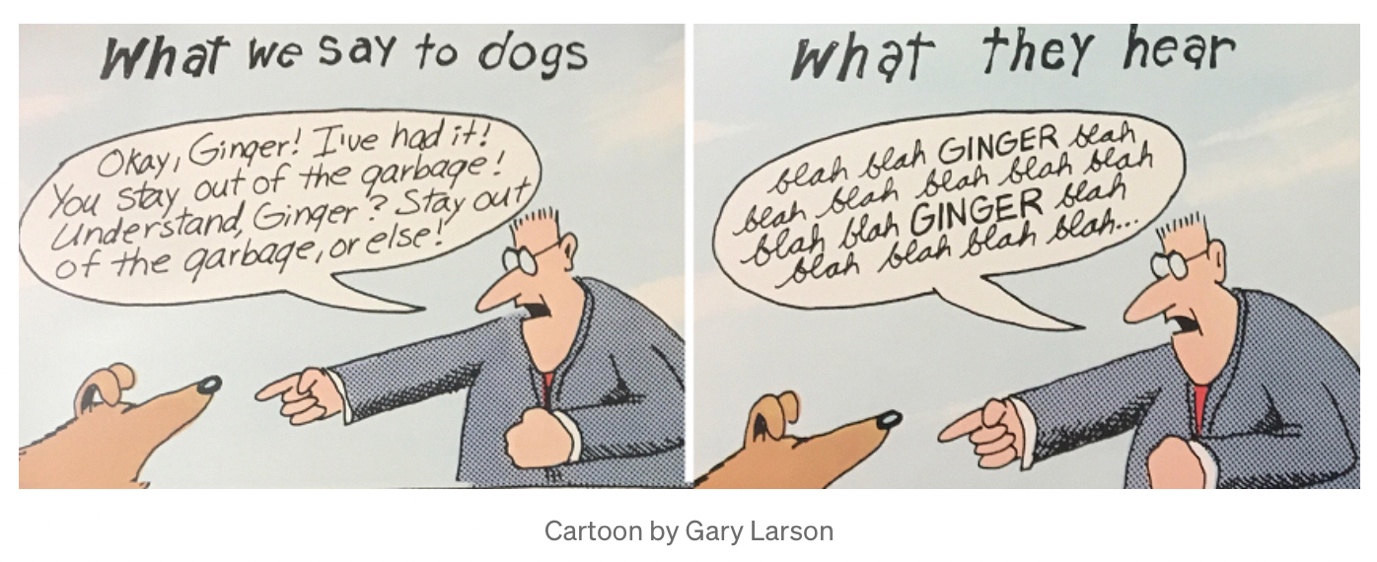
    Breaking the speed limit is illegal and potentially dangerous; the question carries social and psychological ‘baggage’ and brings a host of other questions eg what is at stake, what should I say, have I gone too fast by mistake etc? How people answer a question, in research and in life generally, reveals how they position themselves, not what they do.

    One final point, let’s call it the ‘say-do switcheroo’: rather than studying how attitudes (testimony) predict behaviour (spoiler alert, they don’t), why not look at how behaviour affects attitudes?

    In our study on driving behaviour, we looked at how feedback loops inform drivers. This is increasingly common with newer cars, which nudge us with various beeps and dashboard signs (car ahead is moving off, lane assist, parking sensors etc).

    With telematics feedback, drivers see for themselves whether and how often they have strayed over the speed limit, braked or accelerated harder than normal, etc. Reflecting on this behavioural information seemed to affect how people then spoke about their driving.

    With the right design and with enough time, research can learn about behaviour and use behavioural input deliberatively to close (and reverse) the say-do gap and thus suggest ways of changing behaviour.

    Summary:

    • the say-do gap is a people thing, not just a research thing
    • knowing it is there and how it operates (cf communication modes) is the first step
    • using multiple research inputs, including actual behaviour and feeding this back
    • over time allows for behaviour to inform testimony, for more accurate insight.

    http://www.wardlemclean.co.uk/

  • RECORDING: Jane Frost (MRS): The Alchemy of 2023: Is Insight Still Working??

    RECORDING: Jane Frost (MRS): The Alchemy of 2023: Is Insight Still Working??

    • We welcomed Jane Frost (CEO of the MRS) at the start of our AGM online on Weds 20th September.

    Jane spoke about some macro trends within the market research sector and what this means for us all.

    WATCH THIS TALK HERE 

  • RECORDING: Knowledge Share: An Introduction into Insight Synthesis

    RECORDING: Knowledge Share: An Introduction into Insight Synthesis

    This Knowledge Share has been generously sponsored by Opinion Hub

    Insight budgets are under pressure. Rather than commission new projects, our clients are being asked to do more with what they already know. In this introduction to insight synthesis, we’ll show you how to maximise the value in your client’s existing research.

    We’ll cover:

    – Why you should synthesise your insight

    – Four simple steps to follow

    – Tools and techniques to help

    – And pitfalls to avoid

    Dan Young

    Dan set up Shed Research to help organisations make more of their existing research. In the past year, he’s been doing this for HSBC UK, Cancer Research UK, General Mills, Guide Dogs, and BSH Group (the people behind Bosch and Siemens). In 2020, Dan was fortunate enough to win the ICG/MRS Independent Consultant Award. He’s a frequent speaker on the topic of insight synthesis and regularly trains insight teams how to make more of their existing insight.

    Shed Research Consulting

    +44 (0)7980 988 762

    RECORDING HERE 


  • RECORDING: Lunch&Learn with ResearchBods

    RECORDING: Lunch&Learn with ResearchBods

    Come and join us at this Lunch&Learn session with ResearchBods.

    What will be covered?

    ResearchBods is a UK based Global Data Collection partner that offers Agencies, Brands and Independent Consultants, a range of innovative online Qual and Quant Solutions. We combine tech with operational excellence to ensure consistent and high quality delivery across research projects.

    We’d love to share a quick overview of our Online Community platform, our approach to ensuring Data Integrity during online Quant studies, and our introduction of AI solutions to enrich your insight delivery. Most of the session will be focused on Data Integrity, however, and the measures we put in place to ensure real people are providing the responses to your questions.

    Why is ResearchBods  a great fit for micro-businesses in research?

    We’ve supported micro-businesses and freelancers for years, so we truly value the importance of offering a trusted partner service that can deliver time and again! Our service model is scaleable and can support self serve clients, or those that require full serve and everything in-between!  The solutions we offer are not only industry leading, but we’re also massively competitive on price and our dedicated support teams will do whatever they can to help you convert projects.

    Dale Henry, Sales Director

    Dale has been at ResearchBods for 7 years, working across various Product Solutions in a client servicing capacity. Dale’s passion lies within tech enablement and supporting clients with making strategic business decisions through accurate data delivery.

    https://researchbods.strat7.com/

    https://www.linkedin.com/company/strat7.researchbods/mycompany/

    Discount for ICG members

    As mentioned our project prices are always competitive, we rarely lose out on price. We’re happy to offer 15% discount to ICG members on the first project commissioned with us. 

    DOWNLOAD RECORDING HERE

    Presentation slides here ResearchBods ICG L&L Presentation – Data Integrity

    Summarised slides of services provided here: Researcg Bods Data Integrity – A must for all insight professionals 2

  • Recording: Introduction to Amsr – a Free Resource for Storytelling and Bringing Context to Research and Insights

    Recording: Introduction to Amsr – a Free Resource for Storytelling and Bringing Context to Research and Insights

    Please join ICG member Judith Staig for this webinar.

    Tim Harford advises that, when we see a number, we should ask ‘is that a big number?’ One of the ways we can answer that question is to look at recent history. For example, is the interest rate high? Only when compared with the last few years – back in November 1979, it was 17%.

    This webinar will introduce you to the AMSR – a fantastic free resource for researchers. The AMSR curates post-war market research projects, papers, and publications and is full of nuggets of gold that will help you put context around today’s markets, find data to spin stories around and bring your insights to life.

    The webinar uses the three recent AMSR publications to showcase stories about key issues of our time such as women at work, sustainability, diversity and inclusion, inflation and referendums, as well as to report on the changes and developments we have seen in our industry. Link to publications here

    What will I learn? You will know how to use the AMSR for your own research and also what you can do to become involved with what is one of the foremost and most valuable charitable endeavours in our industry.

    Judith Staig

    Judith is a writer and content strategist working in the research and insights sector. She helps AMSR with marcomms as a volunteer.

    https://www.linkedin.com/in/judith-staig-993153/


    AMSR home

    WATCH THIS WEBINAR HERE

  • Why I Love Business to Business (B2B) Qualitative Research

    Why I Love Business to Business (B2B) Qualitative Research

    Article by ICG member Carol Raithatha, Carol Raithatha Ltd.

    You all probably know what it’s like – Some projects are just more motivating than others. In other words, certain areas of research seem to dovetail more easily with what I enjoy.

    So, I’ve been pondering why I like B2B qualitative research so much. Here are some thoughts on what makes it such a rewarding area to be involved in, IMHO at least.

    B2B qualitative research is diverse, stimulating, and worth doing. It is:

    · The opportunity to learn how organisations and sectors operate and fit into the wider context.
    · Talking to competent individuals and hearing all about professional worlds I might never have even thought about.
    · Getting into detail while being able to look at the bigger picture. Looking at both the individual bricks that make up the wall as well as the whole wall; both when standing in front of it, but also from up in space.
    ·A full timeline approach: How has the past informed what is happening in the present and what is likely to happen in the future.
    · Often a chance to learn about other regions and countries and sometimes use a bit of language skills too.
    · Finding that golden nugget that helps the client deliver a better experience and become more profitable. Almost always a win-win situation!
    · Having some great conversations and asking lots of questions!

    Getting out of bed for a B2B qualitative project is easy. It’s like having tuition on the real world from the experts and being paid for the pleasure.

    If you are a researcher what are your experiences? Do you also enjoy B2B qualitative projects? Why?

    #qualitativeresearch #marketresearch #B2Bresearch

    Carol Raithatha | LinkedIn