Topic: Qualitative Research

  • QR Provides Practical Wisdom

    QR Provides Practical Wisdom

    Article written by ICG member Kevin McLean, first published on LinkedIn.

    More and more data, but less and less time

    More and more data but less and less time

    Marketers are surrounded by more and more data, with less and less time to deal with it. To adapt Coleridge’s famous poem, “Data, data, everywhere, / Nor any stop to think.”

    Given the increasing prevalence and sophistication of ‘qual (data) at scale’, what role should qualitative research have? Where does its real value lie?

    I presented a paper at the recent AQR World Conference to suggest an answer: practical wisdom. This is not a completely new concept* but it has particular relevance today.

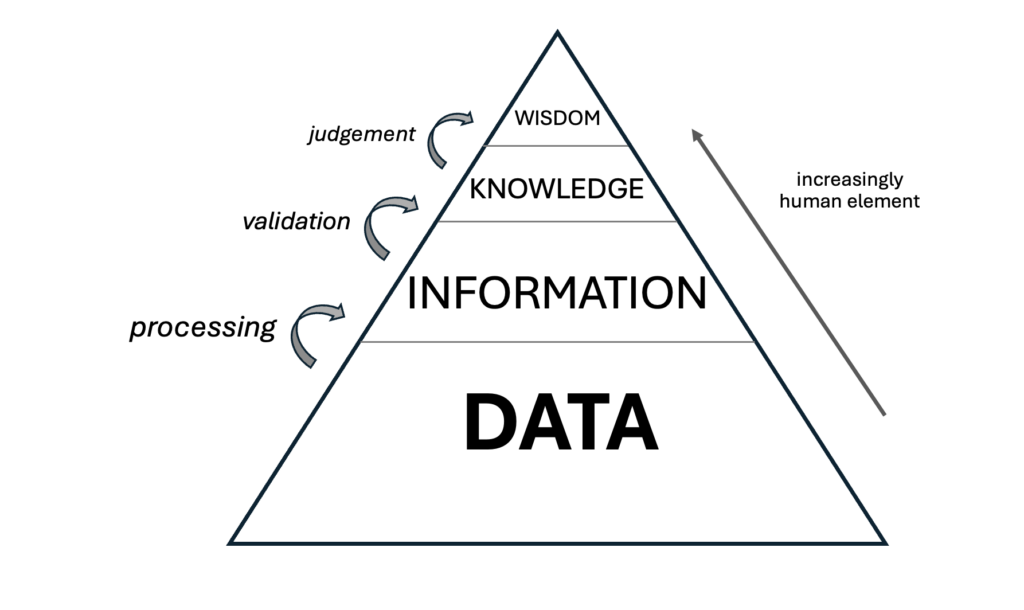
    By wisdom I mean a ‘higher order’ benefit than is afforded by data/information alone, as shown in this informational hierarchy chart.

    the ‘DIKW’ pyramid

    In the literature, the ‘wisdom’ part of this pyramid is less discussed than the other levels and some have questioned its relevance. Wisdom can sound rather abstract or lofty.

    So what do I mean by practical wisdom in the context of marketing and qualitative research?

    I argue that practical wisdom means the following five things:

    • standing in another’s perspective, not your own – ‘you are not your customer’
    • a deeper rooted understanding, not a superficial view
    • critical thinking, healthy scepticism, not taking things as they may first appear
    • flexibility/reflexivity, being able to adapt as or if things change
    • knowing how as much as knowing that, ie knowing what to do next and how to do it

    Seen in this way, qualitative research complements AI-based or automated forms of research, which are very cost efficient at providing information and analysing existing data. To quote Mohit B, VP, InsightAssist:

                  “The real value of research is not generating (data); it’s asking the right questions,      challenging assumptions and interpreting context. AI should amplify researchers, not    replace their judgement.”

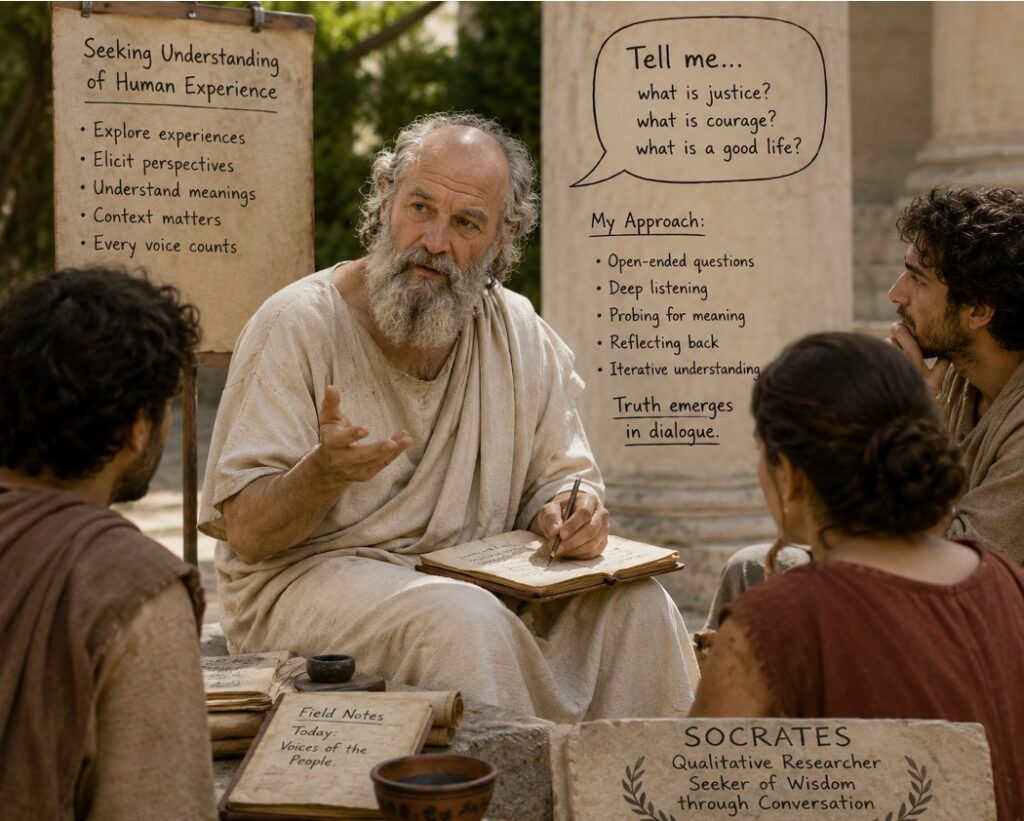
    * When I said this idea is not brand new, it’s at least 2,500 years old. Socrates, practised ‘phronesis’, usually translated as practical wisdom, applied know-how, derived from experience.

    Socrates, the OG researcher?

    Socrates, the OG researcher?

    Red Bull may give you wiiings, but qualitative research gives you wisdom. Literally.

    Kevin McLean (FMRS) | LinkedIn

  • The Say/Do Gap: Are We Focusing on the Wrong Problem?

    The Say/Do Gap: Are We Focusing on the Wrong Problem?

    Article by ICG member Iona Carter, Tracer Insight Consultancy.


    The phrase “say/do gap” has become one of the most common criticisms of consumer research. If you’re a consumer or shopper insight user (or provider), you’ll have heard it all before…

    • Consumers say one thing and do another.
    • Only behaviour reveals the truth.
    • Self-reported data can’t be trusted.

    But I think the industry has become so focused on proving the say/do gap exists that we’ve stopped asking a more interesting question: Are we focusing on the wrong problem?

    Firstly, some so-called say/do gaps are actually research design gaps. Researchers are often asking consumers to perform surprisingly difficult tasks: predict future behaviour or explain past behaviour.

    Secondly, what consumers say isn’t necessarily wrong simply because it doesn’t show up in behaviour.  In fact, understanding what consumers say may be just as important as understanding what they do – the gap often becomes a goldmine of valuable insight.

    Behaviour, Motivation and Barriers

    I like to think of the say/do gap using three lenses:

    Behaviour What happened?

    Motivation What was the consumer trying to achieve?

    Barriers What prevented those motivations translating into behaviour?

    The mistake is assuming that if motivations don’t show up in behaviour, they must be irrelevant.

    So let’s think of an example: consider sustainability.

    A consumer tells us sustainability is important when buying laundry detergent.  But, behavioural data then shows they bought the cheaper alternative.

    The conventional interpretation is often:

    “They said sustainability mattered, but their behaviour proves it didn’t.”

    I’m not convinced that’s the right conclusion.

    Perhaps sustainability genuinely mattered… but it simply lost the battle in the complex trade-offs between multiple goals that we all make when making decisions.

    Behaviour tells us which of these goals or motivations  won…. it doesn’t tell us which goals or motivations existed.

    And, it certainly doesn’t tell us why one goal defeated another… and that is where understanding barriers becomes important.

    Whereas the conventional interpretation of the ‘say/do gap here might be:

    “They said sustainability mattered, but their behaviour proves it didn’t.”

    An experienced researcher might conclude…

    “Sustainability is important, but is currently constrained by something else”

    Those constraints (or barriers) might be price, trust, availability, convenience or something else entirely.

    Understanding those barriers may be more commercially valuable than simply observing the outcome.

    Why Gaps Occur

    There are two broad reasons why what consumers say and what they do don’t always align.

    The first is prediction.

    When consumers tell us what they will do in the future, they’re making forecasts: any behavioural scientist will confirm that humans are notoriously poor at forecasting their future behaviour.  Not because they’re dishonest, but because future decisions are made in future contexts that do not yet exist.

    The second is explanation.

    When consumers tell us why they did something, they’re reconstructing a decision after the event.

    But…

    • memory is imperfect.
    • some (a lot) of what influences behaviour is non- conscious

    Yet, people naturally create explanations that are coherent, rational and (depending on the case in point) socially acceptable.

    In short…  consumers are often imperfect predictors of their future behaviours and imperfect witnesses to their past behaviour.

    But imperfect doesn’t mean useless.

    The Limitation of Behaviour Alone

    Over recent times, there are those in the marketing community that have moved from

    “Behaviour is important.”

    to:

    “Behaviour is the only truth.”

    That’s a much harder claim to defend.

    Behaviour tells us what happened, but it often struggles to tell us:

    • What almost happened
    • What alternatives were considered
    • What the consumer was trying to achieve
    • What tensions existed
    • What barriers prevented a different outcome
    • What opportunities might emerge if those barriers were removed

    Behavioural insight is inherently backward looking – it looks at what happened.  Yet, growth depends on understanding what could happen under different conditions.

    And that’s why understanding motivations and barriers still matter… not because they always predict or explain observed behaviour, but because they often reveal future opportunity.

    The Role of Research Design

    If consumers struggle to answer some questions directly, the solution isn’t necessarily to stop asking them, as has unfortunately become the fashionable thing to claim in some circles.

    The solution is to ask better question, and use more intelligent analysis and interpretation.

    For example…

    When exploring past behaviour, good qualitative researchers will avoid jumping straight to the “why?”

    Instead, they help consumers reconstruct past events and behaviours.  They reinstate context.  They allow insights to emerge through conversation and observation not just questions. They explore rejected alternatives and uncover tensions and trade-offs. And, they use techniques that help consumers explore motivations, barriers and associations that may otherwise be difficult to articulate or access.

    In short, the goal is not simply to collect explanations – it is to help consumers access explanations that may not be immediately available.

    In the same vein, good quantitative research often avoids relying solely on direct questioning.

    Key Drive Analysis, for example, infers what matters from the relationship between attitudes and outcomes rather than simply asking consumers what’s important.

    Implicit and other behaviourally informed techniques can help uncover associations that are difficult to consciously articulate.

    Similarly, when predicting likely future behaviour, the best researchers often improve prediction by introducing realistic constraints, trade-offs and competitive choices rather than asking consumers to evaluate ideas in isolation.  And they don’t look at respondent answers in isolation, they benchmark against historical outcomes, combine multiple measures and so on.

    Many of the most valuable research techniques exist for exactly the same reason:

    To reduce reliance on consumers’ ability to perfectly explain or predict their own behaviour in response to an overly simplistic question.

    What This Means for Modern Research

    One implication of all this is that the quality of research design matters enormously.

    If predicting future behaviour and explaining past behaviour are inherently difficult tasks for humans, then simplistic questioning becomes particularly risky.

    The growth of DIY platforms, automated surveys and rapid insight tools has made research faster, cheaper and more accessible than ever before.

    In many ways, that’s a positive development.  But it has also become easier than ever to “collect answers” without fully considering whether we’re asking the right questions, let alone interpreting the answers correctly.

    A question such as “How important is sustainability?” may appear straightforward. Yet experienced researchers immediately start considering issues such as social desirability, trade-offs, predictive validity and whether direct questioning is even the best way to answer the business problem.

    A Better Way to Think About the Say/Do Gap

    The most common interpretation of the say/do gap is that consumers are unreliable.

    But rather than throwing the baby out with the bath water, and ignore what consumers say completely – I believe that an altogether better solution is to acknowledge that human behaviour is inherently complicated.

    Behaviour tells us what happened.

    Motivations tell us what consumers are trying to achieve.

    Barriers explain why the two don’t always align.

    Great insight comes from understanding all three.

    The solution to the say/do gap isn’t choosing between what consumers say and what consumers do.

    It’s understanding what each can tell us, and what insight gold dust lies in the very gap that we’ve come to fear so much.


    Iona Carter CMRS | LinkedIn
  • RECORDING: How to Run Online Qual Your Way – Not the Platform’s Way (Pitch Perfect from Incling)

    RECORDING: How to Run Online Qual Your Way – Not the Platform’s Way (Pitch Perfect from Incling)

    Note that ICG members are offered a 10% platform hire discount. Click here to redeem. Note that 10% would be off all platform hires commission (regardless of duration or size) however any additional services such as moderation, participant management, onboarding, task design and creation would be charged at the standard rate. For any questions, contact Glen Tooke. This offer is applicable until the end of September 2026

    This session shows how to run online qual your way – fast, flexible and free from the constraints of rigid platforms. We’ll break down how to deliver quick‑turn studies, shape communities to fit your needs and run multi‑market work without losing depth or control.

    You’ll learn:
    • What quick, flexible online qual looks like in the real world
    • How to adapt approaches to different clients, timelines and budgets
    • When to choose platform‑only, managed support or full‑service delivery
    • How AI‑supported moderation speeds things up while keeping the human touch
    • Practical examples of agile online qual that actually works

    It’s a straight‑talking, practical session for researchers who want to work smarter, move faster and stay in control

    About incling

    incling is a qualitative research provider specialising in online communities and multi‑market online qual. Our platform is built for flexibility – from rapid pop‑ups to complex global programmes, and works in 27 languages with built‑in translation, transcription and AI‑supported moderation.

    You can work with us in three ways:

    • Platform‑only when you want full control
    • Managed support when you want to stay hands‑on but need operational help
    • Full‑service qual when you want end‑to‑end delivery

    Everything we build is designed to help researchers run online qual their way – fast, flexible and without compromise

    Glen Tooke – Commercial Director

    Glen is Commercial Director at incling, where he helps agencies and insight teams run fast, flexible online qual that fits the way they work. He specialises in shaping go‑to‑market strategy, elevating client engagement and building research programmes that balance speed, depth and operational clarity.

    Before joining incling, Glen held senior commercial and insight roles across Consumer Edge, FDM, and more than a decade at Kantar – leading investment, financial services and fashion, insight and business development teams. His background spans business development, strategic consulting and client leadership, giving him a blend of commercial sharpness and research fluency

    Across his career, Glen has helped brands, agencies and financial institutions make smarter decisions by combining strong narrative, rigorous insight and practical commercial thinking. At incling, he brings this experience to the world of online qual – helping teams design agile, researcher‑led approaches supported by modern tools, AI‑assisted moderation and multi‑market delivery.


    Watch this session here 

    Presentation slides 

    Summary of Presentation (1 min read)

    Glen Tooke | LinkedIn

    incling – Online market research | Online Communities

  • RECORDING: Collecting Qual in a Quant Environment

    RECORDING: Collecting Qual in a Quant Environment

    Do you struggle to capture deep, qualitative insights within surveys that are primarily limited to quantitative, closed-ended questions?


    Join Senior Account Manger Oku Egho and discover how to collect real-time video feedback in your research through QuestionPro’s VideoAI solution.

    AI-driven emotion and sentiment analysis provides you with the flexibility to generate comprehensive reports and create snapshot views for instant insights.

    Specifically, this session will show you how to gain;

    ● Authentic insights: capture ‘the why’ through tone, facial expressions, and natural language
    ● Unified workflow: add qualitative depth without switching tools or platforms
    ● Compelling Storytelling: share human stories and video clips that resonate with stakeholders more than charts alone

    Recording here 

    Presentation slides here   

    QuestionPro Pitch Perfect Summary Doc QuestionPro


  • RECORDING: Getting Representation Right In Qual and Quant

    RECORDING: Getting Representation Right In Qual and Quant

    Join us for this panel discussion about the impact that getting a properly representative sample can mean for the effectiveness of your research, and how to go about persuading clients of the importance of this.

    We welcome Daniel Singham (Yonder Data Solutions) and Kate Dale (This Girl Can) to share their experiences, alongside ICG member Annabelle Phillips, who’ll give her experiences from a qualitative perspective.

    We will then open up for a discussion about the challenges we face in this and where to go/what you can use to help navigate this.

    This will be a discussion rooted in real case studies and shared experiences.

    Daniel Singham

    Daniel Singham is Commercial Director at Yonder Data Solutions and a member of the MRS Main Board, with more than 20 years’ experience across commercial and operational roles in market research. He also chairs the MRS Representation in Research Committee, where he champions inclusion, representation and better reflection of diverse audiences across the industry.

    Kate Dale

    After starting life as a journalist, Kate evolved into a campaign and digital specialist. She’s currently leading This Girl Can – Sport England’s award-winning, disruptive campaign to get more women more active. She’s a strategic communicator with extensive experience in producing integrated behaviour change and marketing campaigns. Kate is also a confident and inspiring public speaker, experienced writer and analytical campaign and content strategist. Outside work, she’s a stand-up comedian and co-owner of The Queer Comedy Club and Milli Productions.

    Annabelle Phillips 


    Annabelle is the founder of AP Research, specialising in getting beyond the obvious, finding the insights that make effective solutions that make the difference.

    She combines social and market research approaches – using creative research solutions often with the seldom heard.

    She was previously ICG committee member responsible for Diversity & Inclusion, sits on the MRS EDI Board and its Social Equity Group.

    Watch this session here 

    Other resources of relevance:

    MRS_PP_NatRepJourneychecklist_2023.pdf

    Representation in Focus – Yonder Data Solutions

    Nationally representative samples-65+ new quotas

    EssenceMediacom Case study

    An MRS Purpose Group wide study on Language Matters


  • RECORDING: The Human Advantage in a Digital World

    RECORDING: The Human Advantage in a Digital World

    How to navigate the tension between convenience and connection

    This webinar has been generously sponsored by Babble Research, Research, Meeting and Training Facility in Solihull Birmingham 

    Babble logo


    In a world which is increasingly digitised, and in an industry in which digital and agentic services abound, it’s hard to remember the power that in-person, real-life, human interactions can bring at every stage of the research journey.

    This webinar will act as this reminder.

    We welcome representatives from two industry initiatives, ‘Power of Presence’ and ‘The Fieldwork Collaboration Group’ to talk about their work, after which we will open up the discussion for your thoughts.

    Specifically, you will leave the webinar with;

    • A greater understanding of what these industry initiatives are doing – and how we can all benefit
    • An understanding of the sorts of arguments that you can present to clients who resist the human advantage
    • An appreciation of the power of industry collaboration (rather than competition)
    • A sense of hope about the future of the Insight sector.


    Power of Presence

    As research becomes increasingly digital and AI-supported, the industry is asking an important question: what role does human presence still play in insight? Drawing on findings from the Power of Presence (POP) industry survey, this session explores why connection remains central to understanding people. Rather than positioning technology and human interaction in opposition, POP highlights the importance of balance. In a screen-mediated world, the ability to connect, observe and engage meaningfully may be one of the most valuable and undervalued skills in modern research.

    The Fieldwork Collaboration Group

    The Field Collaboration Group (FCG) was formed in early 2025 by Richard Bryan, Managing Director at Qa Research and Kathy Tomlin, Managing Director at QRS Market Research. It is a collective of market and social research agencies’ across the UK that offer or use face-to-face research as a key service offering. The aim is to grow the volume of interviewers, particularly in low coverage areas across the country.

    Since the Covid-19 Pandemic the volume of face-to-face interviewers and recruiters has declined significantly, with many at the time deciding to retire or find other forms of employment. Some parts of the country have a very low volume if any interviewers at all, which affects our industry’s ability to fully meet client demands for this methodology when required.

    The face-to-face research method is critical to accessing parts of the population that are harder to reach via online research methods. It is able to target very specific local geographies and therefore fulfil survey quotas that other methods struggle to achieve.

    The main goal of the FCG collective is to boost face-to-face interviewer numbers by 100-200 into the market and social research industry over the next couple of years.

    Interest in the group is continually growing with 16 companies actively involved.

    In March 2026 the FCG are running a pilot training session with prospective interviewers in Greater Manchester following a recruitment process in the region and working collectively to produce training materials.

    Following the pilot agencies across the FCG will share and discuss lessons learnt and agree improvements that could be made to the process. They will then select another region in the UK to deliver a recruitment and training session, focusing on a locality that has low interviewer coverage but continued high demand for this methodology.

    During the webinar Richard and Kathy will share more about the FCG and its aspirations and how others can get involved.

    Our Speakers:

    Cara Allan

     Cara is a Director at Plus Four Market Research (and The Qualitative Lab, London SW19) with over 20 years of international qual and quant expertise. She is known for her quick grasp of complex issues and cutting through the noise to achieve clear, human-centred insight. Cara energises projects with creative thinking, combining methodologies to produce tailored approaches across sectors. She brings audience motivations to life and delivers sharp, actionable findings that inspire confident decisions and drive meaningful change. With an awareness of the need for an evidence base, Plus4 have supported the POP campaign delivering a pro bono industry survey.

    Richard Bryan

    Richard is Managing Director of Qa Research a full service social and market research agency operating in a range of sectors including transport, education, utilities, health and social care, agriculture, environment, and tourism. Qa offers a wide range of online and offline qual and quant research services. A key part of Qa’s offer includes face-to-face surveying, often as part of multi-mode projects or as the only method on a project. Richard worked with Kathy Tomlin as a joint founder of the Field Collaboration Group (FCG) to bring the industry together to help boost the volume of interviewers in low coverage areas of the country. Richard chairs monthly online meetings with the FCG and provides advice on strategy. He also chaired a smaller group of FCG members to focus on developing the process and materials for training new interviewers.

    Sam Grey

    Sam is Managing Director of i-view London and has worked in market research for over 24 years. Beginning her career in recruitment and fieldwork operations, she has supported both qualitative and quantitative research across a wide range of sectors. Sam now leads one of the UK’s most awarded viewing facilities and is the founder of the Power of Presence (POP) campaign, a collaborative initiative bringing together UK viewing facilities to champion the value of face-to-face research. Her work is grounded in the belief that insight is created through human connection, and that as research evolves, empathy, interpretation and presence remain central to its impact.

    Kathy Tomlin

    Kathy is Managing Director of QRS Market Research with over 30 years’ experience in the industry. As a fieldwork specialist, Kathy initially started as a telephone interviewer and mystery shopper before her career spanned into all methodologies and areas of the business. Operationally, it has been impossible to ignore the sharp decline in UK based interviewers following the Covid pandemic and its resulting impact on fieldwork coverage, quality, and cost — issues Kathy believes are critical to the long-term sustainability of face-to-face research. As a joint founder of the Field Collaboration Group (FCG), Kathy is responsible for overseeing the group’s operations and co-ordinating its first recruitment pilot in March ‘26. Boosting interviewer numbers and maintaining a quality field force is imperative for safeguarding the long-term survival and future of face-to-face interviewing in an evolving research landscape.


     

    Watch this session here 


  • How to Run Online Qual Your Way – Not the Platform’s Way

    How to Run Online Qual Your Way – Not the Platform’s Way

    Join us as we host incling for this Pitch Perfect* This session shows how to run online qual your way – fast, flexible and free from the constraints of rigid platforms. We’ll break down how to deliver quick‑turn studies, shape communities to fit your needs and run multi‑market work without losing depth or control.
    You’ll learn:
    • What quick, flexible online qual looks like in the real world
    • How to adapt approaches to different clients, timelines and budgets
    • When to choose platform‑only, managed support or full‑service delivery
    • How AI‑supported moderation speeds things up while keeping the human touch
    • Practical examples of agile online qual that actually works
    It’s a straight‑talking, practical session for researchers who want to work smarter, move faster and stay in control
    About incling
    incling is a qualitative research provider specialising in online communities and multi‑market online qual. Our platform is built for flexibility – from rapid pop‑ups to complex global programmes, and works in 27 languages with built‑in translation, transcription and AI‑supported moderation. You can work with us in three ways:
    • Platform‑only when you want full control
    • Managed support when you want to stay hands‑on but need operational help
    • Full‑service qual when you want end‑to‑end delivery
    Everything we build is designed to help researchers run online qual their way – fast, flexible and without compromise
    Glen Tooke – Commercial Director
    Glen is Commercial Director at incling, where he helps agencies and insight teams run fast, flexible online qual that fits the way they work. He specialises in shaping go‑to‑market strategy, elevating client engagement and building research programmes that balance speed, depth and operational clarity. Before joining incling, Glen held senior commercial and insight roles across Consumer Edge, FDM, and more than a decade at Kantar – leading investment, financial services and fashion, insight and business development teams. His background spans business development, strategic consulting and client leadership, giving him a blend of commercial sharpness and research fluency Across his career, Glen has helped brands, agencies and financial institutions make smarter decisions by combining strong narrative, rigorous insight and practical commercial thinking. At incling, he brings this experience to the world of online qual – helping teams design agile, researcher‑led approaches supported by modern tools, AI‑assisted moderation and multi‑market delivery.

    Register for this session here

    Glen Tooke | LinkedIn incling – Online market research | Online Communities *Pitch Perfect is the new name for Lunch&Learns
  • Getting Representation Right In Qual and Quant

    Getting Representation Right In Qual and Quant

    Join us for this panel discussion about the impact that getting a properly representative sample can mean for the effectiveness of your research, and how to go about persuading clients of the importance of this. We welcome Daniel Singham (Yonder Data Solutions) and Kate Dale (This Girl Can) to share their experiences, alongside ICG member Annabelle Phillips, who’ll give her experiences from a qualitative perspective. We will then open up for a discussion about the challenges we face in this and where to go/what you can use to help navigate this. This will be a discussion rooted in real case studies and shared experiences. Daniel Singham Daniel Singham is Commercial Director at Yonder Data Solutions and a member of the MRS Main Board, with more than 20 years’ experience across commercial and operational roles in market research. He also chairs the MRS Representation in Research Committee, where he champions inclusion, representation and better reflection of diverse audiences across the industry. Kate Dale After starting life as a journalist, Kate evolved into a campaign and digital specialist. She’s currently leading This Girl Can – Sport England’s award-winning, disruptive campaign to get more women more active. She’s a strategic communicator with extensive experience in producing integrated behaviour change and marketing campaigns. Kate is also a confident and inspiring public speaker, experienced writer and analytical campaign and content strategist. Outside work, she’s a stand-up comedian and co-owner of The Queer Comedy Club and Milli Productions. Annabelle Phillips  Annabelle is the founder of AP Research, specialising in getting beyond the obvious, finding the insights that make effective solutions that make the difference. She combines social and market research approaches – using creative research solutions often with the seldom heard. She was previously ICG committee member responsible for Diversity & Inclusion, sits on the MRS EDI Board and its Social Equity Group.

    Register for this session here 

  • AI for Depth, Not Just Speed: A Platform Built by Researchers, for Researchers

    AI for Depth, Not Just Speed: A Platform Built by Researchers, for Researchers

    Join us for this Pitch Perfect* with Alok Jain, founder of DoReveal, and also now an ICG member. 

    About DoReveal

    Built by researchers, for researchers, DoReveal is an AI-assisted qualitative research platform designed with a craft-first mindset. It supports researchers in developing accurate, nuanced, and in-depth insights, rather than simply accelerating output. The platform reflects real research workflows, helping teams move from raw data to clear, well-structured, and evidence-based findings. DoReveal is used by over 100 researchers, including independent practitioners, boutique agencies, and organisations such as Snap, Amazon, and Kantar. As one customer put it:
    “It makes us more thorough. It makes us better and more competent.”

    What You’ll Learn

    This session will provide a practical walkthrough of the DoReveal platform, illustrating how qualitative researchers can move from raw interview data through structured analysis to report-ready outputs.
    • From interviews to insight How to go from interview recordings to synthesized findings and report-ready outputs.
    • AI that supports depth, not shortcuts Using AI to enhance critical thinking, not bypass it—keeping the researcher in control of interpretation.
    • Working with research frameworks Applying structured analysis approaches to achieve rigor, clarity, and depth in qualitative work.
    • Researcher-first workflows How DoReveal aligns with how qualitative research is actually conducted, rather than forcing rigid processes.
    • Transparent, project-based pricing A practical look at affordability for small teams, with simple and predictable pricing.

    Alok Jain

    Alok Jain is a research professional with over 30 years’ experience and the Founder and CEO of DoReveal, an AI-powered synthesis platform designed specifically for qualitative researchers. Prior to founding DoReveal, he led research, strategy, and design initiatives at organisations including the World Bank, BNP Paribas, Carfax, Capital One, and Centene Corporation. Alok Jain | LinkedIn Alok Jain, Author at The ICG DoReveal – Transforming Research with AI-Powered Insights

    Register for this session here 

    * Pitch Perfect is the new name for our Lunch&Learn programme
  • Qual at Scale: Optimisation…or Oxymoron?

    Qual at Scale: Optimisation…or Oxymoron?

    Article by ICG member Simon Shaw

    We’ve all been there: the qual findings being questioned by client stakeholders on the basis of sample size.  “But you only spoke to thirty people!” is a sadly familiar refrain for many qualitative researchers.

    It’s well-intentioned, and to some extent it’s understandable: why should client stakeholders ‘trust’ findings that have been derived from thirty people, when just last week they saw data from a sample of a thousand?

    The platforms selling ‘qual at scale’ have heard that question too.  And to their credit, they’ve answered it brilliantly.  Eighty thousand interviews.  One hundred and fifty-nine countries.  Results back in a week.  You can hardly blame a procurement team for being impressed.

    And superficially, it makes sense.  The trouble is, it fundamentally misunderstands what qualitative research is, and what it is for.  It’s the right answer to the wrong question.

    Qual at scale is an oxymoron

    Qualitative research was never designed to be run at volume, and it doesn’t benefit from being.

    Its value has never lain in the number of people you speak to. Rather, it lies in taking a tightly defined, carefully chosen group of people and delving deep with them as individuals: exploring their feelings, their attitudes, their behaviour, and the motivations that lie behind them.

    It is built for narrowness and depth, not breadth and scale, which is not a weakness but the whole point.

    It takes the essence of qual out of the research

    A good qualitative researcher sits with recordings, transcripts and notes.  They wrestle with responses that don’t fit the emerging framework.  They are alert to the thing that was almost said but wasn’t.  They recognise that one person’s off-the-cuff remark, while seeming peripheral at the time, can turn out to be the golden nugget that unlocks the whole brief.

    This process requires immersion, judgement and, crucially, time.  It simply cannot be done properly if the feedback the researcher is wrestling with is too voluminous.  The depth of exploration that makes qual so powerful gets crowded out by the need to absorb masses of information.

    There is also something important about the researcher’s own interpretive journey through the data.  Qualitative research is a subjective discipline in which the researcher is part of the method.  Their curiosity, their empathy, their willingness to be surprised and to change their mind are not inefficiencies, but rather the mechanism through which qualitative research produces its particular kind of knowledge.

    The law of diminishing returns

    Every qualitative researcher is familiar with the feeling of going into that nth interview or group, knowing they are unlikely to learn much that is genuinely new.  By the twentieth depth interview with a garage mechanic, you’ve probably learned everything you’re going to learn about engine oil.  The cost of running the twenty-first is no longer justified by what it adds.

    This reflects something real about how qualitative insight works.  Within a tightly defined sample, recruited by attitude or behaviour rather than demographic quota, findings converge and patterns emerge surprisingly quickly.

    Beyond that point of convergence, additional interviews are not adding much.  Instead, they are confirming what has already been established.

    So why is ‘qual at scale’ becoming a thing then?

    Whether qualitative researchers like it or not, client-side pressures do exist.  Procurement teams do measure cost per interview, and stakeholders do feel more comfortable presenting findings derived from large samples to their boards.  Platforms have invested heavily, they are well-funded, and they are making inroads.

    I have heard first-hand accounts of clients removing human-moderated qual entirely from projects that historically would have depended on it.  They do so not because the output is better, but because it is faster, cheaper, and easier to sell internally.

    Unlike law, accounting, or compliance, qual is not subject to external statutory requirements, making it an easy place to start when clients are looking for ‘efficiencies’.

    And its impact is hard to measure.  How do you quantify the impact of the insight that unlocks the brief, the recommendation that changes the direction of an innovation funnel?  When it comes to quant, as well as being more at ease with results expressed as percentages and samples at scale, large organisations have KPI infrastructure that protects quant: few ads get made without a positive Link Test result, while brand tracking studies are used to measure the success or failure of brand teams.  Quant is ‘baked in’ to their systems in a way that qual never has been.

    There may also be a broader cultural shift at play.  Some believe that US-led framing of qualitative research, driven partly by VC-backed MRTech investment, is redefining what the discipline is expected to deliver.  Speed, multi-market consistency, and numerical ‘validity’ are the new priorities.  The language of ‘scaling qual’ is becoming normalised, particularly among clients who are newer to the discipline and have no prior experience of what genuine qualitative inquiry looks like.  And once this understanding takes hold, it will be hard to shift.

    The right relationship

    None of this is an argument against quant.  Or against technology.  Or even against the kind of hybrid AI-mediated interviewing that even the ‘traditional’ market research firms are now developing.  On the contrary, these approaches produce something distinctive and useful, even if it isn’t qual.

    It is instead an argument for clarity about what each discipline is actually for.  Qualitative research works best when used alongside quantitative research, either before it, to develop hypotheses, or after it, to dive deep into headline findings.

    The right approach is to do the qual well, do the quant well, and then synthesise the outputs into holistic insight.  It is not to use quant techniques to try to get ‘qual’ insights, or to count hands in a qual group, or to run eighty thousand AI interviews and call it the largest qualitative study ever conducted.

    What next for qual?

    Qualitative research does not seek to measure.  It seeks to describe and explain how people behave, what they think, and crucially why.  Done well, it produces truths that can be linked up with everything else the client knows, to arrive at something richer and deeper than either discipline could produce alone.

    This is worth defending, not just for our own sake, but for the sake of our clients too. We must make the case for what qual genuinely offers, and keep making it, clearly and confidently.

    To every client who has ever asked ‘but you only spoke to thirty people,’ the answer isn’t more people.  It’s better questions, deeper immersion, and the profound, human approach to moderation and analysis that no algorithm, however powerful, can yet replicate.

    —

    This article originally appeared on Linkedin in April 2026

    https://www.linkedin.com/pulse/qual-scale-optimisationor-oxymoron-simon-shaw-igfne/?trackingId=iYdB3s9NT3Wj6da0Hgb1Og%3D%3D

    Ignite exists to help global brands get qualitative research right in China and beyond.

    https://www.linkedin.com/in/simon-shaw-ignite/


    —

    Ignite exists to help global brands get qualitative research right in China and beyond.

    https://www.linkedin.com/in/simon-shaw-ignite/

    —