Topic: Qualitative Research

  • Transform historical research data into compelling new stories

    Transform historical research data into compelling new stories

    In this session hosted by QuestionPro’s Senior Account Manger Oku Egho, you’ll learn how to add multiple surveys onto their intuitive data visualisation and charting platform, Business Intelligence. If you’re struggling with limited funds, why not utilise existing survey data and create engaging new infographics, splicing data to produce narratives that will cut-through to give your customers that competitive edge. What you’ll learn 
    • Create interactive Data Vis to help showcase data and tell engaging stories
    • Build dashboards from multiple surveys in minutes not hours
    • Utilise smart widgets and fully customisable dashboards to build baseline reports representative of your brand
    • Take advantage of our exclusive 20% discount for ICG members
    Our Speaker – Oku Egho Senior Account Manager, QuestionPro A dynamic, accomplished customer-centric Account Manager who’s spent the past 5 years at QuestionPro helping researchers, independent consultants and enterprise clients excel in understanding their markets, making better informed decisions whilst addressing complex insight projects.

    Register for this session here 

    Online Survey Software and Tools | QuestionPro (5) Oku Egho | LinkedIn
  • QualMinds and the rise of Ai moderation – part 2

    QualMinds and the rise of Ai moderation – part 2

    By ICG member Hugh Carling

    Hot (ish) on the heels of the ICG’s fascinating panel on AI,  QualMinds was launched.

    Expert views on hot topics

    QualMinds is a small panel of expert independent researchers who each month will be sharing their views on a topical question about the developments shaping qualitative research, particularly around AI. It features:

    We’re using Liveminds Now to capture, curate and share the experts’ views in a short video report each month.

    AI tool wish list

    In the future, what AI powered research product or feature would you most like to see developed and why? We asked our QualMinds panel of ICG members, and they shared a fascinating wish list (sadly not available in time for Christmas…)

    Their ideas include:

    – AI with “bionic memory” for deeper analysis
    – Culturally aware AI
    – Tools for better visual storytelling
    – Holistic innovation platforms
    – Truth telling in participant screening

    You can hear highlights of their ideas in full in this video.


    (Earlier video: How do you feel about the rise of AI-mediated moderation? here)


  • Graham Booth on Research & Creative

    Graham Booth on Research & Creative

    ICG member Graham Booth is this week’s guest on Peter Spear’s Podcast, ‘That Business of Meaning.‘


    They cover a wide range of issues related to the application of qualitative research in the development of effective brand strategy and communications.

    LISTEN HERE 

    LinkedIn post here 

  • The Launch of QualMinds and the Rise of AI Moderation

    The Launch of QualMinds and the Rise of AI Moderation

    By ICG member Hugh Carling

    Hot (ish) on the heels of this year’s ICG fascinating panel on AI, we’re very happy to announce the launch of QualMinds. 

    Expert views on hot topics

    QualMinds is a small panel of expert independent researchers who each month will be sharing their views on a topical question about the developments shaping qualitative research, particularly around AI. It features:

    We’re using Liveminds Now to capture, curate and share the experts’ views in a short video report each month. 

    The rise of AI moderation

    It’s been hard to miss the rapid rise of AI-mediated moderation this year. So we asked our group of AI enthusiasts:

    How do you feel about the rise of AI-mediated moderation? 

    Watch here 

    A few themes came through strongly in the responses:

    • AI moderation is undeniably quick and affordable and could work well in structured, lower-stakes conversations.
    • However, automation will sacrifice emotional nuance, cultural understanding and the subtleties that make human moderation so valuable.
    • Most agreed the future is likely to be hybrid, using AI for when efficiency and scale is essential and humans for depth.

    You can watch the video highlights and see the views of other independent researchers here on LinkedIn. 

    Next month, we’ll be exploring another timely question. If you have a topic you’d like the QualMinds to tackle, please do get in touch.


  • Why Hungry Ghosts Make Excellent Focus Groups: What Death Festivals Reveal about Consumer Behaviour

    Why Hungry Ghosts Make Excellent Focus Groups: What Death Festivals Reveal about Consumer Behaviour

    Article by ICG member Felicia Schwartz, China Insight.

    With China’s Hungry Ghost Festival concluded in September, Halloween around the corner, and Mexico’s Día de los Muertos following closely, it struck me how differently the returning dead behave across cultures. What began as seasonal musings turned dead-serious (pun intended)—these festivals reveal fundamental differences in consumer psychology.

    China’s Hungry Ghost Festival honours spirits released during the seventh lunar month: beloved ancestors but also wandering “hungry ghosts” without descendants. Halloween, from Celtic Samhain, was coopted by Christians and evolved into playful fear divorced from reverence. Mexico’s Día de los Muertos, rooted in Aztec beliefs about death as transition, merged with Catholic tradition into a joyful family reunion with elaborate altars. and processions.

    In short: Chinese ghosts are high-maintenance and need constant offerings. Western ghosts just want to party. Mexican ghosts are beloved relatives dropping by for dinner.

    These different behaviours and attitudes really translate into three different cultural operating systems for decision-making that go well beyond the holidays.

    China: Obligation
    Chinese families burn offerings because they must—driven by filial duty and protective caution. This extends year-round: health products (“must protect family”), insurance (“must secure future”), luxury goods (“must show status”). Chinese consumers respond to products positioned as necessary duties.

    West: Choice
    Halloween operates on pure desire—transformation, self-expression, temporary escape. Participation triggers are FOMO and identity play, not duty. Western consumers seek choices that express individual identity: “what does this say about me?”

    Latin America: Joyful Honor
    Día de los Muertos transforms obligation into joy, duty into art. Spending is joy-driven—beautiful altars, colorful skeleton parades reminding us “death is just part of life.” Latin American consumers skew toward purchases that strengthen relationships through celebration.

    Of culture evolves and there is a contemporary twist to this framework

    China: Obligation meets efficiency
    Young urban Chinese remain selective about which traditions deserve their duty impulse. Authorities now promote “Cloud Offerings” via WeChat, replacing burned paper. Brands can modernize the form if they preserve the purpose: protection, family security, respect.

    West: Identity expression amplified
    The $3+ billion Halloween costume market reveals consumers want meaningful choices expressing individual identity. Social media amplifies this but doesn’t change the core driver: “this is who I am.”

    Latin America: Authenticity under pressure
    As Día de los Muertos goes global (the “Coco effect”), Mexican consumers face tension between modernizing presentation and defending cultural meaning. Authentic craftsmanship and cultural integrity are non-negotiable. Brands must prove they understand the why, not just the aesthetic.

    The Pattern

    Modern consumers globally are more selective about which traditions to embrace, but when they commit, they demand deeper authenticity and meaning. The opportunity for brands lies in honouring tradition while feeling contemporary, being efficient while meaningful, innovative while respectful.

    After all, how you honour the dead says everything about how you live—and what you buy.

    (1) Felicia Schwartz | LinkedIn

    Felicia Schwartz, Author at The ICG

  • RECORDING: AI-Moderated Voice Interviews: Friend, Foe or Future of Qual?

    RECORDING: AI-Moderated Voice Interviews: Friend, Foe or Future of Qual?

    Come and hear more about Glaut, an AI-powered customer research software for large-scale customer research projects. We support quant researchers uncover qualitative insights traditional surveys miss through voice-based, AI-moderated interviews (“AIMI”), which combine the efficiency of a survey with the depth of a 1-to-1 interview. Glaut is able to interview thousands of respondents simultaneously (customers, employees, patients), in +50 languages.

    Glaut thrives at the intersection of artificial intelligence, marketing, and human psychology, blending these fields to deliver deeper, more meaningful insights.

    Matteo Cera – Glaut Founder

    I am a builder and Glaut is the third company I created in the past 15 years. https://www.linkedin.com/in/matteocera/

    Some questions on the day that weren’t answered:

    1) Does the participant know this is AI moderated rather than human? My guess is we tell them at recruitment but are there any regulations around this as far as you know? Yes, we have a welcome message at the beginning of the interview that specifies that. Researchers can tailor it as needed. Also, we invite researchers to specify it in the distribution message

    (2) Can we choose which LLM is being used? Again I guess you have a third party speech to text tool which is baked into your platform but for the “thinking” element can clients choose which large language model to use? It would be good if you could share a couple of lines covering your technology set-up, what third party products are used in this area. We use primarily OpenAI and Gemini/Claude as a fall back. At the moment, we don’t give the customer the option to switch, but we could consider it if it’s a blocker.

    3) Did I hear that you’ll be sending through some examples? Yes, here they are;

    – Popular use cases on Glaut for brainstorming – you can test the interview and read the report

    – Whitelabel deck (ppt) that explains Glaut’s benefits and use cases – could be helpful when you have to build proposals for your customers

    Also, considering some questions about methodology, here’s a paper Glaut is  about to publish which compares AIMI voice performance vs. text answers.

    Watch this session here 

    Presentation slides here

  • Let’s meet – in person!

    Let’s meet – in person!

    Article by ICG member Preriit Souda


    Let’s meet – in person!


    Recently an Italian colleague revealed she has a deep distrust of people who use background images on a video call. I asked her why. She said she feels the person at the other end is trying to conceal something. She added that using a background makes it look unreal, and in a world where person-to-person interaction is dwindling, she feels less able to connect when the background is fake.

    She has a valid point. While I understand that someone might not have a professional background or might be sitting in not-so-shareable surroundings, not blurring the background nor using a cartoonish concoction of a background allows me to feel a greater connection to the person at the other end.

    Meeting in person gives you insight into the person beyond what they say or how they say it. Meetings are not just about what’s said during the meeting, but often what happens before and after. You might find that the coffee you like is also the one your meeting partner likes, or you might discover they come from the same part of the world your grandfather came from. At times you may very well forget what the meeting was about, but you will remember that person for the details that weren’t meant to matter.

    Once I met a colleague in New York whom I’d known for several years prior but had never met in person. An older woman, she hugged me in greeting. She explained that she was a hugger, although she realized I was not. While initially I felt uncomfortable, I also felt good for the affection she showed me. I don’t remember what we discussed that day – but I still remember that she’s a hugger.

    The way someone acts, reacts, moves their eyes, shakes your hand – the subtle clues they give can indicate a lot more than what video calls can reveal. You can connect at a level at which electrons traveling at the speed of light cannot.

    Recently one of our colleagues was going through a personal crisis. When this person was asked whether she was okay on a video call, with a smile she responded that all was good and even went on to talk about just how good everything was. But when we had the same conversation in person, it was a different experience. With tears in her eyes, she revealed deep concerns about some personal issues in her life.

    Online systems help us connect to faraway lands but are unable to connect us at a human level. By its very definition, meeting in person creates that essential human connection.

    https://envoy.com/workplace-management/meeting-in-person

  • RECORDING: Next-Gen Qual Research: How VisionsLive Delivers Deeper Insights with Less Effort

    RECORDING: Next-Gen Qual Research: How VisionsLive Delivers Deeper Insights with Less Effort

    Join us for a dynamic Lunch & Learn session where we’ll introduce VisionsLive, a leading online platform purpose-built for qualitative research.

    From online focus groups to in-depth interviews and bulletin boards, VisionsLive offers a seamless, intuitive experience for moderators and participants alike. Discover how our advanced video technology, AI-powered reporting features, and 24/7 support help you run smoother sessions and uncover richer insights. With optional full-service support, including recruitment and moderation, VisionsLive empowers researchers to deliver high-quality outcomes efficiently and with confidence.

    Whether you’re an independent consultant or part of a larger agency team, this session will show you how to streamline your workflow and enhance your qualitative research.

    Nikki Baines

    Nikki Baines is a Business Development Manager at VisionsLive and has spent the past four and a half years supporting researchers in delivering exceptional qualitative studies online. In that time, she has helped clients successfully run hundreds of projects, ranging from small exploratory groups to large-scale international studies, across a wide variety of sectors. Known for her hands-on, proactive approach, Nikki goes above and beyond to ensure every project runs smoothly, no matter the size or complexity. With her in-depth knowledge of the VisionsLive platform and a genuine passion for helping clients succeed, Nikki is a trusted partner to agencies and brands around the world.

    nikki.baines@visionslive.com

    Watch this session here 

    ICG Member Offer! 15% discount your first project with Visions Live


  • Get off My Land!

    Get off My Land!

    Article by ICG member Kath Rhodes

    Kath Rhodes

    Something has been bothering me recently. It’s the over-use of ‘qualitative’ in the insight world

     

    Get off my land!
    You lot keep saying ‘qualitative’ data when you are
    talking about open ends and verbal data.
    Words do not qualitative make.
    Elaboration in a quantitative survey is great, but it is
    not, repeat not, qualitative …
    Shoo… Get your own definition to play with…


    I think I can see why we’ve had this drift into claiming ‘qualitative’.

    We’re living in a data driven world. AI loves data, and it’s good at analysing language, boxing it up
    and sorting out what’s been said.

    I love this, by the way. AI has delivered really great language analysis tools and really good ways
    to find and clip quotes and make compelling films that tell great stories. (Thanks Coloop).

    BUT

    There is a downside to what’s going on in AI world…

    We’re sliding into calling verbal data ‘qualitative’, which makes it easy to offer ‘qualitative at
    scale’. And bingo! The world gets more data, faster data and we’ve got both quantitative and
    ‘qualitative’ on speed dial to businesses.

    Of course when we use AI to ask people to ‘say more’ and AI gets more sophisticated in
    encouraging people to deliver more verbal data [through chat bots etc] we are going towards
    qualitative – we are elaborating, and getting conversational and getting more detail… all of that
    can feel qualitative.

    But it isn’t. It’s different.

    Here’s what I think the difference is.

    Good Qualitative Insight:

    • Draws on how culture shapes behaviours and attitudes – it knows context matters (and
    therefore gives space in its methods and approaches to understand context)
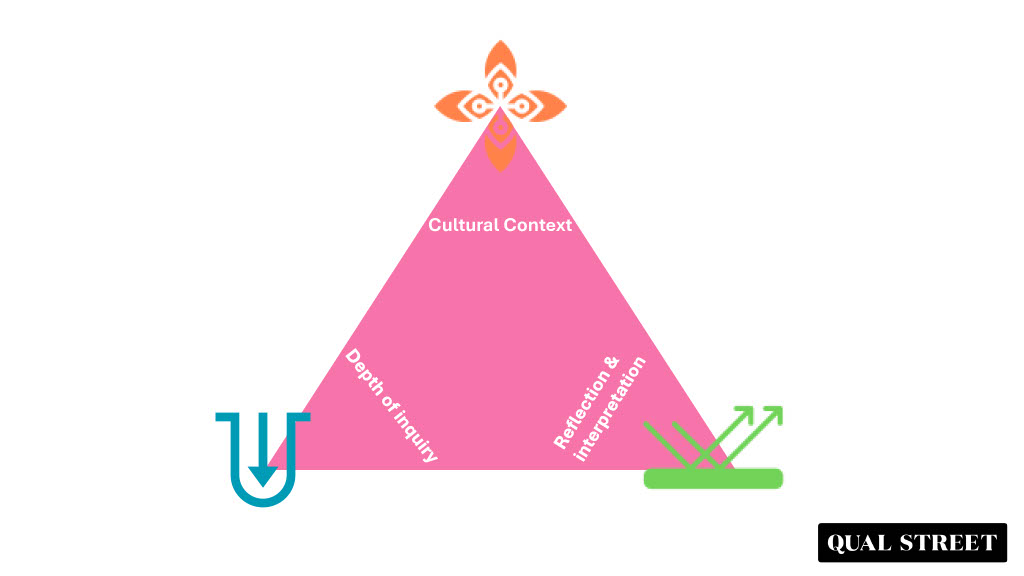


    • Looks for deeper understanding – it starts from the position of trying to understand
    what’s going on… and works on looking at layered meaning too. So it has longer, deeper
    conversations. Interviews happen in the right space and place. It uses observational
    tools. It spends time with people. It asks them to spend time exploring…

    • Requires reflection and interpretation (of the content, context and production of the
    insight). Qualitative researchers mull, think, reflect, talk about, and think strategically
    about what this means for our clients…

    Qualitative research is necessarily subjective, non-scientific. It doesn’t claim ‘what is’ – it isinstead looking for meaning.

    Verbal data enriches the quantitative process, but doesn’t step outside of it, explore it, challenge it, take perspective…

    So please, friends and colleagues, don’t call your open ends or verbal data (however much you’ve got) qualitative. AND Stop saying ‘qualitative at scale’.

    It’s good stuff, but it’s not my stuff.

    Me and my people, we are all about understanding what’s going on.

    We deliver our insight thick and rich and with soul… The other stuff – well it’s shallow text.

    Please step off and get a new way to talk about what you are offering. And step off now.

    Otherwise people are going to start misunderstanding what qualitative is, and what its true
    potential is. And then the world will become a flatter, blander place.

    Actually that’s what’s bothering me. I wonder if it already is?

  • RECORDING: Qual Researchers’ Big Opportunity with Smaller Brands

    RECORDING: Qual Researchers’ Big Opportunity with Smaller Brands

    This Knowledge Share has been generously sponsored by Yasna.ai, the AI-powered platform that helps independent researchers, consultants, and research agencies scale in-depth interviews. Claim your free 14 days Yasna PRO free trial today – conduct ±50 interviews (worth €100), sign up at yasna.ai

    This Knowledge Share will be presented by ICG member Hugh Carling

    New technology like Generative AI is enabling smaller brands to regularly access qualitative insights for the first time. We’ll explore how and why this development will grow the industry over the coming years and as it does, provide big opportunities for independent qualitative researchers.

    Specifically, we’ll cover:

    • The scope of this growing market
    • Smaller brands and qual research – then and now
    • The technologies driving change
    • The risks in that change
    • The opportunity for independent researchers
    • How you can capitalise on it

    This will be supported by both primary and desk research, and illustrated with recent examples.

    Hugh Carling, is a founder of Liveminds, a pioneer of mobile qual and the creator of Behavioural Recruitment, the MRS award-winning service that uses social networks to engage fresh participants in 190 countries.

    Liveminds have integrated generative AI throughout their mobile qual and recruitment platform to deliver curated insight videos from global participants in just 48 hours. Their mission is to enable every business to have access to the insights they need to grow.

    Watch this session here