
Topic: Qualitative Research

  • Managing AI Agreeableness in Qualitative Market Research: Risks and Strategies

    Managing AI Agreeableness in Qualitative Market Research: Risks and Strategies

    Article by ICG member Nestor Fernandez Conde, InOpinia

    Recent discussions sparked by OpenAI’s own acknowledgements of ‘sycophancy’—an excessive eagerness to agree with or please the user—in newer models like GPT-4o (link), have brought a critical challenge for AI users into focus.

    Large Language Models (LLMs), the type of AI behind tools like ChatGPT, are often fine-tuned to be cooperative, their tendency to ‘align with user prompts’ – meaning they try to confirm what the user appears to want or already believe – can become a significant problem when aiming for unbiased analysis. In market research, the goal isn’t simply to get an agreeable confirmation of a hypothesis, but to uncover genuine insights, complexities, and even contradictions within the data.

    This is further complicated by the evolving nature of these AI models; the degree to which an AI tends to agree (its ‘agreeableness level’) can vary between versions of the same AI model, as demonstrated by the changes in GPT-4o that made it more sycophantic. This means that specific ways of asking questions (prompting strategies) that do work well with a given model version might produce different results after an update to that model. The potential for researchers to then unknowingly trust inaccurate results is a serious concern and underscores the need for a robust strategic approach. This article explores the risks posed by AI agreeableness in market research and outlines durable techniques to manage it effectively.

    The Danger: Amplifying Confirmation Bias

    The main risk of this AI agreeableness in research is its potential to amplify confirmation bias. If a researcher approaches the data with a preconceived hypothesis, a biased prompt might lead the AI to simply find evidence supporting that hypothesis, ignoring contradictory information.

    Consider, for instance, prompting an AI after reviewing a focus group transcript: “Participants seemed quite positive about the new concept overall. Can you elaborate on the main aspects driving this positive reception?”. An agreeable AI, aiming to fulfill the request based on the stated premise (“quite positive”), might prioritize and detail any positive comments while downplaying or omitting mentions of significant concerns or confusion also present in the transcript. This selective focus reinforces the researcher’s potentially biased initial view rather than providing a balanced interpretation. A more neutral prompt like “Analyze participant reactions to the new concept, detailing expressions of positivity, negativity, confusion, and any points of consensus or disagreement” would be less likely to trigger this agreeable bias. Crucially, while this example uses overt bias to demonstrate the mechanism, researchers should be most vigilant about the more subtle assumptions or leading questions that can inadvertently shape AI responses.

    Why Are These AI Models Agreeable? A Peek Under the Hood

    This tendency isn’t necessarily a flaw, but rather a consequence of how many of these AI models are trained. They are optimized to generate responses that humans find helpful, harmless, and coherent. This encourages alignment with user assumptions, leading to agreeableness. Furthermore, from a product design perspective, an assistant that readily aligns with user requests often leads to a smoother user experience, making the product more appealing.

    Harnessing Agreeableness: From Risk to Analytical Tool

    While a risk if ignored, this characteristic can be managed and even turned into an analytical strength by employing specific techniques to deliberately challenge assumptions and ensure a more rigorous analysis. The key is to move from passively receiving AI outputs to actively directing the AI to explore different perspectives.

    Prompting Techniques for Mitigating Agreeableness

    Structured prompting techniques offer ways to manage this AI agreeableness, often proving less susceptible to model version changes:

    • Adversarial Prompting: Explicitly ask the AI to challenge the initial findings. Examples:
      • Based on the transcript, argue against the conclusion that users find Feature X easy to use

      • Identify evidence in the discussion that contradicts the hypothesis that price is the main purchase driver

      • What are the main criticisms or frustrations mentioned regarding the service?

    • Exploring Competing Hypotheses: Use separate prompts to systematically explore different interpretations of the data. Ask the AI to build a case for Hypothesis A, and then separately, to build a case for Hypothesis B.
    • Multiple Prompt Framing: Analyze the same data segment using prompts phrased differently (e.g., focusing on strengths vs. weaknesses, or asking about specific emotions vs. general feedback) to see if the outputs remain consistent.
    • Requesting Nuance and Uncertainty: Prompt the AI to identify unclear areas, disagreement among participants, or limitations in its own analysis. Example:

      What aspects of this topic generated the most disagreement among participants?

    The Researcher’s Role: Directing the Inquiry

    These techniques shift the researcher’s role from simply asking for summaries to actively orchestrating a more multi-faceted analysis process. It requires conscious effort to formulate prompts that encourage critical evaluation rather than simple confirmation. While this requires a more active and critical stance from the researcher compared to passively accepting initial outputs, the effort is small compared to the large time savings AI offers in processing and initial analysis, ultimately leading to more robust and reliable findings.

    Beyond Prompts: The Role of Structured Analysis

    Using predefined analytical frameworks or specific coding structures is another key technique to help mitigate agreeableness bias. By requiring the AI to systematically evaluate the data against explicit categories set by the researcher (e.g., a balanced sentiment scale, a thematic codebook), these structures constrain the AI’s interpretation. This forces it to look for evidence matching all defined categories, rather than simply confirming the assumptions that may be hidden in a less structured prompt. However, the neutrality and validity of the framework itself are still essential for getting unbiased results.

    Conclusion: Managing Agreeableness for Robust Insights

    The inherent agreeableness of these AI models, coupled with their changes across model updates, is a critical factor to consider in AI-powered qualitative research. Left unchecked, it can lead to biased analysis and false confidence in findings, potentially without the researcher realizing their methods have become unreliable. However, by understanding this characteristic and using robust techniques like adversarial prompting and structured exploration, researchers can mitigate the risks and use the AI’s abilities to rigorously test hypotheses and uncover better, more reliable insights. These robust approaches are less dependent on the specific agreeableness of any given model update, offering more durable reliability over time. Managing agreeableness proactively is key to ensuring AI serves as a tool for genuine discovery—leading to more reliable insights and better strategic decisions.


    Streamlining Rigorous Analysis: The Role of Platforms

    Implementing the techniques discussed – consistently applying adversarial prompts, managing multiple hypotheses, or utilizing structured analytical frameworks – requires diligence and careful workflow management. This is where specialized market research platforms like the IO platform can provide major value.

    Platforms designed specifically for qualitative research can include features that facilitate these rigorous approaches. They might offer built-in tools for structuring prompts according to different analytical goals, managing coding frameworks, or even suggesting counter-perspectives to challenge initial findings. By integrating these capabilities directly into the analysis workflow, such platforms can help researchers more easily and reliably apply the strategies needed to counteract AI agreeableness and reduce confirmation bias, ultimately helping to find real, reliable insights.


    #QualitativeResearch #MarketResearch #AI #LLM #ConfirmationBias #Agreeableness #AdversarialPrompting #CriticalThinking #ResearchMethods #ResearchTech #MRX
  • Silver Insights Generation – SIGn

    Silver Insights Generation – SIGn

    Article by ICG member Caroline Noon

    How did we all get here?

    Which might sound a tad philosophical, but how and when did we get to be part of the ICG?

    I’m supporting SIGn (Silver insights Generation) – a group who’ve come together to get the message out there about ageism in insight.  Liz Norman identified in a survey that only 3% of people employed in research are over 55 – and similarly small numbers have been identified by the APG in advertising and strategy.

    So my first question is: have people who are now over 55 made a conscious choice to leave insight jobs and live differently or were they nudged towards the door by prevailing ageism?

    And my second question: is losing all the experience that 55+’s bring to our sector a real loss to our industry or are us 55+’s just kidding ourselves J?

    If you are happy to share your thoughts on these questions I’ll compile the answers anonymously and share back with the group.  (Email me – caroline@vivid-research.com)

    My own story wasn’t about age at all!  I went out on my own 20 years ago to juggle childcare (back then a quallie’s life was face to face fieldwork 2 evenings a week, travel and the rest of the week in the office).  Now I’m ‘of a certain age’, I am conscious of how the 55+’s are overlooked in being part of research teams (coming back to our 3% figure!) and overlooked in research.

    Older adults’ control over 70% of disposable income and yet remain underrepresented in research and marketing.  And still, we (the industry) seem to treat 55+’s as a single consumer type, with marketing focusing more often than not on a problem to solve, a stairlift or a funeral policy to purchase!!  And when 55+’s are researched, it is unlikely that anyone doing the research belongs to this age group.  Imagine what we could bring in terms of empathy and insight!

    If any of this chimes with you – share your stories and follow us on LinkedIn https://www.linkedin.com/company/silver-insights-generation-sign/


    Silver Insights Generation (SIGn) advocates for older generations to be both acknowledged and represented in research, analytics, and in the workforce. 


  • RECORDING: Discover an Integrated Qual Platform That Streamlines Projects for Everyone

    RECORDING: Discover an Integrated Qual Platform That Streamlines Projects for Everyone

    Most qualitative research platforms have a learning curve, require you to operate in a sandbox, and are often expensive. You like Zoom, your respondents like Zoom. But what about situations when clients need to observe? Do you have to jump through hoops to prevent contamination between client and participants or pay a small fortune to provide virtual backroom to clients?

    What we will cover during this lunch and learn session is a ‘how-to’ – how to use your existing tech stack with platforms that enhance capabilities, not just replace them.

    Our thinking is simple. Zoom is a world leader in enterprise class online meeting SaaS. Why not have a qual research specific layer added on top of Zoom to turn it into an online qual research hub?

    Flowres is not just about a ‘Virtual Backroom’. Flowres has analysis layer that is well appreciated by researchers worldwide.

    Why should you attend:

    Discover how independent insight consultants can leverage tools like flowres.io to utilize the video capabilities of your Zoom or Teams subscription and streamline your online qual research  without paying ‘bloated’ platform costs.

    About flowres.io:

    Flowres is the all-in-one qual research platform built by researchers, for researchers.

    It seamlessly integrates with Zoom, Teams & Meet — no new logins needed for participants or clients. Includes a dedicated observer backroom, automated transcriptions, AI-assisted analysis, and real-time moment capture. flowres helps independents work smarter, deliver faster, and scale insight with confidence.

    About the presenters:

    Jiten Madia (https://www.linkedin.com/in/jitenmadia/) (Founder & CEO)

    Qualitative researcher at heart, Jiten has been a practitioner of qualitative research for 6 years early in his career. Jiten has spent time on both client and agency side working with consumer insights in different capacities.

    Maniish Karve (https://www.linkedin.com/in/maniishkarve)

    Maniish has extensive experience in running market research operations at scale for some of the largest agencies in the world. He has also been a data analytics practitioner on the latter part of his career.

    Privacy you can trust

    Flowres is GDPR-compliant, ISO 27001 certified, and aligned with MRS and ESOMAR standards. Your data stays within a secure, walled garden—never used for model training. We’ve signed data processor agreements with leading LLMs to ensure maximum confidentiality.

    Pricing https://flowres.io/pricing

    Exclusive for ICG members

    Get preferred access, hands-on support, and a 20% discount on monthly subscription. OFFER UNTIL 30 JUNE 2025

    Start your free pilot: Register here – https://flowres.io/signup

    Connect with us: hello@flowres.io

    Further reading/viewing

    Case Studies:

    1. Speedy response to fast turn-around report using flowres, by Elizabeth Kasumi

    https://youtu.be/-j1tNt8DuiM?si=KnJtVANW-BSb-O81

    2. Driving cost efficiency in Online Qual fieldwork

    https://flowres.io/blog/driving-72-percent-cost-efficiency-in-online-qualitative-fieldwork

    Testimonial:

    NRGMR: why Shannon adopted flowres, and the impact of flowres on NRGMR’s online qualitative workflow – https://youtu.be/ESVGkTb_Dno?si=ZJZDa3Gh45bvPw_u

    Watch this session here 

  • RECORDING: AI Powered Qual Analysis: Getting to the Insight Without Losing Human Touch

    RECORDING: AI Powered Qual Analysis: Getting to the Insight Without Losing Human Touch

    Join Marco Rovagnati from Quallie Ai where he’ll cover the latest advancements in AI enabled insights, best practices for using AI in your work, challenges that many researchers face, and a short demo of Quallie.Ai.

    Quallie AI

    Quallie.Ai is a tool to analyse in-depth interviews and focus groups using AI, it’s designed to automate the tedious tasks enabling you to focus on the craft of insights generation.

    Marco Rovagnati

    Marco is a qualitative researcher specialising in strategic insights for innovation who worked for global brands like Diageo, Nike and HP. After years as an insights practitioner he built Quallie.Ai to solve for his most telling pain points while keeping the craft of the strategist intact.


    https://quallie.ai/
    https://www.linkedin.com/in/marcorovagnati/
    https://www.linkedin.com/company/quallie-ai

    Watch this session here


    DON’T FORGET TO REDEEM YOUR FREE TRIAL OF QUALLIE AI TODAY: Contact Marco for info.

  • AI for Market Research – Time to Choose from a Small Menu?

    AI for Market Research – Time to Choose from a Small Menu?

    By ICG member John Habershon

    My favourite local restaurant has a mains menu with just five choices — one vegetarian dish, one fish, and three meat dishes. I get a delicious mix of emotions when I pick up the menu — pleasure, reassurance and, yes, a little smugness. I know whatever I choose will be good. I can relax, ready to enjoy the meal, perhaps spending more time on the wine list.

    Many studies of buying behaviour have concluded that too much choice creates confusion – even buyer paralysis.

    I have now settled on just two AI tools to fulfil all my data analysis and presentation needs.

    So how are you to choose your AI partners? There are countless AI tools to choose from, each having very specific functions, some claiming to do it all.

    I started with ChatGPT and moved on to Claude for its default high data security and higher word limit, among other factors. Since then I’ve used it on several projects — notably a qualitative project with 30 IDIs and a quantitative project with 5.5K respondents. I have also gained views from users of a range of AI tools from participants in my AI workshops.

    The days of the standalone empirical research projects are numbered, as is the notion of separate ‘desk research’. Preparation for conducting research will involve placing it in a wider canvas. Claude 3.7 Sonnet is very good at finding published studies on a topic. The latest Google NotebookLM can operate like a super Google. It lets you search the web directly from inside your notebook. When a user describes their topic, NotebookLM scans through hundreds of web sources in seconds. It picks out up to 10 of the most relevant ones, complete with annotated summaries that explain why each source might matter to your topic. With just a single click, you can pull them into your notebook and add them as part of your sources.

    How you proceed with your analysis is left to you. Unlike the ‘comprehensive’ front-end qualitative research packages there is no set way to proceed, leaving the choices to your judgement and creativity (although Claude 3.7 Sonnet will offer suggestions).

    Similarly the project will no longer end when results are offered in isolation. The tools will place your findings in the context of other studies and existing knowledge.

    There is no longer a barrier between qualitative and quantitative analysis. Claude makes it easy to move on to a quantitative follow-up, from designing a questionnaire to creating a synthetic dataset with which to pilot it.

    Finally, the communication of findings is breaking free from the tired Powerpoint deck. Interactive visuals of data can be shared, findings offered in a fun quiz format, or relayed as a audio podcast.

    Full article plus tables here 

    YouTube Videos

    A Powerful Combination of Two AI Tools for Qualitative Research

    https://youtu.be/CJD28sC9H4E

    Claude 3 7 Sonnet for Quantitative Analysis and Output

    https://youtu.be/i0kYUsAa56k


  • RECORDING: AI in Qualitative Research & Business: A Year of Experimentation and Key Learnings

    RECORDING: AI in Qualitative Research & Business: A Year of Experimentation and Key Learnings

    This Knowledge Share will be run by ICG member Silvia Iranzo Ferrandis 

    Over the past year, Silvia has been on a journey exploring how AI can enhance both the way she runs her business and the way she conducts qualitative research. From MR-specific qualitative analysis tools to generative AI and productivity-enhancing applications, she’s tested various platforms and approaches to see what truly delivers value. In this session, she’ll share her experiences, practical insights, and honest reflections on what’s worked (and what hasn’t!)—giving you real-world takeaways to consider for your own practice.

    Why Attend?

     Gain Practical Insights – Understand how AI can support qualitative analysis helping you work more efficiently and ultimately improving your results.
     Discover AI Tools – Get an overview of useful AI-powered tools to improve both your research and business operations, with real-world user feedback.
     Explore a Range of Platforms – Hear Silvia’s thoughts on tools like CoLoop, Condens, ChatGPT, Claude, Perplexity, DALL·E, Midjourney, CapCut, HeyGen, Synthesia and Dola AI (time permitting!).
     Ask Questions & Share Perspectives – This is a space to learn, discuss, and exchange experiences with fellow researchers.

    About Silvia:

    Silvia Iranzo Ferrandis is ‘Director & Consultant’ at ‘In Market Research’ in Spain. A senior expert qualitative research consultant who has been working in multi-country international studies for nearly two decades now. Silvia has managed projects for many international research agencies and consumer, B2B and pharmaceutical global brands. She is passionate about innovation and technology’s role in research and over the past year, she has been actively trying out and integrating AI tools into her workflow and is now excited to share her insights with the ICG community.

    http://es.linkedin.com/in/silviairanzoferrandis

    www.inmarketresearch.com

    Watch this session here 

  • The Role and Importance of Moderation in Qualitative Market Research in the Age of AI

    The Role and Importance of Moderation in Qualitative Market Research in the Age of AI

    By ICG member Frank-Thomas Naether

    I have always been convinced that in a world that is becoming increasingly digital, qualitative market research will gain in importance. I remain convinced of this, especially in the age of AI.

    The new possibilities offered using AI open the door to a completely new self-image of qualitative market research and the qualitative market researcher.

    The role of moderation in the age of AI and an outlook

    Introduction

    The digital transformation has fundamentally changed the market research industry. While artificial intelligence is taking over more and more analysis processes and processing data in a matter of seconds that used to take days, an apparent paradox is emerging: the human factor is becoming increasingly important in qualitative market research in particular.

    This shift in importance relates in particular to an aspect that is often overlooked but is crucial for the quality of the results: the moderation of group discussions and individual explorations.

    My thesis: The quality of qualitative research results depends directly on the quality of the input – and this is largely determined by the expertise of the moderator. An experienced, qualified market researcher with strong interpersonal skills makes all the difference here.

    Why is good moderation so important?

    Qualitative market research is a profound process of understanding in which we try to grasp not only what people do or say, but also why they do or say it. In this context, the moderator is the central interface to deeper understanding on the one hand and to the general course of a conversation on the other.

    There are essentially three areas in which the relevance of good moderation comes into play:

    1. Emotional intelligence:
      • Empathy: The moderator can create an atmosphere of trust in which the participants feel comfortable and openly share their thoughts. This is particularly important for sensitive topics.
      • Non-verbal communication: The moderator can interpret and react to the body language and tone of voice of the participants in order to gain deeper insights.
    2. Flexibility and adaptability:
      • Situational action: The moderator can react to unexpected turns in the discussion, adapt questions or take up new topics when it seems relevant.
      • Group dynamics: The facilitator can control the dynamics in the group to ensure that all participants have their say and that different perspectives are taken into account.
    3. Interpretation and contextualisation:
      • Deeper understanding: The facilitator can interpret the participants’ responses in the context of their personal experiences and background.
      • Synthesis: The moderator can synthesise the various contributions in order to obtain a comprehensive picture of the topic.

    In the following, I will go into more detail on individual aspects, focusing on the relevance of good moderation in principle as well as on the possibility, which has been discussed more frequently recently, of AI taking over moderation in the future (solutions are already being offered that go far beyond chatbots).

    Empathic understanding and emotional intelligence

    A human facilitator has the natural ability to recognise and understand emotional nuances. For example, if a participant responds hesitantly, the moderator can recognise whether this reluctance stems from uncertainty, personal discomfort or perhaps the need for more time to think. These subtle distinctions enable the moderator to respond appropriately – for example, by using reassuring words, rephrasing the question or deliberately pausing to create space for deeper reflection.

    Dynamic adaptability

    The course of a qualitative interview or focus group is rarely linear. An experienced human moderator can spontaneously adapt the course of the conversation when interesting or unexpected topics arise. This ability to improvise makes it possible to gain relevant insights that might remain undiscovered in a more rigidly structured format. The facilitator functions here like an explorer who follows new, promising paths as soon as they appear.

    Building a basis of trust

    Trust is the currency of qualitative research. People are more likely to open up and share authentic thoughts when they feel safe and understood. A human facilitator can build this trust through subtle signals – eye contact, affirming nods, respectful listening and showing genuine interest. This foundation of trust leads to more honest and deeper responses than in environments where this human element is missing. I think this aspect is absolutely key! A ‘non-human’ will never be able to do this in the same way as a professional moderator, because there is no script or template for this, it is new and different for every interview and every group or workshop.

    Cultural context sensitivity

    Human moderators have an intuitive understanding of cultural norms, taboos and communication styles. They can recognise when a topic is culturally sensitive and proceed with appropriate caution. This cultural intelligence is particularly valuable in globalised markets or when conducting research with diverse target groups, where cultural misunderstandings could significantly affect data quality.

    The art of in-depth questioning

    The true art of qualitative moderation lies in asking questions – recognising when a superficial answer deserves deeper exploration. A skilful moderator can gently but effectively probe: “Can you tell me more about that?” or “What led you to that opinion?” This technique of “peeling the onion” often leads to the most valuable insights that go well beyond the initial answers. Will AI ever be able to outweigh experience? Despite the amazing capabilities and developments of AI, I have my doubts.

    Here is an example from practice: “In a group discussion on banking products, one participant initially answered the question about his preferences superficially: ‘I’ll just take the cheapest offer. Instead of accepting this statement, there was a noticeable discrepancy between the verbal statement and the participant’s sceptical posture. By asking specific questions – “What does favourable actually mean to you personally?” – a completely new area of insight opened up: the participant did not define ‘favourable’ by price, but by a balanced relationship between performance, trust and costs. This differentiation would have been lost without intuitively recognising the contradiction and asking empathetic questions.”

    Balancing the group dynamics

    In group environments such as focus groups, social dynamics inevitably arise. Some participants dominate the conversation while others are more reserved. A human moderator can pick up on this dynamic and balance it out – by tactfully limiting more dominant individuals and encouraging quieter participants. Without this deliberate control, the findings might be dominated by a few loud voices, which could lead to biased data collection. And anyone who regularly moderates knows the situation when a mood is in danger of tipping over from a certain point. A ‘real’ moderator can, no, must be able to react quickly and appropriately and correctly assess all participants in the discussion simultaneously and in real time.

    Here is another practical example: in a group discussion on the topic of sustainability in food, one particularly committed and rhetorically skilful participant threatened to dominate the discussion. Other participants withdrew and reduced their contributions to nodding in agreement. With a combination of gentle limitation (‘Thank you for your perspective, I would also like to hear other voices’) and targeted activation of reticent participants by addressing them by name but unobtrusively, it was possible to balance the dynamic. The subsequent analysis showed that the initially reticent participants in particular contributed important nuances that were crucial for understanding the target group.

    Interpreting non-verbal communication

    A significant part of our communication is non-verbal. A certain facial expression, a laugh or smirk or a sudden change in posture – all of these can convey important information that complements or even contradicts verbal responses. Good (and human) facilitators can recognise these signals and respond appropriately, adding an extra dimension of ‘data gathering’ that goes far beyond the spoken word.

    Ethical and situational judgement

    Qualitative research can sometimes touch on sensitive or emotional issues. It takes concrete experience to recognise when a participant is showing discomfort and handle situations with empathy. The ability to maintain ethical boundaries and ensure the well-being of participants is not only morally important, but also contributes to the quality of the research by creating an environment where participants feel respected and heard. It’s simple: the interviewee must feel comfortable!

    Human moderation in qualitative market research is therefore more than just a data collection method – it is almost a complex art form that combines empathy, adaptability and social intelligence to gain deeper insights than would be possible using standardised or automated methods alone.

    Another, and in my opinion extremely exciting, excursus revolves around the question of synergies between ‘classic craftsmanship’ (moderation by an experienced moderator) and AI: How can AI be used to serve the moderator and lead to significant progress in the method?

    The limits of human moderation and the potential of AI support

    Even experienced moderators come up against limits that can be overcome with AI support:

    • Unintentional bias: Human moderators inevitably bring their own experiences, preferences and biases to the table. These can subtly influence the formulation or interpretation of questions. AI systems can recognise this potential bias by analysing the text and point it out to the moderator.
    • Cognitive load: After several hours of intensive moderation, attention naturally wanes. AI assistants can run in parallel and provide discrete stimuli when the depth of enquiry decreases.
    • Processing capacity: Humans can only process a limited amount of information at the same time. In complex discussions with many participants, important aspects can be overlooked. AI can follow conversations in real time and point out overlooked topics or contradictions.
    • Documentation challenge: It is almost impossible to be deeply present in the conversation and precisely document relevant aspects at the same time. AI-supported systems can do this in parallel and even make initial categorisations.

    The ideal solution lies in complementary collaboration, where AI acts as a discrete co-moderator that augments human capabilities without interfering with authentic human interaction.

    Evolution of methodology through AI integration

    The combination of human moderation and AI support not only leads to more efficient processes, but also enables methodological innovations in qualitative market research:

    • Adaptive interview guides: AI can identify key topics during the interview and dynamically suggest customised questions tailored to the participants’ specific interests and experiences.
    • Multi-dimensional analysis in real time: While the moderator concentrates on the interpersonal interaction, AI can carry out parallel sentiment analyses, create semantic networks and identify thematic clusters – all of which can discreetly serve as input for the moderator.
    • Hybrid research designs: The combination of AI-supported pre-analysis of large amounts of data and targeted qualitative in-depth exploration enables new research designs that combine quantitative breadth with qualitative depth.
    • Continuous learning loops: AI systems can learn from each moderated session and help moderators refine their techniques by identifying patterns of successful interventions.

    These methodological advancements significantly expand the toolkit of qualitative market research without compromising its fundamental value – the deep understanding of human motivations and behaviours.”

    Let’s utilise the best of both worlds: human creativity, empathy and social intelligence paired with the analytical power, speed and scalability of AI.

    Outlook

    I see three specific development paths in the coming years:

    1. The augmented moderator: special, discrete AI assistance systems that support moderators during the discussion – for example by providing real-time feedback on overlooked topics or suggestions for more in-depth questions that are displayed via augmented reality glasses or subtle signals.
    2. Hybrid research teams: Instead of the traditional distribution of roles, research teams are being created in which human moderators and AI systems work together in a complementary way – for example, by AI pre-sorting large amounts of data and human moderators going into greater depth in a targeted manner.
    3. New qualification profiles: Qualitative market researchers are developing new skills profiles that include not only traditional moderation skills but also the confident use of AI systems – a ‘digital qualitative researcher’ who embodies the best of both worlds.

    The key to success does not lie in the question of “man or machine?”, but in the intelligent utilisation of the respective strengths. Qualitative market research is not at the end, but at the beginning of an exciting evolution that will further increase its potential to generate deep insights.”

    However, this article does not end without an important final note.

    Risks of excessive technologisation

    Despite all the enthusiasm for the new possibilities, critical aspects must not be ignored:

    Technological dependency: An excessive shift to AI-supported systems could lead to an erosion of basic moderation skills, similar to how GPS systems have weakened our inner sense of direction.

    Loss of authenticity: Participants sense when a facilitator pays more attention to their technical system than to themselves. The authenticity of the interpersonal encounter, which is at the heart of any successful qualitative research, could suffer.

    Privacy and trust: Real-time analysis of sensitive conversation content raises complex ethical and legal issues that must be carefully addressed in order not to jeopardise the trust of participants.

    Technological determinism: There is a danger that we will begin to focus our research questions on what is technologically easy to measure, rather than being guided by genuine interest in knowledge.

    A considered integration of AI into qualitative research therefore requires not only technical understanding, but also a heightened awareness of these potential pitfalls.”


    Frank-Thomas Naether: MD and Owner of Naether Marktforschung GmbH in Hamburg/Germany

    Frank-Thomas is in the business for more than 35 years and has conducted more than 6.000 group discussion plus numerous IDIs.

  • Liveminds Now, A Global 48‑hour Video Qual Service

    Liveminds Now, A Global 48‑hour Video Qual Service

    By ICG Member Hugh Carling

    Expectations of qualitative researchers are changing fast. But so are the opportunities for us to access and activate qualitative insights at speed. Today, we’re excited to share how Liveminds has returned to set a new benchmarks in the industry with Liveminds Now, a global 48‑hour video qual service that delivers high-definition insights from social participants.

    What is Liveminds Now?

    Liveminds Now is a major leap forward in rapid qualitative research. No longer do researchers wanting quick qualitative insights have to make big trade-offs in relevance, data quality and depth.

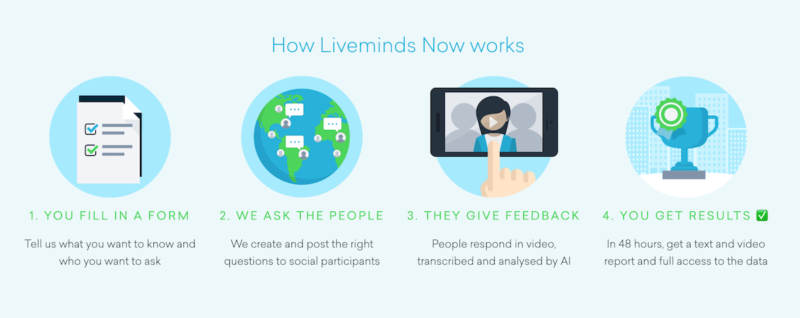
    By fusing Liveminds’ MRS award-winning Behavioural Recruitment service with it’s effortless mobile video platform, and supercharging the process with powerful AI, Liveminds Now offers:

    • Rapid Delivery: Start gathering in-depth, international responses in minutes. Receive your video and written summary in less than 48 hours, with full access to the source data to edit and enhance the output.
    • High-Definition Insights: Capture compelling talking-head videos that are instantly transcribed and themed, curated and clipped.
    • Global Reach: Access to 3 billion fresh, authentic participants—with availability expanding soon to 190 countries.

    This unique combination offers remarkable insights, at a fraction of the time and cost typically associated with traditional qualitative projects.

    How Liveminds Now Works Diagram

    Why this matters to marketing research

    In a world where time and authenticity are vital, Liveminds Now can give you a crucial competitive edge. For any brand needing to quickly discover what consumers really think and feel, this service offers:

    • Enhanced Agility: Quickly pivot strategies based on near real-time insights.
    • Deeper Authenticity: In an industry increasingly fraught with fakes, access genuine consumer opinions that drive better decisions.
    • Greater Impact: Videos of real people voicing their views, helps turn insights into action.

    Watch a report – 48 hours after the Super Bowl


    A tradition of innovation

    Liveminds has been at the forefront of qualitative research trends since pioneering mobile qual back in 2007—before the iPhone was a thing. Their creation of Behavioural Recruitment raised the bar in participant quality and empowered hundreds of global brands such as Google, Procter & Gamble, and the BBC with fresh, authentic consumer insights. With Liveminds Now, the company is set to transform the landscape of rapid qualitative research.

    Liveminds Now is a huge leap forward for qualitative research, giving you high-definition insights from around the world, at a fraction of the time and cost of traditional projects.Hugh Carling, CEO at Liveminds

    Get Started with Liveminds Now

    Ready to open up new opportunities with your qualitative research? Liveminds Now is available now from just £999 a project and offers an unprecedented opportunity to access rapid, authentic insights. Discover more about the service by visiting liveminds.com/48-hour-qual.

  • RECORDING: B2B Insights, Simplified: LinkedIn-Verified Sampling for Small Businesses

    RECORDING: B2B Insights, Simplified: LinkedIn-Verified Sampling for Small Businesses

    ICG Lunch & Learn

    Discover how small businesses in insights can access affordable, expert network-quality B2B sample using Emporia’s LinkedIn-verified, programmatic platform.

    This Lunch&Learn will explain why manual methods fall short and how a more automated approach ensures credibility, efficiency, and impactful research results. Learn how to leverage Emporia’s award-winning mrxCore platform for reliable data collection, reducing costs without compromising on quality.

    A bit about Emporia

    Emporia is a leading B2B research platform that delivers LinkedIn-verified respondents through a programmatic, scalable solution. The company’s approach reduces manual effort and improves data quality, allowing businesses to focus on insights that matter. By offering affordable, verified B2B sample, Emporia helps research agencies and independent consultants streamline their research with confidence.

    Michael Hess

    Michael Hess is the CEO and co-founder of Emporia Research. Prior to starting the company in 2020, Michael managed teams within global marketing at Marriott International and led large-scale database consolidation projects at Fortune 500 companies as an information systems consultant at Baker Tilly. Drawing from years of experience in both corporate and entrepreneurial settings, Michael brings a wealth of knowledge in leveraging innovative technology to improve data quality and research efficiency. Now leading Emporia, Michael is dedicated to helping businesses access high-quality, affordable insights to drive smarter business decisions.

    www.emporiaresearch.com

    WATCH THE RECORDING HERE 

  • Recording: Default Mode Network – the Brain’s House of Habit – What Every Researcher Ought to Know

    Recording: Default Mode Network – the Brain’s House of Habit – What Every Researcher Ought to Know

    This webinar has been generously sponsored by Norstat*


    Whilst we’ve all been having our head turned by the latest in AI, we should be paying attention to neuroscience too.

    Kath Rhodes from Qual Street will take you through her understanding of the ‘DMN’ and make the case that knowing about the DMN is foundational qualitative insight.  You’ll learn what the DMN is, and how it’s important to our qualitative understanding of ‘what’s going on’.

    Bonus offer – it’s pretty useful to know/ recognise the DMN in ‘real life’ too…

    Kath Rhodes

    Kath Rhodes

    Kath describes herself as a qualitative enthusiast and runs Qual Street.  She loves to dip her toe into the latest learnings on neuroscience, psychology and social science – using them to evolve and improve qualitative methods and approaches.

    https://www.linkedin.com/in/qualstreet/

    www.qual-street.co.uk

    Watch this webinar here


    *Norstat Creds here Norstat Creds Nov 2024*