Topic: Pitching and Procurement

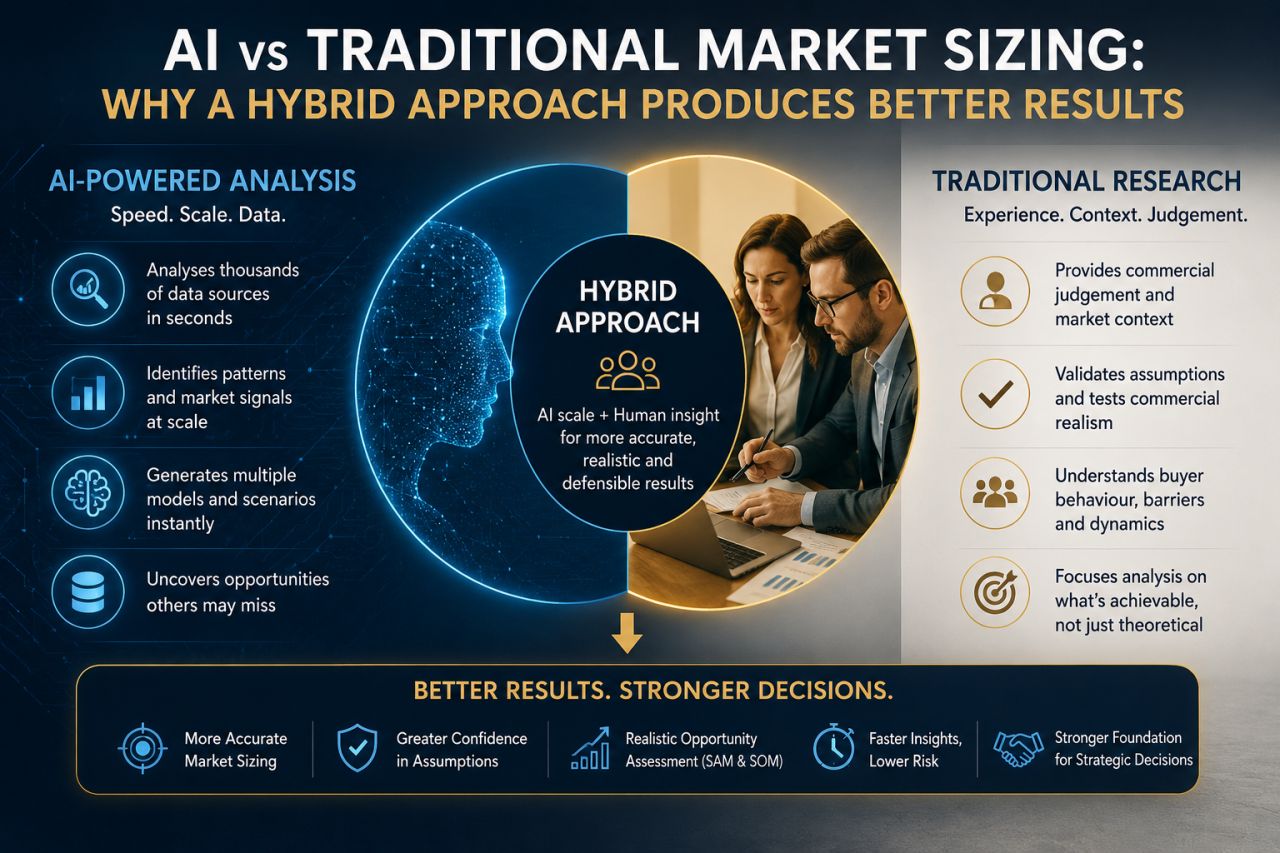
  • Market Sizing – Why a Hybrid Approach Produces Better Results

    Market Sizing – Why a Hybrid Approach Produces Better Results

    Article by ICG member Kevin Simmonds, Advantage Market Intelligence UK & Peru


    Artificial intelligence is transforming market sizing and market research, but AI alone cannot determine whether an opportunity is commercially achievable.

    This article (below) explores why combining AI-powered market analysis with expert human validation delivers more accurate TAM, SAM and SOM assessments. Learn how a hybrid Human + AI approach improves market opportunity assessment, reduces uncertainty, and supports better strategic decision-making.

    Full Article

    Kevin Simmonds | LinkedIn

  • Campaigning for Improved Public Procurement

    Campaigning for Improved Public Procurement

    Article by ICG member Liz Montgomery, Sharp Research

    Back in summer 2025 I participated in a survey run by the FSB (Federation of Small Business) about public procurement, which also covered procurement by large organisations more generally.  It had a decent number of  open ends, and I added my views on public procurement in quite a direct way.  A couple of months later they contacted me (and a number of other small businesses for a follow up interview, which was moderated (very well) by one of the FSBs policy specialists.

    The report, Signed, Sealed, Delivered was published  towards the end of 2025  (free to download here https://www.fsb.org.uk/resources/policy-reports/signed-sealed-delivered-MCGXDJ3J475NEPFOLCT6WGFAHFVU), and contains a mix of positive proposals, but also quite damning findings about public procurement processes.  Several striking stats emerge

    • the number of SMEs directly invoicing the public sector has fallen since 2020 (and was already pretty low at well under 150,000;
    • A national ambition to grow procurement spending with SMEs to reach 33% by 2020, but is reported to have been stuck at around 20% of the total spend by central government, and even including indirect spend in some departments is less than 13%!

    The report is also pretty damning on the experience of the RFP process.

    Late in December I was surprised to be invited to participate in a round table with the Parliamentary Secretary for the Cabinet Office, Chris Ward MP, to whom, among others the report had been presented.  This was held in January of this year, and in advance of the session I asked members of the ICG to submit their experiences and comments so I could hopefully share them at the Round Table.

    I  had a super amount of input from many people.   The comments that from other ICG members really reflected a lot of the findings in the report, and I shared an anonymous version of this with the policy team at the FSB, which they found very helpful and interesting.  Our experiences included

    1. Issues with payment terms and financial pressures on micro and small research insight businesses , including extended and unilateral payment terms, cashflow vulnerability, and psychological impacts, plus undermining the value of the work delivered, especially at the bidding stage
    2. Barriers to accessing public sector work – too many complex processes which are biased to large organisations, excessive focus on price and they simply take too much time and effort with often a zero success rate (sometimes over many years). Incumbent suppliers seem to be favoured at every point. And then there is unhelpful or no feedback on why the bid was unsuccessful.
    3. Structural issues in procurement culture included impersonal and inaccessible processes, plus examples of lack of guidance and clarity. One ICG member reported attending a supposed pre-tender webinar that was completely confusing rather than enabling, and often it was felt that public sector buyers simply did not understand the nature or value of the services  they are procuring!

    The round table itself, held on 27th January, was well attended, and I felt initially it might not be a very open session.   But, in fact, it was very lively, the minister was very engaged, and those of us attending as SMEs (all of whom I think had been quoted in the report), were not shy in any  way in pitching in  with our views.  Well chaired by Tina McKenzie, the FSB’s Policy Chair (a small business owner herself), she made sure we all had our say.

    Apart from other SMEs, there were also attendees from the rest of the Cabinet office, the Department for Business and Trade, Tech Nation, and Technology UK plus the JP Morgan Chase  Foundation who funded the research (I was sitting between their 2 reps!)

    The input from those of us there as SMEs focused on

    • the ridiculous nature of the procurement processes themselves (impersonal, complex, time consuming, why bother?!)
    • the apparent bias towards incumbent providers
    • the need for improved terms and conditions (especially that primary contractors should not over-ride 30 day payment terms) – payment terms are a massive issue, as we all know.
    • a need for increased and more helpful pre bid engagement
    • there are still too many different government bid platforms, and a lot of bids not going on, for example, Contracts Finder and various questions were raised as to whether the Crown Commercial Service is actually doing a decent job on this
    • emphasizing that often those doing the procurement lacked the knowledge to do so effectively
    • also the importance of social value, and the focus on local employment and driving local change
    • it also contradicted the finding reported that local authorities are good at prompt payment!

    A strong and interesting theme was that by excluding small businesses, government and other public procurers were often stymying the innovation that SMEs can provide, and that there is a perception that there is a strong tendency to stay with the safe option, which may not necessarily be the most effective (or cost effective) option.

    Many of these are common to the issues we highlighted, and I was able to reinforce the arguments about current processes apparently supporting incumbent suppliers, as well as the challenges of the procurement processes.  But it was definitely evident that our experiences are by no means unique to us.  Which is a very helpful finding.

    The minister seemed very engaged and open, as did other government representatives there.  I was seated near a DBT mandarin, who clearly recognised the issues of lack of understanding in his teams of these procurement issues, although I was not convinced he would be in a position to do anything about them

    What were the conclusions from this lively and very open discussion?  The chair summarised these quite succinctly, and here are the elements I think most relevant to us as a community:

    • A strong argument for focusing on solutions-based tendering rather than solely price based tendering
    • Highlighting issues with local authority payments
    • A need to protect the supply chain – i.e. to make sure that those of us that are not primary contractors get treated fairly (and paid on time not 90 days…)
    • That the government needs to think about a better contract/bids information platform than the current solution it offers (and, yes, the FSB did float the idea that they could operate one for SMEs!

    It was a very interesting 90 minutes, and the Minister and his team even stayed on for a while after.

    On reflection, I am not sure that “Signed, Sealed, Delivered” has been achieved.   It has certainly been delivered, and the Minister and his team made reassuring comments and seemed engaged.   Apparently two government departments, including the MoD have now made commitments to increase their use of SMEs.   However it is going to take a massive effort for the dial to be moved, and that effort will be required by all parties, especially all governmental organizations.

    I should also add everyone agreed that the catering at the event (another FSB) was some of the best we have ever had.   Freshly made eggs benedict, various healthy mini muffins, croissants, fruitiness, home made compote, juices… I was impressed.  If you need caterers in London go to these guys – Piptree   https://www.piptreecatering.com/  Very impressive ! If you go to the website, the husband was looking after the eggs benedict and others on the pic were also there.


    Liz Montgomery | LinkedIn

  • Win More Projects With AI-Moderated Qual – And Get Paid For It

    Win More Projects With AI-Moderated Qual – And Get Paid For It

    This is a Lunch&Learn session with Tellet In this session, Greg Burke from Tellet will show you exactly how AI-moderated qualitative research works in practice – from designing a discussion guide to analysing hundreds of in-depth conversations at once. You’ll see a live demo of the Tellet platform, hear how independent researchers and agencies are already using it to win new business, and learn how you can start including it in your own proposals. He’ll also walk through our new referral scheme for ICG members.

    About Tellet 

    Tellet is an AI-moderated qualitative research platform used by agencies, consultancies, and independent researchers worldwide. It lets you run hundreds of in-depth, conversational interviews simultaneously – giving you qualitative depth at quantitative scale, without needing a large team. For independents and small firms, that means you can take on bigger briefs, deliver faster, and offer something genuinely differentiated.

    Greg Burke

    Greg Burke is the CEO and co-founder of Tellet. Based in Amsterdam, he has spent the last three years building Tellet into a platform used by some of the world’s leading research agencies and brands, including Kantar, NielsenIQ, Vodafone, and KPMG. Greg is passionate about giving independent researchers access to the same tools the big agencies use.

    The referral scheme

    Tellet are introducing a referral arrangement for ICG members, valid throughout 2026. If you introduce a new client to Tellet and they go on to complete a qualifying project (minimum 100 participants), we’ll pay you a referral fee of €500 for the first project. For every subsequent qualifying project that client runs on Tellet during 2026, you’ll earn €250. There’s no ongoing commitment – just a straightforward way to earn from recommending a tool you already know works.

    Register for this session here 

  • RECORDING: From Barriers to Buy-In: A Guide to Overcoming Client Resistance to Online Community Research

    RECORDING: From Barriers to Buy-In: A Guide to Overcoming Client Resistance to Online Community Research

    Ever receive pushback from a client after suggesting an online community approach? If so, you’re not alone! Even after decades of online qual research and with communities being an established methodology today, we can still see client hesitancy in making the jump to a digital solution.

    Join us at this Lunch & Learn where we’ll discuss 4 common client concerns around online communities, and how to turn those barriers into buys-ins!

    We’ll share a few pro tips around:

    • How to educate (and inspire) clients around online community use cases
    • How to address potential concerns around the richness and reliability of the data
    • How smart technology can in fact enhance multi-market research and help uncover cultural nuance
    • How online makes it easier than ever for client to immerse themselves in the research, live, as it happens

    At the end of the sessions, you’ll be equipped to help your clients understand the possibilities of online research and get excited about going online!

    About incling

    incling was founded in 2013 and since then we’ve run over 500,000 online qualitative conversations in over 30 languages with participants all over the world. Our proprietary online community platform has a range of tools which have been designed to help research and marketing teams gather in-depth and in the moment qualitative feedback (on any device). Our clients can lean on us for a wide range of methodologies – from exploratory, digital diaries to exploring customer journeys and UX experiences.

    Presenter: Anna Coombe

    Anna started her journey in market research right here at incling, initially as a community manager before transitioning to the commercial side of the company. Throughout her career, she has collaborated with a wide range of clients, brands, and agencies, managing projects ranging from quick short-term studies to long-term communities. Her extensive online qualitative experience spans FMCG, financial, retail and travel and hospitality sectors, providing her with a broad and adaptable skill set.

    Recording here

  • 4 Key Reasons to Choose a Boutique Research Agency

    4 Key Reasons to Choose a Boutique Research Agency

    Article by ICG member Isla Cullingworth, NailedOn Research

    Within the food and beverage market, trends and purchasing behaviours are changing all the time. For businesses to stay competitive in this ever-evolving landscape, they need to be able to adapt quickly and pivot wherever necessary. That’s why many turn to market research agencies to support their efforts. When it comes to choosing a market research provider, there are many factors to consider. Whilst the expertise and experience of the organisation is paramount, it’s also important to consider your requirements and exactly how they will be met. Whilst there is never a “one size fits all” approach to choosing the right market research agency, in this blog, we’ll explore three key advantages of working with a boutique consultancy, helping you to make an informed decision.

    The personal touch

    If you’re looking for one-on-one attention and a personalised service, then choosing a boutique market research consultancy might be right for you. Boutique consultancies are often small by design, meaning you’ll commonly work directly with the directors of the company, who have a vested interest in making sure that any project they work on is treated like it’s their own. This not only allows for a more personal connection and easier communication, but also instils a sense of loyalty and responsibility to the client – you!

    Diving into the nuances of your business and taking the time to understand the unique challenges you face, boutique market research consultancies immerse themselves into every step of your project’s lifecycle. Feeling more like a partner than a service provider, they’ll become an invaluable extension of your company’s operations, working side-by-side with you from the beginning to make sure that you get exactly what you need to drive your business forward.

    No stone left unturned

    The food and beverage industry is one of the most competitive in the world, and it takes serious innovation to stay at the forefront of consumer trends. This not only means having access to high-quality market insights, but it also means working with a market research organisation that goes the extra mile to help you stand out from the crowd. With the time, resources and capacity to deliver creative solutions to your problems, working with a boutique market research consultancy can make all the difference when it comes to finding out what consumers want and need, bringing with them a fresh perspective to exploring new ways to build your brand’s presence.

    For boutique market research consultancies every single project is crucial, which means they are always looking for ways to innovate and improve their processes so that they can give clients better results than ever before. It’s not just about doing a good job – it’s about being the best at what they do, every single time. With a greater incentive to perform, smaller agencies are more likely to leave no stone left unturned for your business, channelling maximum effort into your project to help you differentiate your offerings from the competition.

    Unique insights for your industry 

    You may be considering a larger, more established organisation which offers a wide range of services as a “one-stop-shop” for your requirements, but it’s important to consider that these larger full-service agencies tend to work across a wide span of business sectors. In comparison, boutique consultancies often specialise in one industry or niche, meaning they have a wealth of specialist knowledge at their fingertips, and experience in working with a wide range of brands who face similar challenges to yours.

    Knowing the industry they specialise in from the inside out, boutique market research consultancies are perfectly placed to understand the necessary steps to put you on the path to success. This allows them to create bespoke market research strategies and solutions tailored specifically for you, without offering you packages or services that aren’t applicable or useful for your business’s long-term goals. As your needs grow and evolve, a boutique market research consultancy has the flexibility to adapt to your changing needs continually, with dynamic solutions for sustainable business growth.

    Agility and flexibility

    In the world of food and beverages, you need a market research consultancy that can keep up with shifting consumer preferences and understand emerging trends. When new opportunities arise within your target market, it’s important to be able to act quickly and decisively – because if your brand isn’t relevant, it’s going to be left behind. Yet, red tape can stand in the way of quick action, and you may feel as if you are losing momentum with lengthy approval processes, complex contracts, and communications with multiple people or departments.

    Instead of focusing on multiple projects at once, boutique consultancies work with a select number of clients at a time, taking an adaptive, agile, and client-centric approach to research that matches the momentum of consumer trends and shifts. With a direct line of communication to your consultant, you can pivot to navigate the ever-changing consumer landscape and adapt to change with greater speed, ensuring resilience even in the face of changing markets and uncertainties. This enables your business to deliver for its customers, innovate consistently, and maintain a competitive advantage, getting your product or service to market as effectively, efficiently, profitably and as quickly as possible.

    Could a boutique market research consultancy be right for you?

    Before choosing the right market research provider for your business, it’s vital to define your budget, values and requirements, and reflect upon what’s truly important to you. What comes at the top of your list – is it the peace of mind that seeing a client portfolio full of household names brings, or does a personalised, one-to-one approach with an experienced industry specialist take precedence for you? Are you looking to work with a large team who can offer a wide range of services, or an out-the-box creative thinker who can deliver agility and flexibility? Research agencies come in all shapes and forms, but if it’s the latter, the smaller size and specialisation of a boutique market research consultancy could be exactly what you’re looking for to help you achieve your goals.

    At Nailed On Research, we’re proud to be boutique! We believe that ’boutique’ doesn’t mean small – it means something much more than just numbers. It means knowing your client inside-out. It means understanding what they need before they know it themselves. It means building up a rapport like no other – and doing so with every single one of our clients, for every single project we take on. Providing high-quality market research services to the food and drink industry, our personalised approach means we can provide a highly intuitive and creative service at every step of the way, with actionable insights and contextual market intelligence that we’re proud to stand behind.

    Does a boutique market research consultancy sound like the right fit for you? Get in touch today to discuss your current challenges and find out how we can help, and we’ll work with you to create a bespoke strategy that will take your business to new heights.

    Isla Cullingworth <isla@nailedonresearch.com>

    Home | Nailed On Research | Food & Drink Market Research