Resource Type: Article

  • Co-Pilots for Qual Analysis

    Co-Pilots for Qual Analysis

    Article by ICG member Karen Cooper, Living Brands. 

    New year’s resolution anyone?

    No, not the personal eat-less, exercise-more types, but the work ones…. like less printing, no slack after 7pm, and perhaps embrace AI? If the last one’s on your list, I did a little comparison of co-pilots for qual analysis that may help you on your way.

    I’m no expert (don’t ask me to explain github or python), but I had a feeling that AI co-pilots could help me with labour intensive qualitative analysis.

    My test compared human brain-only analysis, to brain plus three different co-pilots fed recordings of a recent qual project. To spare blushes I’m only going to reveal my favourite pilot, but for context one was on a well-established meeting platform, one on a specialised qual/community research platform and the third on a transcription platform.

    Brain-only worked well (phew), but that’s because it was a small (4 focus group) UK only project and I could retain most of it in my head. Brain also caught the non-language cues and knew the cultural context intuitively and added them into analysis.  So, brain’s not being replaced right now (phew again). However, I found one assistant helped me find deeper insights whilst also saving me time.

    Disclaimer –  I didn’t replicate prompts word-for-word, so perhaps not a completely scientific test, though I asked similar big and general questions first and followed up with specific questions digging deeper into a particular line of enquiry.

    Two were disappointingly bland.  Summaries and big themes were solid and quotes easily found to back each point up (a fabulous time saver compared to the old days of manually finding quotes in transcripts – yay!), but I got no real depth.

    The magic happened on the transcription platform – name check: otter ai, when using its chat function. Perhaps because they have been in the language game for longest, it seemed to understand more obscure questions and became my trusted friend – I kept going back to ask further questions which genuinely helped my thinking.

    My only gripe was the inability to use chat function across the whole project (can only do it  by transcription session/group by group).  So, otter, next iteration please add this function.

    I know the market’s evolving like crazy and am sure there a many other assistants out there (check their privacy policies and weigh up different pricing), but I will be using Otter.aichat to help my thinking going forwards.

    That’s one news year’s resolution I will keep.

    Karen Cooper | LinkedIn

  • What Do You Think Britain Was like in 1956 (Less than a Decade After WW2)? Story by @GeoffWicken

    What Do You Think Britain Was like in 1956 (Less than a Decade After WW2)? Story by @GeoffWicken

    For anyone researching specific topics, the reports AMSR – The Archive of Market and Social Research –  provide insight into a huge range of subject-matter. Additionally some of the documents offer fascinating portraits of Britain at given points in time.

    One example is the 1956 #Hulton Readership Survey report, which recently appeared on eBay. (Bidding was not hotly contested )

    The report itself is lovely, still smelling faintly of leatherette, and offering an intriguing picture of Britain in 1956, via its reading habits study.

    ✓ WW2 was still a fairly recent memory in 1956.

    ✓ Food rationing had finally concluded just two years earlier

    ✓Car ownership stood at 11%, whereas 24% of people were categorised as cyclists.

    ✓ Media:

    ✓ TV sets were present in 42% of homes

    ✓ ITV had been launched as the first commercial channel in September 1955

    ✓ Print was the major advertising medium and this survey existed to support it

    It’s a fascinating read, to get the full story, and to access the Hulton report, click on the below to continue

    https://www.amsr.org.uk/a-picture-of-britain-in-the-1950s/


    AMSR: Making History

  • The Perky Poet (Nanda Marchant) with ‘The Respondent’

    The Perky Poet (Nanda Marchant) with ‘The Respondent’

    ICG member Nanda Marchant regularly pens poems which many of our members enjoy. Here’s her latest one.

    THE RESPONDENT


    A lady collared me one day outside my local church

    She wanted willing volunteers to do market research ‘It’s just a chance to air your views, for which you get some cash’

    With money tight I thought: ‘Why not, I might give this a bash’

    So I went on a database but didn’t hear for ages

    This wouldn’t be the magic wand to supplement my wages

    They had some strange criteria, like needing organ donors

    But then one day the call went out: ‘We’re seeking kitten owners Your cat must try some different foods, then you provide your views

    It’s all done on the internet’ – well here’s one I could choose

    I opened up with diligence the tins that came by post

    And monitored which fishy tastes my kitten sniffed the most

    How much he ate, how much he left, so many forms to tick

    It would have all been worth it, but the food made Tiddles sick

    ‘It’s not your fault’ I cooed and gave a reassuring hug

    ‘But judging by that whiff of fish I’ll need a brand new rug’

    I’m now awaiting eagerly for them to reimburse I lack the funds to buy it, but the smell is getting worse

    I’ve called to check, I’ve emailed in, but they are not attentive

    I did my bit, I gave my views, so where is my incentive?

    A month on, I’m no better off, I’ve just that ghastly smell So will I do it all again? No, they can go to hell!


  • Data Visualisation & Storytelling – 5 tips!

    Data Visualisation & Storytelling – 5 tips!

    ICG member Elliot Fern, Fern Insight, shares his top tips for data visualisation and storytelling. These include;

    • Understanding the context
    • Choosing an effective visual
    • Eliminating clutter
    • Focusing attention with colour, shapes & font
    • Telling your story with a focus on a call to action.

    Full article here 


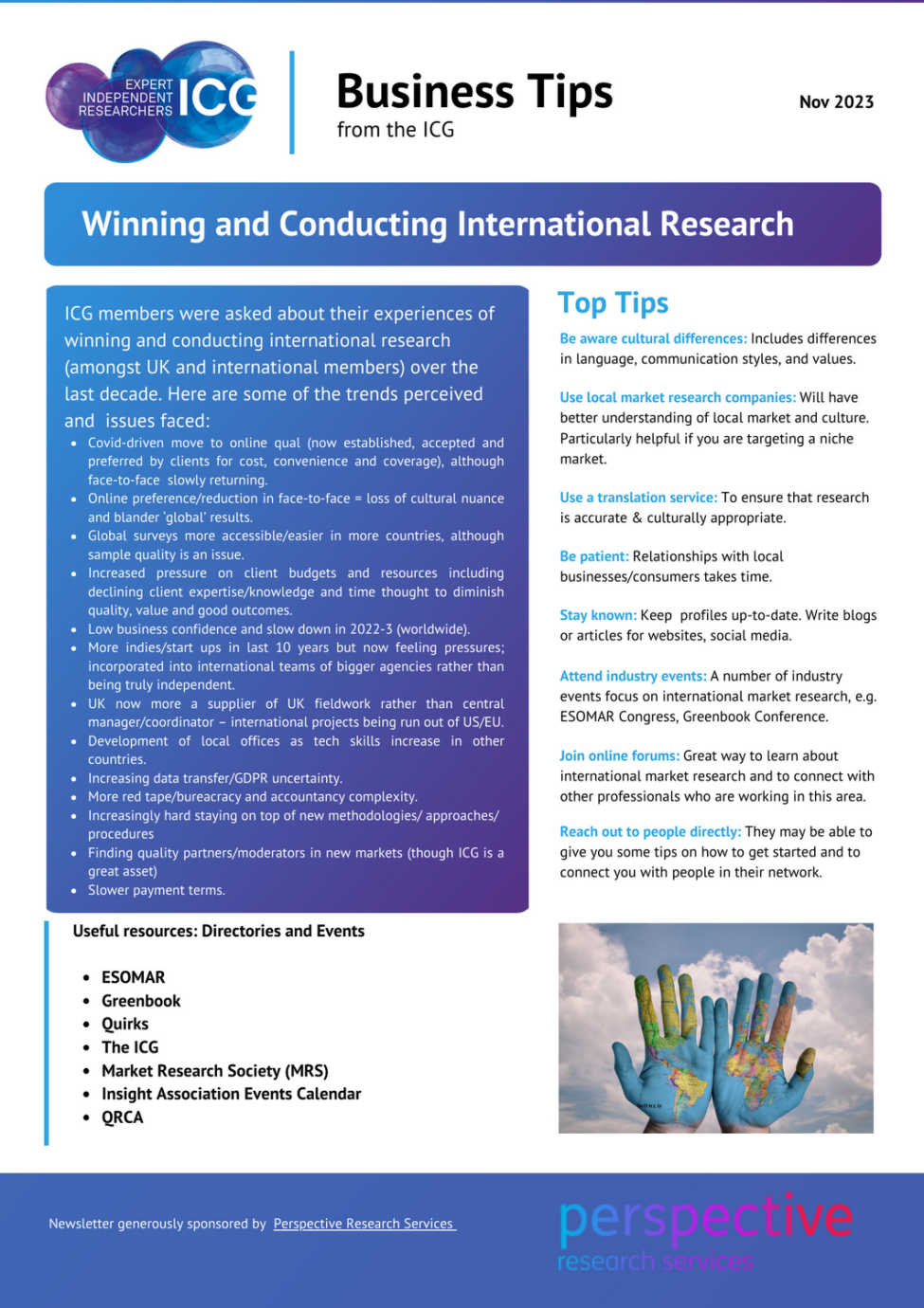
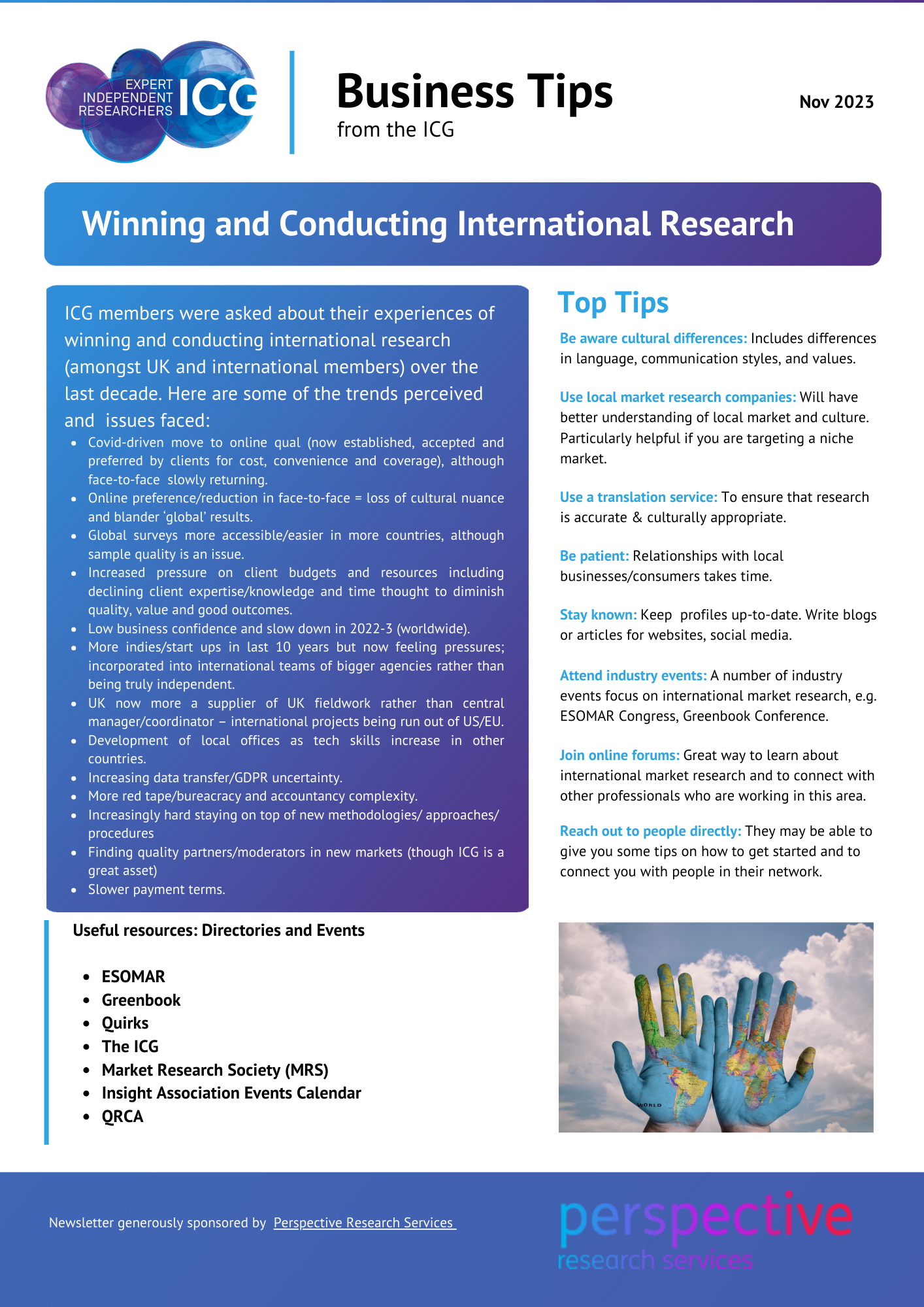
  • Business Newsletter: International Research

    Business Newsletter: International Research

    This newsletter has been generously sponsored by  Perspective Research Services,  here to help you at every stage in the data journey.


  • Driving Together the Say-Do Gap in Research

    Driving Together the Say-Do Gap in Research

    By ICG member Kevin McLean, Wardle McLean 

    Pic: Goofy in Disney animation, Motor Mania


    I’ve been researching motor insurance. Before you glaze over, it has revealed both a Fundamental Truth about human nature and a persistent marketing ‘blind spot’.

    The FT is the (in)famous ‘say-do gap’. People don’t do what they say, or say what they do, especially in a research context. Specifically, what people say (testimony, attitudes) is a very poor predictor of what they then do (behaviour).

    In our study, 86% of our sample said that they believed they were good drivers. This is backed up in other studies.

    How to deal with the say-do gap in research, given that we cannot change human nature? In his excellent recent article, The Say-Do Gap in Driving Behaviour, Simon Shaw of Trinity McQueen outlines three key steps:

    • use multiple sources/methods
    • get real ie study actual behaviour (as well as reported behaviour)
    • do this over time, rather than as a one-off snapshot

    But it goes even further: the say-do gap is a perennial marketing issue due to a  confusion between two communication modes. Organisations often use the rules of the first mode to judge speech in the second mode.

    In ‘contract mode’, statement and behaviour are directly and explicitly connected. The ‘keep off the grass’ sign on the lawn, marriage vows or sworn legal testimony, are examples of contractual speaking, tied to behaviour, occurring within an agreed frame of reference.

    But most interactions are in ‘conditional mode’, where speech is conditioned by a host of factors, such as context, what’s at stake, who is speaking and why, the emotions at play. ‘I’ll go the gym 3 times per week’, ’14 units of alcohol per week’, ‘Let’s have a coffee some time’, are all be examples of this mode.

    Qualitative research tries to recognise and mediate between these different modes. Client organisations (in contractual mode) may want the public to do X, for Y reasons; the public may or may not want to do this, it all depends, but will nod and smile in either case.

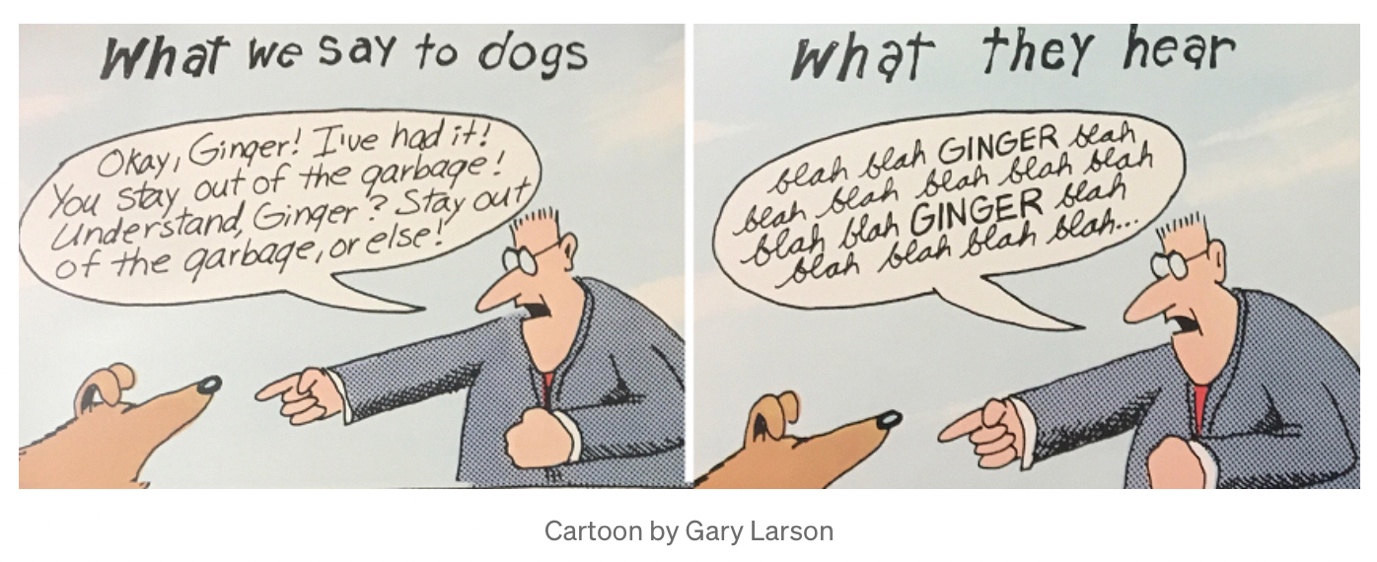
    Driving is a great example of ‘mode confusion’. The question ‘have you broken the speed limit’ is asked in contract mode, directly about a specific behaviour, but is received conditionally, ie the framing changes, leading to a communication mismatch, similar to the famous Larson cartoon:

    Breaking the speed limit is illegal and potentially dangerous; the question carries social and psychological ‘baggage’ and brings a host of other questions eg what is at stake, what should I say, have I gone too fast by mistake etc? How people answer a question, in research and in life generally, reveals how they position themselves, not what they do.

    One final point, let’s call it the ‘say-do switcheroo’: rather than studying how attitudes (testimony) predict behaviour (spoiler alert, they don’t), why not look at how behaviour affects attitudes?

    In our study on driving behaviour, we looked at how feedback loops inform drivers. This is increasingly common with newer cars, which nudge us with various beeps and dashboard signs (car ahead is moving off, lane assist, parking sensors etc).

    With telematics feedback, drivers see for themselves whether and how often they have strayed over the speed limit, braked or accelerated harder than normal, etc. Reflecting on this behavioural information seemed to affect how people then spoke about their driving.

    With the right design and with enough time, research can learn about behaviour and use behavioural input deliberatively to close (and reverse) the say-do gap and thus suggest ways of changing behaviour.

    Summary:

    • the say-do gap is a people thing, not just a research thing
    • knowing it is there and how it operates (cf communication modes) is the first step
    • using multiple research inputs, including actual behaviour and feeding this back
    • over time allows for behaviour to inform testimony, for more accurate insight.

    http://www.wardlemclean.co.uk/

  • Inclusive Research Design: Why It Matters and Practical Hints and Tips

    Inclusive Research Design: Why It Matters and Practical Hints and Tips

    Article by ICG member Julie Ellison,  Emerald Insights 

    https://www.linkedin.com/in/julie-ellison-6a270964/

    As a researcher with a personal interest in inclusive research, I have seen first-hand the challenges faced by people with disabilities. My sister became physically disabled as young mum of three boys following a brain tumour. I have seen how she has had to overcome many obstacles in her life simply because products and services are not designed with her in mind. For example issues using websites and apps because they aren’t inclusively designed or having to give up on using a product or service because she can’t open, use or navigate it.

    I’m passionate about making research more inclusive to reflect the people who actually do, or potentially could, use a specific product or service. Recently I delivered a face-to-face qualitative project focusing on usability and designing for the future. The project involved a series inclusive groups and in-depth interviews (IDIs) with people with a wide variety of different people including those with visual, dexterity, and cognitive challenges. As a moderator, I found these groups to be hugely worthwhile and rewarding. The participants were highly engaged in the research, gave a different perspective offering insights into potential barriers of use (with some really innovative solutions). They even thanked me at the end for having the opportunity to participate in the research!

    This experience made me think about the importance of inclusive research design. When we are inclusive of people with disabilities, we get a more representative view of the population as a whole. We also create products and services that are more accessible and usable for everyone.

    Inclusive research design is the process of ensuring that all people, regardless of their abilities, have the opportunity to participate. There are a number of practical considerations to take into account when conducting inclusive face-to face Qualitative research. These include:

    1.Choosing an accessible location if face to face (or consider whether it can be adapted and delivered online/ mobile)

    The location should be accessible to all participants, including those with mobility challenges. This may mean choosing a location with ramps, accessible bathrooms, and wide doorways. It’s thinking through how participants move around the facilities during the research – this has involved me moving and changing furniture in a room to make it more comfortable!

    2. Using accessible materials and stimulus

    The research materials should be accessible to all participants, including those with visual or hearing impairments. This may mean using large print materials or using a different format for example printed boards or laminated individual stimulus packs. It can also involve providing sign language interpretation, or using audio recordings rather than relying on text. This applies to all documentation used including consent forms – its important participants are fully informed!

    3. Providing accommodations as required

    Participants may need accommodations, such as extra time, breaks, or assistance with communication. It is important to be flexible and accommodating to the needs of each participant and to understand exactly what these needs are during the recruitment phase. I’d advise allowing time pre-fieldwork to check what the participant would find helpful. This can also allow you to answer any questions or concerns they might have and set expectations for the research.

    4. Being respectful to participants needs

    Researchers should treat all participants with respect, regardless of their abilities. This means being sensitive to any needs and limitations, and avoiding any language or behaviour that is discriminatory or could offend. I’ve found that often its simply being curious and interested in listening to their story, lived experience & opinions. It’s about being observant and can be as simple as moving around the room more, crouching down beside someone to show stimulus or to check on understanding.

    5. Being flexible with your research approach

    It’s important to think through the research methodology to make sure it is truly inclusive. I’ve found that it is important to allow more time upfront to allow for any introductions and to listen to and understand the rich context that participants offer.  Most tasks can be adapted or changed to suit the audience and meet the objectives & don’t forget to utilise pre-tasks to strip back your discussion guide and give the flexibility of more time. Make sure that you are clear & concise in what you are asking and use everyday language. Be ready to change direction or flow of the discussion if needed. I normally shorten the length of groups (2 hrs is too long!) to 60-90 minutes and reduce groups size or conduct mini groups with 3-4 participants.

    Inclusive research is not always easy, but it is essential to ensure that all people have a voice in the research process. By following these practical considerations and working with clients to high-light the benefits to the research outputs and the valuable insights gained, we can help to create a more inclusive environment. Small adjustments can make a big difference. Inclusive research design is not just about doing the right thing. It’s also about making better products and services that are more accessible and usable for everyone.

    If you are a researcher, I encourage you to consider conducting inclusive research in your next project. It will make a difference!


  • How Much Do Certified Translation Services Cost?

    How Much Do Certified Translation Services Cost?

    Article by ICG member Harrison Pardoe, TauRho Transcribes

    https://www.linkedin.com/in/harrison-pardoe-97558686/


    What is Certified Translation?

    Certified translation is a service provided by professional translation agencies to ensure accurate and legally valid translations of documents. These translations are typically required for official purposes, such as immigration, legal proceedings, academic applications, or business transactions. Certified translations are carried out by expert translators who have been accredited or certified by official bodies or organizations. Verifying their proficiency and expertise in the translation field. These translators adhere to strict industry standards and guidelines, ensuring the highest level of accuracy and quality. Certified translations also include a signed affidavit or a certification letter attesting to the authenticity and accuracy of the translation.

    Professional certification, credentials and any accreditation by official bodies such as the Institute of Translation and Interpreting (ITI).

    This certification guarantees that the translated document is a true representation of the original, making it legally recognised and accepted by official institutions and authorities. The cost of certified translation services can vary depending on factors such as the complexity of the document, the language pair, the volume of the content and the urgency of the request.

    Why Is Certified Translation Important?

    Certified translation is a crucial service that ensures accuracy and cultural appropriateness in translated documents. It is important for various reasons.

    Firstly, certified translation guarantees accuracy. Professional translators, with their expertise, are adept at delivering precise translations. They have the knowledge and skills to accurately convey the message, tone, and nuances of the source material in the target language. This accuracy is especially vital for legal and complex documents, where even a minor error can have significant consequences.

    Secondly, cultural appropriateness is crucial in translation. Certified translators understand the cultural context and can adapt the content to cater to the target audience. They possess cross-cultural training and awareness, which helps them avoid any language that may offend or be misunderstood.

    Furthermore, professional certification, credentials, and accreditation from official bodies provide credibility and assurance. These certifications reflect the translator’s proficiency and expertise in the field. Clients can have peace of mind knowing that their documents are in the hands of qualified professionals.

    Average Costs of Certified Translation Services

    Certified translation services provide an essential solution for ensuring the accuracy and authenticity of translated documents. However, the costs associated with these services can vary depending on various factors.

    Translation costs can be influenced by supply and demand. Spanish has almost half a billion native speakers, so translators will be easier to find than those of Norwegian. Considering Norwegian has just four and a half million speakers.

    Simple Documents (Birth Certificates, School Transcripts)

    Certified translation services are essential when you need accurate and reliable translations of important documents. For simple documents like birth certificates and school transcripts, the average costs of certified translation services can vary depending on different factors.

    Translation costs are typically calculated on a price-per-word basis. For simple documents, the rates can range from £0.05 to £0.10 per word. These costs may include the translation itself, proofreading, certification, and delivery.

    The final cost is determined by the number of words in the original document. Therefore, longer documents tend to be more expensive than shorter ones. Additionally, the complexity of the subject matter or any specific requirements can also affect the cost.

    It’s important to note that as technology improves, the cost of certified translation services is expected to lower over time. Machine translation and artificial intelligence (AI) are becoming more prevalent in the translation industry, offering cheaper alternatives. Neural Machine Translation (NMT) is an end-to-end learning approach for automated translation that aims to improve translation process.  However, for certified translations, where accuracy is crucial, human translation is still the preferred option.

    When it comes to simple documents like birth certificates and school transcripts, certified translation services provide the assurance that the translation is accurate and meets legal requirements. By investing in professional translation services, you can ensure that your important documents are accurately translated and accepted by relevant authorities.

    Legal Documents (Contracts, Patents)

    When it comes to translating legal documents such as contracts and patents, several factors can influence the cost. These factors include the complexity and length of the document, the professional level needed for the project, and any additional services required.

    Legal documents are often intricate and require specialist knowledge in both the legal and linguistic fields. Translators who specialise in legal translations generally charge higher rates compared to general translators. The more complex the legal document is, the higher the cost will be.

    Another factor that impacts the cost is the length of the document. Longer documents naturally require more time and effort to translate, and thus, the cost will be higher.

    In addition to the translation itself, there may be additional services required for legal documents. These can include proofreading, certification, notarization, and formatting. These services typically come at an extra cost.

    Based on industry standards, the average cost for translating legal documents such as contracts and patents can range from £0.10 to £0.20 per word. However, it’s important to note that prices may vary depending on the language pair and the specific requirements of the project.

    For accurate quotes and to get a better understanding of the costs associated with translating legal documents, it is recommended to consult a professional translation agency that specialises in legal translations.

    Do all professional translators charge the same?

    Professional translation services are not all priced the same. There are many factors that go into how much a language service provider will charge for their legal document translations. Some of the elements that play into pricing include the cost of living in that particular region, the translator’s level of experience, and any qualifications they may have within their field. This means depending on which company you choose, you can end up with vastly different rates for translation services.

    Most companies make it easy to request an exact quote for your project, so you can compare prices to get a good idea of what your budget should be. Most websites offer a simple form to fill out with information about your project requirements and contact info. This allows them to calculate their rates quickly and accurately. There is also usually an option to ask questions about any inquiries you may have regarding the process or pricing structure before committing to anything.

    After doing some research among various language service providers, it should be fairly straightforward to find competitive rates that best suit your needs. However at this point it’s worth noting that price is just one factor to consider when choosing the right translation service provider for you.

    Why is legal translation more expensive than regular translation?

    Legal translation is more expensive compared to a regular translation because of the complexity involved in the process. Different languages often have various sets of rules and structures that must be respected or taken into account. This means that when translating for legal documents, focus must be placed on both accuracy and precision. Legal translators need a higher level of knowledge to understand the nuances between different laws and terminology used across multiple languages.

    Since there is such an emphasis on accuracy, quality assurance measures are more drawn out in the process. The translation must reflect not only the words, but also convey their exact meaning which requires specialised skills beyond what would normally be necessary for regular translations. Furthermore, legal translations often require a deeper understanding within specific fields such as business and finance, all of which require highly experienced professionals who charge more for their specialist services.

  • 8 intriguing glimpses into the minds and behaviors of GenZers and Millennials

    8 intriguing glimpses into the minds and behaviors of GenZers and Millennials

    Article by ICG member Brian Loeb, Research, Insights & Analysis for Branding, UX/CX, Strategy & Innovation

    https://www.linkedin.com/in/brianloeb/

    In a series of qualitative interviews with Gen Z and Millennial youths in Spain we explore how they communicate and a host of other behaviors and attitudes, answering 8 intriguing questions:

    • Do they need to be connected?
    • Do they feel in control of their online time?
    • Are virtual friends the equivalent of real-world ones?
    • Is communicating with older generations online different?
    • Do influencers have an impact?
    • Can spending so many hours online and on social media have a negative impact on self-esteem?
    • Are they in favor of cancel culture?
    • Are they optimistic?

    Warning: The questions are all loaded, there are no right or wrong answers, and all the answers come with caveats and flipsides!

    Do they need to be connected?

    Yes!

    Both to keep themselves entertained and to communicate

    They’re digital natives and being connected is in their nature, and it’s not just needed for entertainment but for communication with friends and family.  Miquel, who is 23, explained: “If WhatsApp were to fail and we couldn’t group chat, we’d never figure out where to meet and what to do.”

    To test how strong their need to be connected is, we asked if they would go to a remote island with no internet or connection of any kind, and most answered something similar to Leire, who is 29: “I would go for 2 weeks and only if accompanied by someone, otherwise it would be very boring. I don’t think I can go a whole month without internet.”

    And it’s not just needed for social comms, but also for work and study comms. One 17-year-old explained that before Covid her classes were all in-person and essentially all of her schoolwork too. And when she’d exceed her allowed online time her parents would take away her devices. But with Covid all her classes and schoolwork went online and even though she’s back in face-to-face classes, most of the schoolwork has remained online and so when her parents try to take her devices away they can’t because she always needs them to complete an assignment.

    Do they feel in control of their online time?

    Yes!

    But… they recognize the addictive and anti-productive nature of much of it

    The trick to this question is that they feel in control, but are they really? Our participants spent between 5 and 12 hours a day connected, and most confess that a lot of that is for purely entertainment and more of a waste of time than a productive use of it. Some periodically feel the need to detox and get reset to reality.

    Amira, who is 17, explains: “My sister stops using all social media every now and then because it consumes so much of her time. She says it’s like a social media diet.”

    And quite a few would be in favor of an option in social media apps to auto control via alerts for overuse.

    Nagore, who is 26, explains: “Parents should limit time in the case of children, and in the case of young adults we should limit ourselves. It would be interesting if the social network offered the user the option of limiting the access time. “

    According to a report by Konrad Collao of Craft Strategies, “Beyond Z: The Real Truth About British Youth”, done for Channel 4, we know that one in five GenZers say they have paused their social media use to protect their mental health.

    Are virtual friends the equivalent of real-world ones?

    No

    Virtual ‘friends’ are totally valid in their own way, but are not quite the same as ‘real’ ones

    Alba who is 32, explains “I have a very good relationship with a person that I met on Tinder that I haven’t even seen a picture of. In that sense the two relationships are equally valid. However, you cannot replace personal relationships with purely virtual ones. It is necessary at some point to go to the mountains hunting for mushrooms or something like that.”

    However, there is a bit of a flip side to that, as Ash, who is 17, explains: “I am a shy person, and it is easier for me to start talking to people online. Social Media has helped me in fostering friendships.”

    The power of Social Media to help foster friendships is backed up by a study done by PEW Research called “Connection, Creativity and Drama: Teen Life on Social Media in 2022” where 80% of US teens say Social Media allows them to be more connected.

    Is communicating with older generations online different?

    Yes!

    They do this but in different ways, especially avoiding emojis and animated gifs.

    Alvaro, who is 20, explains: “Emojis may be misinterpreted by older generations. They do not understand emojis when we use them, and sometimes when they decide to use them we do not understand what they mean because they use them badly.”

    Leire, who is 29, says: “People confuse the crying emoji with the laughing yourself to tears emoji.”

    And that is not even mention the confusion with the skull emoji which, despite its morbid first impression, quite innocuously means ‘dying of laughter’.

    On the flip side, however, not using emojis may be just as confusing, as Miquel explains: “Text-only messages are the ones that cause the most confusion because you can’t read the tone.”

    Avoiding inter-generational misinterpretations of text and emojis will only become more important as more Gen Zers enter the workforce. Gen Z workers are expected to more than triple in the United States, Australia, France, Germany, the Netherlands and United Kingdom, accounting for 30% of total employment by 2030, according to a study by Oxford Economics entitled “Gen Z’s Role In Shaping The Digital Economy” done for Snap Inc.

    Do influencers have an impact?

    Yes

    But a limited one… or it depends…

    When we asked simply if ‘influencers have an influence?’ we got some very non-committal answers, but when we asked specifically “Who influences more when selling a product, an influencer or an advertisement?” all agree that for younger demographics they would go with the influencer.

    All also seem to make their own influencer segmentation which is very subjective, but very generally divides them into 2 buckets, one full of “mindless entertainment” (silly dances and pranks) and another which promises greater value-added “educational and informative” content.

    Then, there also looms a middle gray area of fashion and self-care influencers who may be more superficial, or actually provide valuable tips.

    According to an IAB study of Influencers based on Nielsen’s InfluenceScope, Instagram is the first platform by number of influencers in Spain, United Kingdom and Italy. TikTok, meanwhile, is the first platform by number of influencers in France, Germany and the Netherlands. TikTok influencers are mostly Gen Zs (60%), while Instagram is more populated by millennials (55%). Youtube is fairly balanced with 35% and 38%.

    Can spending so many hours online and on social media have a negative impact on self-esteem?

    Yes

    But for most it’s a learning experience which they overcome.

    While none of participants felt this to be true for them currently, many have experienced this in the past and nearly all have seen negative impacts in their peers.

    Amira, who is 17, opened up about her experiences: “Previously, social media influenced my lack of self-esteem a lot because I wasn’t like the girls I saw on Social Media. Now I have realized that the physique does not matter. I have stopped watching those videos, but many of my friends continue to be affected by them and it hurts them not to be like the girls they see on social media. They change their way of dressing to look more like those stereotypes and when they do not achieve it, I see my friends are sad or even it seems sometimes they are not present when we get together to talk.”

    Results from a study by Marta Delgado of Twiga Research for the Spanish Mental Health Federation and insurance company Mutua Madrileña help to provide some idea of the dimension of the problem. In that study over a quarter, 26.4% of the 18-24 age range describe their mental health as “very bad”, and when we look at older ranges above 24, only 8.5% use the “very bad” descriptor. That said, there are a lot caveats to this finding, especially the higher access to information about mental health issues and the lower perception of the stigma attached to them, but the difference is still striking.

    And on the flipside, online content may also have a positive impact on self-esteem. According to the study “Beyond Z: The Real Truth About British Youth”, 44% of Gen Z said they had been helped to accept their body as it is by information or images they found online, almost exactly the same proportion as said the opposite.

    Are they in favor of cancel culture?

    No

    But to stop following someone who annoys them is perfectly normal and not considered ‘cancelling.’

    This question generated a lot of comments in defense of free speech, but there is an important flip side where tolerance has it’s limits, especially online where the ease of ‘cancelling’ can be done by clicking a button to unfriend or stop following…

    Alba, who is 32, explains: “I think that in social networks there is less tolerance than in society because anonymity, ease of access and immediacy come together.”

    And Ash, who is 17, explained that as a baby they were assigned female, and that as a pre-teen and early teen they read all the Harry Potter books and watched all the movies, but right at the age when Ash was beginning to identify as non-binary, JK Rowling, the author of Harry Potter, started tweeting criticisms of trans people with regards to their choice of which bathroom to they could use. Ash explained that it felt like her childhood hero (and current role model) was negating the new identity that Ash was just coming to terms with, and described it as “like a hole was being ripped out of my childhood.” Given that they felt that their identity was being attacked, it was only natural to stop consuming JK Rowling’s content and de-link themselves from the attacker.

    Are they optimistic?

    Yes and No…

    While they view their own futures positively, the future of society overall isn’t so bright…

    Anne, who is 27, offers an insightful glimpse into the conflicting currents of optimism and pessimism that the younger generations face: “The country’s economy, fake news and the lack of job options for young people are what worry me. I hope life will improve, that there will be more opportunities and that society will not demand so much in terms of beauty, money and established canons. The future in general looks ugly. But personally I think that for me the situation will improve, but I am not quite sure… Before life had defined steps (you study, work, get married) and now those steps can not be taken so easily and there are different paths. The older generations do not understand that society has changed and judge us with outdated criteria.”

    So, even though they view their own future with more optimism than that of society, in both cases the view to the future is tempered by a high degree of uncertainty.

    To wrap up, here are the 8 answers to the original questions

    • Being connected is embedded in their behaviors and culture
    • They control their time online and will waste it, or use it, as they see fit
    • Friends are friends, but virtual ones aren’t quite real
    • Communicating online with older generations requires a different lexicon
    • Influencers only influence if they let them
    • Maintaining self-esteem online is a learned skill
    • Cancel culture is not cool, but if annoyed they will stop following
    • The future is bright, unless it’s that of society in general

    This is a summary of the 15-minute session Brian Loeb lead at the IIEX Conference in Amsterdam in March of 2023. The session was more oriented to being an entertaining flyby than a deep analysis. In the coming months we will do more research and elaborate a richer analysis with insights into even more key topics such as sustainability, sexuality and gender identity. The primary research consists of 16 qualitative videoconference interviews with youths aged 17 to 34 residents in Spain in November 2022. This was augmented by secondary research with special attention paid to the following sources:

    Channel 4 – Beyond Z : The Real Truth About British Youth

    https://www.linkedin.com/events/beyondz-therealtruthaboutbritis6993156422842597376/comments/

    PEW Research – “Connection, Creativity and Drama: Teen Life on Social Media in 2022”

    https://www.pewresearch.org/internet/2022/11/16/connection-creativity-and-drama-teen-life-on-social-media-in-2022/

    Oxford Economics – “Gen Z’s Role In Shaping The Digital Economy” done for Snap Inc. https://resources.oxfordeconomics.com/hubfs/Gen_Zs_Role_In_Shaping_The_Digital_Economy.pdf

    “La situación de la salud mental en España”, elaborado por la Confederación SALUD MENTAL ESPAÑA y la Fundación Mutua Madrileña

    https://www.consaludmental.org/publicaciones/Estudio-situacion-salud-mental-2023.pdf

    Internet influencers and generation gaps – BBC Podcast with Olivia Yallop, Sarah Ogilvie and Bobby Duffy

    https://www.bbc.co.uk/programmes/m0011cg7

  • Market Entry Strategy For India

    Market Entry Strategy For India

    Article by ICG member Priti Verma

    https://www.linkedin.com/in/priti-verma-2811208/

    Entering the Indian market requires a well-thought-out strategy that considers the unique cultural, economic, regulatory, and competitive factors. Indian market requires careful planning and consideration of various factors, and it can be complex, but with thorough planning and a well-executed strategy, organizations can position their business for success in this dynamic and promising market. It is advisable to consult with experts familiar with the Indian market to tailor the strategy to specific industry and market conditions.

    Here’s an informal guide for market entry strategy for the Indian market:

    Market Research and Analysis:

    It is imperative that organizations conduct thorough market research to understand:

    • Target audience, consumer behaviour, and preferences
    • Analyse the competitive landscape to identify key players, their strengths, weaknesses, and market positioning
    • Assess the regulatory environment, including legal, tax, and trade regulations that may impact business

    Choose the Right Entry Mode:

    Depending on the business model and resources, businesses should decide the appropriate entry mode: exporting, licensing, franchising, joint ventures, partnerships, or setting up a wholly owned subsidiary.

    Adapt Your Offering:

    Indian market is diverse and customising the products or services to meet the specific needs and preferences of the Indian market is imperative. Organizations should consider factors such as pricing, packaging, branding, and features that resonate with local consumers.

    This is one of the most important steps for success in this market. 

    Establish Local Partnerships:

    Collaborate with local partners, distributors, or agents who have a deep understanding of the market and established networks. Partnerships can provide valuable insights, help navigate regulatory challenges, and accelerate market penetration.

    • Strong Relationship with distributors: Distributors are not forthcoming to get associated with new players. They are always hesitant to take the distributorship for a new or lesser-known player. New entrants have to establish good business relationship with them. They have to give extra support to their distributors, this includes:
      • Giving good credit terms: Most of the distributors buy the products on their own and keep a stock and in case of an established player, they buy extra stock and keep it with them. With the lesser-known brand, they are a bit risk averse and do not want to buy and keep the stock. In these situations, the organization can work out good credit terms with them so they always have the stock and can promote the product.
      • Help with the sales pitch (in case of a B2B product company): End users like to interact and get support from the manufacturer. That gives them a lot of confidence. It is advisable for the company representatives to accompany the distributor for few initial discussions and for closing the deal as well.
      • Support with competitive price- India is a cost conscious market and right price is crucial to success in the country.

    Invest in Marketing and Branding:

    There is a need to develop a comprehensive marketing strategy that leverages both traditional and digital channels. By utilizing social media, online advertising, and localized content, businesses can reach their target audience effectively.

    This initial phase is essential in ‘setting the tone’ and will eventually lead to the creation of a right placement of products and services, building positive brand image and generate further demand. 

    Long-Term Commitment:

    Entering the Indian market requires patience and a long-term commitment. Establishing a strong presence takes time, and success may not be immediate.

    Business in India is built and expanded through trust-based relationships. There is a fair amount of informality in the way business is done. A typical business relationship is not strictly professional, it is partly social. Another important element to keep in mind is that geographically India is a vast country which means that distance/time factors and regional aspects cannot be underestimated. Seeking guidance from local experts and consulting with professionals who have experience in the Indian market can greatly enhance chances of success.

    Priti Verma, Market Entry Expert, President, ResearchnConsulting, Bangalore, India