Resource Type: Article

  • How Qual Researchers Really Feel About Generative AI

    How Qual Researchers Really Feel About Generative AI

    Article written by ICG member Tom Woodnutt for Research Live. 

    Extract:

    To help qualitative research skills survive the onset of generative AI, the industry must do a better PR job for its uniquely human skills, argues Tom Woodnutt.

    The advent of generative artificial intelligence (AI) has triggered an existential crisis for qualitative researchers. Its mechanisation of knowledge threatens to undervalue our craft as it churns out increasingly credible discussion guides, hypotheses, summaries and even probes. Unsurprisingly, a 2023 paper from Princeton University said market research analysts are in the top 10% at risk from generative AI.

    In these changing times, we qual researchers must ensure that clients appreciate the value they get from our uniquely human talents of curiosity and empathy (both when using and not using AI tools). This means being less humble about how specialised our craft is.

    Read full article here. 

  • Testing, Testing! 5 Tests for Your Online Survey

    Testing, Testing! 5 Tests for Your Online Survey


    Congratulations on creating your survey! But before you dive into collecting responses, it’s crucial to prioritise testing. Effective testing can be the difference between success and failure in your survey research project. Let’s explore five key tests you should conduct before fully launching your survey.

    1) Question Test

    The importance of testing your questions cannot be overstated. Start by ensuring that your questions are functioning as intended. Review your original questionnaire or survey document to ensure question types, answer options, and question text is correct and matches. Does each question type align with its purpose? For example, should a single-choice question actually be a multiple-choice question? Additionally, verify if the “none of the above” option automatically excludes other options.

    2) Direction Test

    While basic surveys follow a linear structure, others may require routing based on respondent demographics/groups or specific answers to a previous question. Testing randomisation & rotation is also important to reduce bias and sometimes survey fatigue. To conduct a ‘direction’ test, create an Excel or Google Sheet listing the routes or audiences that require different survey routes. You and your colleagues should rigorously test the routes as if they belonged to the intended demographic/group. Are they encountering the expected questions? Should certain respondents be excluded? Provide a comments column for individuals to report issues encountered during the test (this isn’t just limited to routing; this could be randomisation, question flow, user experience or device issues). Alternatively, some survey platforms allow users to apply comments directly within the survey but I prefer to get an overview of things via a spreadsheet – that way I can mark if they’re done or not. Remember to thank respondents on the disqualification page, as you might want to engage them in the future.

    Survey routing file

    3) UX Test

    This is the sense check. Put yourself in the respondents’ shoes and evaluate their experience. Make sure at the start (or in prior communications) the purpose of the survey is clearly conveyed, and respondents understand their privacy rights and data protection. Consider the engagement level and interest generated by your question types. Does the survey start with easy qualifying questions and gradually progress to more complex ones? Ensure that answer options are comprehensive and aligned with respondent’s potential answers. Can participants skip open-ended questions if pressed for time (the longer the survey, the more likely respondents will disengage). Additionally, consider providing incentives to boost response rates and encourage more considered answers. It’s essential to ensure that your survey is also accessible to all potential respondents, including those with disabilities. Test the survey’s compatibility with screen readers, check for appropriate colour contrast, and verify that it can be navigated using keyboard-only inputs. By conducting accessibility testing, you promote inclusivity.

    4) Device Test

    With surveys being accessible on both mobile and desktop devices, it’s crucial to test their functionality across platforms. Most survey platforms offer device-specific views, allowing you to assess the respondent’s experience on desktop, mobile and tablets. Keep in mind that certain question types, such as card sorts or highlighting questions, may not work optimally on mobile devices. According to Kantar, 40% of survey starts occur on mobile devices, yet approximately 67% of surveys aren’t compatible or user-friendly on respondents’ preferred devices. Consider the question types you’re using and weigh them against the device profile of your sample.

    5) The Soft Launch Test

    After conducting thorough tests, you may believe you’re ready to go. However, it’s essential to perform a soft launch before reaching your full sample. A soft launch involves sending the survey to a limited number of respondents, typically 5-10% of your sample. Some may carry out a second soft launch, perhaps with 20% of the sample. A soft launch allows you to identify any design errors or routing issues that may have been missed during testing. Keep an eye out for high drop-off rates, which could indicate survey fatigue or technical problems. If available, consider running “dummy” responses using the survey platform’s features. Remember, real-world responses can present unforeseen challenges, making the soft launch an integral part of the process. Use the insights gained from the soft launch to make any final adjustments before launching to your full sample. Remember to schedule this step into your workflow.

    By ICG member Elliot Fern, Fern Insight

    If you have a research project in mind, get in touch at elliot@ferninsight.com or tell me more about your project here

  • Geographical Spread of Icg Members in the UK

    Geographical Spread of Icg Members in the UK

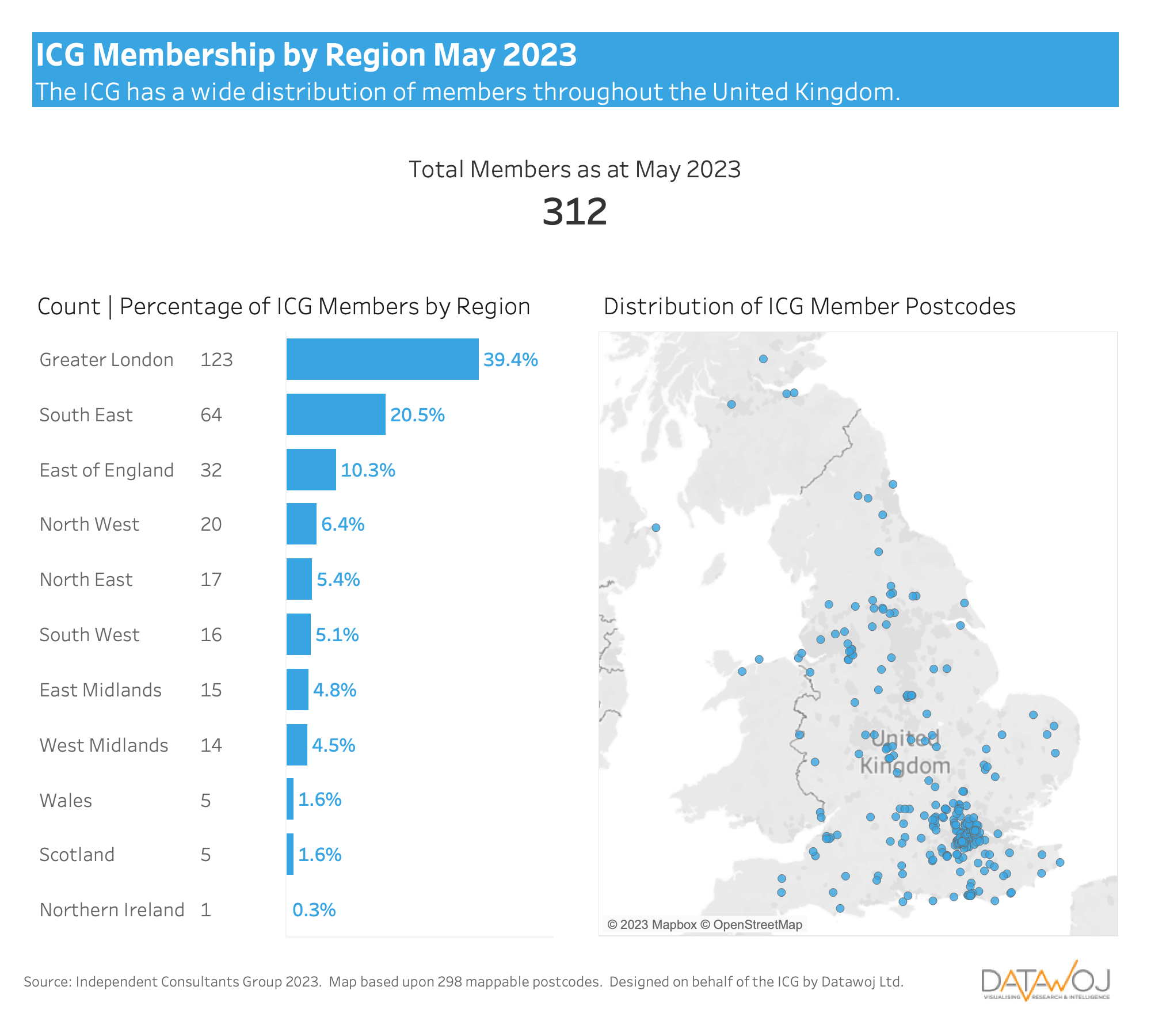
    As part of our mission to promote the varied expertise of our members, we asked Colin Wojtowycz of Datawoj Ltd., to help us depict where our UK members were geographically based.

    Concentration is in the South-East of England but our reach extends across the whole of the UK.

    A percentage of our members are also based across the globe, including Europe, the US and Asia.

    https://public.tableau.com/app/profile/colin.wojtowycz/viz/ICGMemberMappingJune2023PCDS/ICGMembership2023

    https://public.tableau.com/views/ICGMemberMappingJune2023PCDS/ICGMembership2023?:language=en-US&publish=yes&:display_count=n&:origin=viz_share_link


    About Datawoj Ltd:

    Providing expertise and additional capacity in research data analysis and visualisation to deliver actionable insights.

    Saving you time, engaging your audience and improving your business performance.

    We have delivered many successful data visualisation projects for a wide range of clients including national bodies, local authorities, charities, research agencies as well as data start-up companies.

    Building upon this experience, our specialties are:

    • Online survey and questionnaire design
    • Survey data analysis and reporting
    • Spatial data analysis
    • Data visualisation design
    • Designing and building Tableau dashboards
    • Training and coaching in data visualisation.

    Find out more at www.datawoj.co.uk


  • Business Newsletter: Cyber and Information Security

    Business Newsletter: Cyber and Information Security

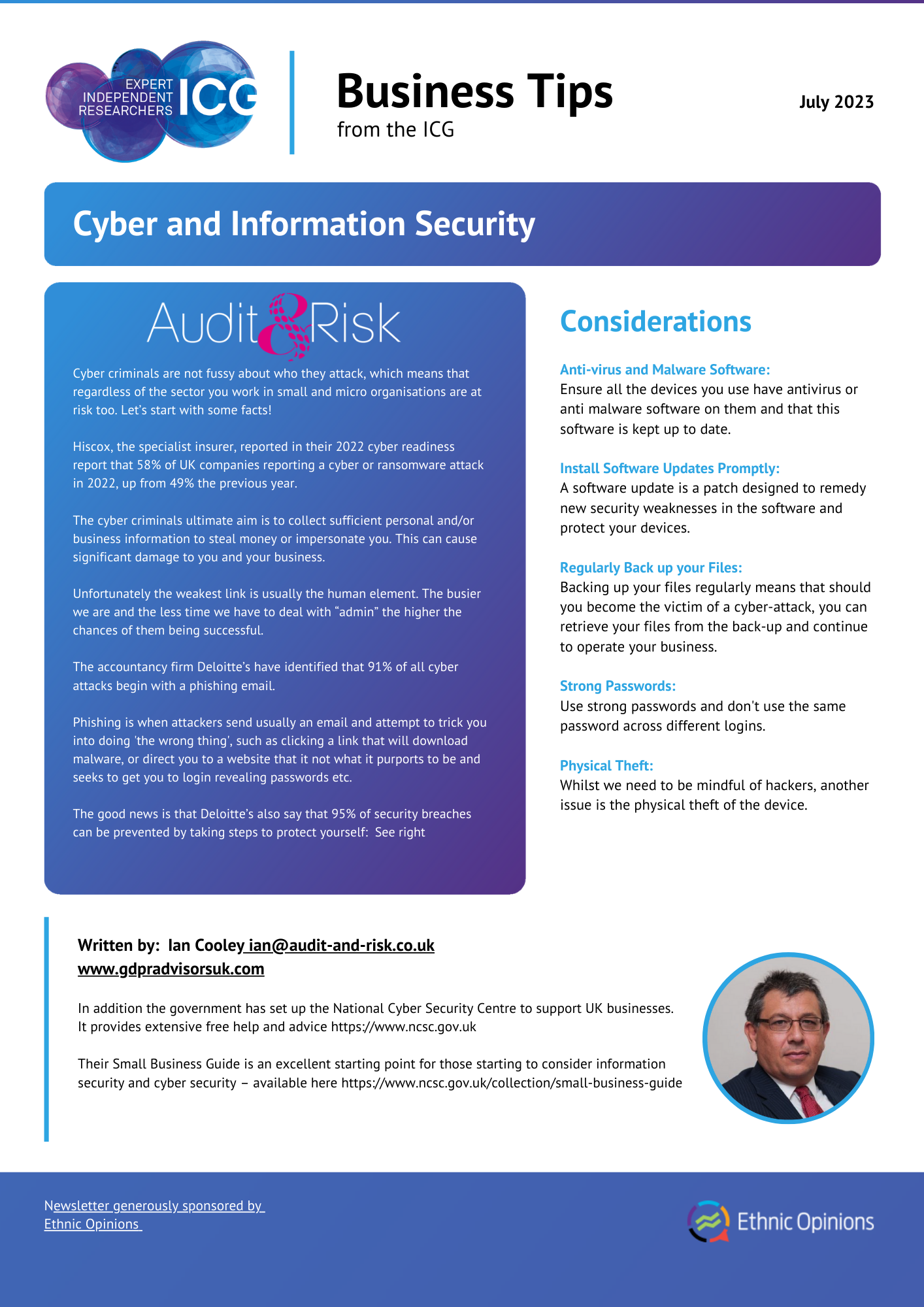
    This newsletter is generously sponsored by Ethnic Opinions. They are designed to give you an expert overview of the sort of business issues  you should be thinking about as a micro-business owner.


    More info 

    ISO27001 Certification advice and support (audit-and-risk.co.uk)

    www.gdpradvisorsuk.com

    ian@audit-and-risk.co.uk

    Small Business Guide: Cyber Security – NCSC.GOV.UK

  • 4 Key Reasons to Choose a Boutique Research Agency

    4 Key Reasons to Choose a Boutique Research Agency

    Article by ICG member Isla Cullingworth, NailedOn Research

    Within the food and beverage market, trends and purchasing behaviours are changing all the time. For businesses to stay competitive in this ever-evolving landscape, they need to be able to adapt quickly and pivot wherever necessary. That’s why many turn to market research agencies to support their efforts. When it comes to choosing a market research provider, there are many factors to consider. Whilst the expertise and experience of the organisation is paramount, it’s also important to consider your requirements and exactly how they will be met. Whilst there is never a “one size fits all” approach to choosing the right market research agency, in this blog, we’ll explore three key advantages of working with a boutique consultancy, helping you to make an informed decision.

    The personal touch

    If you’re looking for one-on-one attention and a personalised service, then choosing a boutique market research consultancy might be right for you. Boutique consultancies are often small by design, meaning you’ll commonly work directly with the directors of the company, who have a vested interest in making sure that any project they work on is treated like it’s their own. This not only allows for a more personal connection and easier communication, but also instils a sense of loyalty and responsibility to the client – you!

    Diving into the nuances of your business and taking the time to understand the unique challenges you face, boutique market research consultancies immerse themselves into every step of your project’s lifecycle. Feeling more like a partner than a service provider, they’ll become an invaluable extension of your company’s operations, working side-by-side with you from the beginning to make sure that you get exactly what you need to drive your business forward.

    No stone left unturned

    The food and beverage industry is one of the most competitive in the world, and it takes serious innovation to stay at the forefront of consumer trends. This not only means having access to high-quality market insights, but it also means working with a market research organisation that goes the extra mile to help you stand out from the crowd. With the time, resources and capacity to deliver creative solutions to your problems, working with a boutique market research consultancy can make all the difference when it comes to finding out what consumers want and need, bringing with them a fresh perspective to exploring new ways to build your brand’s presence.

    For boutique market research consultancies every single project is crucial, which means they are always looking for ways to innovate and improve their processes so that they can give clients better results than ever before. It’s not just about doing a good job – it’s about being the best at what they do, every single time. With a greater incentive to perform, smaller agencies are more likely to leave no stone left unturned for your business, channelling maximum effort into your project to help you differentiate your offerings from the competition.

    Unique insights for your industry 

    You may be considering a larger, more established organisation which offers a wide range of services as a “one-stop-shop” for your requirements, but it’s important to consider that these larger full-service agencies tend to work across a wide span of business sectors. In comparison, boutique consultancies often specialise in one industry or niche, meaning they have a wealth of specialist knowledge at their fingertips, and experience in working with a wide range of brands who face similar challenges to yours.

    Knowing the industry they specialise in from the inside out, boutique market research consultancies are perfectly placed to understand the necessary steps to put you on the path to success. This allows them to create bespoke market research strategies and solutions tailored specifically for you, without offering you packages or services that aren’t applicable or useful for your business’s long-term goals. As your needs grow and evolve, a boutique market research consultancy has the flexibility to adapt to your changing needs continually, with dynamic solutions for sustainable business growth.

    Agility and flexibility

    In the world of food and beverages, you need a market research consultancy that can keep up with shifting consumer preferences and understand emerging trends. When new opportunities arise within your target market, it’s important to be able to act quickly and decisively – because if your brand isn’t relevant, it’s going to be left behind. Yet, red tape can stand in the way of quick action, and you may feel as if you are losing momentum with lengthy approval processes, complex contracts, and communications with multiple people or departments.

    Instead of focusing on multiple projects at once, boutique consultancies work with a select number of clients at a time, taking an adaptive, agile, and client-centric approach to research that matches the momentum of consumer trends and shifts. With a direct line of communication to your consultant, you can pivot to navigate the ever-changing consumer landscape and adapt to change with greater speed, ensuring resilience even in the face of changing markets and uncertainties. This enables your business to deliver for its customers, innovate consistently, and maintain a competitive advantage, getting your product or service to market as effectively, efficiently, profitably and as quickly as possible.

    Could a boutique market research consultancy be right for you?

    Before choosing the right market research provider for your business, it’s vital to define your budget, values and requirements, and reflect upon what’s truly important to you. What comes at the top of your list – is it the peace of mind that seeing a client portfolio full of household names brings, or does a personalised, one-to-one approach with an experienced industry specialist take precedence for you? Are you looking to work with a large team who can offer a wide range of services, or an out-the-box creative thinker who can deliver agility and flexibility? Research agencies come in all shapes and forms, but if it’s the latter, the smaller size and specialisation of a boutique market research consultancy could be exactly what you’re looking for to help you achieve your goals.

    At Nailed On Research, we’re proud to be boutique! We believe that ’boutique’ doesn’t mean small – it means something much more than just numbers. It means knowing your client inside-out. It means understanding what they need before they know it themselves. It means building up a rapport like no other – and doing so with every single one of our clients, for every single project we take on. Providing high-quality market research services to the food and drink industry, our personalised approach means we can provide a highly intuitive and creative service at every step of the way, with actionable insights and contextual market intelligence that we’re proud to stand behind.

    Does a boutique market research consultancy sound like the right fit for you? Get in touch today to discuss your current challenges and find out how we can help, and we’ll work with you to create a bespoke strategy that will take your business to new heights.

    Isla Cullingworth <isla@nailedonresearch.com>

    Home | Nailed On Research | Food & Drink Market Research

  • Why I Love Business to Business (B2B) Qualitative Research

    Why I Love Business to Business (B2B) Qualitative Research

    Article by ICG member Carol Raithatha, Carol Raithatha Ltd.

    You all probably know what it’s like – Some projects are just more motivating than others. In other words, certain areas of research seem to dovetail more easily with what I enjoy.

    So, I’ve been pondering why I like B2B qualitative research so much. Here are some thoughts on what makes it such a rewarding area to be involved in, IMHO at least.

    B2B qualitative research is diverse, stimulating, and worth doing. It is:

    · The opportunity to learn how organisations and sectors operate and fit into the wider context.
    · Talking to competent individuals and hearing all about professional worlds I might never have even thought about.
    · Getting into detail while being able to look at the bigger picture. Looking at both the individual bricks that make up the wall as well as the whole wall; both when standing in front of it, but also from up in space.
    ·A full timeline approach: How has the past informed what is happening in the present and what is likely to happen in the future.
    · Often a chance to learn about other regions and countries and sometimes use a bit of language skills too.
    · Finding that golden nugget that helps the client deliver a better experience and become more profitable. Almost always a win-win situation!
    · Having some great conversations and asking lots of questions!

    Getting out of bed for a B2B qualitative project is easy. It’s like having tuition on the real world from the experts and being paid for the pleasure.

    If you are a researcher what are your experiences? Do you also enjoy B2B qualitative projects? Why?

    #qualitativeresearch #marketresearch #B2Bresearch

    Carol Raithatha | LinkedIn

  • I Asked ChatGPT to Write a Poem for My Son’s Birthday. What Does the Result Tell Us About the Potential Impact of Generative AI?

    I Asked ChatGPT to Write a Poem for My Son’s Birthday. What Does the Result Tell Us About the Potential Impact of Generative AI?

    Daily predictions of imminent apocalypse are only part of the heady cocktail that is the forecasting of generative AI’s potential impact on work, society and our very existence.  Market researchers, like so many in all fields of public and business life, have been frantically exploring the implications of generative AI’s capabilities over recent weeks, contemplating and discussing its potential impact on our work and whether it represents a threat or an opportunity.

    I am only one amongst many who have been experimenting with ChatGPT and other platforms to explore its effectiveness in performing various tasks, with a particular focus on its potential to replace the human element in our practice.  However, I took perhaps a slightly unusual path in this exploration, by asking ChatGPT to write a poem for my son’s 20th birthday card – it may be worth mentioning that I have been creating individual bespoke cards for friends and family for many decades now, as in the examples here:

    No alt text provided for this image


    Having become highly aware that the ‘rubbish in, rubbish out’ principle is fundamental to the effective performance of natural language AI, I took great care to hold ChatGPT’s hand and give it careful guidance regarding what I sought.  Here was the brief:

    Write a 12 line poem for my son Ned’s 20th birthday. He is at university in Manchester, loves to party, has a great group of friends and is very charming.

    And the result wasn’t half bad.  I don’t think Simon Armitage has much to worry about and the poem would have benefitted from a consistent rhyming scheme, but the result was clearly on brief and the language used was unexpectedly literate.

    No alt text provided for this image

    My intuitive response was instructive.  I was impressed with the overall quality, amused by the language and surprised that, given its general literacy, it mucked up the rhyming scheme.  But beyond that, I realised that it really did feel machine-made.  For all its quality, it lacked the human dimension: the emotion and fallibility that is perhaps uniquely human, traits that are demonstrated through the poem I then wrote to appear on the inside of my son’s card.

    No alt text provided for this image

    So, I was broadly heartened, choosing to see this experience as supportive of my emerging perspective on generative AI and its implications for my practice.

    I think there are probably three key aspects of the best qualitative research that make it a process intrinsically activated and empowered by a uniquely human set of qualities.

    Empathy and human interaction skills

    Effective interviewing, whether one-on-one or in groups, whether face-to-face or remotely over web video, requires an essential ability to connect with people in a way that engenders trust, honesty and productive interaction, something that is incredibly difficult to imagine any machine ever achieving as effectively as a skilled human.

    Effective interviewing also requires responsiveness and the agility to adapt in real time to what one is hearing, probing appropriately and developing hypotheses to test ‘on the hoof’.  While we always start any session with a framework for exploration, one of the fundamental principles of qualitative research is that we allow research participants to create their own agenda according to how they are processing the ideas we are discussing, rather than impose upon them a pre-existing structure.

    Thus, qualitative interviewing is an intrinsically dynamic, iterative process, that changes between and within every session, in contrast to generative AI which, by definition, can only work from the probability generated by a huge mass of pre-existing data.  For this reason, generative AI will struggle to see significance in the new or pick up and run with the unexpected.

    Content analysis

    I hear much about the potential value of AI in the analysis of feedback, with many talking of allowing it to do the ‘donkey work’ in finding the themes in discussion transcripts, as a prelude to the added value that humans can then add.

    I’m sorry, I don’t buy this at all.  As I have written many times before, qualitative research is not about what people say, it’s about what it means.  Proper qual is not reportage, it is interpretation, using cross-referencing, experience, empathy and imagination to find what lies beneath the surface of what people say to work out why they say it.

    Furthermore, rather like interviewing, analysis is a dynamic process, during the course of which you generate and test new hypotheses, explore the factors that might be driving similarities and differences, and constantly develop your thinking.  I often compare it to peeling the layers of an onion: until you have reached a certain point, you cannot see what comes next, and the insights reveal themselves in stages, often in a non-linear way.

    No alt text provided for this image

    For these reasons, I cannot see myself letting AI do the ‘heavy lifting’ any time soon.  I want to be there at the start of the journey, because only then can you find the real pathway.  There is no point making a start 3/4 of the way through the journey if you then find that you are walking the wrong path.

    Analysis is the ‘black box’ of qualitative research: the part invisible to clients but where the greatest value is added.  And that added value will always be human value.

    Providing actionable direction 

    The final critical human element lies in seeing the implications of the research learning and communicating these effectively in a way that clients can embrace and act upon.  While AI is showing the ability to generate wonderful imagery and diagrams to illustrate our debriefs, the value of the debrief content will be down to us.  The creation of a compelling narrative that leads to a credible, relevant and motivating conclusion is a uniquely human skill, once again relying upon a degree of lateral thinking, creativity and experience that the machine can never possess.

    I am seriously concerned about the socio-cultural threat that natural language AI presents as its development races so far ahead of humanity’s ability to manage it positively and productively. I am genuinely fearful of the potential consequences of its use by bad actors to deceive and defraud, and our widespread inability to apply a critical faculty to separate truth from fiction.

    More prosaically, however, in market research I think it presents a greater threat to practitioners in quantitative than in qualitative, particularly through its ability to eliminate the need for humans in data processing and finding patterns in open-ended responses.  In quant, it also presents the risk of fraud and misdirection from ‘bad actors’ using AI to respond to quant surveys.

    For qualitative research, I can see there being a negative impact in the short-term from the application of generative AI as a way of saving time and particularly costs, most notably through automated content analysis.  It could well be that clients see this as an opportunity to bring more qual in-house, as procurement and CFOs seek to remove the human element in the name of ‘efficiency’.  However, I can foresee a bounce back from this as companies learn to their cost that the guidance provided by machines lacks insight, validity and creativity, and that genuine effectiveness matters more than theoretical ‘efficiency’.  It seems probable to me that, in the medium term, the growth of AI will make the creation, management, analysis and reporting of qualitative research by skilled humans only more important.

    However, this is all, of course, based on the assumption that AI does not bring the world to an apocalyptic end before next Tuesday.


     

  • There’s Nothing more ‘Human’ and ‘Multicultural’ than Sensory Research

    There’s Nothing more ‘Human’ and ‘Multicultural’ than Sensory Research

    Article by Clara Origlia

    Doing Sensory research automatically means dealing with Multisensory and Multicultural dimensions.

    The Sensory world is an immense and highly articulated area of ​​research. Research can go far beyond what is ‘essential’ or imaginable. From the definition of the physical-perceptive characteristics of a product,  its hedonic features, its functional properties and attributes, descriptors and benefits that characterize it, up to fine-tuning all the elements of the marketing mix. Sensory elements allow researchers to measure (on a cognitive/rational but also on a physical/emotional level) the appeal of single components that characterize a product, a brand, its promises and benefits. They also allow researchers to determine how effectively the product as a whole, as well as its specific components, address the users’ needs and desires; to what extent they express the product/brand’s full potential within a category, meeting specific objectives of the marketing strategy vs competing products and brands. Sensory research reveals the personality, but also the soul of a product or a brand and, most definitely, its potential.

    The creation of verbal stimuli, questionnaires, item batteries, descriptors, and evaluations is a particularly delicate activity. Spoken language alone does not always succeed in conveying the depth and the subtleties of human perception. However, the use of a whole range of carefully selected sensory, perceptive, and emotional stimuli can definitely empower language and elicit the expression of precious material, present on an emotional or unconscious level. The use of rich set of stimuli allows researchers to enhance and exploit the multifaceted perceptive-descriptive dimension of ‘human’ language. In a multicultural project, translations shall convey and restore any nuance, enriching and stimulating all the interpretative possibilities, rather than simply guaranteeing understanding and dialogue between users, or facilitating the international outreach of research. This is unfortunately the case of English, which has always been the universal language of marketing and research, often being oversimplified and ‘universalized’.

    Holistic approaches, especially in real life, allow a large variety of stimuli to be used in a flexible way, being adapted to the culture, context, characteristics of the consumer, product or idea being researched on. Stimuli can be adapted to the spirit, rhythm and natural logic that develops in an interview or in group work dynamics, thus stimulating insights that cannot be obtained with purely cognitive and rational methods.

    The stimulus material shall be prepared ad hoc; it cannot be chosen or created on the basis of personal taste or in a disorganized manner, without a strategy. Stimulus material is not something optional, and should not be managed as an optional extra, a filler, an accessory; nor as an enlivening element of the speech or as a way to make the presentation more involving or visually attractive for the Client. Stimulus material is part and parcel of the research approach, and it should be used as such.

    Stimulus material preparation requires sensitivity, expertise and attention. It cannot be randomly delegated, outsourced or created without any brief or coordination. The help of an expert researcher is valuable and could actually allow other researchers  or anyone else on the Client side to use the preparation phase, as a very useful moment of  reflection and teamwork.

    Research approaches in a ‘human to human’ or ‘human-centred’ perspective.

    The use of holistic, hybrid, multicultural, multidisciplinary, cross-generation approaches can truly enrich the work of professionals in the fields of research and communication, marketing, strategic consultancy, and innovation. Research and insights are brought back into an authentic, ‘human to human’ perspective of real life.

    Sensory Analysis, Semiotics, Sensory Semiotics, Design Thinking, Ethnography, Storytelling, and Co-creation allow the best use of the uniquely and exquisitely human ability to establish, manage and describe complex sensory interweaving; to express evaluations, emotions and experiences in an analogical or metaphorical way. This can be achieved by overcoming cognitive and rational barriers and limits, making the most of the expressive potential of other “languages”, both verbal and non-verbal, while describing an experience. ‘Experience’ does not only refer to what can be sensed, felt, physically or emotionally experienced; it also includes what can be imagined, intuited, prefigured, projected, foretasted…. This level of processing requires the awareness of what an experience is, can, or could be. Such an awareness, at least for now, is only human.

    Clara Origlia, Independent Research Consultant , Insight Expert and Coach, and ICG member, is a very experienced, trilingual qualitative researcher, moderator and consumer insights expert.

    linkedin.com/in/claraoriglia

    https://theicg.co.uk/upt_user/user-865/

  • Best Practice for Hiring Independent Market Researchers

    Best Practice for Hiring Independent Market Researchers

    The guidelines 

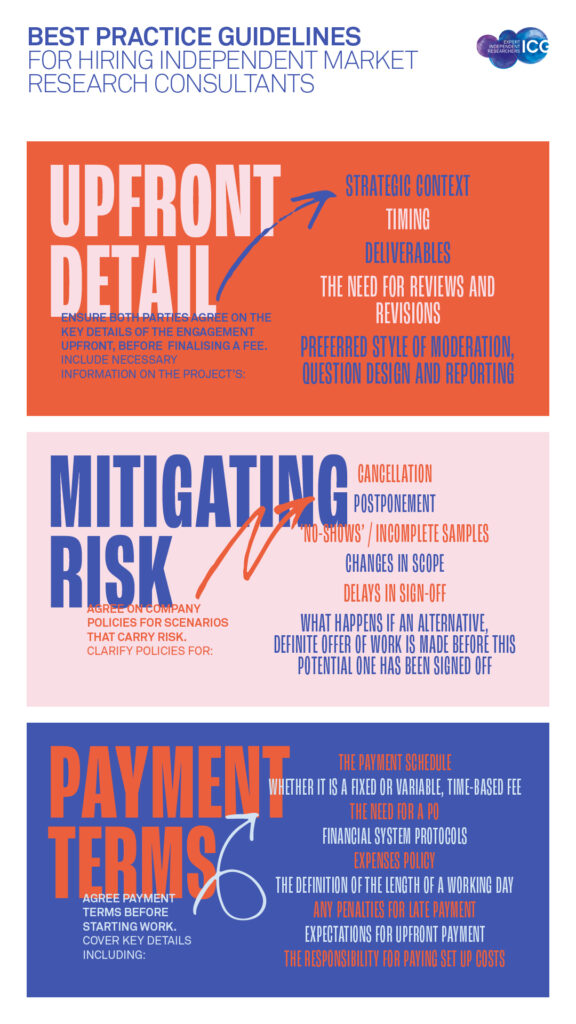
    These guidelines have been developed by the ICG (Independent Consultants Group) in collaboration with 242 market research professionals.  The guidelines’ purpose is to help nurture happier and more productive working relationships between independent consultants and the companies that hire them.   

    In our study, we identified that most issues in the relationship occur because the terms of engagement are unclear and their expectations differ.  To avoid any misunderstanding, independent market research consultants and the companies that hire them should ideally, do the following: 

    DOWNLOAD THE GUIDELINES HERE

    What is this initiative? 

    The Independent Consultants Group (ICG) is a network of over 400 independent market research consultants. Most are UK based but we have members worldwide.  We support one another with professional advice, resources and contacts.  

    Our members have come together to define what we believe best practice means, in the context of hiring independent market research consultants. The purpose of this is to help nurture happier and more productive working relationships between independent consultants and the companies that hire them.   

    What did we discover in our study on best practice in hiring independent researchers? 

    In our industry survey of over 242 independent researchers and hirers, we discovered that often there is insufficient detail agreed upfront, which can destablise relationships between hirers and freelancers. 

    • The biggest risks from independent consultants’ perspective when working with new hirers includes: 
        1. An underestimation of the actual scope of work (according to 60% of consultants) 
        2. Not receiving receiving enough strategic context in client briefings (55%) 
        3. Late payment (40%) 
        4. Not being paid more, despite doing more work than was originally agreed (30%)  
    • All of these risks point towards a central issue:   Insufficient detail is agreed upfront between hirers and independent consultants 
      1. Only 51% of independent consultants agree payment terms upfront 
      2. Only 36% of independent consultants use a signed, statement of work including terms and conditions, before starting work 
      3. Only 23% of independent consultants agree on the hours expected to be worked 
      4. Only 15% state on what is billable if there’s a cancellation 
      5. Only 8% state what will happen if a definite project comes up before a tentative one has been confirmed 
      6. Only 7% agree what is billable if there are no shows (in qualitative research)

    In conclusion, based on the experiences of both hirers and independent consultants and our industry survey, we have identified a clear guiding policy to nurture happier and more productive working relationships:   independent consultants and their hirers need to agree on more detail upfront 

    How did we develop these guidelines? 

    This initiative has been spearheaded by ICG member Tom Woodnutt, founder of online qualitative research specialists – Feeling Mutual.  Over the last 12 months, Tom has co-developed  these guidelines through close collaboration with the market research industry, ICG members, our sponsor Further (who kindly funded the infographics, shared their online qual platform, Together™ for free along with their expertise on the subject). 

    There has been three phases to the development of these best practice guidelines:  

    1. a) Online qualitative research with ICG members and Further, to help define the challenge
    2. b) Crowdsourced ideation with ICG members to generate solutions 
    3. c) Industry survey (with hirers and independent consultants) to validate the best practice guidelines (conducted by Nik Harta of Yolo Comms). 
    • Phase 1: Defining the challenge 

    In November 2020, an online qualitative research forum hosted by Further, was carried out with six hirers and six independent research consultants.   

    The discussion covered the key dimensions in the working relationship from both hirers’ and consultants’ perspectives.  The topics discussed included: risks and rewards from working together, how they feel about the relationship, what determines success, areas of tension, misunderstanding and reactions to an early set of best practice guidelines. 

    This allowed us to develop a draft set of guidelines and hypotheses on both the factors that threaten to destabilize working relationships and those that help enhance them. 

    • Phase 2: Developing solutions 

    In April 2021, 25 ICG members joined a group brainstorm via webcam in which the findings from the previous stage were scrutinised and the draft guidelines were developed further.

    • Phase 3, Validating best practice 

    Between July to September 2021, 242 independent consultants and hirers took part in an online survey.  This measured their experiences and perceptions of the working relationship and what they believed best practice to mean. 

    This allowed us to measure the relative importance of various guidelines and validate our understanding of the context that shapes the relationship.  


  • Get Ready for the Future of Market Research: How Qualitative Insights are Game-Changers!

    Get Ready for the Future of Market Research: How Qualitative Insights are Game-Changers!

    In today’s ever-changing business world, market research has always been key to making smart decisions and shaping winning strategies for all kinds of companies.

    Technology is totally changing our lives, and guess what? Market researchers need to keep up with the times and embrace new tools and methods to really get into the nitty-gritty of how consumers act.

    In this article, we’re diving deep into what lies ahead for market research, specifically highlighting the incredible power of qualitative research.

    Get ready to see how this field is about to shake things up and totally transform how businesses understand their customers!

    The Incredible World of Qualitative Research: Qualitative research has always been a fantastic way to really get inside the heads of consumers and understand what they think, feel, and what gets them going. Back in the day, it mostly involved face-to-face chats, group discussions, and sneaky observations to catch all those little human behavior details.

    But how about now? The digital age has opened up new and exciting possibilities for qualitative research, giving researchers a bunch of cool tools and techniques to explore.

    Digital Ethnography (the big thing!): One amazing development in qualitative research is digital ethnography. With everyone using social media and online communities, researchers can now observe and interact with consumers right in their natural digital habitats. By analysing online conversations, comments, and stuff people create, researchers can get real-time insights into how consumers see brands, products, and trends. It’s a unique chance to understand the context in which people make choices and see how consumer culture keeps changing.

    Mobile Research (so hot right now!): Thanks to smartphones and awesome mobile apps, mobile research is all the rage. Researchers can now engage with consumers in the moment, capturing their experiences and emotions as they happen. Things like mobile diaries, video ethnography, and location-based research are just a few examples of how qualitative researchers can tap into the power of mobile technology to get deeper insights. This shift to real-time data collection not only reduces forgetfulness but also gives us a more authentic understanding of people’s lives.

    AI and Automation (the new kids on the block!): Artificial Intelligence (AI) and automation are totally transforming the landscape of qualitative research. Now, we have super-smart algorithms using Natural Language Processing (NLP) to analyse huge amounts of text data, like open-ended survey responses and online reviews, at lightning speed. These algorithms can even detect sentiment, identify topics, and figure out emotions, giving researchers a number-based understanding of qualitative data. It’s like finding patterns and trends that used to take forever to find manually. The mix of AI and qualitative research is a game-changer, making analysis much easier so that researchers can focus on getting useful insights.

    Virtual Reality and Immersive Research (the cool stuff!): Virtual Reality (VR) is becoming a seriously cool tool for qualitative research, especially when physical presence isn’t possible or costs too much. VR simulations let researchers recreate real-life situations, so participants can experience immersive scenarios that are just like their everyday lives. By watching and interacting with consumers in these virtual worlds, researchers get super deep insights into what they like, how they act, and how they make decisions. VR is perfect for things like ethnographic research, testing products, and even creating virtual focus groups. It helps researchers overcome distance barriers and reach all sorts of participants.

    The Bright Future: As the world of market research keeps evolving, qualitative research is going to be more and more important for understanding how consumers tick. By using innovative technologies and methods, researchers can find deeper insights that capture the subtleties of consumer decision-making in a changing world. When we bring together AI and automation, digital ethnography, mobile research, and immersive tech, we unlock crazy opportunities for businesses to truly connect with their target audiences.

    It’s all about creating customer-focused strategies and driving innovation.


    Stefania Gogna, ICG member and Semiotician and Marketing Researcher

    https://theicg.co.uk/member/infostefaniagogna-com/

    https://www.linkedin.com/in/stefaniagogna/