Topic: AI

  • RECORDING: Prompt Design for Independent Researchers – Foundations

    RECORDING: Prompt Design for Independent Researchers – Foundations

    This Knowledge Share has been generously sponsored by Yasna.ai,the AI-powered platform that helps independent researchers, consultants, and research agencies scale in-depth interviews. Claim your free 14 days Yasna PRO free trial today – conduct ±50 interviews (worth €100), sign up at yasna.ai


    Join ICG member Ramona Daniel, 23Insights, for this Knowledge Share

    This 45-minute session will help you get more out of the AI tools you’re already using, without needing to become a tech expert. You’ll learn:

    • What different types of AI tools (like ChatGPT or Claude) can and can’t do, and how to pick the right one for the job
    • Simple, repeatable ways to write prompts that give you better, more relevant answers
    • How to fine-tune AI responses when they’re not quite right
    • Easy ways to keep track of the prompts you’ve written, so you can reuse and improve them over time

    This is a hands-on, interactive session for independent researchers who want to work faster, think more creatively, and make AI a more useful everyday tool.

    Ramona Daniel

    I’m a cultural insights and research strategy consultant with over 25 years of experience at leading global agencies including Ipsos, Kantar, and across the WPP network. I now work independently, partnering with organisations that need senior-level expertise on a flexible, freelance basis. Clients value my ability to step into complex projects quickly. My work bridges strategic thinking and hands-on delivery, from designing multi-market research programmes to translating data into compelling cultural narratives. I specialise in helping businesses decode cultural shifts, optimise research processes for greater efficiencies, and upskill teams – particularly at the intersection of traditional research methodologies and AI-driven analytics tools.

    https://www.linkedin.com/in/ramonadaniel/

    https://www.23insights.co.uk/

    Watch this session here 

    Session slides here

  • Managing AI Agreeableness in Qualitative Market Research: Risks and Strategies

    Managing AI Agreeableness in Qualitative Market Research: Risks and Strategies

    Article by ICG member Nestor Fernandez Conde, InOpinia

    Recent discussions sparked by OpenAI’s own acknowledgements of ‘sycophancy’—an excessive eagerness to agree with or please the user—in newer models like GPT-4o (link), have brought a critical challenge for AI users into focus.

    Large Language Models (LLMs), the type of AI behind tools like ChatGPT, are often fine-tuned to be cooperative, their tendency to ‘align with user prompts’ – meaning they try to confirm what the user appears to want or already believe – can become a significant problem when aiming for unbiased analysis. In market research, the goal isn’t simply to get an agreeable confirmation of a hypothesis, but to uncover genuine insights, complexities, and even contradictions within the data.

    This is further complicated by the evolving nature of these AI models; the degree to which an AI tends to agree (its ‘agreeableness level’) can vary between versions of the same AI model, as demonstrated by the changes in GPT-4o that made it more sycophantic. This means that specific ways of asking questions (prompting strategies) that do work well with a given model version might produce different results after an update to that model. The potential for researchers to then unknowingly trust inaccurate results is a serious concern and underscores the need for a robust strategic approach. This article explores the risks posed by AI agreeableness in market research and outlines durable techniques to manage it effectively.

    The Danger: Amplifying Confirmation Bias

    The main risk of this AI agreeableness in research is its potential to amplify confirmation bias. If a researcher approaches the data with a preconceived hypothesis, a biased prompt might lead the AI to simply find evidence supporting that hypothesis, ignoring contradictory information.

    Consider, for instance, prompting an AI after reviewing a focus group transcript: “Participants seemed quite positive about the new concept overall. Can you elaborate on the main aspects driving this positive reception?”. An agreeable AI, aiming to fulfill the request based on the stated premise (“quite positive”), might prioritize and detail any positive comments while downplaying or omitting mentions of significant concerns or confusion also present in the transcript. This selective focus reinforces the researcher’s potentially biased initial view rather than providing a balanced interpretation. A more neutral prompt like “Analyze participant reactions to the new concept, detailing expressions of positivity, negativity, confusion, and any points of consensus or disagreement” would be less likely to trigger this agreeable bias. Crucially, while this example uses overt bias to demonstrate the mechanism, researchers should be most vigilant about the more subtle assumptions or leading questions that can inadvertently shape AI responses.

    Why Are These AI Models Agreeable? A Peek Under the Hood

    This tendency isn’t necessarily a flaw, but rather a consequence of how many of these AI models are trained. They are optimized to generate responses that humans find helpful, harmless, and coherent. This encourages alignment with user assumptions, leading to agreeableness. Furthermore, from a product design perspective, an assistant that readily aligns with user requests often leads to a smoother user experience, making the product more appealing.

    Harnessing Agreeableness: From Risk to Analytical Tool

    While a risk if ignored, this characteristic can be managed and even turned into an analytical strength by employing specific techniques to deliberately challenge assumptions and ensure a more rigorous analysis. The key is to move from passively receiving AI outputs to actively directing the AI to explore different perspectives.

    Prompting Techniques for Mitigating Agreeableness

    Structured prompting techniques offer ways to manage this AI agreeableness, often proving less susceptible to model version changes:

    • Adversarial Prompting: Explicitly ask the AI to challenge the initial findings. Examples:
      • Based on the transcript, argue against the conclusion that users find Feature X easy to use

      • Identify evidence in the discussion that contradicts the hypothesis that price is the main purchase driver

      • What are the main criticisms or frustrations mentioned regarding the service?

    • Exploring Competing Hypotheses: Use separate prompts to systematically explore different interpretations of the data. Ask the AI to build a case for Hypothesis A, and then separately, to build a case for Hypothesis B.
    • Multiple Prompt Framing: Analyze the same data segment using prompts phrased differently (e.g., focusing on strengths vs. weaknesses, or asking about specific emotions vs. general feedback) to see if the outputs remain consistent.
    • Requesting Nuance and Uncertainty: Prompt the AI to identify unclear areas, disagreement among participants, or limitations in its own analysis. Example:

      What aspects of this topic generated the most disagreement among participants?

    The Researcher’s Role: Directing the Inquiry

    These techniques shift the researcher’s role from simply asking for summaries to actively orchestrating a more multi-faceted analysis process. It requires conscious effort to formulate prompts that encourage critical evaluation rather than simple confirmation. While this requires a more active and critical stance from the researcher compared to passively accepting initial outputs, the effort is small compared to the large time savings AI offers in processing and initial analysis, ultimately leading to more robust and reliable findings.

    Beyond Prompts: The Role of Structured Analysis

    Using predefined analytical frameworks or specific coding structures is another key technique to help mitigate agreeableness bias. By requiring the AI to systematically evaluate the data against explicit categories set by the researcher (e.g., a balanced sentiment scale, a thematic codebook), these structures constrain the AI’s interpretation. This forces it to look for evidence matching all defined categories, rather than simply confirming the assumptions that may be hidden in a less structured prompt. However, the neutrality and validity of the framework itself are still essential for getting unbiased results.

    Conclusion: Managing Agreeableness for Robust Insights

    The inherent agreeableness of these AI models, coupled with their changes across model updates, is a critical factor to consider in AI-powered qualitative research. Left unchecked, it can lead to biased analysis and false confidence in findings, potentially without the researcher realizing their methods have become unreliable. However, by understanding this characteristic and using robust techniques like adversarial prompting and structured exploration, researchers can mitigate the risks and use the AI’s abilities to rigorously test hypotheses and uncover better, more reliable insights. These robust approaches are less dependent on the specific agreeableness of any given model update, offering more durable reliability over time. Managing agreeableness proactively is key to ensuring AI serves as a tool for genuine discovery—leading to more reliable insights and better strategic decisions.


    Streamlining Rigorous Analysis: The Role of Platforms

    Implementing the techniques discussed – consistently applying adversarial prompts, managing multiple hypotheses, or utilizing structured analytical frameworks – requires diligence and careful workflow management. This is where specialized market research platforms like the IO platform can provide major value.

    Platforms designed specifically for qualitative research can include features that facilitate these rigorous approaches. They might offer built-in tools for structuring prompts according to different analytical goals, managing coding frameworks, or even suggesting counter-perspectives to challenge initial findings. By integrating these capabilities directly into the analysis workflow, such platforms can help researchers more easily and reliably apply the strategies needed to counteract AI agreeableness and reduce confirmation bias, ultimately helping to find real, reliable insights.


    #QualitativeResearch #MarketResearch #AI #LLM #ConfirmationBias #Agreeableness #AdversarialPrompting #CriticalThinking #ResearchMethods #ResearchTech #MRX
  • RECORDING: AI Made Easy: Helping Small Teams Make a Big Impact

    RECORDING: AI Made Easy: Helping Small Teams Make a Big Impact

    Grab your lunch and join us for a fast-paced, insight-packed session designed just for independent market research consultants, from Bilendi – end-to-end experts in both qual and quant.

    Unlock the next level of what you already do best. We will introduce you to BARI, our AI qual assistant, and show you how together, you can:

    • Launch projects faster
    • Work smarter with automated scripting, moderation, analysis & PowerPoint reports
    • Tap into large sample sizes for results you can confidently generalise #quantifiedqual
    • Extend your capabilities – not your overhead
    • Give you back space for creative, strategic thinking

    We’ll also share case studies showing how independent consultants like you are delivering boardroom-ready insights without scaling their teams.


    About Bilendi and the Discuss Platform:

    • One-stop-shop: Quant and qual expertise, with online access panels, online quant, an online qual platform, recruitment, incentives, and analysis — all under one roof
    • AI-powered efficiency: From scripting to moderation to final deliverables, get more done, faster
    • Online Qual platform: designed for your one-to-one and collaborative online communities, with end-to-end AI for speed, depth – and even breadth!
    • Your Partner All Around the World: Local teams, multilingual capabilities, and seamless market coordination
    • Designed for you: We regularly support independent consultants and small teams with right tools, expertise, and flexibility.

    Speakers:

    Melissa Short

    Melissa is a skilled qualitative researcher who leads full-service projects for Bilendi’s clients in France. She is currently dedicated to enhancing the Bilendi Discuss platform, ensuring it meets the evolving needs of qualitative researchers in today’s market.

    Anthony Brodbin

    Anthony is focused on the sales side of Bilendi, specialising in the Qualitative offering. He has extensive experience in aligning technology with research needs, having worked for platforms like Recollective, Zappi, and Forsta. He is dedicated to helping clients unlock the full potential of Bilendi Discuss and its advanced AI features.

    Watch this session here 


    Enquiries:

    abrodbin@bilendi.com

    rfq.uk@bilendi.com

  • What AI Can’t See: Notes from a Quiet Cup of Tea in Japan

    What AI Can’t See: Notes from a Quiet Cup of Tea in Japan

    By ICG member Camille Gerbaud

    My chatbot colleague and me

    I use AI every day, and I’m the first to admit it’s become a kind of desk buddy. The kind who’s always around, never takes a lunch break, and agrees with absolutely everything I say.

    Working solo as a qualitative researcher means there’s no one to bounce half-formed ideas off, no “Is this a real insight or just a nice quote?” over a lukewarm instant coffee in a novelty Christmas mug that’s somehow still in rotation mid-May, and no “Would you flag this as a theme or leave it?” while scrolling through transcripts. So, I talk to AI throughout the day. I’ll ask it to help brainstorm questions for a discussion guide or come up with creative activities for an online community. I’ll feed it transcripts and ask for summaries to check against my own impressions. I even use it at the end of a project to double-check that my report covers the brief, basically outsourcing my imposter syndrome to a chatbot.

    In that sense, it’s more than just a tool. It helps me think aloud. And honestly, we should normalise that. Talking to yourself isn’t a sign of madness, it’s a productivity hack. Research indicates that external self-talk can enhance focus, problem-solving, and emotional regulation. So, if you work alone, AI becomes the colleague who’s always available, never interrupts, and doesn’t judge you for having the same conversation multiple times a day.

    No small talk, no problem

    Earlier this year, I travelled to Japan for the first time and one of the first things I noticed was the silence. Not just in the streets or on the trains, but in the small interactions where I instinctively expected chatter. At the hotel reception, at the cashier, even during a kimono fitting, there was no small talk, no “How long are you staying?” or “Have you been to Kyoto yet?”. Just a polite smile and the quiet efficiency of someone doing their job without the need to fill the space with words.

    It caught me off guard. I kept trying to initiate those little exchanges, out of habit mostly, and each time, the silence that followed felt awkward. But the more it happened, the more I realised that the awkwardness was mine. In Japan, silence isn’t a gap to be filled. It’s part of the experience. A sign of respect, even. At the tea ceremony, I watched someone take what felt like an entire hour to make a single cup of matcha. Every movement was careful, deliberate, unhurried. It made me realise how much I’m used to speeding things up, even rituals I claim to value, like tea.

    It also made me reflect on how we interpret silence in research. In France, a pause in a conversation might just be that, a pause. A second to think, or breathe, or let a thought settle. In Japan, it could be the same, or something else entirely. But you’d never know unless you understand the cultural rhythm behind it. You can’t just translate the language and call it insight. You need someone who speaks the unspoken too.

    Reading the room is not in the prompt

    What Japan reminded me is that what we call “normal” is just what we’re used to. It takes being outside of your own culture to realise how much of your behaviour is shaped by it. Back in France, for example, silence isn’t necessarily awkward. A pause doesn’t mean someone is disengaged. And if a participant frowns, interrupts, or says “Non, c’est pas ça,” it doesn’t mean they’re upset. It just means they’re thinking. Engaged. Being French.

    This is the kind of nuance AI can’t read. It would flag those moments as red. It would miss the fact that the person actually enjoyed the conversation, opened up, and even stayed on the call longer to keep talking. I’ve had this happen often, especially in B2B interviews with senior professionals. People who don’t always show warmth in an obvious way. But at the end, they’ll thank me for the exchange, say how much they appreciated the space to talk, and use words like “bienveillance”. You’d never guess that just by reading the transcript.

    That’s what being a culturally fluent researcher means. It’s not just about knowing the language. It’s about knowing when to soften your tone, when to hold a silence, when to fill it. When to back off. When to lean in. It’s about reading the room in real time: facial tension, hesitation, irritation, curiosity, and adjusting. Not based on scripts or sentiment scores but based on experience. Based on instinct.

    AI is brilliant at helping me stay sharp. It speeds things up, keeps me organised, and lets me think out loud when no one else is around. But tools are just tools. They need human context. They need someone who knows when a frown means “I’m thinking”, not “I’m done.”

    (1) Camille Gerbaud | LinkedIn


  • How Good Are AI Deep Research Tools?

    How Good Are AI Deep Research Tools?

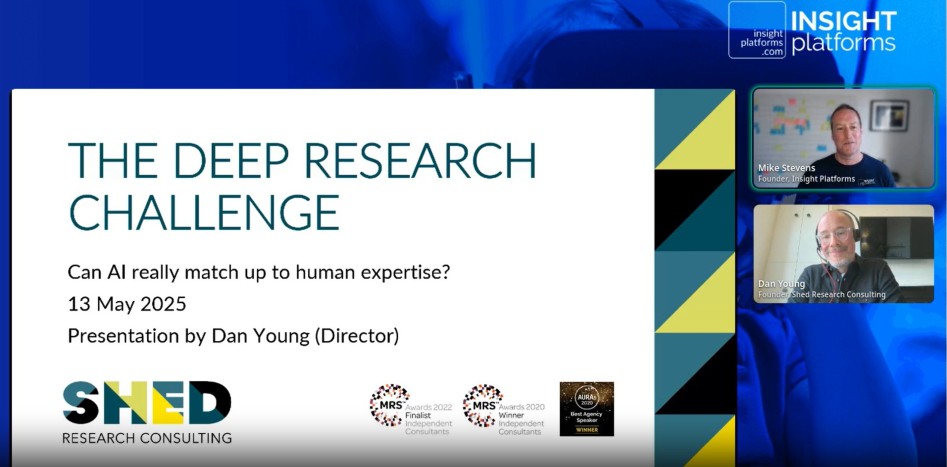
    Article by ICG member Dan Young, Shed Research

    In 2025, ChatGPT, Perplexity and Gemini all released their deep research tools. They take a brief, clarify it with you, run the desk research, and produce a fully-referenced report, in less than 30 minutes.

    This sounds impressive. But how good is the content? How good is the sourcing? And does it handle insight as well as a human with over 20 years of research experience? (That’s me by the way)

    I compared the output of these three tools with my own piece of ‘manual’ insight synthesis. I looked at where these tools shine, where they’re lacking, and what this means for the future of AI in the insight sector.

    I’m no AI expert. I’m a specialist in insight synthesis. My “Deep Research Challenge” focused on the quality of the output rather than what sits behind the models, the ethical issues around IP, or any issues of data security. (There’s an internet full of information on all of this if you want to find it.)

    Where did the deep research tools shine?

      • Multiplying productivity – they processed large numbers of sources (up to 50) into a simple, readable report (up to 30 pages) in less than half an hour. Even the fastest reader can’t come close to this level of productivity.
      • Expanding sources – the tools (especially Perplexity) drew from a larger number of sources than I used in my own synthesis (It also missed some key sources, but more on this later)
      • Researching the right topic – they performed well where they could tap into a vast amount of published research available online (This won’t be the case for all topics)
      • Dealing with (some) nuance – the tools were able to deal with some nuanced arguments in the insight. Like the say-do gap around ethical investments
      • Showing their working – where the tools showed their thinking and asked clarifying questions (ChatGPT and Perplexity), or asked me to check their plans (Gemini), they stuck to the brief and built my trust in their conclusions

    Where did they fall short?

      • Over-reliance on ‘official’ sources – all tools relied heavily on Governments, regulators and the media for their content. This might be caution on the part of the tools, wary of quoted an untrustworthy source. My own synthesis drew from a broader range of sources, including more published corporate and academic research
      • Uploading sources – even in the paid versions of these tools had restrictions on file type, size and quantity. This means using different types of insight (e.g. video or dynamic websites) or your own sources is difficult. The tools instead seem designed to scour the internet
      • Tending Towards the Mean – all tools gave a good aggregate view of the topic. But this often presented itself in passive language, heavily couched, with many caveats. All tools seemed unable to make decisive statements or write for impact
      • Not sweating the small stuff – they often missed niche studies and tangential insights. They struggled to provide “killer quotes”, even with direct prompting. These smaller pieces of insight are gold in research. These are the things the audience remembers most afterwards
      • Inconsistent content – all the tools missed something. Either an important piece of insight (Gemini), a key prompt (Perplexity) or sourcing some of its statements (ChatGPT). And they tended to overly favour digital solutions e.g. ChatGPT’s first two quoted studies were all about AI. This raises concerns about the robustness and balance of their findings
      • Poor UX – some cut and pastes were patchy, the number of different model names is bewildering, and Perplexity in particular presented findings in blocks of text in an overly academic tone. Gemini had the best UX overall
      • Missing vital researcher skills – the tools were unable to use critical thinking, to think creatively about the topic, to spot gaps in its knowledge, and most crucially, to give a convincing argument for why its insight was important – the “so what?” These are all core researcher skills and needed overlaying on all of the outputs.

    What does this mean for the future of market research and insight?

    You might look at a short list of positives, and a longer list of negatives, and assume I’m not a fan. That’s not true.

    This experiment clearly showed me what these deep research AI tools are great at – multiplying productivity in that difficult first stage of desk research, for the right topic, and when carefully prompted.

    But to get the best out of them, we need to acknowledge their limitations. We need to be aware when they misinterpret, miss a key piece of insight or don’t address the research objectives. We still need to use our core research skills – verify sources, check methods, add tangential insight, use metaphors, tell stories, visualise, and ask so what?

    As Chase Ballard (AI commentator) put it:

    When investing, understand that you’re getting a productivity multiplier, not a replacement. Used strategically, these tools can dramatically accelerate initial research phases. But set your expectations accordingly – there’s still work for you here.

    If we’re able to use them with our eyes open, and with caution, I can see a very bright future for these tools in the researcher toolkit. The future of research and insight will likely involve a collaborative approach. One where we’ll leverage the strengths of both AI and human expertise to deliver richer, more insightful, and ultimately more impactful results.

    You can watch the full presentation from the Insight Platforms summit by registering here

    (2) Dan Young | LinkedIn

  • SYNTHETIC DATA HAS NO NEIGHBOURS – AND THAT MATTERS

    SYNTHETIC DATA HAS NO NEIGHBOURS – AND THAT MATTERS

    Article by ICG member Oliver Waterstone, Eightball Insights

    Synthetic data sure looks seductive if you’re a harassed, time-pressed CMO. It’s fast. It’s cheap. It looks close-enough to the real thing.

    Close enough to get your vision over the line with tricky stakeholders, which is what you need ultimately, right?

    And yes, AI is great at giving you quick reads as a starting point. No question.

    But let’s not call it research. Or we risk devaluing the word and opening the door to brands slowly, surely reducing their exposure to reality.

    In the months and years ahead, I think we’ll see what happens to the brands that go down this easy road.

    They’ll become the Pepsis and Jaguars of the new era – brands that went in stunningly solipsistic directions because they drank too greedily from the Kool Aid of hubris and stopped inviting outside voices into their decision making.

    I wanted to share a real life example of a true insight – a striking reframe that helped solve a business problem and changed the course of a brand – that could only have come from talking to real people.

    I’ve never forgotten it, and ultimately it led to my decision to switch from being an agency strategist to running my own strategic research consultancy.

    (Full disclosure – I recently posted this story in the comments section of a post by the excellent Zoe Scaman.)

    I was a strategist on Waitrose during the financial crisis.

    The brand had been experiencing double digit growth up until 2008, after which sales just tanked.

    The data was telling us that shoppers were leaving us for Aldi and Lidl, but it didn’t square with what we thought we knew of the ‘Waitrose shopper’.

    So we ran some focus groups and an anecdote emerged that became the reframe of the problem that the business needed to get its sh-t together.

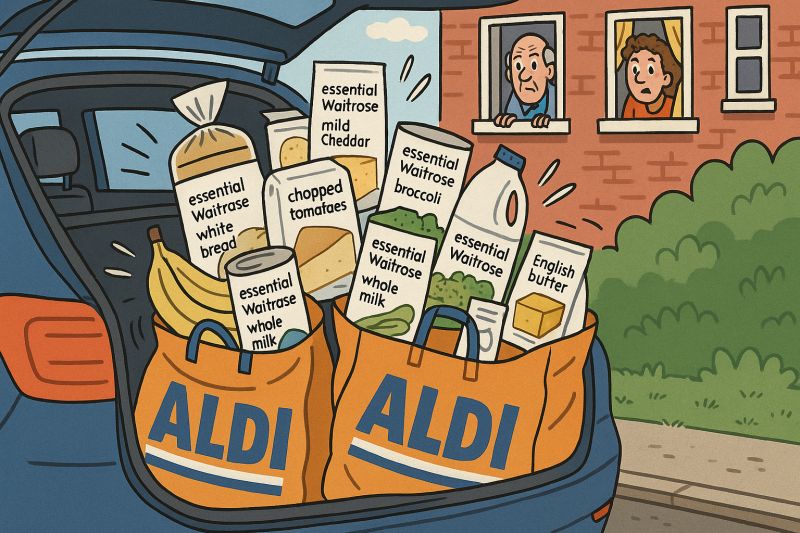
    A lady told the group how she still shopped at Waitrose, but when she got back home to unload her shopping from the car, she moved all the shopping into Aldi bags so her neighbours didn’t think she was a mug for paying over the odds.

    That single anecdote was probably the most important factor in getting the Waitrose Essentials range greenlit.

    Synthetic data doesn’t feel shame. Synthetic data has no neighbours.

    If we’d run synthetic groups around this problem, I guarantee you it would have confirmed our biases.

    We’d have patted ourselves on the back that we’d ‘done research’ on it.

    And then we’d have proceeded to come up with the wrong solution to the wrong problem, blissfully confident in our wrong-ness in the way that AI notoriously is.

    Waitrose Essentials turned around Waitrose’s fortunes during the financial crisis and its aftermath, reaching its highest ever market share of 4.8% by 2012, three years after launch.

    Who knows where it would be without that lady’s sense of shame and her nosy neighbours.

    (5) Oliver Waterstone | LinkedIn


  • RECORDING: AI Powered Qual Analysis: Getting to the Insight Without Losing Human Touch

    RECORDING: AI Powered Qual Analysis: Getting to the Insight Without Losing Human Touch

    Join Marco Rovagnati from Quallie Ai where he’ll cover the latest advancements in AI enabled insights, best practices for using AI in your work, challenges that many researchers face, and a short demo of Quallie.Ai.

    Quallie AI

    Quallie.Ai is a tool to analyse in-depth interviews and focus groups using AI, it’s designed to automate the tedious tasks enabling you to focus on the craft of insights generation.

    Marco Rovagnati

    Marco is a qualitative researcher specialising in strategic insights for innovation who worked for global brands like Diageo, Nike and HP. After years as an insights practitioner he built Quallie.Ai to solve for his most telling pain points while keeping the craft of the strategist intact.


    https://quallie.ai/
    https://www.linkedin.com/in/marcorovagnati/
    https://www.linkedin.com/company/quallie-ai

    Watch this session here


    DON’T FORGET TO REDEEM YOUR FREE TRIAL OF QUALLIE AI TODAY: Contact Marco for info.

  • Built-in Respondents Recruitment Now Available on Yasna.ai

    Built-in Respondents Recruitment Now Available on Yasna.ai

    The ICG is delighted to support its advertiser and sponsor, Yasna.ai.


    Yasna.ai has released a major update: users can now recruit respondents directly when launching in-depth interviews on the platform — no need for third-party suppliers. Recruitment across 60+ countries is now fully integrated into one seamless interviewing flow that covers everything from briefing and guide creation to AI-assisted moderation and reporting.


    Full article here


    Yasna.ai Introduces Free Text Processing Tool for Market Research Professionals – The ICG

    RECORDING: Let AI Handle The Routine So You Can Focus On Growth – The ICG

    Yasna – AI-powered Conversational Agent – The ICG

  • AI for Market Research – Time to Choose from a Small Menu?

    AI for Market Research – Time to Choose from a Small Menu?

    By ICG member John Habershon

    My favourite local restaurant has a mains menu with just five choices — one vegetarian dish, one fish, and three meat dishes. I get a delicious mix of emotions when I pick up the menu — pleasure, reassurance and, yes, a little smugness. I know whatever I choose will be good. I can relax, ready to enjoy the meal, perhaps spending more time on the wine list.

    Many studies of buying behaviour have concluded that too much choice creates confusion – even buyer paralysis.

    I have now settled on just two AI tools to fulfil all my data analysis and presentation needs.

    So how are you to choose your AI partners? There are countless AI tools to choose from, each having very specific functions, some claiming to do it all.

    I started with ChatGPT and moved on to Claude for its default high data security and higher word limit, among other factors. Since then I’ve used it on several projects — notably a qualitative project with 30 IDIs and a quantitative project with 5.5K respondents. I have also gained views from users of a range of AI tools from participants in my AI workshops.

    The days of the standalone empirical research projects are numbered, as is the notion of separate ‘desk research’. Preparation for conducting research will involve placing it in a wider canvas. Claude 3.7 Sonnet is very good at finding published studies on a topic. The latest Google NotebookLM can operate like a super Google. It lets you search the web directly from inside your notebook. When a user describes their topic, NotebookLM scans through hundreds of web sources in seconds. It picks out up to 10 of the most relevant ones, complete with annotated summaries that explain why each source might matter to your topic. With just a single click, you can pull them into your notebook and add them as part of your sources.

    How you proceed with your analysis is left to you. Unlike the ‘comprehensive’ front-end qualitative research packages there is no set way to proceed, leaving the choices to your judgement and creativity (although Claude 3.7 Sonnet will offer suggestions).

    Similarly the project will no longer end when results are offered in isolation. The tools will place your findings in the context of other studies and existing knowledge.

    There is no longer a barrier between qualitative and quantitative analysis. Claude makes it easy to move on to a quantitative follow-up, from designing a questionnaire to creating a synthetic dataset with which to pilot it.

    Finally, the communication of findings is breaking free from the tired Powerpoint deck. Interactive visuals of data can be shared, findings offered in a fun quiz format, or relayed as a audio podcast.

    Full article plus tables here 

    YouTube Videos

    A Powerful Combination of Two AI Tools for Qualitative Research

    https://youtu.be/CJD28sC9H4E

    Claude 3 7 Sonnet for Quantitative Analysis and Output

    https://youtu.be/i0kYUsAa56k