Topic: AI

  • AI in MR: What We Learned from Our First Discovery Session

    AI in MR: What We Learned from Our First Discovery Session

    By ICG member Arthur Fletcher

    A huge thank you to all the members who joined our AI Discovery Session last week – one of the biggest turnouts we’ve had for a while.  Clearly AI is on everyone’s mind, whether you’re already experimenting with it, quietly curious or still wondering what all the fuss is about.

    The aim of the session wasn’t to convert anyone or declare AI ‘the future’, it was simply to understand where members are right now, find out what they want to know and see what the ICG can do to support members as AI becomes more visible in our day-to-day work.

    What’s worrying people?

    Many of you said you feel overwhelmed by the speed of change.  With dozens of tools appearing almost weekly, it’s hard to know where to start and establish which ones are safe, reliable and genuinely useful. Qual researchers in particular voiced concerns about the use of AI in their work and consequently losing nuance, accuracy or even the essence of respondent voices.

    Several members raised the big ethical questions:

    What can we (safely and securely) upload to AI tools?  What are the ramifications for GDPR compliance?  What are the MRS doing about it?

    The lack of clear, independent-friendly guidance is leaving many unsure about how to use AI responsibly.

    And of course, there’s the commercial angle. Some members have already had clients asking whether AI is being used and if that means research should be cheaper.

    What do members want?

    If there was one theme that ran through the whole discussion, it was confidence. Members want:

    • Plain-English explanations of what AI can and can’t do
    • Practical examples of how AI fits into real research workflows
    • Help evaluating tools without wasting hours testing everything
    • Clear guidance on ethics, GDPR and professional standards
    • Advice on how to talk to clients about AI without undermining expertise
    • Case studies – good ones and bad ones – to learn from

    In short: people want support, not hype.

    What’s the role for the ICG (and MRS)?

    There was strong appetite for the ICG to take a leadership role in helping members navigate AI safely and confidently. Suggestions included:

    • Clear guidelines on ethical and responsible AI use
    • Templates for disclosure statements and data protection
    • Training sessions at all levels
    • A shared resource hub with prompts, examples and tool reviews
    • Drop-in ‘AI surgeries’ for questions and troubleshooting
    • Regular updates on new developments
    • Collaboration with MRS to ensure consistency on standards

    Although the ICG should work in the interests of members, it’s the MRS who should carry the flag for the MR industry and determine guidelines, best practice and ethical use.

    What happens next?

    Based on your feedback we’re now shaping the remit of a new ICG AI Working Group. It will bring together enthusiasts, cautious explorers and sceptics alike – because the group will only work if every viewpoint is represented.

    Thank you again to everyone who contributed so openly and honestly. Your insights have set a clear direction for what the ICG should do next. Watch this space for details on how to get involved, upcoming activities and opportunities to help shape the guidance we develop together.  If you haven’t already volunteered to help, please contact Lucie manager@theicg.co.uk

    Arthur Fletcher, Author at The ICG

  • Why Personas Are About to Become More Central to Research than Ever Before

    Why Personas Are About to Become More Central to Research than Ever Before

    Article by ICG member John Habershon



    Personas have been the quietly powerful output of qualitative research – often created, presented, then set aside as merely interesting additions. I believe AI will transform personas from being a nice-to-have deliverable into what they’ve always promised: the central organising principle for understanding brand value and the roadmap for targeted marketing.

    The process of creating personas – identifying patterns and clustering participants into meaningful groups – is a key creative analytical skill of qualitative researchers. But it is also a core strength of AI.

    How do we exploit the power of the new AI tool whilst maintaining our qualitative skillset?

    The Traditional Art of Persona Creation

    Creating personas has always been one of the most satisfying aspects of qualitative research. It’s where analysis transforms into recognition – that moment when a client sees a set of consumers reflected in a persona you’ve uncovered. When each persona sparks genuine recognition from customer-facing people in sales and marketing you know you’ve captured something real.

    The process exemplifies what we achieve through rigorous creative thinking and human empathy.

    But the traditional process has always had limitations: time constraints, restricted sample sizes, and the sheer cognitive load of pattern-matching across dozens of interviews.

    Case Study 1: Plant-Based Meat – Human vs AI

    A couple of years ago I conducted research testing six advertising images and product propositions for plant-based meat.

    Based on interviews with consumers with families, I created five personas by hand:

    ‘Trad’

    ‘Reducer’

    ‘Trialist’

    ‘Foodie’

    ‘Veggie’

    Recently I returned to the data, uploaded the 30 transcripts to Claude AI and asked it to create five personas.

    Here’s what emerged:

    ‘Traditional Sceptics’

    ‘Pragmatic Reducers’

    ‘Convenience Adopters’

    ‘Ethical Pioneers’

    ‘Curious Experimenters’

    The table below compares the two sets of personas side-by-side:

    Article content
    Manual/AI Comparison

    The AI identified the same core segments I had, but the differences made me re-examine my own thinking. There was no ‘Foodie’ in the AI set – on reflection, this was a small number in my sample that had made an impression on me personally. The same applied to the ‘Veggie’ category. Incorporating this under Ethical Pioneers made sense. Similarly, Foodie could be seen as a subset of Traditional Sceptics.

    What the AI added was rigour: it gave me the percentage of the sample for each persona and could list every respondent under each. It also identified crossovers and showed which respondents fit into more than one category.

    The AI’s approach was multi-dimensional, cross-referencing all the factors. This ensured each respondent was classified based on behavioural patterns, not single statements, creating robust, actionable personas.

    Case Study 2: Running Shoes – Where AI Changes Everything

    At just thirty half-hour interviews, the plant-based meat study was manageable. With careful investigation and imaginative reasoning, I could create personas by hand.

    But my running shoe brands project operates at an entirely different scale: 7,432 social media conversations from Twitter/X (27.3%), Reddit (68.6%), and compiled references (4.1%).

    The AI sorted through this data to create six male runner personas:

    ‘The Value Hunter”

    ‘The Max Cushion Comfort Seeker’

    ‘The Performance Optimiser’

    ‘The Brand Loyalist’

    ‘The Pragmatic Beginner’

    ‘The Durability Demander’

    For each persona, it provided detailed information on demographics, running profile, brand preferences, attitudes and motivations, purchase triggers, and pain points.

    To differentiate between personas, the AI looked for patterns across a extensive range of factors: purchase behaviour, running experience indicators, pain and injury language, product knowledge indicators, decision-making language, age and life stage clues, lifestyle and context signals, shoe rotation and collection behaviour, brand interaction patterns, emotional tone and language, durability expectations and complaints, and purchase channel preferences.

    It’s not just that AI manages huge volumes of data. It acts as an inference engine, drawing together comments, preferences and reported behaviour and making deductions in a Sherlock Holmes fashion. At this scale and complexity, achieving this manually isn’t just difficult – it’s inconceivable.

    Why Personas Could Become More Central

    This evolution in capability changes what’s possible. Here’s why I believe personas are about to become more central to research and strategy:

    1. Scale Meets Depth. We can now create robust personas from datasets that were previously impossible to analyse comprehensively. Very large datasets from multiple groups and interviews, social listening data (as in this case), customer reviews, customer support conversations – all become sources for persona development.

    2. Living, Evolving Personas. Traditionally, personas were created once and slowly became outdated. With AI-assisted analysis, personas could be continuously refined as new data is available, keeping them relevant and actionable.

    3. Enhanced Targeting and Testing. AI-generated personas aren’t just analytical outputs – they become active tools for testing concepts, messaging, and advertising before launch, as demonstrated in the LinkedIn articles below.

    Quantitative Analysis – Adding Even More Power

    Here is an example based on a huge dataset of 2,700 respondents with detailed verbatim responses from two open-ended questions. AI is invaluable in creating a coding frame for each question. But we can take it much further and get even more value from asking Claude to create a set of personas. It will analyse the verbatim comments from both open-ended questions and also include the data on age bands, gender, social grade, work status, household income, marital status, presence of children, tenancy type.

    Here is an example of one of the 12 personas

    Persona 4: Affluent Eco-Adopters

    Demographics

    • Age: 35-64 (primarily 35-54)

    • Size: 456 respondents (8.5% of sample)

    • Gender: Evenly split

    • Work Status: 73% full-time employed

    • Income: £75,000+ (£100,000+ for many)

    • Social Grade: Primarily A/B

    • Children: Mixed

    Defining Characteristics

    Affluent Eco-Adopters are actively investing in sustainable technology and products. They’ve purchased electric

    vehicles, installed solar panels, choose organic and sustainable brands, and view environmental responsibility as both

    personal obligation and increasingly good investment.

    This group largely continues their lifestyle with minimal disruption. Whilst noticing price rises, these haven’t forced

    significant behavioural changes.

    Verbatim Examples

    • “I’ve opted for an EV and try to be better on energy management around the home”

    • “I buy organic where possible, avoid fast fashion, and support local businesses. Money is not the barrier to

    sustainable living for me”

    • “I’ve not seen a real change other than prices rises. We’re fortunate to be in a position where we don’t have to

    make difficult choices”

    • “I am a lot more worried about high interest rates. I am saving a lot more and am very conscious of my spending”

    Key Insights

    • Financial capacity to align spending with environmental values

    • Early adopters of sustainable technology (EVs, solar, heat pumps)

    • View sustainability as investment rather than sacrifice

    • Some guilt or awareness of privilege regarding financial security

    The resulting 12 personas, could better be described as market segments since they are based on quantitative data. Being able to conduct further exploratory data analysis based on these segments is a major opportunity.

    Where This Takes Us

    Persona creation represents a perfect merger of human intuition and judgement, combined with AI rigour.

    Additionally, with the help of Claude we also have the scope to test communications against each segment, creating genuinely targeted advertising and marketing.

    https://www.linkedin.com/pulse/testing-concepts-without-conducting-interviews-john-habershon-phd-v4dwe

    https://www.linkedin.com/pulse/developing-testing-ads-without-conducting-interviews-habershon-phd-yq9qe

    The question is no longer whether AI can help create better personas, but how quickly researchers will embrace this capability to deliver insights that are both deeper and more immediately actionable.


    John Habershon PhD | LinkedIn

  • Beyond the Machine: Human Insight in the Era of Post-Editing

    Beyond the Machine: Human Insight in the Era of Post-Editing

    Article by ICG advertiser, The Language Factory.


    It’s tempting to ignore the value of humans in a world that increasingly relies on AI. Indeed, everywhere you turn, you’re invited to streamline, enhance and in some cases replace previously human tasks and processes with AI. But when it comes to one of the most human of experiences, communication, would you really completely trust AI to get it spot on?

    With AI translation in the mix, human expertise is more essential than ever to ensure high-quality, accurate, culturally-sensitive translations that are genuinely authentic and impactful.


    What is machine post-editing for translation?

    Machine translation post-editing services (MTPE) use expert, and crucially human, mother-tongue linguists to refine your AI-generated content to deliver a top-quality, culturally-nuanced final translation. This involves careful review of the materials for accuracy, tone and cultural sensitivity, along with the correct terminology and phrasing to ensure that your message resonates with your target audience.

    Machine translation post-editing is particularly crucial for highly-specialised fields such as market research, healthcare, legal and other technical sectors, where every word counts.


    The power of human insight

    The role of an experienced human linguist in post-editing is more than simply correcting errors from an AI translation. Human insight is indispensable to achieving a precise and culturally-attuned final translation, including:

    • Cultural insight: expert native translators understand regional sensitivities, idioms and humour, ensuring that every translation resonates with a local audience.
    • Emotional intelligence: specialist translators capture tone and intent – not just words – adapting content to evoke the same emotional response, whatever the language.
    • Ethical and brand integrity: human translators can identify bias, preserve brand voice and ensure that translations align with your brand values and sensitivities, something automated systems can’t replace.
    • Contextual decision-making: professional linguists interpret meaning beyond just the literal and recognise how context shapes meaning, especially when translating complex or creative text.
    • Source-text ambiguities: human linguists can identify and rectify ambiguities and errors in the source text that AI translation would simply replicate.


    Best practice for machine post-editing

    • Understand the project: clarify the purpose of the material – is it intended to inform employees, educate on technical issues or promote a new product? Understanding the project goal ensures that the tone, style and terminology resonates with the target audience.
    • Use reference materials: leverage supporting documents to help translators understand industry-specific terminology or complicated concepts, especially for technical or highly specialised content.
    • Assess the quality of the machine translation: check for errors in syntax and style, mistranslations, omissions and structural issues. Make sure that the translated text flows naturally, the sentence structures are grammatically correct and that you review overall readability.
    • Ensure consistency: make use of existing tools, technology and techniques to maintain consistent terminology and phrasing and verify key terms are translated uniformly to provide a cohesive final translation.
    • Adapt for cultural relevance: go beyond literal translation, recognise idiomatic expressions, cultural references and adapt them appropriately so that the content feels natural and connects with the target audience.
    • Conduct ongoing evaluation of MTPE performance: collect feedback from stakeholders and users of the translated content to drive continuous improvement.


    Partner with an expert in machine post-editing

    At TLF, we combine a team of expert mother-tongue translators with specialist Project Managers. All our linguists have a minimum of 5 years of professional experience, hold a Diploma, BA or MA in translation and are professional members of a recognised translation body. We provide a smooth and straightforward, end-to-end post-editing service to ensure your projects are completed on time, within budget and to the highest possible standard. This has earned us a high client satisfaction rating for our post-editing projects.

    Talk to the TLF team to find out how our expert human translators can help you with your next post-editing project.

    Specialist B2B Translation Agency – The Language Factory


  • RECORDING: Prompt Design 2.0: Getting More Useful Results from AI Tools

    RECORDING: Prompt Design 2.0: Getting More Useful Results from AI Tools

    We welcome back ICG member Ramona Daniel to run this follow-up Knowledge Share.


    This follow-up Knowledge Share builds on our foundations session (https://theicg.co.uk/recording-prompt-design-for-independent-researchers-foundations/) and focuses on getting more reliable, useful results from AI tools like ChatGPT or Claude. It’s about moving beyond writing prompts to thinking critically about what the AI gives you back.

    We’ll look at:

    • Simple ways to check and verify the accuracy of AI outputs
    • How to refine prompts when the first answer isn’t quite right
    • Using short, structured prompts to save time and reduce repetition
    • Turning ad-hoc tasks into reusable prompt templates for everyday work

    This is a practical session for independent researchers and consultants who already use AI tools and want to use them with more confidence and consistency – no technical knowledge required.

    Watch the recording here 

  • RECORDING: AI-Moderated Voice Interviews: Friend, Foe or Future of Qual?

    RECORDING: AI-Moderated Voice Interviews: Friend, Foe or Future of Qual?

    Come and hear more about Glaut, an AI-powered customer research software for large-scale customer research projects. We support quant researchers uncover qualitative insights traditional surveys miss through voice-based, AI-moderated interviews (“AIMI”), which combine the efficiency of a survey with the depth of a 1-to-1 interview. Glaut is able to interview thousands of respondents simultaneously (customers, employees, patients), in +50 languages.

    Glaut thrives at the intersection of artificial intelligence, marketing, and human psychology, blending these fields to deliver deeper, more meaningful insights.

    Matteo Cera – Glaut Founder

    I am a builder and Glaut is the third company I created in the past 15 years. https://www.linkedin.com/in/matteocera/

    Some questions on the day that weren’t answered:

    1) Does the participant know this is AI moderated rather than human? My guess is we tell them at recruitment but are there any regulations around this as far as you know? Yes, we have a welcome message at the beginning of the interview that specifies that. Researchers can tailor it as needed. Also, we invite researchers to specify it in the distribution message

    (2) Can we choose which LLM is being used? Again I guess you have a third party speech to text tool which is baked into your platform but for the “thinking” element can clients choose which large language model to use? It would be good if you could share a couple of lines covering your technology set-up, what third party products are used in this area. We use primarily OpenAI and Gemini/Claude as a fall back. At the moment, we don’t give the customer the option to switch, but we could consider it if it’s a blocker.

    3) Did I hear that you’ll be sending through some examples? Yes, here they are;

    – Popular use cases on Glaut for brainstorming – you can test the interview and read the report

    – Whitelabel deck (ppt) that explains Glaut’s benefits and use cases – could be helpful when you have to build proposals for your customers

    Also, considering some questions about methodology, here’s a paper Glaut is  about to publish which compares AIMI voice performance vs. text answers.

    Watch this session here 

    Presentation slides here

  • LWhen AI Writes the Report: What’s Left for Us?

    LWhen AI Writes the Report: What’s Left for Us?

    Article by ICG member Arthur Fletcher


    Imagine this:  You have conducted a short online research community and you have a lot of comment to analyse and report on (20 participants, 30,000 words in all).  You have been offered the use of AI to assist with your analysis and reporting.

    The AI supplier has told you:

    • The AI takes everything into account, all comments from all participants.
    • The AI down-weights the comments from moderators. The moderator probably comments more than any single participant in the community and their words are often important to understand the context of some participant replies (but their peripheral comments will be ignored)
    • The AI is fully briefed on the project background and objectives – taken from your proposal – and anything else you choose to include. Each community task has its own specific objectives.  The AI can also reference specific, trusted websites for additional market/category/product/brand context
    • The AI can analyse by each task in your community as well as groups of tasks (as a combined topic) or analyse all tasks at once
    • The AI can provide summaries, highlight key topics, identify consumer segments and recommend key comments to incorporate into your report
    • The AI can be asked to write in a chosen style – scientific, contemporary, first person etc., you can also upload previous reports that you have written so that it mirrors your own style
    • The AI can also draw conclusions, identify insights and make recommendations based on the briefing
    • The AI can write your final report, providing links to the relevant source material

    So, you go for it (hand over some old reports/docs you have written) and you have the community report in your hands within an hour.

    Of course you are going to read the report and tune the language to your requirements.  You have done the moderation for the community so can review the content and do a memory sense check alongside any contemporaneous notes you’ve made.  You will also review the conclusions, insights and recommendations against the project objectives and see if you agree with them.

    But are you going to do any more checks?  If so, how?  Do you go back to the source material?  Do you review all the comments or just some?  If you read them all, what’s the point of using the AI if you have to go back through everything?  If the first report is good, would you still want to review every subsequent AI generated report in the same way?

    Is the AI report better than your own reporting?  The AI uses a large language model (LLM) which is trained to generate natural text in a style of your choosing, it has a large vocabulary and can take everything you upload into account.  You can also choose how long your report is going to be.  If reporting is a chore for you, is AI likely to do a better job than you?

    Would you tell your client?  What difference would it make to them if they knew your report was (primarily) AI generated?  Would they consider it better or worse?  Would (future) professional standards or legislation oblige you to tell your clients?

    Would you charge the same?  An AI report should use less of your time, so would you now have a 2 tier reporting charge – AI (cheaper) or Human (more expensive)?

    In the end I don’t think AI removes the need for us – it changes it.  Reporting becomes less about writing and more about curating, challenging and validating what the machine produces.  That may sound like less work, but in truth it asks us to be more thoughtful than ever. The question is: are we ready to step into that role or will we let the machine define the story for us?

  • RECORDING: A Whirlwind Tour of Claude Sonnet 4 and Notebook LM

    RECORDING: A Whirlwind Tour of Claude Sonnet 4 and Notebook LM

    An interactive webinar presented by ICG member John Habershon.

    This is an exercise in sharing my experience, starting with a look together at the GUIs of Claude Sonnet 4 and Google NotebookLM, both simple and accessible, but powerful tools for qualitative and quantitative research.

    I began my AI journey early in 2024, collaborating on projects with two ICG colleagues using ChatGPT. I was also in the privileged position of having my own qualitative data, recently made into a report, so I was able to rerun the analysis and compare the process of creating output using Claude. I also collaborated on a huge quantitative project, discovering the power of Claude in analysing spreadsheets.
    I later added NotebookLM to fill any gaps, notably importing audio and video files.

    This will be a session with the aim of familiarising participants with each AI tool. (Incidentally NotebookLM is free, so the combined cost is £18 pcm).

    The 45 minute session will consist of a 30 minute tour of the apps, with 15 minutes for questions (challenge John on anything in the research process that can’t be achieved with this combination).

    John Habershon (PhD)

    Throughout my research career I’ve been dedicated to doing research a little differently, as demonstrated by my analysis of non-verbal communication (one app and two ebooks) and more recently my embrace of AI. I have a PhD from Imperial College, London based on a thesis combining qualitative and quantitative data.

    www.momentumresearch.ai

    Mobile  44 (0)7725 582093

    johnhabershon@icloud.com

    Watch this webinar here 

    Here’s a summary of three of John’s past workshops provide by NotebookLM. He also asked for a Study Guide, which is included.


  • Get off My Land!

    Get off My Land!

    Article by ICG member Kath Rhodes

    Kath Rhodes

    Something has been bothering me recently. It’s the over-use of ‘qualitative’ in the insight world


    Get off my land!
    You lot keep saying ‘qualitative’ data when you are
    talking about open ends and verbal data.
    Words do not qualitative make.
    Elaboration in a quantitative survey is great, but it is
    not, repeat not, qualitative …
    Shoo… Get your own definition to play with…


    I think I can see why we’ve had this drift into claiming ‘qualitative’.

    We’re living in a data driven world. AI loves data, and it’s good at analysing language, boxing it up
    and sorting out what’s been said.

    I love this, by the way. AI has delivered really great language analysis tools and really good ways
    to find and clip quotes and make compelling films that tell great stories. (Thanks Coloop).

    BUT

    There is a downside to what’s going on in AI world…

    We’re sliding into calling verbal data ‘qualitative’, which makes it easy to offer ‘qualitative at
    scale’. And bingo! The world gets more data, faster data and we’ve got both quantitative and
    ‘qualitative’ on speed dial to businesses.

    Of course when we use AI to ask people to ‘say more’ and AI gets more sophisticated in
    encouraging people to deliver more verbal data [through chat bots etc] we are going towards
    qualitative – we are elaborating, and getting conversational and getting more detail… all of that
    can feel qualitative.

    But it isn’t. It’s different.

    Here’s what I think the difference is.

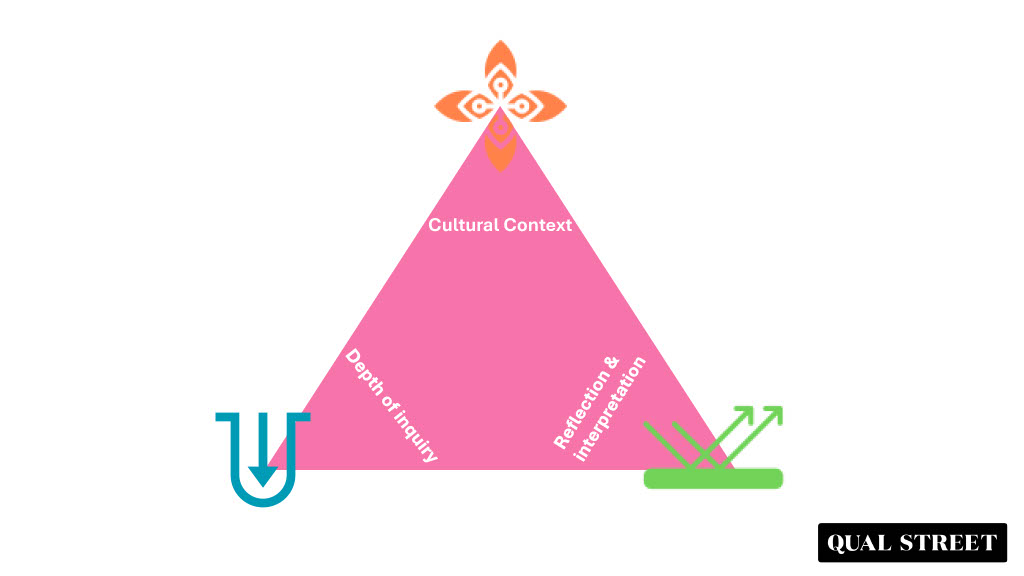
    Good Qualitative Insight:

    • Draws on how culture shapes behaviours and attitudes – it knows context matters (and
    therefore gives space in its methods and approaches to understand context)


    • Looks for deeper understanding – it starts from the position of trying to understand
    what’s going on… and works on looking at layered meaning too. So it has longer, deeper
    conversations. Interviews happen in the right space and place. It uses observational
    tools. It spends time with people. It asks them to spend time exploring…

    • Requires reflection and interpretation (of the content, context and production of the
    insight). Qualitative researchers mull, think, reflect, talk about, and think strategically
    about what this means for our clients…

    Qualitative research is necessarily subjective, non-scientific. It doesn’t claim ‘what is’ – it isinstead looking for meaning.

    Verbal data enriches the quantitative process, but doesn’t step outside of it, explore it, challenge it, take perspective…

    So please, friends and colleagues, don’t call your open ends or verbal data (however much you’ve got) qualitative. AND Stop saying ‘qualitative at scale’.

    It’s good stuff, but it’s not my stuff.

    Me and my people, we are all about understanding what’s going on.

    We deliver our insight thick and rich and with soul… The other stuff – well it’s shallow text.

    Please step off and get a new way to talk about what you are offering. And step off now.

    Otherwise people are going to start misunderstanding what qualitative is, and what its true
    potential is. And then the world will become a flatter, blander place.

    Actually that’s what’s bothering me. I wonder if it already is?

  • Breaking Down Silos: How Integrated Intelligence and AI Agents Are Transforming Market Research

    Breaking Down Silos: How Integrated Intelligence and AI Agents Are Transforming Market Research

    By ICG member Marcello Sasso

    My Journey to Integrated Intelligence

    As a senior market research expert, I’ve witnessed a fundamental problem plaguing our industry for years: the siloing of insights. Early in my career, I noticed something troubling. When I asked different departments within the same organization to describe their typical customer, I received vastly different answers. Sales painted one picture, marketing another, strategy offered a third perspective, and R&D presented something entirely different. Each department was looking at the same customer through their own narrow lens, missing the complete picture.

    This fragmentation wasn’t just inefficient—it was dangerous. Companies were making critical decisions based on partial truths, investing millions in strategies built on incomplete understanding. I realized that the future of market research lay not in generating more data, but in connecting the dots between existing information streams.

    What is Integrated Intelligence?

    Integrated Intelligence is a holistic approach to market research that synthesizes multiple data streams and perspectives to create a unified, actionable understanding of consumer behavior. It’s the practice of breaking down organizational silos and connecting three critical dimensions of consumer understanding:

    1. Behavioral Data: The rational and emotional drivers behind consumer decisions, encompassing everything from customer experience to purchase motivations
    2. Transactional Data: The functional reality of what consumers actually buy, how often, and through which channels
    3. Contextual Intelligence: The external factors—cultural, economic, social, and technological—that influence and shape consumer behavior

    Unlike traditional market research that treats these dimensions separately, Integrated Intelligence weaves them into a coherent narrative that reveals not just what consumers do, but why they do it and what might change their behavior in the future.

    How Integrated Intelligence Works

    The process of Integrated Intelligence operates through a sophisticated orchestration of multiple elements. We gather information from diverse sources—quantitative surveys, qualitative interviews, social listening, transactional databases, cultural trend analysis, and competitive intelligence. Each source contributes a piece of the puzzle that, when combined, reveals the complete picture.

    The magic happens through cross-functional collaboration. Instead of departments working in isolation, Integrated Intelligence requires active dialogue between sales, marketing, strategy, R&D, and customer service teams. Each brings unique insights that, when synthesized, create understanding far greater than the sum of its parts.

    By analyzing data through multiple contextual lenses simultaneously, we can identify patterns that would be invisible when looking at single data streams. A purchase trend that seems random in transactional data might make perfect sense when viewed alongside cultural shifts or emotional drivers.

    Perhaps most crucially, Integrated Intelligence focuses on signal detection—identifying emerging phenomena that have the potential to become major patterns. These signals often appear at the intersection of different data streams, visible only when we look holistically. Knowing them in advance represents a true competitive advantage.

    The Benefits of Integrated Intelligence

    The transformation this approach brings is profound:

    • Predictive Power: Understanding the complete ecosystem of consumer behavior enables better anticipation of future trends
    • Actionable Insights: Recommendations grounded in multiple data points are more robust and implementable
    • Competitive Advantage: Organizations can identify opportunities before they become obvious to competitors

    But beyond these tactical advantages, Integrated Intelligence fundamentally changes how organizations think. It replaces assumptions with evidence, transforms confusion into clarity, and turns contradictions into insights. Resource efficiency improves dramatically as insights are shared and amplified across the organization rather than duplicated in departmental silos.

    Enter AI and AI Agents: The Game Changer

    While the concept of Integrated Intelligence is powerful, its implementation at scale was historically challenging. This is where artificial intelligence, and specifically AI agents, have become instrumental.

    AI excels at precisely the tasks that make Integrated Intelligence difficult for humans: processing vast amounts of disparate data, identifying patterns across multiple dimensions, maintaining consistency in analysis, and scaling insights across different contexts.

    AI Agents: Your Intelligent Research Partners

    AI agents represent a leap forward from basic AI tools. These sophisticated systems autonomously explore data, discovering questions you didn’t know to ask. They simulate consumer personas by synthesizing behavioral, transactional, and contextual data, creating dynamic representations that evolve with new information.

    Through continuous monitoring and pattern recognition, AI agents can identify weak signals that human researchers might miss. They conduct cultural immersion at scale, analyzing vast amounts of content—social media, news, entertainment—to understand the zeitgeist influencing consumer behavior.

    The Democratization of Advanced Research

    Perhaps most excitingly, the emergence of flexible, cost-effective AI platforms has democratized access to these capabilities. Small research agencies no longer need massive budgets or technical teams to leverage AI agents.

    Modern platforms allow researchers with minimal coding knowledge to create custom AI agents through intuitive interfaces. You can train AI on proprietary data sets, customize agent behaviors for specific clients or industries, and build sophisticated analytical workflows without writing a single line of code.

    Building Your Own AI-Powered Integrated Intelligence Platform

    The landscape of AI development has undergone a radical transformation. What once required high investments and teams of data scientists can now be accomplished by small agencies with modest budgets. Today’s AI platforms operate on subscription models that cost less than a junior researcher’s salary, yet provide capabilities that would have been unimaginable just five years ago.

    Modern platforms have eliminated the need for coding expertise through visual interfaces and pre-built templates. A small agency can build their first AI agent in an afternoon, train it on their methodology over a weekend, and have it generating insights by Monday. The initial investment might be as low as a few hundred dollars per month, scaling up only as success demands.

    But the real game-changer is the flexibility these platforms offer. A single foundational AI platform can be infinitely customized for different clients and contexts. The same agent analyzing luxury fashion purchases in Milan can be reconfigured to understand budget shopping behaviors in Mumbai. It can switch from B2B software decisions to teen gaming habits, from financial services to healthcare products. Each configuration maintains its own knowledge base and analytical framework, yet they all run on the same cost-effective platform.

    The platforms grow with your agency—start with basic conversational agents, add persona simulation when needed, integrate predictive capabilities as clients demand forecasting. Each enhancement is modular, allowing agencies to focus their resources on developing unique methodologies and deep client understanding, while the AI platform handles the heavy lifting of data processing and pattern recognition.

    The Future is Integrated and Intelligent

    The convergence of Integrated Intelligence methodology and AI agent technology represents a paradigm shift in market research. We’re moving from a world of fragmented insights to one of unified understanding, from reactive analysis to proactive signal detection, from exclusive enterprise tools to democratized platforms.

    For research agencies of all sizes, this presents an unprecedented opportunity to offer unique value to clients and push the boundaries of what market research can achieve. The silos that once defined our industry are crumbling. In their place, we’re building bridges—powered by AI, guided by human expertise, and focused on truly understanding the complete consumer journey.

    AI is Just a Tool—The Real Magic is in How You Use It

    As we stand at this inflection point in market research, it’s crucial to remember that AI, for all its capabilities, remains just a tool. The most sophisticated AI agent in the world won’t deliver transformative insights if it’s applied within the same siloed thinking that has limited our industry for decades.

    The true differentiator isn’t having AI—it’s understanding how to integrate it into a methodology that breaks down barriers and connects dots. It’s about knowing which questions to ask, which data streams to connect, and which signals matter for your specific context. The agencies that will thrive are those who understand how to weave AI into a broader tapestry of integrated thinking.

    The democratization of AI means that technical capability is no longer the bottleneck. The new competitive advantage lies in vision—in seeing how these tools can transform not just how we analyze data, but how we think about consumer understanding itself. It’s about creating a synthesis between human creativity and AI capability, between technological power and methodological sophistication.

    This is why I remain optimistic about the future of our industry. The tools are accessible, the methodology is proven, but the real innovation will come from how creatively and thoughtfully we apply them. The question isn’t whether to adopt AI—it’s whether you’re ready to rethink how consumer insights are generated, connected, and applied. That’s where the real transformation begins.

    Marcello Sasso, Author at The ICG

    (1) Marcello Sasso, MBA | LinkedIn

  • RECORDING: Why AI Can Be Your Saviour, Not Your Successor

    RECORDING: Why AI Can Be Your Saviour, Not Your Successor

    About the session

    Our industry sometimes feels overwhelmed with the amount of AI tools bursting onto the market promising to do what we have spent our lifetime perfecting for a fraction of the speed and price. We can be suspicious, cynical and a little bit terrified, or accepting, positive and excited.  Or often both at the same time. This session seeks to look at how we worked within both those mindets and shows how we think AI Powered Qual will never replace us, but how it can completely enhance what we do, making us more competitive, able to take on bigger projects and liberate our time to focus on the strategic thinking our clients really pay us for.

    Welcome to QualifyAI

    Spun out of Firefish, we’re not ResTech mercenaries seeking to obsolete you (and us!) but taking a qual heritage built over 25 years and redeploying it in an AI world. We’ll show how using our platform is opening up new revenue opportunities for Qualitative research, reopening people’s eyes to the power of qualitative research, leading to incremental revenues and an appreciation for Qual by clients who simply don’t have the time or budgets to include Qual in its everyday decision making.

    We’ll give you a tour of the platform and its use cases, and leave you with a sense of how you can take advantage of it to power your qualitative future, just as it is helping to transform Firefish, allowing our people to focus on our clients, to do bigger, more complex projects and opening up budget for more deeply human activities.

    And we’d like to have a bit of a debate about AI, qual and the future too while we are at it.

    www.qualifyai.co

    Special Opportunities For ICG Members

    It was lovely to spend time with you all and we really enjoyed the Q&A and the follow up chats we have been having. If you are interested in learning more about QualifyAI, we’ve a few things we’d like to offer to ease you in and give you a chance to explore the platform further and think about how you can write it into your projects:
    1. If you are interested in seeing how it works from the POV of a participant, or to have a look around the dashboard, we have set up a demo project, so just get in touch and we can share links with you.
    2. Anyone who gets in touch to chat further about QualifyAI by the end of August will be entered into a draw for a free trial project
    3. Every ICG member can purchase the first project  (for 50 conversations with your target audience) for £2500 instead of the standard £3500 (a third off!) which includes recruitment, incentivisation and project support to make sure everything goes smoothly…….)
    We’d love to keep the conversation going and find as many ways as we can to support you in your projects and give you the chance to experience the power of AI in your Qual projects.
    Cheers, Richard and Jem


    The Speakers

    Jem Fawcus

    Jem has spent the last twenty five years building a world class qualitative research agency that has excelled in understanding humans to deliver insight that has helped clients create compelling communications to drive brand growth.

    Richard Owen


    Richard’s career has been rooted in innovation from the early days on the transition to online research, to building and selling mobile applications, to consultancy on transformation and now to the application of AI in research.

    RECORDING OF SESSION HERE