
Topic: Innovation, New Thinking & Awards

  • RECORDING: Click, Connect, Engage! Using Cyberpsychology to Motivate Participants Online

    RECORDING: Click, Connect, Engage! Using Cyberpsychology to Motivate Participants Online

    This webinar is generously sponsored by InsightX, specialists in designing custom fieldwork and data collection strategies to meet the unique needs of each client. Whether it’s B2B or B2C, Quant or Qual, CATI/Online/Mixed-Mode, Locally or Internationally, their omni-channel approach fosters authentic participation and ensure the collection of high-quality, representative data.

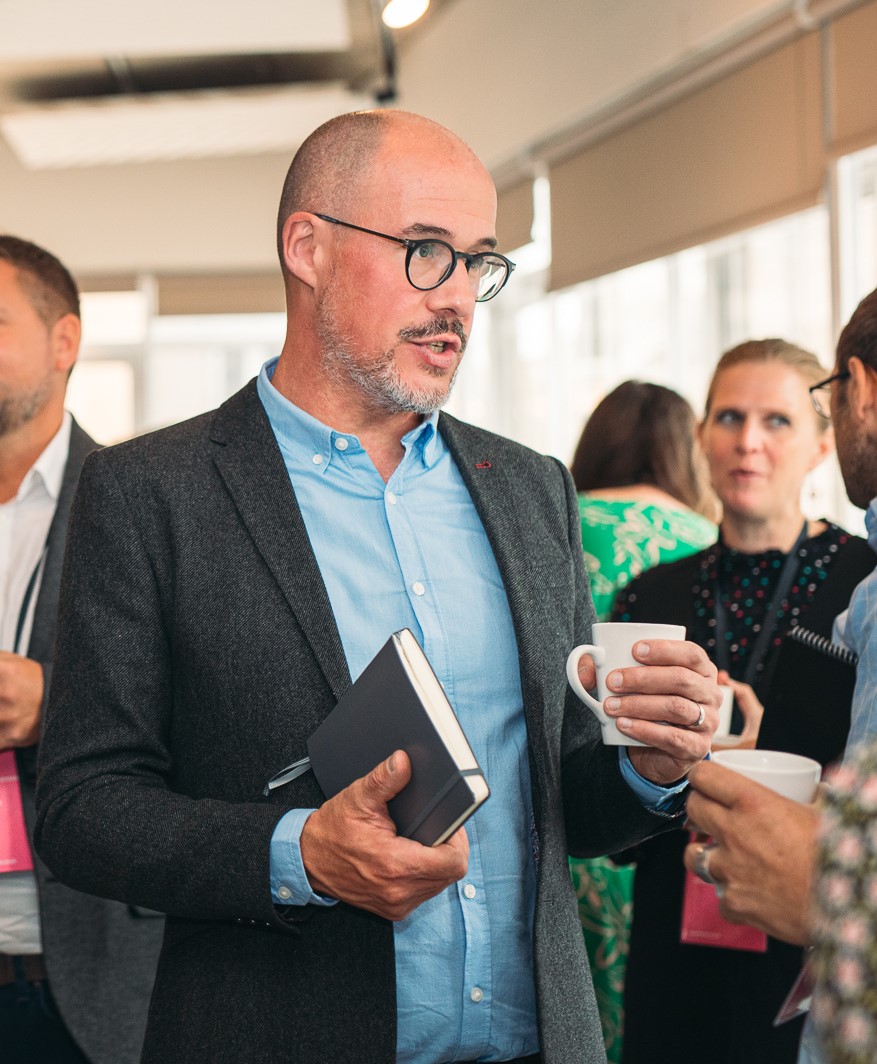
    Do you want to know why participants in an online community won’t engage with each other? Why online focus groups feel so much harder to get going than face-to-face ones? Or why your participant happily videoed himself in the shower for a pre-task? Cyberpsychology has the answers – and more! In this webinar, Dr Jo Meredith – who previously worked as an academic in the field of cyberpsychology – will talk through the high level theories that explain online behaviour, and give insight, tips and tricks into how to make sure you can get the most out of your participants online.

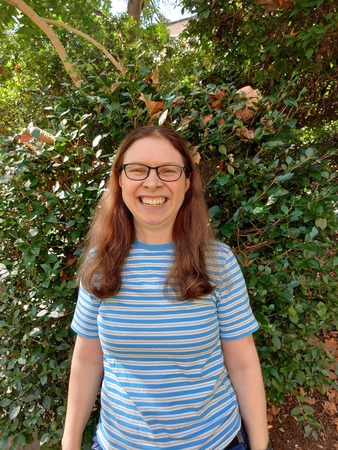
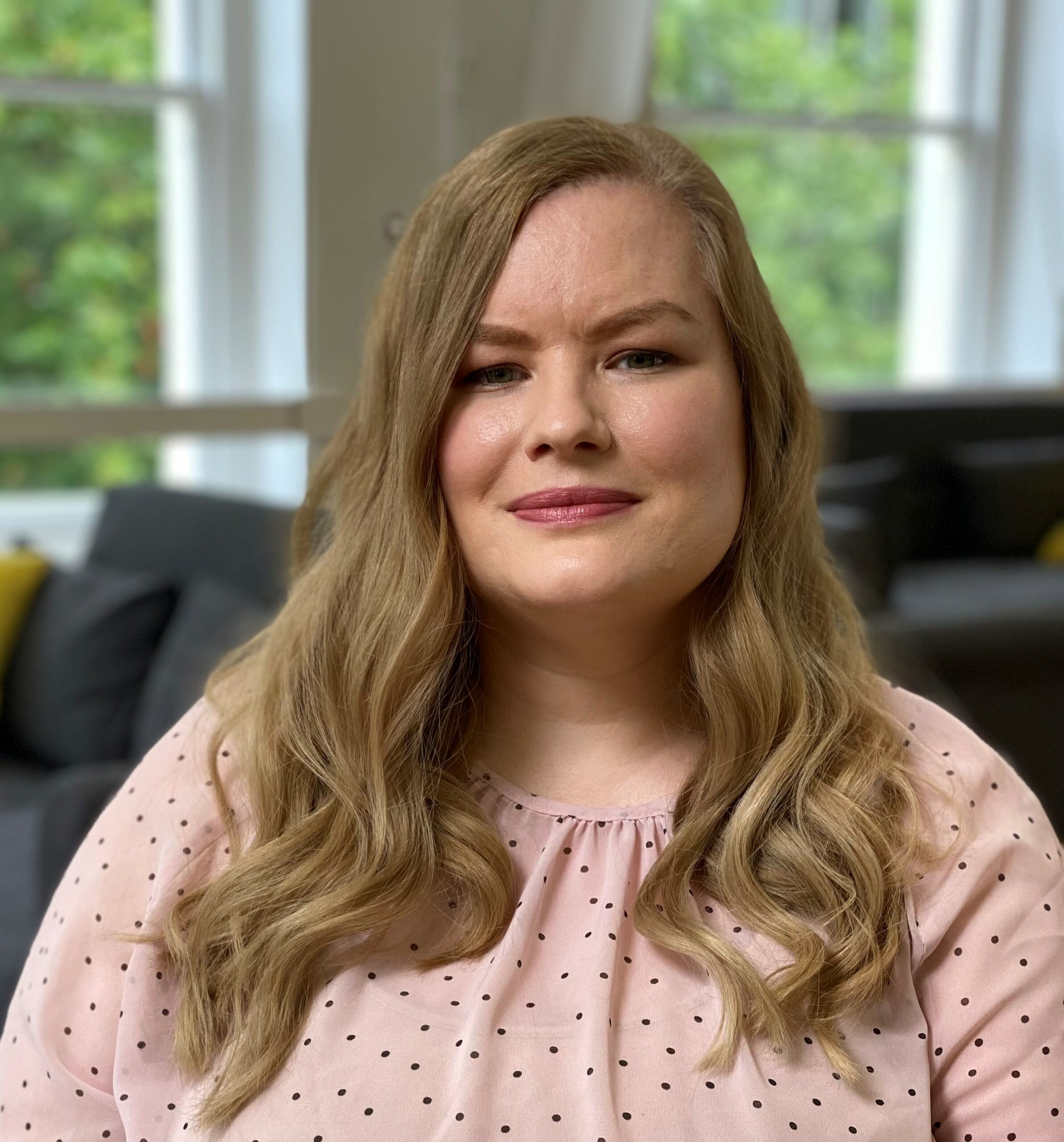
    Dr Jo Meredith 

    Dr Jo Meredith is Associate Director at Magenta Research. With a PhD in Social Psychology and a specialism in cyber and media psychology, Jo has focused predominantly on understanding online behaviour and communication. She has published peer-reviewed academic papers in the specialist journals, and worked in the highly regarded Cyberpsychology Research Unit at the University of Wolverhampton. Since joining Magenta, Jo has made good use of her background in cyberpsychology, working on projects on high media literacy and AI.

    About Magenta
    Magenta is a multi-award winning full-service global consumer insight agency. Magenta is a team of passionate senior researchers with diverse expertise, from anthropology to AI, cyber psychology, semiotics and discourse analysis, using innovative approaches to push boundaries and access how people truly think and feel. We foster an environment of curiosity, challenging norms and brave thinking. Our mission is to bring real voices to the forefront, unbound by methods, choosing approaches that get closer to the consumer. Our visual storytelling will share a story you’ve never heard before.

    (3) Joanne Meredith | LinkedIn
    Jo@magentaresearch.co.uk

    Watch this session here 

  • RECORDING: Prompt Design for Independent Researchers – Foundations

    RECORDING: Prompt Design for Independent Researchers – Foundations

    This Knowledge Share has been generously sponsored by Yasna.ai,the AI-powered platform that helps independent researchers, consultants, and research agencies scale in-depth interviews. Claim your free 14 days Yasna PRO free trial today – conduct ±50 interviews (worth €100), sign up at yasna.ai


    Join ICG member Ramona Daniel, 23Insights, for this Knowledge Share

    This 45-minute session will help you get more out of the AI tools you’re already using, without needing to become a tech expert. You’ll learn:

    • What different types of AI tools (like ChatGPT or Claude) can and can’t do, and how to pick the right one for the job
    • Simple, repeatable ways to write prompts that give you better, more relevant answers
    • How to fine-tune AI responses when they’re not quite right
    • Easy ways to keep track of the prompts you’ve written, so you can reuse and improve them over time

    This is a hands-on, interactive session for independent researchers who want to work faster, think more creatively, and make AI a more useful everyday tool.

    Ramona Daniel

    I’m a cultural insights and research strategy consultant with over 25 years of experience at leading global agencies including Ipsos, Kantar, and across the WPP network. I now work independently, partnering with organisations that need senior-level expertise on a flexible, freelance basis. Clients value my ability to step into complex projects quickly. My work bridges strategic thinking and hands-on delivery, from designing multi-market research programmes to translating data into compelling cultural narratives. I specialise in helping businesses decode cultural shifts, optimise research processes for greater efficiencies, and upskill teams – particularly at the intersection of traditional research methodologies and AI-driven analytics tools.

    https://www.linkedin.com/in/ramonadaniel/

    https://www.23insights.co.uk/

    Watch this session here 

    Session slides here

  • How Good Are AI Deep Research Tools?

    How Good Are AI Deep Research Tools?

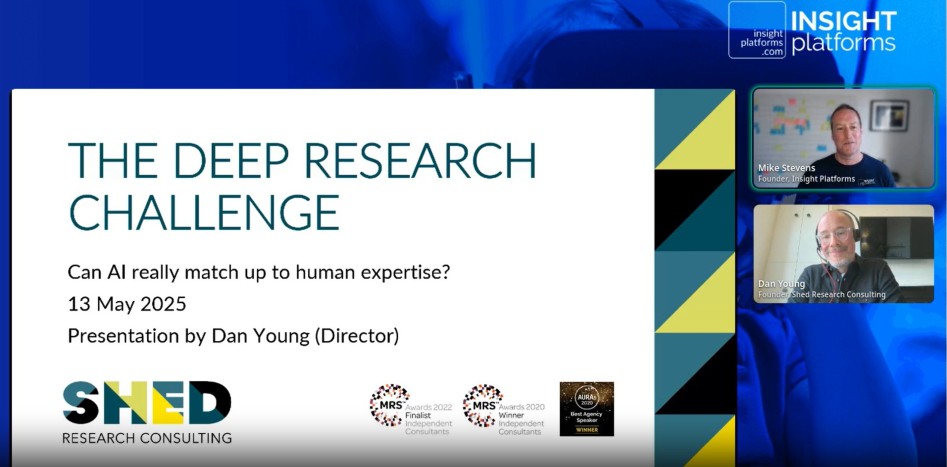
    Article by ICG member Dan Young, Shed Research

    In 2025, ChatGPT, Perplexity and Gemini all released their deep research tools. They take a brief, clarify it with you, run the desk research, and produce a fully-referenced report, in less than 30 minutes.

    This sounds impressive. But how good is the content? How good is the sourcing? And does it handle insight as well as a human with over 20 years of research experience? (That’s me by the way)

    I compared the output of these three tools with my own piece of ‘manual’ insight synthesis. I looked at where these tools shine, where they’re lacking, and what this means for the future of AI in the insight sector.

    I’m no AI expert. I’m a specialist in insight synthesis. My “Deep Research Challenge” focused on the quality of the output rather than what sits behind the models, the ethical issues around IP, or any issues of data security. (There’s an internet full of information on all of this if you want to find it.)

    Where did the deep research tools shine?

      • Multiplying productivity – they processed large numbers of sources (up to 50) into a simple, readable report (up to 30 pages) in less than half an hour. Even the fastest reader can’t come close to this level of productivity.
      • Expanding sources – the tools (especially Perplexity) drew from a larger number of sources than I used in my own synthesis (It also missed some key sources, but more on this later)
      • Researching the right topic – they performed well where they could tap into a vast amount of published research available online (This won’t be the case for all topics)
      • Dealing with (some) nuance – the tools were able to deal with some nuanced arguments in the insight. Like the say-do gap around ethical investments
      • Showing their working – where the tools showed their thinking and asked clarifying questions (ChatGPT and Perplexity), or asked me to check their plans (Gemini), they stuck to the brief and built my trust in their conclusions

    Where did they fall short?

      • Over-reliance on ‘official’ sources – all tools relied heavily on Governments, regulators and the media for their content. This might be caution on the part of the tools, wary of quoted an untrustworthy source. My own synthesis drew from a broader range of sources, including more published corporate and academic research
      • Uploading sources – even in the paid versions of these tools had restrictions on file type, size and quantity. This means using different types of insight (e.g. video or dynamic websites) or your own sources is difficult. The tools instead seem designed to scour the internet
      • Tending Towards the Mean – all tools gave a good aggregate view of the topic. But this often presented itself in passive language, heavily couched, with many caveats. All tools seemed unable to make decisive statements or write for impact
      • Not sweating the small stuff – they often missed niche studies and tangential insights. They struggled to provide “killer quotes”, even with direct prompting. These smaller pieces of insight are gold in research. These are the things the audience remembers most afterwards
      • Inconsistent content – all the tools missed something. Either an important piece of insight (Gemini), a key prompt (Perplexity) or sourcing some of its statements (ChatGPT). And they tended to overly favour digital solutions e.g. ChatGPT’s first two quoted studies were all about AI. This raises concerns about the robustness and balance of their findings
      • Poor UX – some cut and pastes were patchy, the number of different model names is bewildering, and Perplexity in particular presented findings in blocks of text in an overly academic tone. Gemini had the best UX overall
      • Missing vital researcher skills – the tools were unable to use critical thinking, to think creatively about the topic, to spot gaps in its knowledge, and most crucially, to give a convincing argument for why its insight was important – the “so what?” These are all core researcher skills and needed overlaying on all of the outputs.

    What does this mean for the future of market research and insight?

    You might look at a short list of positives, and a longer list of negatives, and assume I’m not a fan. That’s not true.

    This experiment clearly showed me what these deep research AI tools are great at – multiplying productivity in that difficult first stage of desk research, for the right topic, and when carefully prompted.

    But to get the best out of them, we need to acknowledge their limitations. We need to be aware when they misinterpret, miss a key piece of insight or don’t address the research objectives. We still need to use our core research skills – verify sources, check methods, add tangential insight, use metaphors, tell stories, visualise, and ask so what?

    As Chase Ballard (AI commentator) put it:

    When investing, understand that you’re getting a productivity multiplier, not a replacement. Used strategically, these tools can dramatically accelerate initial research phases. But set your expectations accordingly – there’s still work for you here.

    If we’re able to use them with our eyes open, and with caution, I can see a very bright future for these tools in the researcher toolkit. The future of research and insight will likely involve a collaborative approach. One where we’ll leverage the strengths of both AI and human expertise to deliver richer, more insightful, and ultimately more impactful results.

    You can watch the full presentation from the Insight Platforms summit by registering here

    (2) Dan Young | LinkedIn

  • SYNTHETIC DATA HAS NO NEIGHBOURS – AND THAT MATTERS

    SYNTHETIC DATA HAS NO NEIGHBOURS – AND THAT MATTERS

    Article by ICG member Oliver Waterstone, Eightball Insights

    Synthetic data sure looks seductive if you’re a harassed, time-pressed CMO. It’s fast. It’s cheap. It looks close-enough to the real thing.

    Close enough to get your vision over the line with tricky stakeholders, which is what you need ultimately, right?

    And yes, AI is great at giving you quick reads as a starting point. No question.

    But let’s not call it research. Or we risk devaluing the word and opening the door to brands slowly, surely reducing their exposure to reality.

    In the months and years ahead, I think we’ll see what happens to the brands that go down this easy road.

    They’ll become the Pepsis and Jaguars of the new era – brands that went in stunningly solipsistic directions because they drank too greedily from the Kool Aid of hubris and stopped inviting outside voices into their decision making.

    I wanted to share a real life example of a true insight – a striking reframe that helped solve a business problem and changed the course of a brand – that could only have come from talking to real people.

    I’ve never forgotten it, and ultimately it led to my decision to switch from being an agency strategist to running my own strategic research consultancy.

    (Full disclosure – I recently posted this story in the comments section of a post by the excellent Zoe Scaman.)

    I was a strategist on Waitrose during the financial crisis.

    The brand had been experiencing double digit growth up until 2008, after which sales just tanked.

    The data was telling us that shoppers were leaving us for Aldi and Lidl, but it didn’t square with what we thought we knew of the ‘Waitrose shopper’.

    So we ran some focus groups and an anecdote emerged that became the reframe of the problem that the business needed to get its sh-t together.

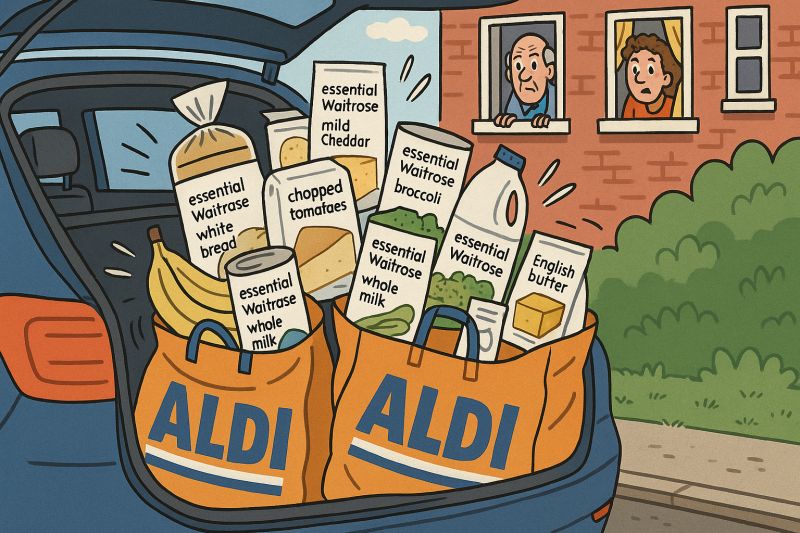
    A lady told the group how she still shopped at Waitrose, but when she got back home to unload her shopping from the car, she moved all the shopping into Aldi bags so her neighbours didn’t think she was a mug for paying over the odds.

    That single anecdote was probably the most important factor in getting the Waitrose Essentials range greenlit.

    Synthetic data doesn’t feel shame. Synthetic data has no neighbours.

    If we’d run synthetic groups around this problem, I guarantee you it would have confirmed our biases.

    We’d have patted ourselves on the back that we’d ‘done research’ on it.

    And then we’d have proceeded to come up with the wrong solution to the wrong problem, blissfully confident in our wrong-ness in the way that AI notoriously is.

    Waitrose Essentials turned around Waitrose’s fortunes during the financial crisis and its aftermath, reaching its highest ever market share of 4.8% by 2012, three years after launch.

    Who knows where it would be without that lady’s sense of shame and her nosy neighbours.

    (5) Oliver Waterstone | LinkedIn


  • RECORDING: Discover an Integrated Qual Platform That Streamlines Projects for Everyone

    RECORDING: Discover an Integrated Qual Platform That Streamlines Projects for Everyone

    Most qualitative research platforms have a learning curve, require you to operate in a sandbox, and are often expensive. You like Zoom, your respondents like Zoom. But what about situations when clients need to observe? Do you have to jump through hoops to prevent contamination between client and participants or pay a small fortune to provide virtual backroom to clients?

    What we will cover during this lunch and learn session is a ‘how-to’ – how to use your existing tech stack with platforms that enhance capabilities, not just replace them.

    Our thinking is simple. Zoom is a world leader in enterprise class online meeting SaaS. Why not have a qual research specific layer added on top of Zoom to turn it into an online qual research hub?

    Flowres is not just about a ‘Virtual Backroom’. Flowres has analysis layer that is well appreciated by researchers worldwide.

    Why should you attend:

    Discover how independent insight consultants can leverage tools like flowres.io to utilize the video capabilities of your Zoom or Teams subscription and streamline your online qual research  without paying ‘bloated’ platform costs.

    About flowres.io:

    Flowres is the all-in-one qual research platform built by researchers, for researchers.

    It seamlessly integrates with Zoom, Teams & Meet — no new logins needed for participants or clients. Includes a dedicated observer backroom, automated transcriptions, AI-assisted analysis, and real-time moment capture. flowres helps independents work smarter, deliver faster, and scale insight with confidence.

    About the presenters:

    Jiten Madia (https://www.linkedin.com/in/jitenmadia/) (Founder & CEO)

    Qualitative researcher at heart, Jiten has been a practitioner of qualitative research for 6 years early in his career. Jiten has spent time on both client and agency side working with consumer insights in different capacities.

    Maniish Karve (https://www.linkedin.com/in/maniishkarve)

    Maniish has extensive experience in running market research operations at scale for some of the largest agencies in the world. He has also been a data analytics practitioner on the latter part of his career.

    Privacy you can trust

    Flowres is GDPR-compliant, ISO 27001 certified, and aligned with MRS and ESOMAR standards. Your data stays within a secure, walled garden—never used for model training. We’ve signed data processor agreements with leading LLMs to ensure maximum confidentiality.

    Pricing https://flowres.io/pricing

    Exclusive for ICG members

    Get preferred access, hands-on support, and a 20% discount on monthly subscription. OFFER UNTIL 30 JUNE 2025

    Start your free pilot: Register here – https://flowres.io/signup

    Connect with us: hello@flowres.io

    Further reading/viewing

    Case Studies:

    1. Speedy response to fast turn-around report using flowres, by Elizabeth Kasumi

    https://youtu.be/-j1tNt8DuiM?si=KnJtVANW-BSb-O81

    2. Driving cost efficiency in Online Qual fieldwork

    https://flowres.io/blog/driving-72-percent-cost-efficiency-in-online-qualitative-fieldwork

    Testimonial:

    NRGMR: why Shannon adopted flowres, and the impact of flowres on NRGMR’s online qualitative workflow – https://youtu.be/ESVGkTb_Dno?si=ZJZDa3Gh45bvPw_u

    Watch this session here 

  • The Power of a Clear Baseline: Identifying What You Truly Need to Change

    The Power of a Clear Baseline: Identifying What You Truly Need to Change

    By ICG members Lara Meyer and Jeff Deighton.


    As independent researchers, we’re often asked to deliver fast solutions—both for clients and ourselves. But when business slows, confidence dips, or change feels inevitable, it’s vital to pause and understand what’s really going on.

    That’s where Baseline, the first step in our B.U.I.L.D.© framework, comes in. Just as we’d never evaluate campaign performance without a baseline metric, we shouldn’t attempt career, business, or mindset transformation without first diagnosing the root cause.

    Sometimes, what feels like a skills gap is really a mindset issue. Or what seems like a client’s indecision may be your own hesitancy showing up in the process.

    Through personal assessments, reflection, and strengths mapping, Baseline helps you uncover the hidden blockers—like self-sabotage, perfectionism, or lack of clarity—that can quietly hold your business back.

    In times of uncertainty, surface-level fixes don’t stick. Deep insight does.

    Download the B.U.I.L.D.©  Info Pack or get in touch with Lara and Jeff:

    Lara Meyer – lara@lara-meyer.com
    Jeff Deighton – jeff.deighton@insight-engineers.com

    (Ensure you mention you are an ICG member to access an exclusive 15% reduction on our 1:1 services)

     Read the full story here

    #MRX #GrowthMindset #BusinessTransformation #PerformanceDevelopment #BUILDframework #Baseline


  • QRCA Worldwide Conference 2025 is May 14-16 in Berlin!

    QRCA Worldwide Conference 2025 is May 14-16 in Berlin!

    By ICG members Pam Goldfarb Liss and Dave Kaye

    We are going. Are you?  Don’t miss the Early Bird deadline on March 26.
    REGISTER NOW! The rate goes up $300 after that, so it’s a really good time
    to register.

    The biannual QRCA Worldwide Conference (once every two years) is one of
    those must-attend conferences for qualitative researchers. It’s an intimate
    setting at the JW Marriott in Berlin with 100-130 qualitative researchers
    from all around the world with the smartest in the business talking about
    creative tools they use to make their practices shine. This conference is
    one of those special ones where you meet everyone and connect because
    everyone is together in the same room hearing from presenters in a plenary
    style. The event’s theme is ‘Qualitative Takes a Creative Turn in Berlin.’
    We have a calendar of amazing speakers too including keynotes that include
    Dali Tembo; Chris Arning and Daniel Plettenberg. It’s a great conference
    with an early bird rate that goes until March 26th. Please check it out at
    https://www.qrca.org/page/2025-worldwide-conference-central


  • Recording: Default Mode Network – the Brain’s House of Habit – What Every Researcher Ought to Know

    Recording: Default Mode Network – the Brain’s House of Habit – What Every Researcher Ought to Know

    This webinar has been generously sponsored by Norstat*


    Whilst we’ve all been having our head turned by the latest in AI, we should be paying attention to neuroscience too.

    Kath Rhodes from Qual Street will take you through her understanding of the ‘DMN’ and make the case that knowing about the DMN is foundational qualitative insight.  You’ll learn what the DMN is, and how it’s important to our qualitative understanding of ‘what’s going on’.

    Bonus offer – it’s pretty useful to know/ recognise the DMN in ‘real life’ too…

    Kath Rhodes

    Kath Rhodes

    Kath describes herself as a qualitative enthusiast and runs Qual Street.  She loves to dip her toe into the latest learnings on neuroscience, psychology and social science – using them to evolve and improve qualitative methods and approaches.

    https://www.linkedin.com/in/qualstreet/

    www.qual-street.co.uk

    Watch this webinar here


    *Norstat Creds here Norstat Creds Nov 2024*

  • RECORDING: Let AI Handle The Routine So You Can Focus on Growth

    RECORDING: Let AI Handle The Routine So You Can Focus on Growth

    Special deal from Yasna for ICG members – Promo Code:

    ICG300 (Activate by November 20; credits can be used afterwards).

    Get 1,000 credits for free (worth €300).

    1,000 credits = up to 100 interviews.
    Sign up here: https://yasna.ai/solution/for-research

    Freelance researchers, consultants, and small agencies are often limited in scaling their businesses due to the capacity of their workforces.

    AI tools like Yasna.ai open up new opportunities for solo researchers and small teams by automating the research interviewing process without compromising on quality.

    In the upcoming Lunch & Learn session, you’ll discover how to use an AI conversational agent to handle more projects, expand into new markets, and win clients — all without exceeding your working hours.

    Yasna.ai

    Yasna.ai is a platform for conversational research through automated interviewing. The AI moderator engages in one-on-one text chats with real respondents and then transforms the transcripts into meaningful summaries.

    Tanya Berlina Client Success Director at Yasna.ai 

    With more than 15 years in qualitative research, both offline and online, Tanya has conducted hundreds (or thousands, who counts?) of IDIs, FGs, and communities. She has carried out ethnographies and multicultural studies with much enthusiasm and is an early adopter of AI technology in market research.

    Website: https://yasna.ai/solution/for-research

    LinkedIn: https://www.linkedin.com/company/yasna-ai/ 

    Email: ask@yasna.ai 

    Yasna – AI-powered Conversational Agent – The ICG

    Watch this session here

    Slides from the session here