Topic: Research Output and Consultancy

  • RECORDING: Co-Creation in Today’s World and Beyond

    RECORDING: Co-Creation in Today’s World and Beyond

    This Knowledge Share will look at the highs and lows of creative workshopping, and what the future might have in store for us.  Drawing on decades (!) of experience between them Rebecca and Annabelle will grieve for what’s been left behind, share some ideas for the current day and look to future possibilities.

    This session is to provide tips and tricks and open up the floor for more inspiration and sharing of ideas on how we can adopt technology to be even more creative in our workshopping techniques in future.

    Our Presenters 

    Rebecca Harrison

    30+yrs ethnographic and qual expertise, Rebecca has conducted numerous workshops across multiple disciplines, topics, countries and cultures both off and on-line. Always looking to push the boundaries of insight and engagement, she’s keen to explore how to best use new or combined techniques to up the ante and ‘bridge the divide’ when it comes to online workshops.

    Annabelle Phillips

    Annabelle has worked in the insight sector for nearly 30 years, and led on Innovation during her time at Ipsos.  Much of her work sits at the intersection of public and private sector: communications, behaviour change, consumer understanding, and everything in between. She is a mixed method research with particular expertise in qual, ethnography and public dialogue workshops.

    Watch this session here (for ICG members only)

  • RECORDING: Why AI flattens qual data towards the average answer, and what it takes to stop it

    RECORDING: Why AI flattens qual data towards the average answer, and what it takes to stop it

    We welcome Alex Charlton, True Stories, to this Pitch Perfect.

    An LLM is a plausibility engine, not a truth engine. It hands you the most convincing-sounding answer, not necessarily the true one. Point it at your qual transcripts and it works from whatever it happens to surface – there is no stratified sampling across your dataset, no language balancing stopping the Spanish groups being drowned out by the English ones. What comes back is the middle of the distribution, fluently written, with the odd, difficult, interesting participant quietly gone.

    Even qual tools that do promise stratified sampling, simply place similar quotes in piles, then label the piles. This is data summarisation, not the analysis our clients pay us for. And then there’s the question of how we combine our own (human) intelligence with the artificial intelligence we’re working with. This is a minefield in and of itself.

    None of this can be fixed by better prompting. The fix has to live in the architecture around the model.

    By joining this session, expect a working demonstration, some lessons learnt along the way, and a sharper set of questions to put to any vendor who tells you their tool “understands” your data.

    Alex Charlton

    Alex Charlton is founder and Managing Director of True Stories. He specialises in qual research and previously founded two London-based insight agencies, Essential Research and Craft. Frustrated that the AI tools arriving in research were built by engineers who had never moderated a group, he spent nearly two years building the alternative himself – writing the platform alongside AI rather than briefing a development team, so that every architectural decision was made by someone who knows what good qual research looks like. True Stories launched in January 2026 and is now used by insight teams across four continents. He works from Medellín, Colombia.

    True Stories

    True Stories is an AI-powered analysis platform for qualitative research. It was built by a career qual researcher, and the design assumption throughout is that the researcher stays in charge: the platform does the reading, the retrieval and the structured analysis, and you lead the analysis, assisted by AI.

    Where other AI tools summarise data, True Stories analyses: drawing on 200+ marketing, consumer psychology and behavioural science frameworks to build a bespoke analysis pathway for each project. Analyses draw evenly across your data rather than sampling whatever the model finds most quotable, work in your participants’ original language without translating the nuance out, and carry confidence ratings. You can interrogate any output conversationally, push on it, then fold the conversation back into a revised analysis. Once analysis is complete, your project reports are generated automatically and include: a written mini-report, a story-driven debrief narrative, and an editable PowerPoint deck.

    True Stories: Human Intelligence. Amplified.

    www.truestories.earth

    Watch this session here

  • RECORDING: ICG Member AI Survey – Wave Three Results (With Discussion About AI Agents)

    RECORDING: ICG Member AI Survey – Wave Three Results (With Discussion About AI Agents)

    This webinar has been generously sponsored by Liveminds

    Come and join us at this ICG-member only discussion which will cover;

    • The results of the third wave of the ICG-member survey about AI (including responses to the questions about AI Agents) 
    • How these results  compare to previous waves
    • Further feedback and discussion about use of AI Agents*
    • Overall next steps for us all as Indies.

    With special thanks to those involved in this survey;

    Aakanksha Haran

    Aakanksha runs Smart Move Ventures, a UK data and research consultancy specialising in quant and qual methodologies, with a significant part of her business currently run via AI tools. She has run all three waves of the ICG AI monitor survey, the results of which will be shared. Aakanksha will be joined by her colleague, Swaraj Hanmante, who was heavily involved in the preparation of these findings.

    Tom Woodnutt 

    Tom is the founder of Feeling Mutual, a  strategic qualitative research consultancy. He has been a co-lead on the ICG AI survey initiative.

    Sally Alsop

    Sally Alsop

    Sally runs Agfora Ltd –  a market research consultancy that has been providing bespoke research services and strategic advice for almost 20 years.They provide qual and quant market research services for organisations operating in B2B and some of the trickier B2C sectors. Sally has been running the ICG webinar programme for many years.

    Watch this session here. NOTE THAT THIS IS RESTRICTED TO ICG MEMBERS ONLY.

    Wave 3 Survey Results here. NOTE THAT THIS IS RESTRICTED TO ICG MEMBERS ONLY.

  • QR Provides Practical Wisdom

    QR Provides Practical Wisdom

    Article written by ICG member Kevin McLean, first published on LinkedIn.

    More and more data, but less and less time

    More and more data but less and less time

    Marketers are surrounded by more and more data, with less and less time to deal with it. To adapt Coleridge’s famous poem, “Data, data, everywhere, / Nor any stop to think.”

    Given the increasing prevalence and sophistication of ‘qual (data) at scale’, what role should qualitative research have? Where does its real value lie?

    I presented a paper at the recent AQR World Conference to suggest an answer: practical wisdom. This is not a completely new concept* but it has particular relevance today.

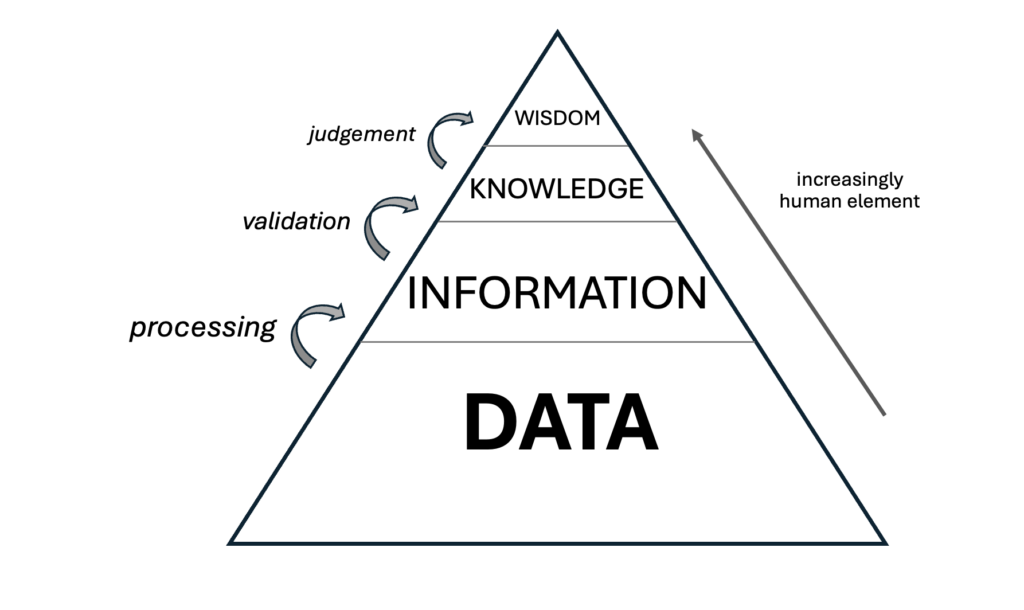
    By wisdom I mean a ‘higher order’ benefit than is afforded by data/information alone, as shown in this informational hierarchy chart.

    the ‘DIKW’ pyramid

    In the literature, the ‘wisdom’ part of this pyramid is less discussed than the other levels and some have questioned its relevance. Wisdom can sound rather abstract or lofty.

    So what do I mean by practical wisdom in the context of marketing and qualitative research?

    I argue that practical wisdom means the following five things:

    • standing in another’s perspective, not your own – ‘you are not your customer’
    • a deeper rooted understanding, not a superficial view
    • critical thinking, healthy scepticism, not taking things as they may first appear
    • flexibility/reflexivity, being able to adapt as or if things change
    • knowing how as much as knowing that, ie knowing what to do next and how to do it

    Seen in this way, qualitative research complements AI-based or automated forms of research, which are very cost efficient at providing information and analysing existing data. To quote Mohit B, VP, InsightAssist:

                  “The real value of research is not generating (data); it’s asking the right questions,      challenging assumptions and interpreting context. AI should amplify researchers, not    replace their judgement.”

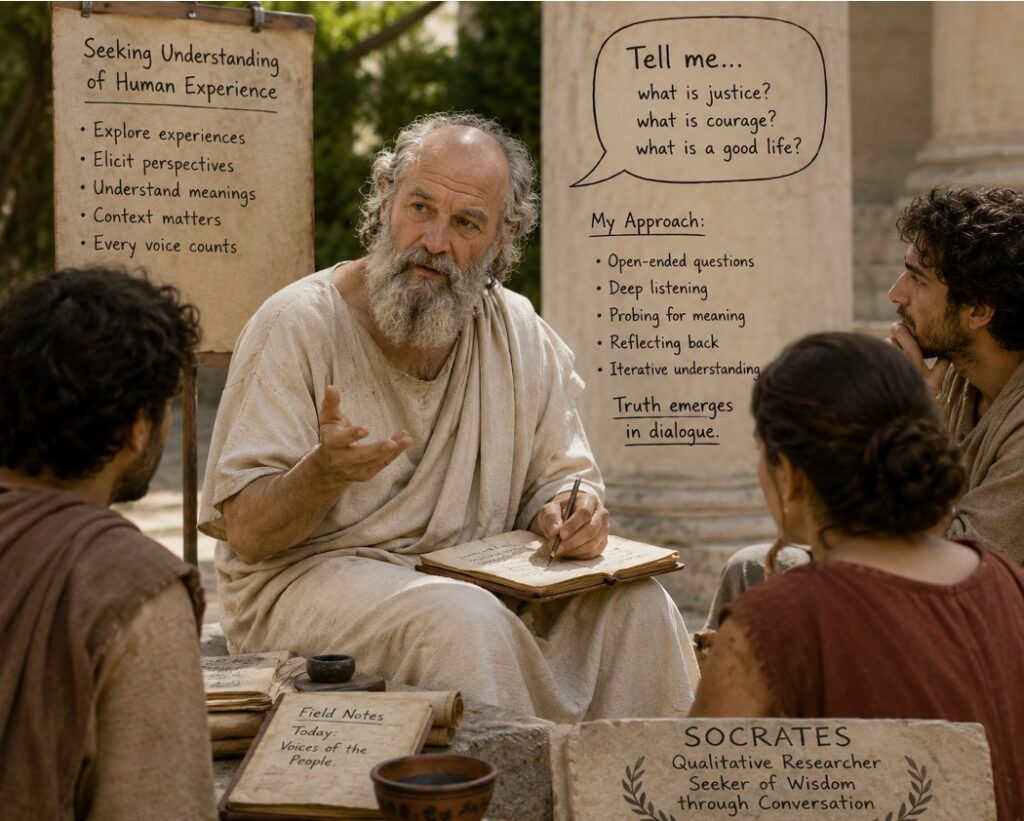
    * When I said this idea is not brand new, it’s at least 2,500 years old. Socrates, practised ‘phronesis’, usually translated as practical wisdom, applied know-how, derived from experience.

    Socrates, the OG researcher?

    Socrates, the OG researcher?

    Red Bull may give you wiiings, but qualitative research gives you wisdom. Literally.

    Kevin McLean (FMRS) | LinkedIn

  • How Insight Functions Reclaim Strategic Agency

    How Insight Functions Reclaim Strategic Agency

    Article written by ICG member Paul Griffiths, Client Advocates



    Customer insight teams often ask for a greater seat at the table. They want more influence over decisions, stronger stakeholder engagement and a bigger role in setting organisational priorities.

    Yet many are still stuck in a reactive cycle, responding to requests rather than shaping the agenda.  The most successful insight functions break out of this pattern. They develop agency.

    Before going further, it’s worth acknowledging an important reality. Most insight teams work within constraints. Priorities are often set elsewhere. Resources are limited. Stakeholders don’t always engage. Teams are judged by how quickly they answer requests rather than how effectively they shape decisions.

    Agency does not mean having complete control. Very few teams do. It means increasing your ability to influence decisions, priorities and conversations within the constraints you operate in.

    By agency, I mean the ability to influence what gets prioritised, what gets discussed and, ultimately, the direction of the insight function itself. It’s the difference between simply responding to business questions and helping shape some of the questions being asked, while bringing greater clarity to which questions matter most.

    The good news is that agency is not dependent on organisational structure, budget or seniority. While it can’t be built overnight, it can be developed deliberately over time. The most influential insight teams are valued not because they generate more research, but because they help organisations make better commercial decisions.

    In my experience, teams that steadily build agency tend to focus on three things:

    • Aligning their work to commercial priorities.
    • Building strong relationships with key stakeholders.
    • Developing the discipline and confidence to prioritise.

    The question, of course, is how. Below are the five key ways I believe any insight function can build agency strategically, drawing on the resources and locus of control available to them.

    1. Map and Prioritise Key Stakeholders

    Not all stakeholders have the same influence over organisational priorities, nor do they have the same relationship with insight.

    The first step is to identify the individuals and teams that are most critical to organisational success and assess the strength of your current relationships with them.This creates clarity about where time, effort and attention should be invested.

    Importantly, this doesn’t require a complex stakeholder management framework. Even a simple assessment of stakeholder influence, interest and relationship strength can help decide where to focus limited time and resources.

    2. Create Clear Accountability for Stakeholder Engagement

    Stakeholder relationships should never be left entirely to chance. Whether you lead a large insight function or operate as a sole practitioner, there should be clear accountability for maintaining relationships with key decision-makers.

    The most influential teams treat stakeholder engagement as a core responsibility, not something that only happens when a project is underway.

    In practice, this may be as simple as assigning ownership of key stakeholder relationships or ensuring regular check-ins take place. The goal is not more meetings. The goal is stronger connections to the people shaping business priorities.

    3. Set Up Regular Communication and Engagement

    Agency is built through continuous conversations. Create regular opportunities to understand stakeholders’ objectives, challenges and priorities. Equally importantly, use these interactions to prove how insight is already contributing to business outcomes.

    This doesn’t need to be resource intensive. A 30-minute monthly conversation with a key stakeholder can often reveal upcoming decisions, emerging risks or strategic opportunities long before a formal request arrives.

    Done consistently, these conversations help shape priorities before they become formal requests and ensure the insight agenda stays closely aligned with business needs. Over time, they also increase the likelihood that insight is brought into discussions earlier, when influence is often greatest.

    4. Build an Evidence Base of Commercial Impact

    Many insight teams create significant value but do a poor job of documenting it. Keep a record of where insight has influenced decisions, reduced risk, driven growth, improved customer experience or created operational efficiencies.

    This can be surprisingly simple. A shared log of decisions influenced, actions taken and outcomes seen is often enough to start building a meaningful evidence base.

    In organisations where stakeholders can see a clear connection between insight activity and business outcomes, insight teams are far more likely to be viewed as strategic partners rather than service providers.
    Agency grows when stakeholders can clearly see the value insight creates.

    5. Communicate Value Relentlessly

    One-off success stories are not enough. The most influential insight teams create regular channels that reinforce the value they generate, whether through stakeholder updates, internal content, presentations or strategic reviews.

    Visibility matters.

    People are far more likely to involve insight in future strategic decisions when they are consistently reminded of its contribution to earlier ones. The goal is not self-promotion. It is helping stakeholders understand how insight contributes to organisational goals and commercial outcomes.

    The Pay-Off

    These activities are often viewed as “nice-to-have” additions to the day job. In reality, they are the work that creates agency. They strengthen stakeholder relationships, increase commercial relevance and create the foundations for effective prioritisation.

    Agency creates leverage. It enables insight teams to move beyond responding to every request and focus more energy on the work that delivers the greatest commercial value. Of course, prioritisation is rarely about saying “no” outright. More often, it is about creating visibility of trade-offs. When a new request arrives, effective teams can explain which existing activities will be delayed, displaced or deprioritised as a result.

    These conversations become much easier when priorities have already been discussed and agreed with stakeholders. Once a clear strategy and agreed set of priorities exist, teams can have far more constructive conversations about new requests, competing demands and resource allocation.

    The purpose of an insight strategy is not simply to define what the team will do. It is to create permission to make conscious choices about what the team will not do.

    Agency Is Earned, Not Granted

    Too often insight leaders wait for agency to arrive through a new executive sponsor, organisational redesign or operating model. Agency is built much more gradually. It appears from consistently aligning insight with commercial priorities, investing in stakeholder relationships and demonstrating value over time.

    The most influential insight teams are not those that simply answer the most questions. They answer important questions well, while also helping the organisation focus on the questions that matter most. Agency is rarely granted in a single moment, and it is never absolute. Most insight teams will not suddenly become the primary driver of organisational priorities.

    But they can steadily increase their influence by becoming more connected to commercial decisions, more deliberate about stakeholder relationships and more disciplined about showing value. Over time, these small shifts accumulate.


    This was by Paul Griffiths, the founder of Client Advocates. He helps leaders of Market Research and Insight Agencies grow revenues through proven strategies. He supports Heads of Insight to increase their influence and budgets by more effectively generating commercial impact.

    With 25 years’ experience growing research agencies and working with client insight teams, Paul understands the challenges of delivering great work while driving commercial value. He’s worked agency and client side, selling and commissioning research, managing commercial relationships, and advising leaders in the UK and internationally.

    If you’re looking to grow your insight agency or adapt to changing market conditions, Paul brings practical strategies that work. Find out more via the Client Advocates website or LinkedIn.
  • RECORDING: Designing Presentations in Canva AI

    RECORDING: Designing Presentations in Canva AI

    Knowledge Shares are presented by ICG members, for ICG members only.

    Last year we did a whistlestop tour of Canva. This Knowledge Share now focusses just on creating presentations in Canva, particularly using Canva AI.

    We’ll start with setting up your brand kit, or your client’s brand kit, in Canva, to get consistent, reproduceable output every single time

    Then we’ll focus on Canva AI, what it can and cannot do, and how it compares to similar AI-presentation tools like Gamma or Beautiful.ai, and how you write effective prompts to save you time designing your slides.

    Our Speaker – Ramona Daniel


    I’m a cultural insights and research strategy consultant with over 25 years of experience at leading global agencies including Ipsos, Kantar, and across the WPP network. I now work independently, partnering with organisations that need senior-level expertise on a flexible, freelance basis. Clients value my ability to step into complex projects quickly. My work bridges strategic thinking and hands-on delivery, from designing multi-market research programmes to translating data into compelling cultural narratives. I specialise in helping businesses decode cultural shifts, optimise research processes for greater efficiencies, and upskill teams – particularly at the intersection of traditional research methodologies and AI-driven analytics tools.

    https://www.linkedin.com/in/ramonadaniel/

    Ramona Daniel, Author at The ICG

    https://www.23insights.co.uk/

    Watch this session here (ICG members only)

    Slide Deck here 

  • Complexity

    Complexity

    This is part of a series of short pieces by ICG member Stefania Gogna that she wrote on LinkedIn. They explore emerging cultural signals and semiotic perspectives on marketing and consumer behaviour.


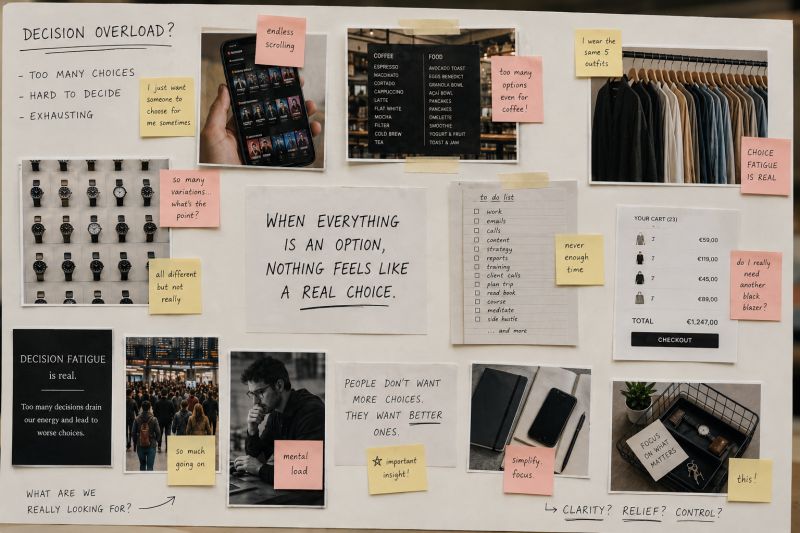
    Consumers say they want freedom, but culturally, they increasingly seek reduction.

    For years, markets celebrated abundance: that means more options, more customisation, more content, more access.

    But across categories, the most desirable experiences are becoming simpler, narrower and more curated.

    For example:

    Apple reduces complexity through its ecosystem. Fashion is shifting toward uniforms and quiet luxury. Food trends reward short ingredient lists and “clean” labels. Hospitality increasingly sells calm, silence and disconnection.

    Even social status is moving from displaying abundance to displaying control.

    What once felt liberating now often feels exhausting.

    In a culture overwhelmed by possibilities, reduction starts feeling premium.

    Maybe people are no longer searching for freedom: They’re searching for relief.

    This image shows the experimental board created during a focus group on decision fatigue.


    More insights from Stefania along these lines can be found on LinkedIn here.

  • RECORDING: Beyond the Slide Deck: Why Dashboards are the Secret Weapons for Independent Consultants

    RECORDING: Beyond the Slide Deck: Why Dashboards are the Secret Weapons for Independent Consultants

    How to utilise dashboards to deliver more value, win back your time, and future-proof your consultancy (even when clients don’t ask for one).

    We welcome DataTile to present this Pitch Perfect. 

    As an independent consultant, your expertise is your product, yet far too much of your time is likely swallowed by the manual “grunt work” of formatting slides and re-running tables. This webinar is about reclaiming that time. We will explore how moving beyond the static PowerPoint deck allows you to stop being a “supplier” and start being a strategic partner. By offering interactive, branded dashboards, you don’t just eliminate the headache of last-minute client requests for “one more cross-tab”—you deliver a high-end, digital asset that keeps your clients coming back. Join us to see how you can provide “big agency” sophistication and seamless data automation while keeping your business lean, agile, and significantly more profitable.

    Session Structure

    1. The PowerPoint Trap: Why static reports limit your earning potential.
    2. The Hidden Demand: Why clients love dashboards once they see their own data in them + examples demonstration
    3. A Live Demo: Transforming a dataset into an interactive environment in minutes.
    4. The Solo Professional Package: An exclusive look at the new DataTile tier designed for ICG members.
    5. Q&A

    DataTile

    DataTile is a specialised analytics and reporting hub designed to streamline everything that happens from the moment you close your fieldwork. For the independent consultant, it replaces a fragmented workflow of datasets, spreadsheets and slide decks with a single, professional environment. The platform empowers you to host large-scale datasets, perform sophisticated statistical tests—such as TURF or correspondence analysis—and instantly transform those results into interactive, client-ready dashboards.

    The platform’s real value lies in automating the “heavy lifting” of data management. By utilising the integrated AI Text-Refiner for rapid open-ended coding and automated charting features, you can eliminate the hours usually wasted on manual data entry and slide formatting. This allows you to pivot from data processing to high-level strategic consultancy, delivering a digital output that rivals the sophisticated reporting of major global agencies.

    Speakers

    Svetlana Dosumova, Client Success Director


    With a background rooted in psychology and over a decade of hands-on experience in market research and product management, Svetlana knows how to make data work for people. Her career includes senior positions at both market research agencies and on the client side.

    Now serving as Client Success Director at DataTile, Svetlana is passionate about research operations and automation. Today, she focuses on helping research teams streamline their reporting and build intuitive dashboards, ensuring clients get the most practical value out of the DataTile platform.

    Watch this session here

    Presentation slides here

    Want to trial DataTile for free? Contact Svetlana below to redeem and/or to answer your questions.

    svetlana.dosumova@datatile.eu

    www.linkedin.com/in/dosumovasvetlana

  • Designing Presentations with Canva AI

    Designing Presentations with Canva AI

    Knowledge Shares are presented by ICG members, for ICG members only.
    Last year we did a whistlestop tour of Canva. This Knowledge Share now focusses just on creating presentations in Canva, particularly using Canva AI. We’ll start with setting up your brand kit, or your client’s brand kit, in Canva, to get consistent, reproduceable output every single time Then we’ll focus on Canva AI, what it can and cannot do, and how it compares to similar AI-presentation tools like Gamma or Beautiful.ai, and how you write effective prompts to save you time designing your slides. Our Speaker – Ramona Daniel I’m a cultural insights and research strategy consultant with over 25 years of experience at leading global agencies including Ipsos, Kantar, and across the WPP network. I now work independently, partnering with organisations that need senior-level expertise on a flexible, freelance basis. Clients value my ability to step into complex projects quickly. My work bridges strategic thinking and hands-on delivery, from designing multi-market research programmes to translating data into compelling cultural narratives. I specialise in helping businesses decode cultural shifts, optimise research processes for greater efficiencies, and upskill teams – particularly at the intersection of traditional research methodologies and AI-driven analytics tools. https://www.linkedin.com/in/ramonadaniel/ Ramona Daniel, Author at The ICG https://www.23insights.co.uk/

    Register for this session here (ICG members only) 

  • RECORDING: AI for Depth, Not Just Speed: A Platform Built by Researchers, for Researchers

    RECORDING: AI for Depth, Not Just Speed: A Platform Built by Researchers, for Researchers

    Join us for this Pitch Perfect with Alok Jain, founder of DoReveal, and also now an ICG member. 

    About DoReveal

    Built by researchers, for researchers, DoReveal is an AI-assisted qualitative research platform designed with a craft-first mindset. It supports researchers in developing accurate, nuanced, and in-depth insights, rather than simply accelerating output. The platform reflects real research workflows, helping teams move from raw data to clear, well-structured, and evidence-based findings.

    DoReveal is used by over 100 researchers, including independent practitioners, boutique agencies, and organisations such as Snap, Amazon, and Kantar. As one customer put it:

    “It makes us more thorough. It makes us better and more competent.”

    What You’ll Learn

    This session will provide a practical walkthrough of the DoReveal platform, illustrating how qualitative researchers can move from raw interview data through structured analysis to report-ready outputs.

    • From interviews to insight
      How to go from interview recordings to synthesized findings and report-ready outputs.
    • AI that supports depth, not shortcuts
      Using AI to enhance critical thinking, not bypass it—keeping the researcher in control of interpretation.
    • Working with research frameworks
      Applying structured analysis approaches to achieve rigor, clarity, and depth in qualitative work.
    • Researcher-first workflows
      How DoReveal aligns with how qualitative research is actually conducted, rather than forcing rigid processes.
    • Transparent, project-based pricing
      A practical look at affordability for small teams, with simple and predictable pricing.

    Alok Jain

    Alok Jain is a research professional with over 30 years’ experience and the Founder and CEO of DoReveal, an AI-powered synthesis platform designed specifically for qualitative researchers.

    Prior to founding DoReveal, he led research, strategy, and design initiatives at organisations including the World Bank, BNP Paribas, Carfax, Capital One, and Centene Corporation.

    Alok Jain | LinkedIn

    Alok Jain, Author at The ICG

    DoReveal – Transforming Research with AI-Powered Insights


    Watch this session here 

     Summary Doc DoReveal