Topic: Research Output and Consultancy

  • Recording: Squeezed – Telling HSBC UK’s Cost of Living Story with Video

    Recording: Squeezed – Telling HSBC UK’s Cost of Living Story with Video

    This webinar is generously sponsored by Qualzy, the quality insights platform


    ICG members Dan Young (Shed Research) and Daniel Parker-Smith The Word is Out used insight synthesis and video animation to build a powerful story of what the cost-of-living meant for HSBC UK and its customers. We blended real-life stories and news footage with data from our research synthesis – using Netflix documentaries as our inspiration. Our hard-hitting video was shown through the Bank and our “six things you need to know” became the foundation of its cost-of-living response.

    Attend this webinar to find out more about this inspiring and innovative piece of work.

    Dan Young

    Dan Young runs Shed Research. Dan helps insight teams do more with their existing research – either by synthesising their insight, or by training them to do it themselves. In 2020, he was the proud winner of the AURA Agency Speaker and MRS/ICG Independent Consultant awards.

    Dan Parker-Smith

    Dan Parker-Smith runs The Word Is Out, specialists in producing videos for the market research sector. With a research background, Dan’s approach uncovers genuine stories from real people, delivering inspiring insight through video and collaborating with agencies to bring video to their projects.

    Social media / web links:
    Shed = W: www.shedresearch.co.uk / X: @danielowenyoung
    TWIO = W: http://www.the-word-is-out.com/ / X: @TheWordIsOutNow

    Watch the webinar here 

  • Data Visualisation & Storytelling – 5 tips!

    Data Visualisation & Storytelling – 5 tips!

    ICG member Elliot Fern, Fern Insight, shares his top tips for data visualisation and storytelling. These include;

    • Understanding the context
    • Choosing an effective visual
    • Eliminating clutter
    • Focusing attention with colour, shapes & font
    • Telling your story with a focus on a call to action.

    Full article here 


  • Driving Together the Say-Do Gap in Research

    Driving Together the Say-Do Gap in Research

    By ICG member Kevin McLean, Wardle McLean 

    Pic: Goofy in Disney animation, Motor Mania


    I’ve been researching motor insurance. Before you glaze over, it has revealed both a Fundamental Truth about human nature and a persistent marketing ‘blind spot’.

    The FT is the (in)famous ‘say-do gap’. People don’t do what they say, or say what they do, especially in a research context. Specifically, what people say (testimony, attitudes) is a very poor predictor of what they then do (behaviour).

    In our study, 86% of our sample said that they believed they were good drivers. This is backed up in other studies.

    How to deal with the say-do gap in research, given that we cannot change human nature? In his excellent recent article, The Say-Do Gap in Driving Behaviour, Simon Shaw of Trinity McQueen outlines three key steps:

    • use multiple sources/methods
    • get real ie study actual behaviour (as well as reported behaviour)
    • do this over time, rather than as a one-off snapshot

    But it goes even further: the say-do gap is a perennial marketing issue due to a  confusion between two communication modes. Organisations often use the rules of the first mode to judge speech in the second mode.

    In ‘contract mode’, statement and behaviour are directly and explicitly connected. The ‘keep off the grass’ sign on the lawn, marriage vows or sworn legal testimony, are examples of contractual speaking, tied to behaviour, occurring within an agreed frame of reference.

    But most interactions are in ‘conditional mode’, where speech is conditioned by a host of factors, such as context, what’s at stake, who is speaking and why, the emotions at play. ‘I’ll go the gym 3 times per week’, ’14 units of alcohol per week’, ‘Let’s have a coffee some time’, are all be examples of this mode.

    Qualitative research tries to recognise and mediate between these different modes. Client organisations (in contractual mode) may want the public to do X, for Y reasons; the public may or may not want to do this, it all depends, but will nod and smile in either case.

    Driving is a great example of ‘mode confusion’. The question ‘have you broken the speed limit’ is asked in contract mode, directly about a specific behaviour, but is received conditionally, ie the framing changes, leading to a communication mismatch, similar to the famous Larson cartoon:
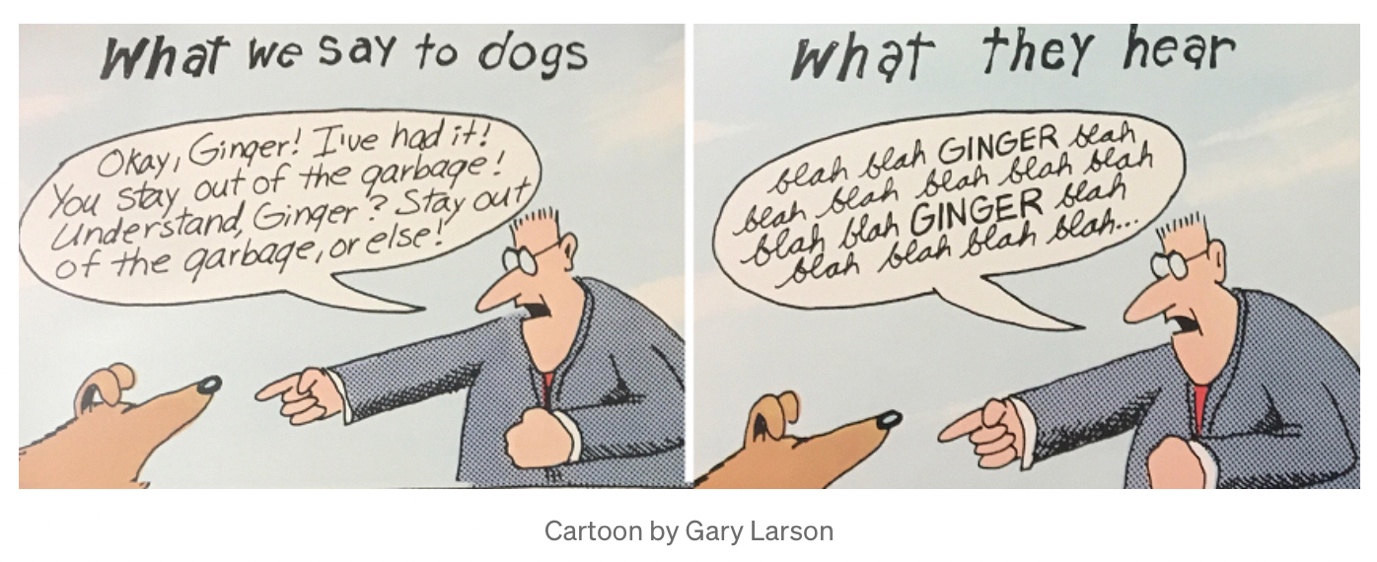
    Breaking the speed limit is illegal and potentially dangerous; the question carries social and psychological ‘baggage’ and brings a host of other questions eg what is at stake, what should I say, have I gone too fast by mistake etc? How people answer a question, in research and in life generally, reveals how they position themselves, not what they do.

    One final point, let’s call it the ‘say-do switcheroo’: rather than studying how attitudes (testimony) predict behaviour (spoiler alert, they don’t), why not look at how behaviour affects attitudes?

    In our study on driving behaviour, we looked at how feedback loops inform drivers. This is increasingly common with newer cars, which nudge us with various beeps and dashboard signs (car ahead is moving off, lane assist, parking sensors etc).

    With telematics feedback, drivers see for themselves whether and how often they have strayed over the speed limit, braked or accelerated harder than normal, etc. Reflecting on this behavioural information seemed to affect how people then spoke about their driving.

    With the right design and with enough time, research can learn about behaviour and use behavioural input deliberatively to close (and reverse) the say-do gap and thus suggest ways of changing behaviour.

    Summary:

    • the say-do gap is a people thing, not just a research thing
    • knowing it is there and how it operates (cf communication modes) is the first step
    • using multiple research inputs, including actual behaviour and feeding this back
    • over time allows for behaviour to inform testimony, for more accurate insight.

    http://www.wardlemclean.co.uk/

  • RECORDING: Knowledge Share: An Introduction into Insight Synthesis

    RECORDING: Knowledge Share: An Introduction into Insight Synthesis

    This Knowledge Share has been generously sponsored by Opinion Hub

    Insight budgets are under pressure. Rather than commission new projects, our clients are being asked to do more with what they already know. In this introduction to insight synthesis, we’ll show you how to maximise the value in your client’s existing research.

    We’ll cover:

    – Why you should synthesise your insight

    – Four simple steps to follow

    – Tools and techniques to help

    – And pitfalls to avoid

    Dan Young

    Dan set up Shed Research to help organisations make more of their existing research. In the past year, he’s been doing this for HSBC UK, Cancer Research UK, General Mills, Guide Dogs, and BSH Group (the people behind Bosch and Siemens). In 2020, Dan was fortunate enough to win the ICG/MRS Independent Consultant Award. He’s a frequent speaker on the topic of insight synthesis and regularly trains insight teams how to make more of their existing insight.

    Shed Research Consulting

    +44 (0)7980 988 762

    RECORDING HERE 


  • Get Ready for the Future of Market Research: How Qualitative Insights are Game-Changers!

    Get Ready for the Future of Market Research: How Qualitative Insights are Game-Changers!

    In today’s ever-changing business world, market research has always been key to making smart decisions and shaping winning strategies for all kinds of companies.

    Technology is totally changing our lives, and guess what? Market researchers need to keep up with the times and embrace new tools and methods to really get into the nitty-gritty of how consumers act.

    In this article, we’re diving deep into what lies ahead for market research, specifically highlighting the incredible power of qualitative research.

    Get ready to see how this field is about to shake things up and totally transform how businesses understand their customers!

    The Incredible World of Qualitative Research: Qualitative research has always been a fantastic way to really get inside the heads of consumers and understand what they think, feel, and what gets them going. Back in the day, it mostly involved face-to-face chats, group discussions, and sneaky observations to catch all those little human behavior details.

    But how about now? The digital age has opened up new and exciting possibilities for qualitative research, giving researchers a bunch of cool tools and techniques to explore.

    Digital Ethnography (the big thing!): One amazing development in qualitative research is digital ethnography. With everyone using social media and online communities, researchers can now observe and interact with consumers right in their natural digital habitats. By analysing online conversations, comments, and stuff people create, researchers can get real-time insights into how consumers see brands, products, and trends. It’s a unique chance to understand the context in which people make choices and see how consumer culture keeps changing.

    Mobile Research (so hot right now!): Thanks to smartphones and awesome mobile apps, mobile research is all the rage. Researchers can now engage with consumers in the moment, capturing their experiences and emotions as they happen. Things like mobile diaries, video ethnography, and location-based research are just a few examples of how qualitative researchers can tap into the power of mobile technology to get deeper insights. This shift to real-time data collection not only reduces forgetfulness but also gives us a more authentic understanding of people’s lives.

    AI and Automation (the new kids on the block!): Artificial Intelligence (AI) and automation are totally transforming the landscape of qualitative research. Now, we have super-smart algorithms using Natural Language Processing (NLP) to analyse huge amounts of text data, like open-ended survey responses and online reviews, at lightning speed. These algorithms can even detect sentiment, identify topics, and figure out emotions, giving researchers a number-based understanding of qualitative data. It’s like finding patterns and trends that used to take forever to find manually. The mix of AI and qualitative research is a game-changer, making analysis much easier so that researchers can focus on getting useful insights.

    Virtual Reality and Immersive Research (the cool stuff!): Virtual Reality (VR) is becoming a seriously cool tool for qualitative research, especially when physical presence isn’t possible or costs too much. VR simulations let researchers recreate real-life situations, so participants can experience immersive scenarios that are just like their everyday lives. By watching and interacting with consumers in these virtual worlds, researchers get super deep insights into what they like, how they act, and how they make decisions. VR is perfect for things like ethnographic research, testing products, and even creating virtual focus groups. It helps researchers overcome distance barriers and reach all sorts of participants.

    The Bright Future: As the world of market research keeps evolving, qualitative research is going to be more and more important for understanding how consumers tick. By using innovative technologies and methods, researchers can find deeper insights that capture the subtleties of consumer decision-making in a changing world. When we bring together AI and automation, digital ethnography, mobile research, and immersive tech, we unlock crazy opportunities for businesses to truly connect with their target audiences.

    It’s all about creating customer-focused strategies and driving innovation.


    Stefania Gogna, ICG member and Semiotician and Marketing Researcher

    https://theicg.co.uk/member/infostefaniagogna-com/

    https://www.linkedin.com/in/stefaniagogna/

  • Recording: Knowledge Share: How to Create Highly Visual and Engaging Research Outputs

    Recording: Knowledge Share: How to Create Highly Visual and Engaging Research Outputs

    This Knowledge Share has been generously sponsored by E-Tabs, bringing cutting edge automated charting for your projects in PowerPoint & Google Slides

    This Knowledge Share will be presented by ICG member Barry Clark, Related Stories. 

    There is a growing client requirement for “highly visual and engaging” outputs to research projects.  Related Stories addresses this need through a combination of photography, ethnography and interviews.  In this session, Barry will discuss his approach and his motivations.

    Related Stories

    https://www.linkedin.com/in/barry-clark-28035314/

    LISTEN TO THIS FREE KNOWLEDGE SHARE HERE

  • How to Make Better Decisions

    How to Make Better Decisions

    ICG member Toby Collins provides an action plan to minimise biases in our everyday lives in order to make better decisions. Toby writes …

    A couple of weeks ago I posted a graphic (from the Visual Capitalist) showing 50 of the most common cognitive biases. Some biases were known concepts such as the bandwagon, stereotyping or placebo effects, while others were less well known but were instantly recognised by readers of the post.

    This resulted in requests to understand how to minimise these biases in everyday lives and make better decisions.

    To provide strategies to combat these biases, we first need to understand them. Put simply, cognitive biases can occur when learnt associations and shortcuts (system 1 thinking or heuristics) are applied to a situation allowing a choice or judgement to be made quickly and easily. This happens when an individual focuses on the most relevant aspects of a problem to develop a solution. Unfortunately, these shortcuts are a common source of bias.

    Deliberative reasoning (system 2) would likely yield a better outcome. It should be noted that bias can also occur in flawed system 2 thinking due to factors such as cognitive ability, information considered or laziness.

    So the simple answer to the question of how to reduce the impact of biases on your decision making is to stop and think about a decision more carefully and broadly.

    Below are a few suggested behaviours and techniques to do this more successfully: ensure that you are in a position to concentrate and allow your brain to evaluate; allow time to think; and avoid making important decisions when you are stressed, fatigued, multitasking or are being distracted.

    1) Become more aware of the biases. The Cognitive Bias Codex identifies around 180 in total, and they are grouped into 4 groups:

    • Memory: Biases that affect our recall of people events and information
    • Too much information: Biases that affect perceptions of people and event
    • Too little information: Biases for filling in the gaps
    • Need to act fast: Biases that affect how we make decisions

    Also, certain biases are prevalent in certain types of decision making (e.g. in investments), so if you can be particularly aware of them while making a choice in those areas.

    2) Become more self-aware and understand which ones you are most susceptible to. Review your current behaviour and previous decisions. What were the outcomes and what reasoning did you use? How could you have achieved a better outcome?

    3) Take an outside view, having somebody with a different viewpoint to challenge your objectives, your thinking and assumptions can be useful, and they may spot your biases.

    4) Challenge your thinking as a part of your consideration. What are the weaknesses in your thinking? Are your assumptions correct? Consider your objectives individually to generate more options to consider. When planning for the future, allow yourself to consider multiple scenarios, not just the most likely one.

    In summary, these biases are part of being human and we are all affected by them to varying degrees. To reduce their influence, and hopefully make better decisions, try to become more aware of the biases and which ones influence you most, get alternative perspectives and give yourself time and the mental tools to stop and think.

    Hopefully, this article has provided a concise overview and provided some simple practical tips to make better decisions, but as with everything nowadays, there are apps to help us.

    References

    https://www.visualcapitalist.com/50-cognitive-biases-in-the-modern-world/

    https://upload.wikimedia.org/wikipedia/commons/c/ce/Cognitive_Bias_Codex_With_Definitions%2C_an_Extension_of_the_work_of_John_Manoogian_by_Brian_Morrissette.jpg

    https://play.google.com/store/apps/details?id=ru.free_coding.biascs

    https://positivepsychology.com/cognitive-biases/

  • Zoom Presentations – How to Keep Your Audience Engaged

    Zoom Presentations – How to Keep Your Audience Engaged

    In the post Covid world, we are finding that we are increasingly conducting meetings and presentations online – but how do you keep your audience engaged when they are in disparate locations and possibly subject to all sorts of distractions? This was a question posed on the e-group, and which generated a lot of helpful suggestions from the ICG Hive which we have summarised here.

    • The key is engagement; if they are on video during the presentation, at least they can’t be doing their emails or IM’ing colleagues (possibly about your presentation!) but if they are just on audio bear this in mind i.e. they might not be focused on you and you need to find a way to get them to stop messaging/checking their email, proofing a document etc … Having the opportunity to see at least some reactions is such a help and limits the amount of diversionary activity by the less engaged.
    • Unfortunately it seems a lot of clients are having bandwidth issues when working from home and they often switch off video even when they are genuinely interested, so being on audio only is not a foolproof engagement check.
    • The part I’ve found hardest is that on some video platforms (eg Google meet) you can only see your screen (unless there’s a setting I’ve missed!) and it can feel like you’re presenting into a black hole. Sometimes (depending on platform) when sharing my screen I have “lost sight” of the participants – and given that most seem to sit with their microphones on mute (and they sometimes switch video off as well to save bandwidth) it really feels like talking into the void – there just isn’t the visual feedback of a nodding head or whatever you would usually get. I really miss being able to spot the odd furrowed brow where it’s clear someone doesn’t agree/ understand even if they’re keeping quiet.
    • I’d suggest keep asking questions of the audience and requesting feedback; permit questions throughout – essentially, don’t make it a broadcast exercise.   One tip is to ask people to save questions for the end of a section, but not right until the end. This avoids being constantly interrupted, but also means people are expected to contribute at certain intervals. You could have some questions prepared to ask them at these points – eg. how close is this to what you expected, what would you have expected to see differently, what does this mean for the business do you think, etc. etc. That way people feel more included, but also it will mean they will potentially listen more closely if they think they have to take part in a discussion at some point.
    • It might also be a good idea to set rules about the chat function as well – I’ve had some people use that rather than interrupt, which can be helpful if you have a way of dealing with it mid-flow, or really distracting if you don’t…
    • Otherwise it’s all the normal good presentation stuff – don’t read the slides, keep the slides clean colourful and relevant, tell a story, focus the slides (and hide a lot), bring in lots of extra insight and illustrations from the research in your voice over and so forth.  Maybe add some polls and some other interactive exercises if the content permits. Several presenters should help too, as long as the story flows nicely.
    • Mentally breaking anything down into smaller components works wonders for keeping people’s attention, so it is probably worth saying up front that there are X number of sections and each will take X amount of time, so you manage expectations and people aren’t sat there thinking god, how much longer 😉
    • If it is a monster then a comfort break halfway through could be suggested upfront (ie. with your specific client) – it might be appreciated and would give everyone a chance to check emails / go to the loo so they don’t just switch off and do those things as you’re going through!
    • Beware of video or audio clips- make sure you check it works (with the sound, which is usually the problem) in advance – that ‘audio permitted’ box is quite hidden for shared content in Teams and in Zoom  (bottom left hand side of the share content element usually – and disappears too quickly, especially in Teams).  Test it in advance with a colleague, or your immediate insight contact.  They want to look good too 🙂
    • And on a positive note, it may be that the online enviornment improves things. Particularly with senior teams there is less of the boardroom sparring (i.e. asking a question just to show to the CEO that your smarter than the last person who asked a question….) and they do genuinely listen and wait until the end for questions.