Topic: Research Output and Consultancy

  • RECORDING: Small But Mighty – Large Scale Reporting With Lean Resources

    RECORDING: Small But Mighty – Large Scale Reporting With Lean Resources


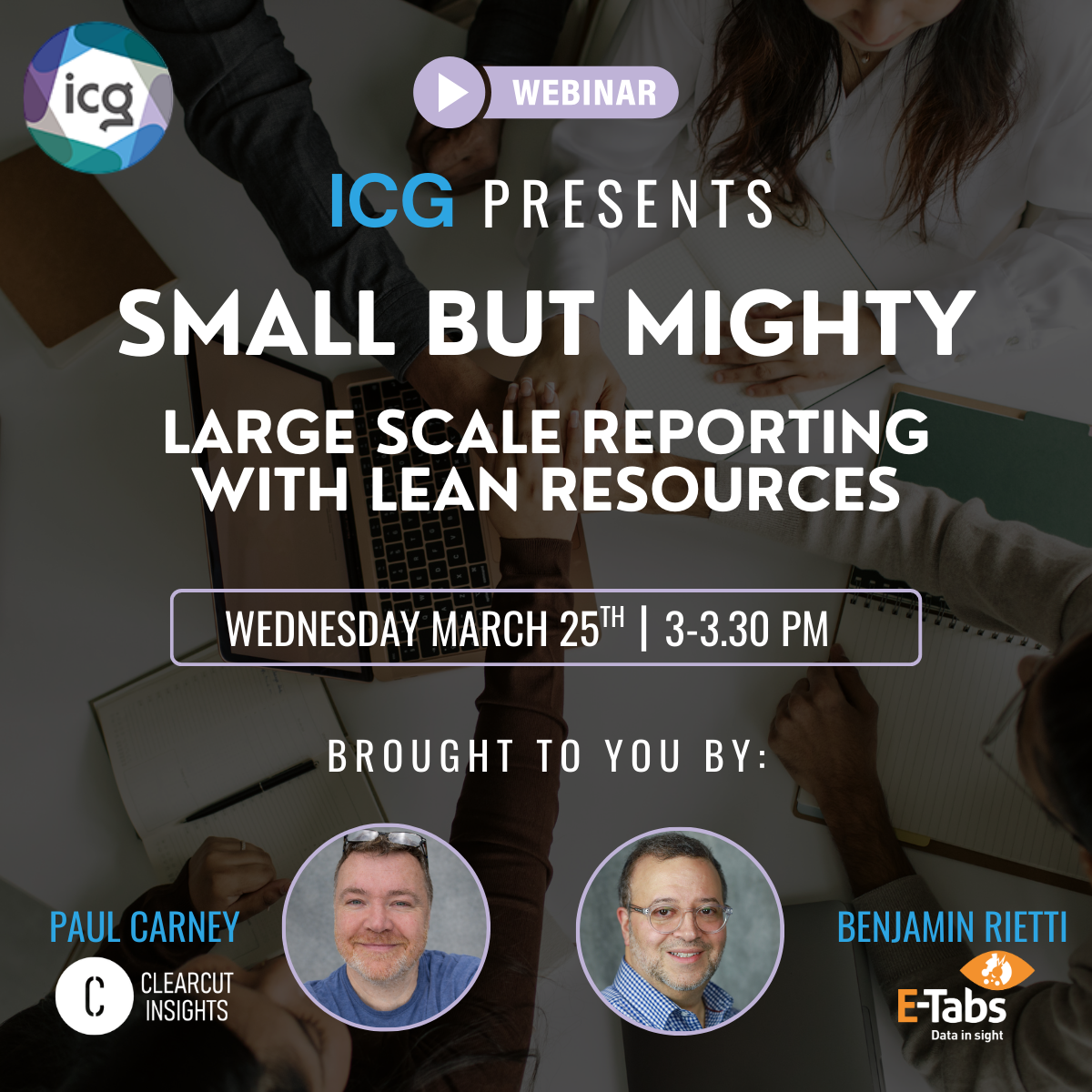
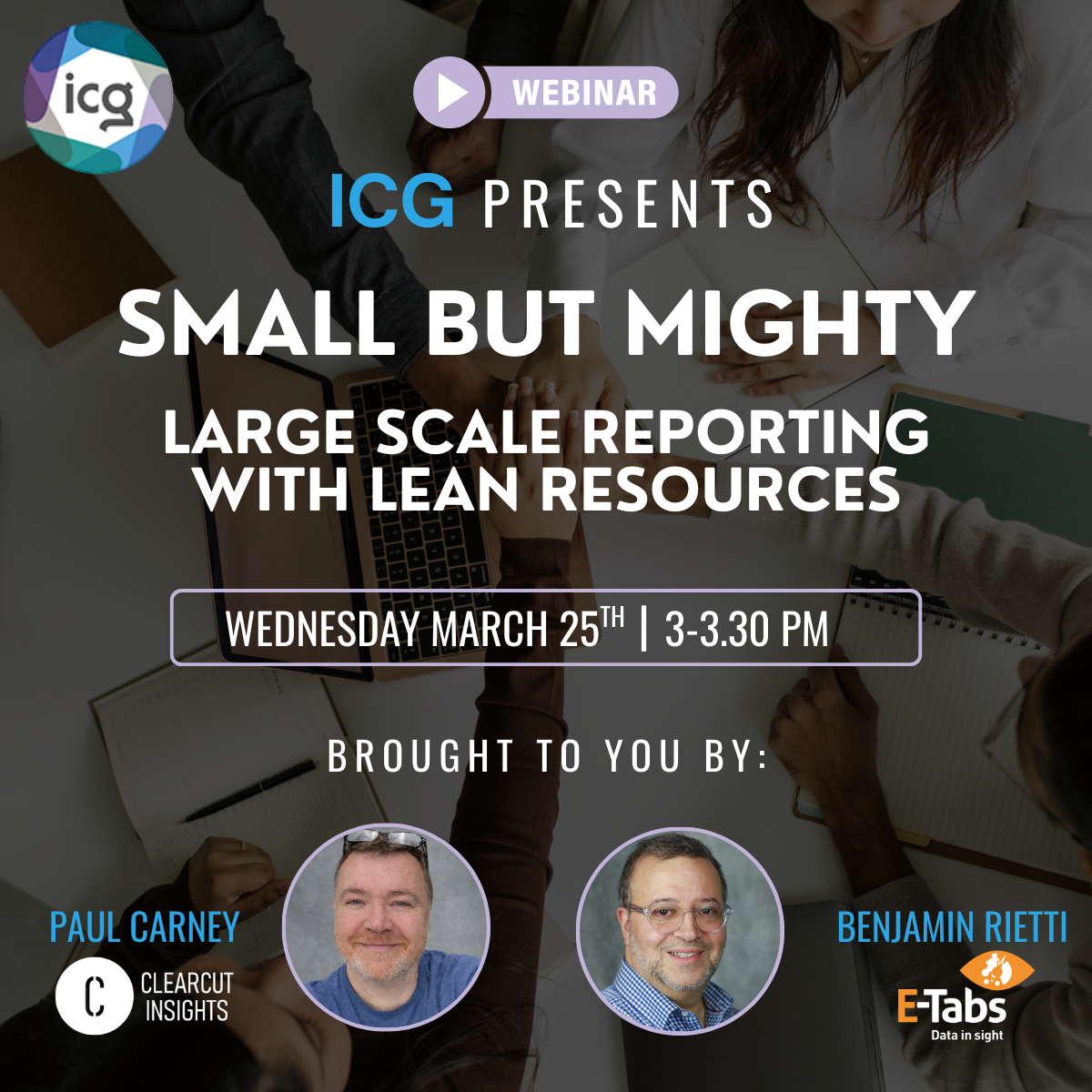
    In this case study Lunch&Learn, ICG Member Paul Carney of ClearCut Insights shares how he used automation – transforming what is traditionally a time-intensive reporting challenge into a streamlined, repeatable process with standout results.

    For smaller companies and independent market researchers who are juggling delivery, analysis and client expectations, reporting often becomes the biggest bottleneck.

    In this session, you’ll discover how automation can fundamentally supercharge the way PowerPoint and Google Slides reports are created – moving from arduous, manual slide building, to faster, more consistent, insight-led outputs, generated directly from original data sources.

    Automation is not just about saving hours (though you absolutely will). It is about:

    • Eliminating manual errors and last-minute fixes
    • Reusing templates easily across markets, waves and data cuts/segments
    • Freeing up time for interpretation, recommendations and more analysis/insights
    • Delivering polished, scalable outputs in a fraction of the time without needing a larger team

    If reporting is eating into your time, this session is for you.

    Speakers: 

    Benjamin Rietti, CEO, E-Tabs

    Benjamin Rietti is the CEO of E-Tabs. His innovative approach has seen the company provide reporting services and solutions to the MR industry for over 30 years. With over two decades of industry knowledge, Benjamin is a talented entrepreneur who recognises the integral role technology plays in market research. A doting family man, he enjoys spending time with his children and grandchildren and has a passion for skiing.

    https://www.e-tabs.com/    linkedin.com/in/benjaminrietti

    Paul Carney, Owner, ClearCut Insights

    Paul has over 25 years of experience in designing, running and deploying multi-country segmentations into some of the world’s largest organisations. He has run Research International’s Marketing Science Centre, was Managing Director of Bonamy Finch, and most recently, was a board member of STRAT7, and a Partner in their Advisory team. Paul set up ClearCut in 2024 to work more closely with client teams on building and embedding strategic segmentations.

    https://theicg.co.uk/member/paulclearcut-insights-com/

    About E-Tabs:

    E-Tabs has been providing award-winning, leading data visualization and reporting solutions to the market research industry for over 30 years. We help businesses all over the globe boost their productivity and engagement by making the process of producing their reports and visualizations quick, simple and cost effective.

    E-Tabs – Global Report Automation Leaders

     

    Watch this session here

  • RECORDING: Transform Historical Research Data into Compelling New Stories

    RECORDING: Transform Historical Research Data into Compelling New Stories

    In this session hosted by QuestionPro’s Senior Account Manger Oku Egho, you’ll learn how to add multiple surveys onto their intuitive data visualisation and charting platform, Business Intelligence. If you’re struggling with limited funds, why not utilise existing survey data and create engaging new infographics, splicing data to produce narratives that will cut-through to give your customers that competitive edge.

    What you’ll learn 

    • Create interactive Data Vis to help showcase data and tell engaging stories
    • Build dashboards from multiple surveys in minutes not hours
    • Utilise smart widgets and fully customisable dashboards to build baseline reports representative of your brand
    • Take advantage of our exclusive 20% discount for ICG members

    Our Speaker – Oku Egho Senior Account Manager, QuestionPro

    A dynamic, accomplished customer-centric Account Manager who’s spent the past 5 years at QuestionPro helping researchers, independent consultants and enterprise clients excel in understanding their markets, making better informed decisions whilst addressing complex insight projects.


    Online Survey Software and Tools | QuestionPro

    (5) Oku Egho | LinkedIn

    Watch this session here 

  • ChatGPT, Claude, or Gemini? Decide by User Experience

    ChatGPT, Claude, or Gemini? Decide by User Experience

    Article by ICG member John Habershon

    John Habershon PhD

    Introduction

    This is the first of three waves of research in this fast moving market, based on 1,264 genuine conversations by informed users on Reddit and X. Although the process is enabled by AI, there is no synthetic data – these are real people exchanging views, based on real experience.

    Timeline

    The online conversations are up-to-date – drawn from the first week of February 2026 for Wave 1.


    Overall Sentiment Ranking

    Article content

    Most suitable for Market Research Professionals

    Article content

    Themes

    10 Primary Themes Tracked:

    USE CASES – 303 mentions (24.0%) Practical applications: Coding, Content creation, API integration; PRICING / ACCESS – 259 mentions (20.5%) Subscription costs (107), Free tier limits (74), API pricing (45); LEARNING / TUTORIALS – 119 mentions (9.4%) How-to guides, community knowledge sharing; API / INTEGRATION – 92 mentions (7.3%) Developer workflows, automation; ISSUES / PROBLEMS; FEATURES; PRIVACY / SAFETY; PERFORMANCE – Speed, quality, accuracy; USER EXPERIENCE Interface, workflow, ease of use; COMPARISON – Tool-to-tool evaluations


    Verbatim Comments

    30 verbatim comments on each theme:

    Provides texture for report

    “There’s a ceiling every serious Claude user hits, and it has nothing to do with prompting skills. If you use Claude regularly for real work, you’ve probably gotten good at it. Detailed system prompts, rich context, maybe projects with carefully curated knowledge files.” Reddit user


    Personas

    Persona 1: The Technical Architect

    Persona 2: The Pragmatic Professional

    Persona 3: The Disappointed Explorer

    Persona 4: The Cost-Conscious Switcher

    Persona 5: The Workflow Optimiser

    Persona 6: The Reddit Community Supporter


    Improvements for each tool

    Implementation Priority Matrix:

    URGENT (0-30 days):

    • X: Emergency quality fixes
    • Y: Pricing strategy revision
    • Z: Pricing communication

    HIGH (30-90 days):

    • X: Privacy + features
    • Y: Differentiation + quality
    • Z: Learning curve reduction

    MEDIUM (90-180 days):

    • All tools: Community improvements
    • All tools: Platform-specific strategies

    Subscribe and gain access to a full report and spreadsheet. You will receive two further waves to track developments and improvements in each tool in this fast developing market.

    johnhabershon@icloud.com

  • Small But Mighty – Large Scale Reporting With Lean Resources

    Small But Mighty – Large Scale Reporting With Lean Resources

    In this case study Lunch&Learn, ICG Member Paul Carney of ClearCut Insights shares how he used automation – transforming what is traditionally a time-intensive reporting challenge into a streamlined, repeatable process with standout results. For smaller companies and independent market researchers who are juggling delivery, analysis and client expectations, reporting often becomes the biggest bottleneck. In this session, you’ll discover how automation can fundamentally supercharge the way PowerPoint and Google Slides reports are created – moving from arduous, manual slide building, to faster, more consistent, insight-led outputs, generated directly from original data sources. Automation is not just about saving hours (though you absolutely will). It is about:
    • Eliminating manual errors and last-minute fixes
    • Reusing templates easily across markets, waves and data cuts/segments
    • Freeing up time for interpretation, recommendations and more analysis/insights
    • Delivering polished, scalable outputs in a fraction of the time without needing a larger team

    If reporting is eating into your time, this session is for you.

    We would love to have you join us.

    Speakers:  Benjamin Rietti, CEO, E-Tabs Benjamin Rietti is the CEO of E-Tabs. His innovative approach has seen the company provide reporting services and solutions to the MR industry for over 30 years. With over two decades of industry knowledge, Benjamin is a talented entrepreneur who recognises the integral role technology plays in market research. A doting family man, he enjoys spending time with his children and grandchildren and has a passion for skiing. https://www.e-tabs.com/    linkedin.com/in/benjaminrietti Paul Carney, Owner, ClearCut Insights Paul has over 25 years of experience in designing, running and deploying multi-country segmentations into some of the world’s largest organisations. He has run Research International’s Marketing Science Centre, was Managing Director of Bonamy Finch, and most recently, was a board member of STRAT7, and a Partner in their Advisory team. Paul set up ClearCut in 2024 to work more closely with client teams on building and embedding strategic segmentations. https://theicg.co.uk/member/paulclearcut-insights-com/ About E-Tabs: E-Tabs has been providing award-winning, leading data visualization and reporting solutions to the market research industry for over 30 years. We help businesses all over the globe boost their productivity and engagement by making the process of producing their reports and visualizations quick, simple and cost effective. E-Tabs – Global Report Automation Leaders

    Register your place here 

  • BOOK GROUP: Will Storr’s ‘A Story is a Deal’

    BOOK GROUP: Will Storr’s ‘A Story is a Deal’

    The ICG’s Book Group is designed to give members a flavour of a range of books that other members value and encourage others to read and discuss them. Each session will be led by an ICG member who’ll talk briefly about the content of the book they’ve chosen, why they chose it, and how they interpret and feel about it. We’ll then open the session up to others to contribute their own thoughts. You don’t have to have read the book being discussed to attend the session, but we encourage as many of you as possible to do so.
    This session will be led by Judith Rose (Explners) and will be about ‘A Story is a Deal: How to use the science of story to motivate and persuade’  by Will Storr.

    Register here 

  • Transform historical research data into compelling new stories

    Transform historical research data into compelling new stories

    In this session hosted by QuestionPro’s Senior Account Manger Oku Egho, you’ll learn how to add multiple surveys onto their intuitive data visualisation and charting platform, Business Intelligence. If you’re struggling with limited funds, why not utilise existing survey data and create engaging new infographics, splicing data to produce narratives that will cut-through to give your customers that competitive edge. What you’ll learn 
    • Create interactive Data Vis to help showcase data and tell engaging stories
    • Build dashboards from multiple surveys in minutes not hours
    • Utilise smart widgets and fully customisable dashboards to build baseline reports representative of your brand
    • Take advantage of our exclusive 20% discount for ICG members
    Our Speaker – Oku Egho Senior Account Manager, QuestionPro A dynamic, accomplished customer-centric Account Manager who’s spent the past 5 years at QuestionPro helping researchers, independent consultants and enterprise clients excel in understanding their markets, making better informed decisions whilst addressing complex insight projects.

    Register for this session here 

    Online Survey Software and Tools | QuestionPro (5) Oku Egho | LinkedIn
  • Beyond the Machine: Human Insight in the Era of Post-Editing

    Beyond the Machine: Human Insight in the Era of Post-Editing

    Article by ICG advertiser, The Language Factory.


    It’s tempting to ignore the value of humans in a world that increasingly relies on AI. Indeed, everywhere you turn, you’re invited to streamline, enhance and in some cases replace previously human tasks and processes with AI. But when it comes to one of the most human of experiences, communication, would you really completely trust AI to get it spot on?

    With AI translation in the mix, human expertise is more essential than ever to ensure high-quality, accurate, culturally-sensitive translations that are genuinely authentic and impactful.


    What is machine post-editing for translation?

    Machine translation post-editing services (MTPE) use expert, and crucially human, mother-tongue linguists to refine your AI-generated content to deliver a top-quality, culturally-nuanced final translation. This involves careful review of the materials for accuracy, tone and cultural sensitivity, along with the correct terminology and phrasing to ensure that your message resonates with your target audience.

    Machine translation post-editing is particularly crucial for highly-specialised fields such as market research, healthcare, legal and other technical sectors, where every word counts.


    The power of human insight

    The role of an experienced human linguist in post-editing is more than simply correcting errors from an AI translation. Human insight is indispensable to achieving a precise and culturally-attuned final translation, including:

    • Cultural insight: expert native translators understand regional sensitivities, idioms and humour, ensuring that every translation resonates with a local audience.
    • Emotional intelligence: specialist translators capture tone and intent – not just words – adapting content to evoke the same emotional response, whatever the language.
    • Ethical and brand integrity: human translators can identify bias, preserve brand voice and ensure that translations align with your brand values and sensitivities, something automated systems can’t replace.
    • Contextual decision-making: professional linguists interpret meaning beyond just the literal and recognise how context shapes meaning, especially when translating complex or creative text.
    • Source-text ambiguities: human linguists can identify and rectify ambiguities and errors in the source text that AI translation would simply replicate.


    Best practice for machine post-editing

    • Understand the project: clarify the purpose of the material – is it intended to inform employees, educate on technical issues or promote a new product? Understanding the project goal ensures that the tone, style and terminology resonates with the target audience.
    • Use reference materials: leverage supporting documents to help translators understand industry-specific terminology or complicated concepts, especially for technical or highly specialised content.
    • Assess the quality of the machine translation: check for errors in syntax and style, mistranslations, omissions and structural issues. Make sure that the translated text flows naturally, the sentence structures are grammatically correct and that you review overall readability.
    • Ensure consistency: make use of existing tools, technology and techniques to maintain consistent terminology and phrasing and verify key terms are translated uniformly to provide a cohesive final translation.
    • Adapt for cultural relevance: go beyond literal translation, recognise idiomatic expressions, cultural references and adapt them appropriately so that the content feels natural and connects with the target audience.
    • Conduct ongoing evaluation of MTPE performance: collect feedback from stakeholders and users of the translated content to drive continuous improvement.


    Partner with an expert in machine post-editing

    At TLF, we combine a team of expert mother-tongue translators with specialist Project Managers. All our linguists have a minimum of 5 years of professional experience, hold a Diploma, BA or MA in translation and are professional members of a recognised translation body. We provide a smooth and straightforward, end-to-end post-editing service to ensure your projects are completed on time, within budget and to the highest possible standard. This has earned us a high client satisfaction rating for our post-editing projects.

    Talk to the TLF team to find out how our expert human translators can help you with your next post-editing project.

    Specialist B2B Translation Agency – The Language Factory


  • Insights That Make an Impact: How Researchers Can Provide More Value to Clients

    Insights That Make an Impact: How Researchers Can Provide More Value to Clients

    Article by ICG member Jay Zaltzman


    I’m excited to announce the launch of my video series “From Insight to Impact” – conversations with leaders in marketing, strategy, and research on how to ensure research delivers meaningful business value to client companies.

    My first guest was James Forr, Head of Insights at Olson Zaltman, the firm founded by Dr. Gerald Zaltman (Harvard Business School) and Dr. Jerry Olson (Penn State University). I asked James how we can provide more value to clients, especially in the age of AI. Two of his points stood out:

    • Ask clients better questions
    • Ask research participants better questions

    On the client side, James said “it’s our job many times to try to help clients think about their problems a little bit more deeply. Sometimes the question that you as a client want to answer is not necessarily the question that you should ask.”

    He gave an example where a client was looking to reverse a decline in sales of their breakfast cereal. They originally wanted to conduct research to understand their brand better, but James and his team suggested learning more about the context in which the brand plays, specifically, breakfast. The client knew that breakfast was an important bonding time for mother and child, so they designed research to learn more about that relationship. They found there were developmental steps children go through, and moms frequently would discover the child went to the next step (e.g., made a friend independently) over breakfast. Those insights helped the client create highly effective marketing.

    Beyond reframing client questions, James also emphasized listening more deeply to participants. He gave an example of a project where a couple consumers said that it’s important to eat healthy “these days.” While it would be easy to skip over the mention of “these days,” James thought there was something behind that. Subsequent probing found that people had concerns about “big food” and “big pharma” – concerns that were shaping consumer behavior in new ways.

    AI can process vast amounts of data, but it doesn’t catch those subtle moments. Human researchers add value when we slow down, notice unexpected comments, and follow up. I’m reminded of an experience I had facilitating a board strategy session. One board member said something that made everyone else laugh uncomfortably. I continued on, because I had a lot to cover. But then I caught it and circled back. That issue turned out to be the crux of the problem of how the organization saw itself and the basis for how it would move forward. It can be difficult to note these kinds of statements because we tend to have packed discussion guides. But it’s worth making that extra effort!

    You can view the full interview with James here: https://www.youtube.com/watch?v=7tIEF546tAE


  • RECORDING: Thriving in the Strategy Swamp (as an Independent)

    RECORDING: Thriving in the Strategy Swamp (as an Independent)

    This Lunch&Learn is presented by Quallie.Ai (we welcome them back again – their first Lunch&Learn recording can be found here 


    Ed Mehmed (former MD at What If, Butterfly, and Accenture) shares what it takes to thrive in today’s independent consulting world.

    Drawing on his journey from boutique to big consultancy to independent consultant, he’ll share real world stories and tips for finding the work that matters to you.

    He’ll be joined by Marco Rovagnati, Co-Founder of Quallie.Ai.

    They’ll also explore how tools like Quallie.Ai help independents stay fast, sharp, and close to the craft, making the right kind of work easier to land.


    Presentation slides


    Watch the recording 

  • LWhen AI Writes the Report: What’s Left for Us?

    LWhen AI Writes the Report: What’s Left for Us?

    Article by ICG member Arthur Fletcher


    Imagine this:  You have conducted a short online research community and you have a lot of comment to analyse and report on (20 participants, 30,000 words in all).  You have been offered the use of AI to assist with your analysis and reporting.

    The AI supplier has told you:

    • The AI takes everything into account, all comments from all participants.
    • The AI down-weights the comments from moderators. The moderator probably comments more than any single participant in the community and their words are often important to understand the context of some participant replies (but their peripheral comments will be ignored)
    • The AI is fully briefed on the project background and objectives – taken from your proposal – and anything else you choose to include. Each community task has its own specific objectives.  The AI can also reference specific, trusted websites for additional market/category/product/brand context
    • The AI can analyse by each task in your community as well as groups of tasks (as a combined topic) or analyse all tasks at once
    • The AI can provide summaries, highlight key topics, identify consumer segments and recommend key comments to incorporate into your report
    • The AI can be asked to write in a chosen style – scientific, contemporary, first person etc., you can also upload previous reports that you have written so that it mirrors your own style
    • The AI can also draw conclusions, identify insights and make recommendations based on the briefing
    • The AI can write your final report, providing links to the relevant source material

    So, you go for it (hand over some old reports/docs you have written) and you have the community report in your hands within an hour.

    Of course you are going to read the report and tune the language to your requirements.  You have done the moderation for the community so can review the content and do a memory sense check alongside any contemporaneous notes you’ve made.  You will also review the conclusions, insights and recommendations against the project objectives and see if you agree with them.

    But are you going to do any more checks?  If so, how?  Do you go back to the source material?  Do you review all the comments or just some?  If you read them all, what’s the point of using the AI if you have to go back through everything?  If the first report is good, would you still want to review every subsequent AI generated report in the same way?

    Is the AI report better than your own reporting?  The AI uses a large language model (LLM) which is trained to generate natural text in a style of your choosing, it has a large vocabulary and can take everything you upload into account.  You can also choose how long your report is going to be.  If reporting is a chore for you, is AI likely to do a better job than you?

    Would you tell your client?  What difference would it make to them if they knew your report was (primarily) AI generated?  Would they consider it better or worse?  Would (future) professional standards or legislation oblige you to tell your clients?

    Would you charge the same?  An AI report should use less of your time, so would you now have a 2 tier reporting charge – AI (cheaper) or Human (more expensive)?

    In the end I don’t think AI removes the need for us – it changes it.  Reporting becomes less about writing and more about curating, challenging and validating what the machine produces.  That may sound like less work, but in truth it asks us to be more thoughtful than ever. The question is: are we ready to step into that role or will we let the machine define the story for us?