Topic: Specialist Methods and Sectors

  • Recording Of: Knowledge Share: Desk Research Uncovered – Practical Tips for Market Research Professionals

    Recording Of: Knowledge Share: Desk Research Uncovered – Practical Tips for Market Research Professionals

    This session has been sponsored by E-tabs, bringing cutting edge automated charting for your projects in PowerPoint & Google Slides

    In this session, ICG member Fiona Silver, Silver Research Services,  talks to us about Desk Research.

    Specifically, she’ll cover:

    • Desk research – The Basics. What it is and when and why you should use it
    • 13 top tips to help you undertake desk research
    • Desk research and AI – ideas on how AI can facilitate the process

    https://www.linkedin.com/in/fionasilver/

    RECORDING HERE 

  • There’s Nothing more ‘Human’ and ‘Multicultural’ than Sensory Research

    There’s Nothing more ‘Human’ and ‘Multicultural’ than Sensory Research

    Article by Clara Origlia

    Doing Sensory research automatically means dealing with Multisensory and Multicultural dimensions.

    The Sensory world is an immense and highly articulated area of ​​research. Research can go far beyond what is ‘essential’ or imaginable. From the definition of the physical-perceptive characteristics of a product,  its hedonic features, its functional properties and attributes, descriptors and benefits that characterize it, up to fine-tuning all the elements of the marketing mix. Sensory elements allow researchers to measure (on a cognitive/rational but also on a physical/emotional level) the appeal of single components that characterize a product, a brand, its promises and benefits. They also allow researchers to determine how effectively the product as a whole, as well as its specific components, address the users’ needs and desires; to what extent they express the product/brand’s full potential within a category, meeting specific objectives of the marketing strategy vs competing products and brands. Sensory research reveals the personality, but also the soul of a product or a brand and, most definitely, its potential.

    The creation of verbal stimuli, questionnaires, item batteries, descriptors, and evaluations is a particularly delicate activity. Spoken language alone does not always succeed in conveying the depth and the subtleties of human perception. However, the use of a whole range of carefully selected sensory, perceptive, and emotional stimuli can definitely empower language and elicit the expression of precious material, present on an emotional or unconscious level. The use of rich set of stimuli allows researchers to enhance and exploit the multifaceted perceptive-descriptive dimension of ‘human’ language. In a multicultural project, translations shall convey and restore any nuance, enriching and stimulating all the interpretative possibilities, rather than simply guaranteeing understanding and dialogue between users, or facilitating the international outreach of research. This is unfortunately the case of English, which has always been the universal language of marketing and research, often being oversimplified and ‘universalized’.

    Holistic approaches, especially in real life, allow a large variety of stimuli to be used in a flexible way, being adapted to the culture, context, characteristics of the consumer, product or idea being researched on. Stimuli can be adapted to the spirit, rhythm and natural logic that develops in an interview or in group work dynamics, thus stimulating insights that cannot be obtained with purely cognitive and rational methods.

    The stimulus material shall be prepared ad hoc; it cannot be chosen or created on the basis of personal taste or in a disorganized manner, without a strategy. Stimulus material is not something optional, and should not be managed as an optional extra, a filler, an accessory; nor as an enlivening element of the speech or as a way to make the presentation more involving or visually attractive for the Client. Stimulus material is part and parcel of the research approach, and it should be used as such.

    Stimulus material preparation requires sensitivity, expertise and attention. It cannot be randomly delegated, outsourced or created without any brief or coordination. The help of an expert researcher is valuable and could actually allow other researchers  or anyone else on the Client side to use the preparation phase, as a very useful moment of  reflection and teamwork.

    Research approaches in a ‘human to human’ or ‘human-centred’ perspective.

    The use of holistic, hybrid, multicultural, multidisciplinary, cross-generation approaches can truly enrich the work of professionals in the fields of research and communication, marketing, strategic consultancy, and innovation. Research and insights are brought back into an authentic, ‘human to human’ perspective of real life.

    Sensory Analysis, Semiotics, Sensory Semiotics, Design Thinking, Ethnography, Storytelling, and Co-creation allow the best use of the uniquely and exquisitely human ability to establish, manage and describe complex sensory interweaving; to express evaluations, emotions and experiences in an analogical or metaphorical way. This can be achieved by overcoming cognitive and rational barriers and limits, making the most of the expressive potential of other “languages”, both verbal and non-verbal, while describing an experience. ‘Experience’ does not only refer to what can be sensed, felt, physically or emotionally experienced; it also includes what can be imagined, intuited, prefigured, projected, foretasted…. This level of processing requires the awareness of what an experience is, can, or could be. Such an awareness, at least for now, is only human.

    Clara Origlia, Independent Research Consultant , Insight Expert and Coach, and ICG member, is a very experienced, trilingual qualitative researcher, moderator and consumer insights expert.

    linkedin.com/in/claraoriglia

    https://theicg.co.uk/upt_user/user-865/

  • RECORDING: Semiotics to the Rescue: Brand Problems Crying out for a Semiotic Solution

    RECORDING: Semiotics to the Rescue: Brand Problems Crying out for a Semiotic Solution

    Semiotics is fundamentally communication problem solving…Chris Arning who has been practising semiotics now for over 20 years spills the beans on the core brand problems semiotics tends to be brought in to solve and what insights semiotics brings to the table to solve them. He will show the different types of semiotics projects he has encountered and worked on from horizon scanning and broad culture scopes to brand positioning to content and programming creation to packaging innovation and logo screening projects.

    CHRIS ARNING – CREATIVE SEMIOTICS LTD.

    Chris specialises in semiotics and cultural insight and he has 20 years experience working as a thinker, planner, qualitative researcher and commercial semiotician. He was Head of Semiotics at Flamingo Research and set up Creative Semiotics – a boutique brand consultancy – in 2010. Chris is the originator and co-founder of Semiofest, a Celebration of Semiotic Thinking and of the LinkedIn Semiotic Thinking Group. He has worked for clients as diverse as the BBC Radio Centre, Netflix, BMW Mini, GSK, Ricola, Huawei and UKTI. Chris led the BBC Humour GAP project which created a strong taxonomy now being used across the organization; including for commissioning new comedy podcasts and this process was then replicated for BBC News. Chris devised and taught the MA Module, Brands and Meaning on Global Media Communications at the University of Warwick and had been a sessional tutor in Contextual Studies at University of Creative Arts.  He teaches a critically acclaimed CPD accredited quarterly course How to Do Semiotics in Seven Weeks. He is currently working on a textbook entitled Brand Semiotics in 25 Diagrams.

    Chris Arning <chris@creativesemiotics.co.uk>

    www.creativesemiotics.co.uk

    LISTEN TO THIS WEBINAR HERE


    Note that Chris is also offering a 7 week course on Semiotics: details here. Contact chris@creativesemiotics.co.uk for more info

    Training Course Mailer_April 2023[2]

  • RECORDING AND SLIDES OF: Using Anthropology in Market Research

    RECORDING AND SLIDES OF: Using Anthropology in Market Research

    Using Anthropology in Market Research with Dr Jonathan Newman, Deep Research – Thurs 25 Aug

    Generously sponsored by Indiefield 

    Anthropology helps understand how different people know the world in different ways and how they make meaning and act in accordance with their visions of where they are. For market researchers, such knowledge is invaluable because it takes us into the changeable realms of interpretation, desire, socially acceptable norms and value.

    ‘What is a stone? For an engineer, the stone is a story of strength, weight, dimension or force. To people living on an island in the Pacific, it is a story about the body of one of their ancestors. To a geologist, it is a story about the body of the planet we live on. To a child playing, it is a story about food and cooking dinner. A stone is all these things and more. My view of a stone depends on the stories that I tell about it; and in different places, different people tell different stories about stones.’ Dr Jonathan Newman

    The talk gives an overview of social anthropology and ethnography in order to provide perspectives and tools to help researchers dig a little deeper.

    Recording here. 

    Slides here.

  • RECORDING: Lunch&Learn with Qualzy

    RECORDING: Lunch&Learn with Qualzy


    ICG Lunch & Learn

    We welcome Ray Davies of Qualzy for our next Lunch&Learn, a half-hour lunchtime slot where members can informally hear about how organisations can help them in their work.

    All Lunch&Learn presenters offer ICG members a significant and exclusive discount. Please support them by attending their Lunch&Learn and hearing more.

    About Qualzy 

    Qualzy have generously sponsored a number of events over the past couple of years. They have a ton of new features to make research easy, affordable, powerful and successful.

    The platform supports all your asynchronous project needs including diary tasks, UX research, video blogging, international projects, long term communities and much much more.

    Qualzy are passionate about quality insight and love working with quality researchers. They look forward to making friends with more ICG Members and helping you to deliver more for your clients.

    Why you should attend this Lunch&Learn

    Ray will be talking about how to maximise the power of video, and how it can be turned into practical insight. They’ll be talking through traditional and modern collection methods and looking at the pros and cons of both before giving attendees a sneak preview of Qualzy’s powerful video analysis tools.

    *THE EXCLUSIVE AND SIGNIFICANT DISCOUNT BEING OFFERED BY QUALZY

    Qualzy are  so sure that you’ll love their platform that they’d love to give all ICG Members their first project setup for free (£400 value). This means that all you’ll have to pay are the platform costs.

    To give you an idea of what a typical project could cost you: 7 Day project including up-to 200 Participants = £769.

    LISTEN TO THIS LUNCH&LEARN HERE 

  • RECORDING: Data Visualisation: An Art or a Science?

    RECORDING: Data Visualisation: An Art or a Science?

    This webinar is generously sponsored by Rigour Research 

    In this ICG webinar Andrew Le Breuilly from Arrowstream and Colin Wojtowycz from Datawoj provide a practical insight into the world of data visualisation. The webinar will provide you with tips that you can immediately apply to your work as well as introducing you to some shortcuts for designing insightful dashboards for the Market Research industry.

    The webinar has been created specifically for the ICG and is suitable for both quantitative and qualitative researchers.

    Andrew Le Breuilly

    Andrew Le Breuilly, founder of Arrowstream, has over 15 years of experience working in Data Visualisation and Market Research, as well as delivering training for clients and for Royal Holloway’s MBA and MSc programmes. He particularly specialises in taking large-scale complex surveys and creating intuitive interactive dashboards for global market research companies. Andrew recently led Arrowstream to become finalists of the ASC/MRS Best Technology Innovation Award 2022 for their new product that rapidly prepares survey data for dashboarding and reporting tools.

    Linkedin: https://www.linkedin.com/in/alebreuilly/

    Website: https://arrowstream.co.uk

    Colin Wojtowycz

    Colin is an expert in visualising business and research data into actionable insights. He has experience of delivering many successful data visualisation consultancy projects. Building on many years of delivering Research and Intelligence to inform Local Government service planning and delivery.  Specialising in survey design, analysis and reporting to understand stakeholder opinion. As a certified Tableau Data Analyst, he creates insightful data visualisations and interactive dashboards within Tableau Desktop.

    Linked In: https://www.linkedin.com/in/datawoj/

    Twitter: https://twitter.com/datawoj

    Tableau Public Portfolio: https://public.tableau.com/app/profile/colin.wojtowycz#!/

    WATCH THE RECORDING HERE

    WEBINAR SLIDES HERE: ICG Dataviz Training Session 2023 v5


  • 10 Ways to Do Bionic Analysis with Virtual Whiteboards

    10 Ways to Do Bionic Analysis with Virtual Whiteboards

    ICG member Tom Woodnutt is hosting an ICG Webinar for us soon on using electronic whiteboards.  In this recent blog Tom highlights some really useful applications of virtual whiteboards.

    “When I studied psychology at the turn of the century, they said 7 was the average number of things that our short term memory can handle (at least I think it was 7?).

    Today we outsource much of what we need to remember to devices, so I’m not sure this still holds true! In any case, as qualitative researchers what we can remember from the conversations we have is critical to the quality of output. Considering memory is fallible, shouldn’t we use technology to enhance our ability to recall the detail?

    Virtual whiteboards like Miro and Mural give qualitative researcher bionic memory! You can zoom in and out and organise lots of information on them. Virtual whiteboards help us to gather more detail, collaborate more efficiently with others on analysis, and paint more rounded pictures of participants as people (not just soundbites). Moreover, using them can accelerate analysis and report writing (because the story is quicker to develop and substantiate).

    In fairness to us qualitative researchers, we have honed our cognition to cope with the challenge of remembering what we need. We have learned to ignore the dross and retain what is strategically relevant, intellectually curious and emotionally salient. So we can write a good report based on recall alone.  But having used virtual whiteboards like Mural for analysis, I believe we can do an even better job with them – especially on online qual projects.

    No alt text provided for this image

    The challenges facing qualitative analysis today

    1) Not enough time for transcripts

    Research briefs are increasingly agile, with shorter timelines. It is harder for qual researchers to have time to wait for professional transcripts.  Many researchers end up relying on recall and missing details.  

    2) Clients need more detail and nuance

    Despite having less time, clients need more detail – especially for innovation and experience design projects! This challenge is magnified in asynchronous online qual (which tends to generate more input from participants) and global qualitative studies with larger sample sizes.

    3) Participants are reduced to soundbites rather than real people

    It is hard to connect everything a participant said early on in a discussion (e.g. when exploring the context around a subject) with their feedback to concepts later in a discussion. This is particularly the case in online qual projects because I think it’s harder to remember what people say when they tell us remotely (as we’re not so emotionally connected as when we speak in-person). This means participants’ utterances can be reduced to isolated soundbites.

    3) Analysis is too linear and isolated

    Too often I believe that researchers do analysis in isolation and then come back with a perspective that has not benefited enough from other stakeholders (such as the creative, design or innovation agency or client). This means that findings are restricted by the limitations of the researchers’ brains and knowledge base, rather than being stretched by other stakeholders expertise (which often results in more useful insights).

    How virtual whiteboards can help

    Here are 10 benefits from using virtual whiteboards for analysis. . .

    1. Never forget what was said: Cut and paste insightful quotes from discussions, transcripts or asynchronous online qual platforms into a bespoke framework means nothing important is forgotten. Organise it under themes (that follow the discussion guide or analysis framework).
    2. Understand participants as people: Create a row for each participant, so you can easily cross reference their answers to earlier contextual questions with their reactions to subsequent questions and stimulus. This makes it easier to interpret why they said what they said.
    3. Don’t lose your ideas: Too often we have useful ideas that fall by the wayside and get lost as we moderate or get distracted. Whenever you make an observation or think of a potential recommendation you can keep hold of it on the virtual whiteboard, with a unique virtual post-it (rather than allowing it to fall away into your subconscious or note pad!).
    4. See useful patterns emerge more easily: Once you have all feedback summarised visually with themes and meta-themes neatly laid out, patterns in the data will emerge more easily than if the information were trapped in your (and others’) heads
    5. Get more inspiration from the agency or client stakeholders: When more of the detail in analysis is laid out on a whiteboard it’s easier to invite clients and agency partners into the analysis process. This means you can learn from their perspective and have more data-led discussions during analysis (as you can quickly share examples of what was said).
    6. React faster to client requests: If your analysis is neatly organised in a virtual whiteboard you can respond more effectively to follow up questions from clients. Colour coded virtual post-its, ‘tagging’ and ‘search’ functions make it even easier to do follow-up analysis if requested (compared to going back into the data).
    7. Let clients pay for your thinking more than the format of your output: Explore the idea of sharing a whiteboard instead of a traditional report. You can still put in clear recommendations and summary points onto it. But it has the added benefit of containing more detail. This means clients are paying for your analysis and interpretation rather than the time it takes to make PowerPoint look pretty!
    8. Share thoughts with fewer meetings and emails: You can @mention people on whiteboards and ask them to elaborate and supplement it where needed. This means less meetings and emails and more efficient collaboration.
    9. Let the work live beyond the project more easily: Since the detail of participants’ feedback is contained, tagged and neatly organised, you or your client can mine it for new insights in the future more easily.
    10. Tune feedback into agile workflows: This type of reporting lends itself to agile workflows as agencies can see analysis as it is uploaded in real-time – rather than having to wait for the final report. If managed carefully, this means they can have a head-start on prototyping and iterating designs.

    Although these guidelines can be applied to the analysis of any type of qualitative research, I think it’s most useful for asynchronous online qual (that is largely text based and running over a few days) – as it generates a lot more detail than the equivalent number of people in real time focus groups. It gives you instant transcripts after each day of the study. I’m impressed by how much easier it is to do collaborative analysis, find the story, write reports, substantiate what you want when you have analysis neatly organised in virtual whiteboards.”

    You can read Tom’s regular blogs here, including Tom’s write up defining best practice guidelines for hiring freelance consultants (an ICG initiative) here.

  • RECORDING: Applications of Behavioural Science to Quantitative Market Research

    RECORDING: Applications of Behavioural Science to Quantitative Market Research

    This webinar is generously sponsored by MIS Group 

    Over the past decade or more, many market research agencies and their clients have been influenced by findings from behavioural science. In particular, some agencies have incorporated insights and approaches from behavioural science into their qualitative research offer.

    However, while some have also had similar success in quantitative research, there remains significant untapped potential here. A huge opportunity exists for clients to improve their ability to understand, predict, and influence key stakeholder behaviour – through application of behavioural science insights and approaches to quantitative research.

    This webinar will provide you with both the theory and tools to rectify this. We’ll first examine behaviour change models in detail. Next, we’ll look at behavioural economic approaches. Finally, we’ll cover personality trait insights.

    This webinar will provide both the rationale for why, but crucially also the “how to”. Importantly, everything described will complement existing quantitative research techniques and data collection methods. Therefore, no significant initial investment is required to put any of these approaches into practice.

    The webinar will also summarise the highlights from a detailed, upcoming 35-page guide: Applications of Behavioural Science to Quantitative Market Research. A free copy can be pre-ordered here: https://www.activate-research.com/quantitative-research-guide

    Chris Harvey

    Chris Harvey is the Founder of Activate Research, which inspires change and drives growth through enabling a deeper understanding of how people think and why they behave as they do. Drawing on an MSc Behavioural Science and 15 years research industry experience, Activate Research adds complementary insights and approaches from behavioural science – and psychology more broadly – to agencies’ research offer. This enables end clients to better understand, predict, and influence target audience behaviour.


    WATCH THIS WEBINAR HERE 

    Webinar slides 

    Would you like to increase the chances of your clients taking actions following your research debriefs? Activate Research’s new, free publication uses behavioural science to help tackle this, and 5 other important everyday research challenges: https://www.activate-research.com/behavioural-science-and-mr  

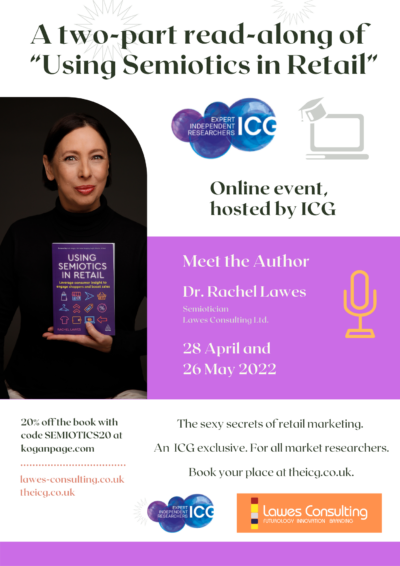
  • Recordings Of: A Two-Part Read-Along of “Using Semiotics in Retail” by Rachel Lawes

    Recordings Of: A Two-Part Read-Along of “Using Semiotics in Retail” by Rachel Lawes

    This webinar was generously sponsored by Perspective Research Services 

    YOU ASKED, WE ANSWERED. By popular demand, here is a read-along with Dr. Rachel Lawes of her new book, “Using Semiotics in Retail”. You can:

    – Learn semiotics from Rachel in two live sessions.
    – Bring your comments, questions and marketing problems for immediate responses.
    – Read this exciting new book with Rachel and gain a revolutionary new view of retail marketing.

    This read-along, a live online event hosted by ICG, is in two parts, on 28th April and 26th May 2022. Read the first half of the book now and you’ll be prepared for part 1 on Thurs 28th April.

    The first part of the book (event of 28 April) is all about the present day. It is full of practical marketing actions that marketers, retailers and brands can take TODAY to aid and engage shoppers. Learn how to use semiotic signs to improve stores, fixtures and packaging.

    The second part of the book (event of 26 May) is about the future. Semiotics is a tool for thinking and you can use it to get a view of the future of business, retail, employment, technology and human lives.

    LISTEN TO THE RECORDING OF THE FIRST SESSION HERE 

    LISTEN TO THE RECORDING OF THE SECOND SESSION HERE 


    This event is free and open to anyone. Not just ICG members.

    Get 20% off your copy of “Using Semiotics in Retail” when you use code SEMIOTICS20 at Rachel Lawes (koganpage.com) . “Using Semiotics in Retail” is also available worldwide from Amazon and all good bookstores.

  • Research in Romania – how to…

    Research in Romania – how to…

    Four things that may take you by surprise if you decide to run research in Romania:

    Don’t let yourself be fooled by geography.

    While Romania is usually considered part of the Balkans, we speak Romanian (which, by the way, is also the 2nd most spoken language in Microsoft offices around the world!), a Romance language, and we claim a Roman heritage.  This means part of the Romanian spirit is considered to be Latin – for example, we tend to be quite emotional and exaggerate both enthusiasm and disappointment.

    Traditionally, Romania is split into 3 main geographic regions that are supposed to differ in historic and cultural background: Transylvania, Moldova and Muntenia.  Depending on the category you are researching, you may discover however that in big cities across the country you will encounter the same more progressive attitudes, while in smaller cities and rural areas (we still have one of the largest rural societies in Europe), irrespective of the geographic region, more conservative and traditionalistic.  The differences between the major regions tend to become more and more about the economy (with Moldova being the poorest), which reflects into everything else.  Of course, there are also finer differences, this is why when planning research design, you should enlist the help of a local expert (just like with any kind of international research).

    Bucharest is huge compared to the other big cities – 2.5 million inhabitants (vs. ~400K for the next biggest city – Lasi), which means it is the main market for most advertisers and many times, in qual, just running some research in Bucharest is reassuring enough.

    Romanian Internet is FAST

    Romania is actually 5th (!!!) in a worldwide top of countries with the fastest broadband download rates (for reference, UK is 35th: https://www.cable.co.uk/broadband/speed/worldwide-speed-league/).  This means that if you are planning to run a mobile ethnography research heavy in evidence, you don’t have to worry about respondents being able to upload videos and larger files (it has always been refreshing news to the platform providers I had worked with).

    You must worry, however about the general population being digitally illiterate (remember, 46% of Romania is still rural).  So, choose your method wisely depending on demographic (just like anywhere, younger, more educated, urban targets are more computer literate), and keep the digital tools as simple and intuitive as possible.

    Yet, according to ESOMAR, almost 30% of qual and quant research spend in Romania is represented by online methods while – for reference, in UK it is 32%.  So … do what you would do in UK … or, not? (Have I mentioned already about asking a local expert?)

    If your brief asks for 6 respondents, you will get 12

    This is best explained by turning it on its head: how I was taken by surprise, with my first project in the UK (a very tightly scheduled one, with an international team flying from all over the world).  I learnt then, halfway through the recruitment stage, that me asking for 6 in-home visits meant 6 people had been quoted for (and recruited), no over-quota/ extra-recruitments having been factored in.

    In Romania, the recruitment agency would have automatically included stand-bys in the price for the 6 in-homes (50-100% over-quota, depending on agency and target) – the briefs we write here mention only the final number of respondents expected to show up, and it is up to the recruitment agency ensure they do (and include the appropriate number of over-recruits).

    The research market is a market of agencies, not of freelancers.

    These agencies have everything in-house (fieldwork, facility, qual, quant services) and the consequence of that the industry lacks in service providers: very few fieldwork only providers (not including here major online panels providers who operate a global business from Romania), no independent focus group facilities.  So, if you need only a focus group facility, you will most likely have to rent from one of the full-service agencies (yes, focus groups typically run in dedicated facilities in Bucharest and in hotel apartments outside Bucharest).  However, if you should decide to work via one of the (few) freelancers, they have their networks set up, and can help with all the referrals a project might need.

    Oana Rengle is one of the few freelance qualitative research expert based in Bucharest, Romania.