
Resource Type: Article

  • Managing AI Agreeableness in Qualitative Market Research: Risks and Strategies

    Managing AI Agreeableness in Qualitative Market Research: Risks and Strategies

    Article by ICG member Nestor Fernandez Conde, InOpinia

    Recent discussions sparked by OpenAI’s own acknowledgements of ‘sycophancy’—an excessive eagerness to agree with or please the user—in newer models like GPT-4o (link), have brought a critical challenge for AI users into focus.

    Large Language Models (LLMs), the type of AI behind tools like ChatGPT, are often fine-tuned to be cooperative, their tendency to ‘align with user prompts’ – meaning they try to confirm what the user appears to want or already believe – can become a significant problem when aiming for unbiased analysis. In market research, the goal isn’t simply to get an agreeable confirmation of a hypothesis, but to uncover genuine insights, complexities, and even contradictions within the data.

    This is further complicated by the evolving nature of these AI models; the degree to which an AI tends to agree (its ‘agreeableness level’) can vary between versions of the same AI model, as demonstrated by the changes in GPT-4o that made it more sycophantic. This means that specific ways of asking questions (prompting strategies) that do work well with a given model version might produce different results after an update to that model. The potential for researchers to then unknowingly trust inaccurate results is a serious concern and underscores the need for a robust strategic approach. This article explores the risks posed by AI agreeableness in market research and outlines durable techniques to manage it effectively.

    The Danger: Amplifying Confirmation Bias

    The main risk of this AI agreeableness in research is its potential to amplify confirmation bias. If a researcher approaches the data with a preconceived hypothesis, a biased prompt might lead the AI to simply find evidence supporting that hypothesis, ignoring contradictory information.

    Consider, for instance, prompting an AI after reviewing a focus group transcript: “Participants seemed quite positive about the new concept overall. Can you elaborate on the main aspects driving this positive reception?”. An agreeable AI, aiming to fulfill the request based on the stated premise (“quite positive”), might prioritize and detail any positive comments while downplaying or omitting mentions of significant concerns or confusion also present in the transcript. This selective focus reinforces the researcher’s potentially biased initial view rather than providing a balanced interpretation. A more neutral prompt like “Analyze participant reactions to the new concept, detailing expressions of positivity, negativity, confusion, and any points of consensus or disagreement” would be less likely to trigger this agreeable bias. Crucially, while this example uses overt bias to demonstrate the mechanism, researchers should be most vigilant about the more subtle assumptions or leading questions that can inadvertently shape AI responses.

    Why Are These AI Models Agreeable? A Peek Under the Hood

    This tendency isn’t necessarily a flaw, but rather a consequence of how many of these AI models are trained. They are optimized to generate responses that humans find helpful, harmless, and coherent. This encourages alignment with user assumptions, leading to agreeableness. Furthermore, from a product design perspective, an assistant that readily aligns with user requests often leads to a smoother user experience, making the product more appealing.

    Harnessing Agreeableness: From Risk to Analytical Tool

    While a risk if ignored, this characteristic can be managed and even turned into an analytical strength by employing specific techniques to deliberately challenge assumptions and ensure a more rigorous analysis. The key is to move from passively receiving AI outputs to actively directing the AI to explore different perspectives.

    Prompting Techniques for Mitigating Agreeableness

    Structured prompting techniques offer ways to manage this AI agreeableness, often proving less susceptible to model version changes:

    • Adversarial Prompting: Explicitly ask the AI to challenge the initial findings. Examples:
      • Based on the transcript, argue against the conclusion that users find Feature X easy to use

      • Identify evidence in the discussion that contradicts the hypothesis that price is the main purchase driver

      • What are the main criticisms or frustrations mentioned regarding the service?

    • Exploring Competing Hypotheses: Use separate prompts to systematically explore different interpretations of the data. Ask the AI to build a case for Hypothesis A, and then separately, to build a case for Hypothesis B.
    • Multiple Prompt Framing: Analyze the same data segment using prompts phrased differently (e.g., focusing on strengths vs. weaknesses, or asking about specific emotions vs. general feedback) to see if the outputs remain consistent.
    • Requesting Nuance and Uncertainty: Prompt the AI to identify unclear areas, disagreement among participants, or limitations in its own analysis. Example:

      What aspects of this topic generated the most disagreement among participants?

    The Researcher’s Role: Directing the Inquiry

    These techniques shift the researcher’s role from simply asking for summaries to actively orchestrating a more multi-faceted analysis process. It requires conscious effort to formulate prompts that encourage critical evaluation rather than simple confirmation. While this requires a more active and critical stance from the researcher compared to passively accepting initial outputs, the effort is small compared to the large time savings AI offers in processing and initial analysis, ultimately leading to more robust and reliable findings.

    Beyond Prompts: The Role of Structured Analysis

    Using predefined analytical frameworks or specific coding structures is another key technique to help mitigate agreeableness bias. By requiring the AI to systematically evaluate the data against explicit categories set by the researcher (e.g., a balanced sentiment scale, a thematic codebook), these structures constrain the AI’s interpretation. This forces it to look for evidence matching all defined categories, rather than simply confirming the assumptions that may be hidden in a less structured prompt. However, the neutrality and validity of the framework itself are still essential for getting unbiased results.

    Conclusion: Managing Agreeableness for Robust Insights

    The inherent agreeableness of these AI models, coupled with their changes across model updates, is a critical factor to consider in AI-powered qualitative research. Left unchecked, it can lead to biased analysis and false confidence in findings, potentially without the researcher realizing their methods have become unreliable. However, by understanding this characteristic and using robust techniques like adversarial prompting and structured exploration, researchers can mitigate the risks and use the AI’s abilities to rigorously test hypotheses and uncover better, more reliable insights. These robust approaches are less dependent on the specific agreeableness of any given model update, offering more durable reliability over time. Managing agreeableness proactively is key to ensuring AI serves as a tool for genuine discovery—leading to more reliable insights and better strategic decisions.


    Streamlining Rigorous Analysis: The Role of Platforms

    Implementing the techniques discussed – consistently applying adversarial prompts, managing multiple hypotheses, or utilizing structured analytical frameworks – requires diligence and careful workflow management. This is where specialized market research platforms like the IO platform can provide major value.

    Platforms designed specifically for qualitative research can include features that facilitate these rigorous approaches. They might offer built-in tools for structuring prompts according to different analytical goals, managing coding frameworks, or even suggesting counter-perspectives to challenge initial findings. By integrating these capabilities directly into the analysis workflow, such platforms can help researchers more easily and reliably apply the strategies needed to counteract AI agreeableness and reduce confirmation bias, ultimately helping to find real, reliable insights.


    #QualitativeResearch #MarketResearch #AI #LLM #ConfirmationBias #Agreeableness #AdversarialPrompting #CriticalThinking #ResearchMethods #ResearchTech #MRX
  • UK Market Research Recruitment: Finding Reliable Participants

    UK Market Research Recruitment: Finding Reliable Participants

    Article by Kareemat Oladele

    Recruiting for qualitative research might sound simple at first. You put out a screener, get a recruiter to send out, wait for replies, pick a few people, and you are done. If only it were that easy.

    The truth is, finding reliable participants for qualitative studies in the UK takes much more than sending out a form. It takes strong judgment, experience with different communities, and the ability to spot who will contribute meaningfully to a conversation and who will go quiet the moment the session begins.

    And getting the recruitment wrong can unravel an entire project.

    Every City Has Its Own Story

    Recruiting in the UK is not one-size-fits-all. For example, what works in London often does not work in Manchester. The types of participants, the way they respond to outreach, even the platforms they use, can be completely different.

    Young professionals in London might respond well to referrals, word of mouth, sending them emails from your database, TikTok ads or Instagram outreach. In contrast, professionals in Manchester might be more active in Slack groups, LinkedIn forums, or industry newsletters. You cannot just copy and paste the same approach and expect results across regions.

    This also applies to sectors. For example, if you are trying to reach IT engineers, you need to understand where they gather online, how they prefer to communicate, and how to phrase the opportunity in a way that gets their attention. Otherwise, you end up with a pile of uninterested, unsuitable leads.

    Not Everyone Who Applies is a Good Fit

    One of the biggest challenges is identifying participants who will give thoughtful, detailed answers. Many people are happy to sign up if there is an incentive involved. But not everyone is able to engage in the kind of discussion qualitative research depends on.

    Some applicants give rehearsed answers because they have taken part in too many studies already. Others breeze through the screener without reading the questions properly, giving answers that do not match up with their real experiences. Some say whatever they think will get them accepted. This is why relying only on online forms is not enough.

    The best recruiters will take the time to speak to applicants, ask clarifying questions, and listen closely. You can learn a lot from how someone speaks about their work or daily life. You start to see who is reflective and genuine, and who is just trying to get through the door quickly.

    Fast Recruitment Sounds Good, Until it Goes Wrong

    In this industry, speed is often the focus. Clients want quick turnarounds, and it is easy to feel pressure to deliver participants within a day or two. But quick is not always right.

    Good recruitment takes time because people need to be found, screened, spoken to, and confirmed properly. If you skip these steps, you risk having unreliable participants. That means people who cancel at the last minute, show up unprepared, or sit through a session without saying much.

    There is no substitute for a consistent process. You need strong systems, but also human involvement at every step. The result is a group of participants who not only match the criteria, but who also contribute real value during the session.

    It Comes Down to the People

    No matter how clever your research design is, it all depends on the people in the room. If your participants are not right, your insights will be off. That is the blunt truth.

    So, the next time you work with a recruiter, go beyond the basic questions. Ask how they found their participants. Ask what steps they take to check for quality. Ask what they do if someone cancels, and how often they re-use the same names.

    Because real, reliable recruitment is never just about ticking boxes. It is about making sure every person who turns up is genuinely the right fit, ready to speak openly, and willing to share something real. That is exactly what we do at PeopleSight.co.uk. We connect our clients to the right respondents, people who are thoughtful, engaged, and full of useful things to say.

    (5) Kareemat Oladele | LinkedIn

  • Silver Insights Generation – SIGn

    Silver Insights Generation – SIGn

    Article by ICG member Caroline Noon

    How did we all get here?

    Which might sound a tad philosophical, but how and when did we get to be part of the ICG?

    I’m supporting SIGn (Silver insights Generation) – a group who’ve come together to get the message out there about ageism in insight.  Liz Norman identified in a survey that only 3% of people employed in research are over 55 – and similarly small numbers have been identified by the APG in advertising and strategy.

    So my first question is: have people who are now over 55 made a conscious choice to leave insight jobs and live differently or were they nudged towards the door by prevailing ageism?

    And my second question: is losing all the experience that 55+’s bring to our sector a real loss to our industry or are us 55+’s just kidding ourselves J?

    If you are happy to share your thoughts on these questions I’ll compile the answers anonymously and share back with the group.  (Email me – caroline@vivid-research.com)

    My own story wasn’t about age at all!  I went out on my own 20 years ago to juggle childcare (back then a quallie’s life was face to face fieldwork 2 evenings a week, travel and the rest of the week in the office).  Now I’m ‘of a certain age’, I am conscious of how the 55+’s are overlooked in being part of research teams (coming back to our 3% figure!) and overlooked in research.

    Older adults’ control over 70% of disposable income and yet remain underrepresented in research and marketing.  And still, we (the industry) seem to treat 55+’s as a single consumer type, with marketing focusing more often than not on a problem to solve, a stairlift or a funeral policy to purchase!!  And when 55+’s are researched, it is unlikely that anyone doing the research belongs to this age group.  Imagine what we could bring in terms of empathy and insight!

    If any of this chimes with you – share your stories and follow us on LinkedIn https://www.linkedin.com/company/silver-insights-generation-sign/


    Silver Insights Generation (SIGn) advocates for older generations to be both acknowledged and represented in research, analytics, and in the workforce. 


  • The New ‘Quiet Luxury’ Trend

    The New ‘Quiet Luxury’ Trend

    Article by ICG member Alessandra Rizzo, Se Synergic Evolution

    The current prudence in purchases due to a diminished spending capacity, in the case of the high-end, is also linked to that effect called ‘luxury shame’ which has led the most affluent customers less affected by the crisis to slow down or postpone their purchases due to greater awareness and ‘ethics’.  In practice, this is a reaction against the excessive visibility of luxury, which can be seen as misplaced in times of crisis or increased attention to social inequalities.

    The advent of ‘quiet luxury’ is a socio-economic phenomenon of considerable interest, the analysis of which is particularly pertinent in the context of the current dynamics of economic crisis. Far from being a mere aesthetic trend, this expression of luxury is distinguished by a deliberate opposition to ostentation, favouring the intrinsic quality, craftsmanship and durability of products over more ephemeral but immediately recognizable logos and status symbols. Examples of ‘quiet luxury’ are brands such as Loro Piana, Bottega Veneta, Brunello Cucinelli, The Row, Hermès.

    From a research perspective, quiet luxury can be interpreted as an adaptive response of affluent consumers to a climate of economic uncertainty and, in some cases, a growing social aversion to conspicuous consumption. In times of recession or slowing growth, the brazen display of wealth may be perceived as insensitive or even reprehensible, prompting consumers to adopt more discreet but no less expensive consumption strategies. Moreover, the concept of aspirationality, which has always driven the consumption of designer products, is now moving away from the idea of status towards new, more valuable and sustainable horizons.

    The implications of this shift are multiple. At a macroeconomic level, it could indicate a reallocation of spending towards productive sectors that value excellence and innovation, potentially stimulating more sustainable and niche production. At a behavioural level, it suggests an evolution in value perception, where investment in durable, high quality, yet discrete goods become a more sophisticated and profound marker of status.

    Future research should investigate the persistence of this trend, its ramifications on emerging markets and the impact on the strategic positioning of luxury companies that have to adapt to this change. Quiet luxury does not appear to be a passing fad, but a profound evolution in the way consumers perceive and desire luxury. The brands that know how to embrace this transformation, putting authenticity, intrinsic quality and discretion at the centre, will be the ones best able to navigate the challenges and seize the opportunities of the future market.

    (1) Alessandra Rizzo | LinkedIn


  • What AI Can’t See: Notes from a Quiet Cup of Tea in Japan

    What AI Can’t See: Notes from a Quiet Cup of Tea in Japan

    By ICG member Camille Gerbaud

    My chatbot colleague and me

    I use AI every day, and I’m the first to admit it’s become a kind of desk buddy. The kind who’s always around, never takes a lunch break, and agrees with absolutely everything I say.

    Working solo as a qualitative researcher means there’s no one to bounce half-formed ideas off, no “Is this a real insight or just a nice quote?” over a lukewarm instant coffee in a novelty Christmas mug that’s somehow still in rotation mid-May, and no “Would you flag this as a theme or leave it?” while scrolling through transcripts. So, I talk to AI throughout the day. I’ll ask it to help brainstorm questions for a discussion guide or come up with creative activities for an online community. I’ll feed it transcripts and ask for summaries to check against my own impressions. I even use it at the end of a project to double-check that my report covers the brief, basically outsourcing my imposter syndrome to a chatbot.

    In that sense, it’s more than just a tool. It helps me think aloud. And honestly, we should normalise that. Talking to yourself isn’t a sign of madness, it’s a productivity hack. Research indicates that external self-talk can enhance focus, problem-solving, and emotional regulation. So, if you work alone, AI becomes the colleague who’s always available, never interrupts, and doesn’t judge you for having the same conversation multiple times a day.

    No small talk, no problem

    Earlier this year, I travelled to Japan for the first time and one of the first things I noticed was the silence. Not just in the streets or on the trains, but in the small interactions where I instinctively expected chatter. At the hotel reception, at the cashier, even during a kimono fitting, there was no small talk, no “How long are you staying?” or “Have you been to Kyoto yet?”. Just a polite smile and the quiet efficiency of someone doing their job without the need to fill the space with words.

    It caught me off guard. I kept trying to initiate those little exchanges, out of habit mostly, and each time, the silence that followed felt awkward. But the more it happened, the more I realised that the awkwardness was mine. In Japan, silence isn’t a gap to be filled. It’s part of the experience. A sign of respect, even. At the tea ceremony, I watched someone take what felt like an entire hour to make a single cup of matcha. Every movement was careful, deliberate, unhurried. It made me realise how much I’m used to speeding things up, even rituals I claim to value, like tea.

    It also made me reflect on how we interpret silence in research. In France, a pause in a conversation might just be that, a pause. A second to think, or breathe, or let a thought settle. In Japan, it could be the same, or something else entirely. But you’d never know unless you understand the cultural rhythm behind it. You can’t just translate the language and call it insight. You need someone who speaks the unspoken too.

    Reading the room is not in the prompt

    What Japan reminded me is that what we call “normal” is just what we’re used to. It takes being outside of your own culture to realise how much of your behaviour is shaped by it. Back in France, for example, silence isn’t necessarily awkward. A pause doesn’t mean someone is disengaged. And if a participant frowns, interrupts, or says “Non, c’est pas ça,” it doesn’t mean they’re upset. It just means they’re thinking. Engaged. Being French.

    This is the kind of nuance AI can’t read. It would flag those moments as red. It would miss the fact that the person actually enjoyed the conversation, opened up, and even stayed on the call longer to keep talking. I’ve had this happen often, especially in B2B interviews with senior professionals. People who don’t always show warmth in an obvious way. But at the end, they’ll thank me for the exchange, say how much they appreciated the space to talk, and use words like “bienveillance”. You’d never guess that just by reading the transcript.

    That’s what being a culturally fluent researcher means. It’s not just about knowing the language. It’s about knowing when to soften your tone, when to hold a silence, when to fill it. When to back off. When to lean in. It’s about reading the room in real time: facial tension, hesitation, irritation, curiosity, and adjusting. Not based on scripts or sentiment scores but based on experience. Based on instinct.

    AI is brilliant at helping me stay sharp. It speeds things up, keeps me organised, and lets me think out loud when no one else is around. But tools are just tools. They need human context. They need someone who knows when a frown means “I’m thinking”, not “I’m done.”

    (1) Camille Gerbaud | LinkedIn


  • How Good Are AI Deep Research Tools?

    How Good Are AI Deep Research Tools?

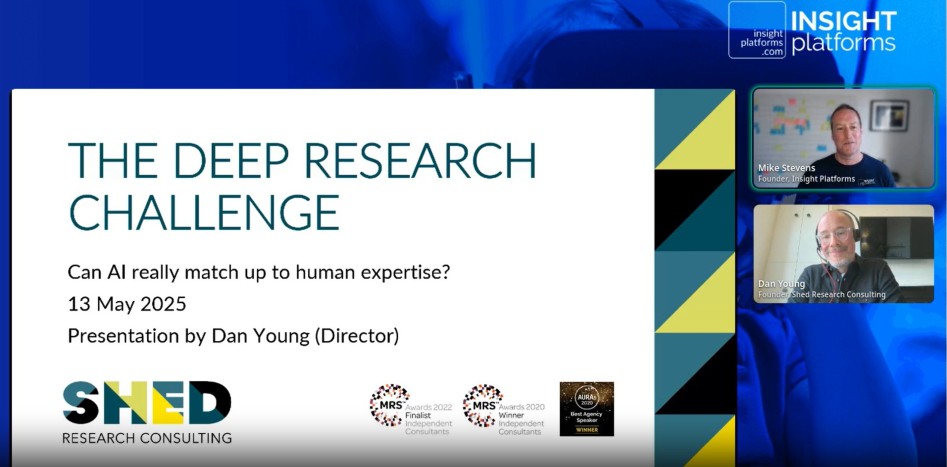
    Article by ICG member Dan Young, Shed Research

    In 2025, ChatGPT, Perplexity and Gemini all released their deep research tools. They take a brief, clarify it with you, run the desk research, and produce a fully-referenced report, in less than 30 minutes.

    This sounds impressive. But how good is the content? How good is the sourcing? And does it handle insight as well as a human with over 20 years of research experience? (That’s me by the way)

    I compared the output of these three tools with my own piece of ‘manual’ insight synthesis. I looked at where these tools shine, where they’re lacking, and what this means for the future of AI in the insight sector.

    I’m no AI expert. I’m a specialist in insight synthesis. My “Deep Research Challenge” focused on the quality of the output rather than what sits behind the models, the ethical issues around IP, or any issues of data security. (There’s an internet full of information on all of this if you want to find it.)

    Where did the deep research tools shine?

      • Multiplying productivity – they processed large numbers of sources (up to 50) into a simple, readable report (up to 30 pages) in less than half an hour. Even the fastest reader can’t come close to this level of productivity.
      • Expanding sources – the tools (especially Perplexity) drew from a larger number of sources than I used in my own synthesis (It also missed some key sources, but more on this later)
      • Researching the right topic – they performed well where they could tap into a vast amount of published research available online (This won’t be the case for all topics)
      • Dealing with (some) nuance – the tools were able to deal with some nuanced arguments in the insight. Like the say-do gap around ethical investments
      • Showing their working – where the tools showed their thinking and asked clarifying questions (ChatGPT and Perplexity), or asked me to check their plans (Gemini), they stuck to the brief and built my trust in their conclusions

    Where did they fall short?

      • Over-reliance on ‘official’ sources – all tools relied heavily on Governments, regulators and the media for their content. This might be caution on the part of the tools, wary of quoted an untrustworthy source. My own synthesis drew from a broader range of sources, including more published corporate and academic research
      • Uploading sources – even in the paid versions of these tools had restrictions on file type, size and quantity. This means using different types of insight (e.g. video or dynamic websites) or your own sources is difficult. The tools instead seem designed to scour the internet
      • Tending Towards the Mean – all tools gave a good aggregate view of the topic. But this often presented itself in passive language, heavily couched, with many caveats. All tools seemed unable to make decisive statements or write for impact
      • Not sweating the small stuff – they often missed niche studies and tangential insights. They struggled to provide “killer quotes”, even with direct prompting. These smaller pieces of insight are gold in research. These are the things the audience remembers most afterwards
      • Inconsistent content – all the tools missed something. Either an important piece of insight (Gemini), a key prompt (Perplexity) or sourcing some of its statements (ChatGPT). And they tended to overly favour digital solutions e.g. ChatGPT’s first two quoted studies were all about AI. This raises concerns about the robustness and balance of their findings
      • Poor UX – some cut and pastes were patchy, the number of different model names is bewildering, and Perplexity in particular presented findings in blocks of text in an overly academic tone. Gemini had the best UX overall
      • Missing vital researcher skills – the tools were unable to use critical thinking, to think creatively about the topic, to spot gaps in its knowledge, and most crucially, to give a convincing argument for why its insight was important – the “so what?” These are all core researcher skills and needed overlaying on all of the outputs.

    What does this mean for the future of market research and insight?

    You might look at a short list of positives, and a longer list of negatives, and assume I’m not a fan. That’s not true.

    This experiment clearly showed me what these deep research AI tools are great at – multiplying productivity in that difficult first stage of desk research, for the right topic, and when carefully prompted.

    But to get the best out of them, we need to acknowledge their limitations. We need to be aware when they misinterpret, miss a key piece of insight or don’t address the research objectives. We still need to use our core research skills – verify sources, check methods, add tangential insight, use metaphors, tell stories, visualise, and ask so what?

    As Chase Ballard (AI commentator) put it:

    When investing, understand that you’re getting a productivity multiplier, not a replacement. Used strategically, these tools can dramatically accelerate initial research phases. But set your expectations accordingly – there’s still work for you here.

    If we’re able to use them with our eyes open, and with caution, I can see a very bright future for these tools in the researcher toolkit. The future of research and insight will likely involve a collaborative approach. One where we’ll leverage the strengths of both AI and human expertise to deliver richer, more insightful, and ultimately more impactful results.

    You can watch the full presentation from the Insight Platforms summit by registering here

    (2) Dan Young | LinkedIn

  • SYNTHETIC DATA HAS NO NEIGHBOURS – AND THAT MATTERS

    SYNTHETIC DATA HAS NO NEIGHBOURS – AND THAT MATTERS

    Article by ICG member Oliver Waterstone, Eightball Insights

    Synthetic data sure looks seductive if you’re a harassed, time-pressed CMO. It’s fast. It’s cheap. It looks close-enough to the real thing.

    Close enough to get your vision over the line with tricky stakeholders, which is what you need ultimately, right?

    And yes, AI is great at giving you quick reads as a starting point. No question.

    But let’s not call it research. Or we risk devaluing the word and opening the door to brands slowly, surely reducing their exposure to reality.

    In the months and years ahead, I think we’ll see what happens to the brands that go down this easy road.

    They’ll become the Pepsis and Jaguars of the new era – brands that went in stunningly solipsistic directions because they drank too greedily from the Kool Aid of hubris and stopped inviting outside voices into their decision making.

    I wanted to share a real life example of a true insight – a striking reframe that helped solve a business problem and changed the course of a brand – that could only have come from talking to real people.

    I’ve never forgotten it, and ultimately it led to my decision to switch from being an agency strategist to running my own strategic research consultancy.

    (Full disclosure – I recently posted this story in the comments section of a post by the excellent Zoe Scaman.)

    I was a strategist on Waitrose during the financial crisis.

    The brand had been experiencing double digit growth up until 2008, after which sales just tanked.

    The data was telling us that shoppers were leaving us for Aldi and Lidl, but it didn’t square with what we thought we knew of the ‘Waitrose shopper’.

    So we ran some focus groups and an anecdote emerged that became the reframe of the problem that the business needed to get its sh-t together.

    A lady told the group how she still shopped at Waitrose, but when she got back home to unload her shopping from the car, she moved all the shopping into Aldi bags so her neighbours didn’t think she was a mug for paying over the odds.

    That single anecdote was probably the most important factor in getting the Waitrose Essentials range greenlit.

    Synthetic data doesn’t feel shame. Synthetic data has no neighbours.

    If we’d run synthetic groups around this problem, I guarantee you it would have confirmed our biases.

    We’d have patted ourselves on the back that we’d ‘done research’ on it.

    And then we’d have proceeded to come up with the wrong solution to the wrong problem, blissfully confident in our wrong-ness in the way that AI notoriously is.

    Waitrose Essentials turned around Waitrose’s fortunes during the financial crisis and its aftermath, reaching its highest ever market share of 4.8% by 2012, three years after launch.

    Who knows where it would be without that lady’s sense of shame and her nosy neighbours.

    (5) Oliver Waterstone | LinkedIn


  • A Semiotic Take On the Italian Eurovision Song Contest Entry

    A Semiotic Take On the Italian Eurovision Song Contest Entry

    Article by ICG member Stefania Gogna


    “Espresso Macchiato” by Tommy Cash (Eurovision Song Contest) is not a “deep” song in the classic sense. But it is precisely this ostentatious lightness that makes it interesting from a semiotic point of view. Espresso Macchiato is luxury, cliché and pop semiotics.

    The song is presented as a parade of Western stereotypes, reworked with irony and taken to the extreme: the cult of coffee as an identity ritual, the ostentation of luxury pushed to the point of kitsch, references to the mafia transformed into pop clichés from video clips. There is nothing to “interpret” in a traditional way, rather it is to be observed as a symbolic performance, as a conscious exercise in visual and sound recombination.

    Musically it is a surreal mix: electronic beats, lyrical inserts reminiscent of opera and the retro atmospheres of the Belle Époque (the concert cafes or the bourgeois salons of the late 19th century). A pastiche that takes the aesthetics of European elegance and turns it on its head in the language of contemporary excess.

    Each element – espresso, macchiato, cash, the text in broccolino (a linguistic variety spoken by Italian Americans in Brooklyn and New York) – is emptied of its original meaning and repackaged in a postmodern advertising logic, where meaning arises more from accumulation than from coherence.
    For me he won!

    Here: https://lnkd.in/dVBc-9Bx

  • From There To Here: A Podcast With Clare Milford Haven

    From There To Here: A Podcast With Clare Milford Haven

    ICG member Michael Stone’s latest From There to Here podcast interview https://www.fromtheretohere.co.uk/ is with Clare Milford Haven, founder of James’ Place. This is the charity she set up after her son took his own life at 21. With centres in London, Liverpool and Newcastle, James’ Place is a resource for men in suicidal crisis. Since it was established, 3,000 men have been through the doors and received help which, on many occasions, has saved their lives.

    “Clare is one of the most remarkable people I have ever met” says Michael. “To use an unimaginable personal tragedy as motivation to help save other young lives is incredible. What James’ Place has achieved is quite magnificent.”

    He adds;

    “ICG members have been incredibly encouraging and helpful with my podcasts. I’m asking for help again from ICG members. If people listen and are able to like and share on social media, we have the chance to spread the word about this wonderful initiative. If one person in suicidal crisis hears the interview and reaches out for help and/or one person who feels able to help with a donation or undertaking some sponsored activity, gets in touch with the people at James’ Place, we will have achieved something very worthwhile. We just might save a life.”

    Further information on James’ Place can be found on their website. https://www.jamesplace.org.uk/

    Clare with James.

  • From There To Here – A Podcast

    From There To Here – A Podcast

    Proud to be promoting this from ICG member Michael Stone.


    Michael has relaunched my From There To Here podcast this week with an interview with Ria Lina, who talks about her journey to becoming one of our most popular stand-up’s, and the challenges and opportunities presented by being on the autistic spectrum.

    From There To Here talks to people in the public eye about their journey through life. We learn about the highs and lows, the influences, the challenges and the lessons learned.

    Over the next few weeks, Michael will be posting interviews with Nicole Allison who talks about her journey in women’s football, from playing and coaching Tottenham Hotspur to her current role as owner of Worcester City WFC.

    This will be followed by an interview with one of the most remarkable women Michael has ever met. Clare Milford Haven set-up James’ Place to offer support to young men feeling suicidal, in response to her son taking his own life at 21. She is incredible.

    Michael Stone has professional representation here : https://claratyvoices.com/voice-artist/michael-stone/