Resource Type: Article

  • Why We Might Be Witnessing a Return to the Spirit of Punk

    Why We Might Be Witnessing a Return to the Spirit of Punk

    Article by ICG member Hanna Chalmers


    Sameness is everywhere. And the internet is to blame.

    Much has been written about the plague of the global coffee shop, so called ‘enshittification’, AI eating (or reading) itself, the global TikTok ‘mewing’ of teenage boys, beauty standards that reduce all women to a Love Island model of smoothness, all lips and lashes. The colours of beige, putty, cappuccino from cars to leggings, brands that all spout the same words, if it has been ‘crafted’ and ‘artisan’ for the last five years, it’s now all about ‘joy’.

    It’s all so seamless and dull.

    We’ve reached a point in mainstream culture that has never felt less exciting.

    As a life long fan, watcher, non sneery participator and lover of #mainstreamculturethis is a hard truth to stomach.

    The algorithm, designed to serve us what we want to see (buy) and tempt us with what it thinks we might want to see, is driving us downwards into a spiral of sameness and echo chambers. At best, and most hopefully, we are served more of the niche content we are interested in, at worst algorithms suck us into new uncomfortable and sometimes sinister spaces.

    All the while, it’s watching what we look at, ready to flood our screen spaces with more of what we have half-heartedly browsed.

    This surveillance has, until now, been a price worth paying for many, the content vs ads balance felt worth it. But, as content creators are pushed to create blander content in order to get the brand deals – again we are seeing – people that we might have enjoyed watching in the past – become less idiosyncratic, less opinionated, less lively.  And in doing so, they become less interesting to watch, more cynical and more sales focused.

    But this surveillance, which is the pact we make as social users, whether as viewers or creators, is also becoming riskier. As the geopolitical climate hardens and becomes more divided – what we view, say or do, online is being more widely monitored. For most of us, similarly to the balance of content vs ads – this notion of surveillance has felt tolerable (less so in Germany where the long shadow of cold war surveillance tactics has impacted heavily on concepts of privacy).

    Recently, we have seen stories emerge of law makers attempting to access period apps in order to police women’s bodies. We’ve seen broadcasters lose their jobs for voicing their opinions. We also police our own reading material according to our preferences politically and culturally. And that means there is a shrinking of exchange, less open conversations across the boundaries.

    A lot has been said and written about this process of silo-fication. Less is said about the consequences of losing out in being curious about other people and different cultures.

    As a Gen X’er (just) I grew up in the 90’s rave scene. We were unsurveilled – we raved, we did what often looks like quite mad dancing, many took ecstasy and gurned (!) for hours in fields all over the country with no thought given to how they looked – male and female alike.

    Looking at the footage (there are so many pages/accounts on social media devoted to old 90’s rave footage) as someone that was there, and that has experienced what life was like before the internet, it still has the ability to sort of surprise me – it looks totally anarchic – unfettered, unconstrained, nuts and genuinely joyful.

    Watching this old rave content with Gen Z’ers (my teenage sons) it’s sort of incomprehensibleto them to have lived in a moment that was so unsurveilled. And it brings into sharp relief the constraints of today’s level of surveillance and self policing.

    Is it any wonder clubs are dying a death – when everyone now feels so self-conscious, body and internally focused, rather than outward looking?

    But as we see in trend cycles, as mainstream culture feels like its imploding in on itself, interesting things, as ever, are emerging at the edges. It’s more or less off-line – or at the very least in private online spaces, – it’s smaller, more DIY in sensibility, and it’s a safer space for its participants.

    What we’re seeing is a return to difference. There is real emotion, angrier music/art/media, a rejection of so-called perfection, more anarchic, non branded, not chasing ‘likes’, with an embrace of greater physicality, bodies that we simply inhabitrather than view from the outside in and outspokenness. A fuck you attitude, is just around the corner.

    And as a Gen X’er looking on – I can’t wait to see more.

    #enshittification #entertainment #massmarket #mainstreamculture #subcultures #offline #rageagainstthemachine #ai #punk #rave #politics #sameness

  • DEVELOP: Sustaining Momentum for Long-Term Growth

    DEVELOP: Sustaining Momentum for Long-Term Growth

    Article by ICG members Jeff Deighton and Lara Meyer.

    In our last article, Learn, Lara and I explored how reflection and realignment help create clarity and awareness to make smart, timely decisions, and to foster a culture of purposeful reflection to support performance. But sustainable growth requires more than periodic check-ins, it demands a commitment to continuous evolution.

    That’s where the final stage of the B.U.I.L.D.® framework comes in: Develop.

    This phase focuses on future-proofing progress by strengthening leadership, refreshing strategy, and embedding a culture of learning, innovation, and adaptability.

    Why Develop Matters

    Most change initiatives run out of steam because they were designed to end.

    In the Develop phase, we help you continue a conscious shift from “project mode” to continuous growth mode where learning loops, leadership evolution, and strategic thinking become part of the day-to-day DNA.

    This isn’t about adding more complexity. It’s about keeping your attitude, systems, and people fit for the future.

    “We didn’t want to fall into the trap of business as usual. With this phase, we finally had the space to future-proof what we’d started.”

    What Development Looks Like in Practice

    At this stage of B.U.I.L.D.®, we help leaders and teams promote a mindset and operational model that fuels long-term success:

    Ongoing Leadership Development
     We provide on-going 1:1 and group coaching to reinforce positive mindset shifts, reduce conflict spirals, strengthen strategic decision-making, and elevate leadership presence over time.

    “I started seeing myself as a real leader, not just a manager trying to stay afloat.”

    Product & Proposition Development Workshops
    We facilitate innovation sessions to bring new creativity that help teams apply their enhanced mindset to product strategy and market positioning

    Strategic Growth Planning & Mentoring
     We work with leadership teams to shape the next phase of growth. This includes advisory support and mentoring around recruitment, team structures, and external positioning.

    Re-establishing the Baseline
    The end of the B.U.I.L.D.® cycle is also the beginning of the next. With each iteration, a return to the Baseline with deeper awareness, more data, and a stronger foundation for even bolder progress, encourages progress and adaptability.

    Develop in Action: Future-Proofing a Leadership Team

    One client’s leadership team had just come off the back of a high-growth year. But with growth came new challenges: burnout risk, role confusion, and an unclear path forward.

    Over six months, through quarterly coaching, mindset refreshers, and facilitated planning, we helped them:

    • Build a “Mind the Gap” 2-year roadmap
    • Define a new set of shared values
    • Rework their internal comms and decision-making structure
    • Embrace courageous conversations with greater ease

    “We were so used to firefighting. Now we make better decisions, faster—and we actually enjoy working together again.”

    The biggest shift? Less fear. More foresight. And a renewed sense of identity and purpose.

    For Individuals: Becoming the Leader You’re Meant to Be

    Personal development doesn’t end with insight, it accelerates with action. At this stage, we help professionals:
    ✔ Stay aligned with their long-term goals
    ✔ Strengthen habits that support confidence, clarity, and impact for themselves and colleagues
    ✔ Build thought leadership, influence, or new career chapters

    “I stopped just ‘managing the day’ and started designing my career.”

    For Teams: Growth That’s Cultural, Not Just Tactical

    High-performing teams that invest in ongoing development report higher levels of:

    • Psychological safety
    • Cross-functional collaboration
    • Creativity and innovation
    • Employee engagement and retention

    Because when growth becomes a way of being, not a one-off event, organisational change is no longer a struggle. It becomes a shared ambition.

    B.U.I.L.D.® in Full Circle

    Develop is the phase where transformation becomes self-sustaining.
    And just like that, the cycle restarts, stronger, deeper, and more intentional.

    That’s the power of the B.U.I.L.D.® framework:
    A repeatable, human-centred approach to mindset-driven growth, at the personal, team, and organisational level.

    “We didn’t need another strategy. We needed a system to keep growing. That’s what this gave us.”

    Ready to evolve?

    Whether you’re coming to the end of a growth initiative or just starting to think bigger, the Develop phase is where leaders step up and businesses scale wisely.

    Download the B.U.I.L.D.® info pack or book a call here with fellow ICGers Jeff (Deighton) or Lara (Meyer)

  • 40 Years In Market Research – Lynne Chapman

    40 Years In Market Research – Lynne Chapman

    Initially I worked as a librarian, but after relocating from London to Nottingham, a friend and neighbour, Bev Wener, who had moved into market research recruitment, persistently told me I’d be perfect for it. I resisted at first, forgetting I’d once been a participant in a dessert focus group, where I’d enthusiastically over-shared my opinions — a sign, perhaps, of things to come.

    Eventually, largely thanks to Bev’s encouragement (and being broke), I contacted QRS, her agency. By chance, they were running a training day, and on a whim — and a sick day — I went. That day, 4th November 1984, changed my life. I met Marilyn, who needed a lift home from the training and lived nearby. That lift turned into a 34-year business partnership and a lifelong friendship. We became each other’s lifeline in a job full of unpredictability.

    At first, we handled simple projects: tea drinkers, Basildon Bond writing paper buyers. It was all very manual — clipboards, catalogue cards, and door-to-door recruitment. Bev and our supervisor Pat offered us great support. In those days, recruitment was often about stopping strangers on the street or knocking on doors — not something you’d get away with today.

    The projects were endlessly varied and often bizarre: aftershave, mayonnaise, fishing gear, and even a secret chocolate launch (Cadbury’s Spira). We once recruited for a group hidden behind a false wall for a Woman’s Realm ad. We worked in homes, hotels, and viewing studios, and sometimes found ourselves caught up in strange moments — like a respondent urinating on my sofa or researchers throwing tantrums over crisps.

    Tech slowly reshaped the work. I embraced it (eventually), while Marilyn resisted, earning the affectionate nickname “The Luddite.” We moved from handwritten notes to PCs, then to online screeners and databases. But some things never changed: the unpredictable nature of the job, the quirks of respondents, and the challenge of hitting quota.

    We built a client base through word of mouth, often receiving calls from people who’d simply “heard of us.” Working with agencies like Abbott Mead Vickers and BMP was a joy — they valued recruiters, treated us well, and hosted fabulous parties where stories (and wine) flowed freely (and a recruiter and a planner enjoyed some “afternoon delight” in the fax room…..). One memorable moment was my daughter mishearing “AMV” as “Albert Needs Knickers” — a family legend.

    In 1998, Drusilla Gabbott sparked debate by writing about the difference between repeat respondents and actual corruption in recruitment. Shortly after, her colleague Deirdre Cordwell commissioned us to recruit a project under the guise of butter buyers but specifically sought experienced focus group participants. The resulting research, presented at the 1999 MRS conference as “Do We Assume Too Much?”, challenged the industry norm that repeat respondents were problematic, suggesting instead that they could enrich group discussions.

    Despite the humour, we also faced serious challenges. In 1997, a proposed national respondent database threatened independent recruiters. I founded FAIR — Freelance and Independent Recruiters — and, alongside others, successfully campaigned against it.

    At a 2013 event, I challenged the lack of recruiter representation on a working party. That conversation led to my participation in the creation of the Recruiter Accreditation Scheme. I became its first certified recruiter, passing with distinction — twice. It was a career-defining moment. In recognition of my work, the MRS made me a Certified Member.

    I also served on the committee of the Insight Consultants Group (ICG), which became another professional home. It’s a place of mutual support, collaboration, and shared values — one of the reasons I’ve stayed in the industry so long.

    Some moments have left a deep personal mark. One respondent, a young Indian woman, once cried at my kitchen table. She told me it was the first time anyone had ever asked her opinion. It reminded me that our work can give people voice and dignity, not just data.

    Then came the pandemic. I was about to send reminders for face-to-face groups when lockdown hit. That same night, I hosted my first Zoom group. It was a seismic shift. My local, Midlands-based model suddenly didn’t make sense. Clients preferred national online groups, and my workload dropped dramatically.

    But slowly, things have picked up. Face-to-face groups have returned. I’ve even handed out cash in envelopes again — very nostalgic. That said, the inconsistency of online incentive payments remains frustrating. There’s a need for more fairness and industry-wide standards.

    Forty years since that first training day, I’m still here. Still recruiting. Still believing in the power of a good group. The industry has changed dramatically — from handwritten notes to digital quotas, from teabag buyers to GDPR-compliant NDAs. But what hasn’t changed is the importance of listening.

    What we do matters. We include people. We ask them to share. We give them space to be heard — whether it’s about chocolate or direct debits. It’s been a career full of oddities, laughter, frustration, and pride. And I’m so grateful for it all.

    Just don’t ask me to recruit a group of Basildon Bond users!


  • From Tapes to Tech: How Transcription is Evolving – and So Are We

    From Tapes to Tech: How Transcription is Evolving – and So Are We

    By Accu-Scribe Limited, an ICG long-standing advertiser.

    Accu-Scribe logo


    There was a time, not that long ago, when transcription meant sending out physical tapes in the post and waiting days, sometimes weeks, to receive a typed transcript in return. For researchers, agencies, and consultants, it was a slower world. But one thing was always certain: transcription was essential to capturing and analysing human insight.

    Fast forward to 2025, and the landscape has shifted dramatically. With the rise of digital audio technology, cloud computing and automatic speech recognition and generative AI, transcription can now be turned around in hours, not days. These technologies have brought undeniable benefits: speed, scale, and affordability.

    And yet, as many insight professionals know, speed is not always synonymous with accuracy. For example, while the current star of the show, AI, can do a lot, it doesn’t always pick up on nuance, clarity, or context. Speaker attribution can falter, key phrases may be misinterpreted, and the subtleties that matter to researchers can get lost.

    The Human Touch Still Matters

    That’s why Accu-Scribe continues to play an important role in today’s evolving ecosystem. For years, we’ve been known for our reliable, accurate, and human-led transcription services, and that remains at the heart of what we do.

    But we’re evolving too.

    As the demands of the industry shift, we’re combining the best of technology with the rigour of human expertise to deliver a suite of services designed to support insight professionals, agencies, and independent consultants in a fast-changing world.

    Our Evolved Service Offering

    Hybrid Transcription

    Our most popular new offering – a service that uses AI to generate a fast first draft, which is then checked and corrected by an experienced transcriber. It’s the perfect balance of speed and accuracy.

    Focus Group Plus

    A complete support package for qualitative research tailored to your company’s needs, offering speaker identification, optional keyword tagging, summary outputs, and rapid delivery – helping researchers make sense of group dynamics quickly and clearly.

    Analysis Plus

    Designed for those who want more than transcription. Our content analysis service turns transcripts into structured insights, including coding, thematic summaries, and highlight extraction.

    Excel Transcription

    When data comes in tabular formats or needs structured outputs, our Excel transcription delivers content that’s ready for use in spreadsheets, dashboards, or reports.

    Admin Support Services

    Our newest offering supports freelancers, SMEs, and boutique agencies with flexible admin help – from formatting documents to managing calendars – giving you more time to focus on growth and client delivery.

    Keeping Pace with Change

    We know the demands of transcription and insight work are changing – and so are we. At Accu-Scribe, our goal is not just to keep up, but to actively support our clients as they adapt and grow.

    By combining technology with human judgment, we’re helping to build a future where transcription isn’t just faster, but smarter – and where insight professionals can count on quality, every time.

    For more information, or to talk about how we can support your next project, feel free to reach out to us at info@accu-scribe.co.uk or visit our new website at www.accu-scribe.co.uk

    Accu-scribe Ltd – The ICG

  • Get off My Land!

    Get off My Land!

    Article by ICG member Kath Rhodes

    Kath Rhodes

    Something has been bothering me recently. It’s the over-use of ‘qualitative’ in the insight world


    Get off my land!
    You lot keep saying ‘qualitative’ data when you are
    talking about open ends and verbal data.
    Words do not qualitative make.
    Elaboration in a quantitative survey is great, but it is
    not, repeat not, qualitative …
    Shoo… Get your own definition to play with…


    I think I can see why we’ve had this drift into claiming ‘qualitative’.

    We’re living in a data driven world. AI loves data, and it’s good at analysing language, boxing it up
    and sorting out what’s been said.

    I love this, by the way. AI has delivered really great language analysis tools and really good ways
    to find and clip quotes and make compelling films that tell great stories. (Thanks Coloop).

    BUT

    There is a downside to what’s going on in AI world…

    We’re sliding into calling verbal data ‘qualitative’, which makes it easy to offer ‘qualitative at
    scale’. And bingo! The world gets more data, faster data and we’ve got both quantitative and
    ‘qualitative’ on speed dial to businesses.

    Of course when we use AI to ask people to ‘say more’ and AI gets more sophisticated in
    encouraging people to deliver more verbal data [through chat bots etc] we are going towards
    qualitative – we are elaborating, and getting conversational and getting more detail… all of that
    can feel qualitative.

    But it isn’t. It’s different.

    Here’s what I think the difference is.

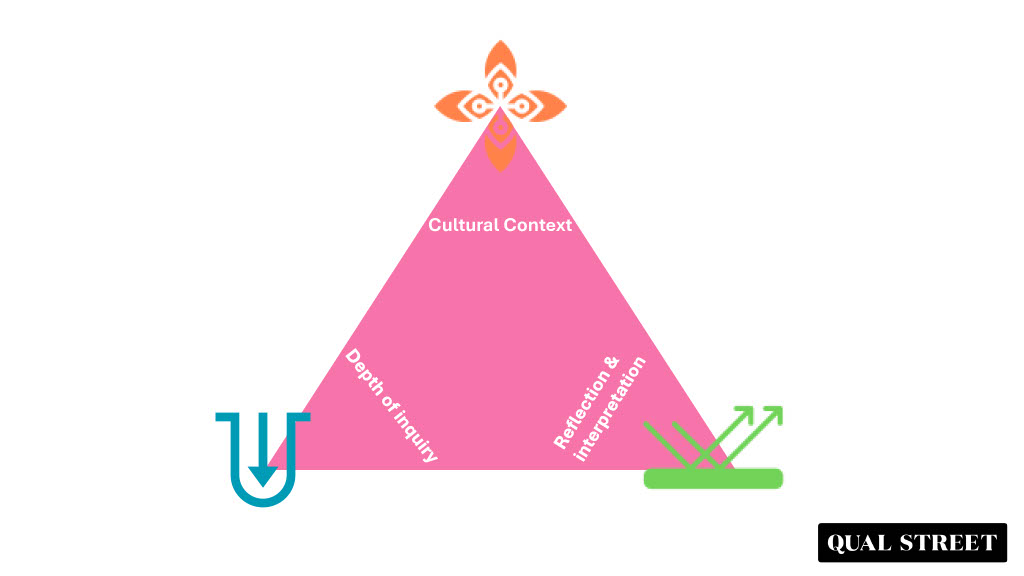
    Good Qualitative Insight:

    • Draws on how culture shapes behaviours and attitudes – it knows context matters (and
    therefore gives space in its methods and approaches to understand context)


    • Looks for deeper understanding – it starts from the position of trying to understand
    what’s going on… and works on looking at layered meaning too. So it has longer, deeper
    conversations. Interviews happen in the right space and place. It uses observational
    tools. It spends time with people. It asks them to spend time exploring…

    • Requires reflection and interpretation (of the content, context and production of the
    insight). Qualitative researchers mull, think, reflect, talk about, and think strategically
    about what this means for our clients…

    Qualitative research is necessarily subjective, non-scientific. It doesn’t claim ‘what is’ – it isinstead looking for meaning.

    Verbal data enriches the quantitative process, but doesn’t step outside of it, explore it, challenge it, take perspective…

    So please, friends and colleagues, don’t call your open ends or verbal data (however much you’ve got) qualitative. AND Stop saying ‘qualitative at scale’.

    It’s good stuff, but it’s not my stuff.

    Me and my people, we are all about understanding what’s going on.

    We deliver our insight thick and rich and with soul… The other stuff – well it’s shallow text.

    Please step off and get a new way to talk about what you are offering. And step off now.

    Otherwise people are going to start misunderstanding what qualitative is, and what its true
    potential is. And then the world will become a flatter, blander place.

    Actually that’s what’s bothering me. I wonder if it already is?

  • Breaking Down Silos: How Integrated Intelligence and AI Agents Are Transforming Market Research

    Breaking Down Silos: How Integrated Intelligence and AI Agents Are Transforming Market Research

    By ICG member Marcello Sasso

    My Journey to Integrated Intelligence

    As a senior market research expert, I’ve witnessed a fundamental problem plaguing our industry for years: the siloing of insights. Early in my career, I noticed something troubling. When I asked different departments within the same organization to describe their typical customer, I received vastly different answers. Sales painted one picture, marketing another, strategy offered a third perspective, and R&D presented something entirely different. Each department was looking at the same customer through their own narrow lens, missing the complete picture.

    This fragmentation wasn’t just inefficient—it was dangerous. Companies were making critical decisions based on partial truths, investing millions in strategies built on incomplete understanding. I realized that the future of market research lay not in generating more data, but in connecting the dots between existing information streams.

    What is Integrated Intelligence?

    Integrated Intelligence is a holistic approach to market research that synthesizes multiple data streams and perspectives to create a unified, actionable understanding of consumer behavior. It’s the practice of breaking down organizational silos and connecting three critical dimensions of consumer understanding:

    1. Behavioral Data: The rational and emotional drivers behind consumer decisions, encompassing everything from customer experience to purchase motivations
    2. Transactional Data: The functional reality of what consumers actually buy, how often, and through which channels
    3. Contextual Intelligence: The external factors—cultural, economic, social, and technological—that influence and shape consumer behavior

    Unlike traditional market research that treats these dimensions separately, Integrated Intelligence weaves them into a coherent narrative that reveals not just what consumers do, but why they do it and what might change their behavior in the future.

    How Integrated Intelligence Works

    The process of Integrated Intelligence operates through a sophisticated orchestration of multiple elements. We gather information from diverse sources—quantitative surveys, qualitative interviews, social listening, transactional databases, cultural trend analysis, and competitive intelligence. Each source contributes a piece of the puzzle that, when combined, reveals the complete picture.

    The magic happens through cross-functional collaboration. Instead of departments working in isolation, Integrated Intelligence requires active dialogue between sales, marketing, strategy, R&D, and customer service teams. Each brings unique insights that, when synthesized, create understanding far greater than the sum of its parts.

    By analyzing data through multiple contextual lenses simultaneously, we can identify patterns that would be invisible when looking at single data streams. A purchase trend that seems random in transactional data might make perfect sense when viewed alongside cultural shifts or emotional drivers.

    Perhaps most crucially, Integrated Intelligence focuses on signal detection—identifying emerging phenomena that have the potential to become major patterns. These signals often appear at the intersection of different data streams, visible only when we look holistically. Knowing them in advance represents a true competitive advantage.

    The Benefits of Integrated Intelligence

    The transformation this approach brings is profound:

    • Predictive Power: Understanding the complete ecosystem of consumer behavior enables better anticipation of future trends
    • Actionable Insights: Recommendations grounded in multiple data points are more robust and implementable
    • Competitive Advantage: Organizations can identify opportunities before they become obvious to competitors

    But beyond these tactical advantages, Integrated Intelligence fundamentally changes how organizations think. It replaces assumptions with evidence, transforms confusion into clarity, and turns contradictions into insights. Resource efficiency improves dramatically as insights are shared and amplified across the organization rather than duplicated in departmental silos.

    Enter AI and AI Agents: The Game Changer

    While the concept of Integrated Intelligence is powerful, its implementation at scale was historically challenging. This is where artificial intelligence, and specifically AI agents, have become instrumental.

    AI excels at precisely the tasks that make Integrated Intelligence difficult for humans: processing vast amounts of disparate data, identifying patterns across multiple dimensions, maintaining consistency in analysis, and scaling insights across different contexts.

    AI Agents: Your Intelligent Research Partners

    AI agents represent a leap forward from basic AI tools. These sophisticated systems autonomously explore data, discovering questions you didn’t know to ask. They simulate consumer personas by synthesizing behavioral, transactional, and contextual data, creating dynamic representations that evolve with new information.

    Through continuous monitoring and pattern recognition, AI agents can identify weak signals that human researchers might miss. They conduct cultural immersion at scale, analyzing vast amounts of content—social media, news, entertainment—to understand the zeitgeist influencing consumer behavior.

    The Democratization of Advanced Research

    Perhaps most excitingly, the emergence of flexible, cost-effective AI platforms has democratized access to these capabilities. Small research agencies no longer need massive budgets or technical teams to leverage AI agents.

    Modern platforms allow researchers with minimal coding knowledge to create custom AI agents through intuitive interfaces. You can train AI on proprietary data sets, customize agent behaviors for specific clients or industries, and build sophisticated analytical workflows without writing a single line of code.

    Building Your Own AI-Powered Integrated Intelligence Platform

    The landscape of AI development has undergone a radical transformation. What once required high investments and teams of data scientists can now be accomplished by small agencies with modest budgets. Today’s AI platforms operate on subscription models that cost less than a junior researcher’s salary, yet provide capabilities that would have been unimaginable just five years ago.

    Modern platforms have eliminated the need for coding expertise through visual interfaces and pre-built templates. A small agency can build their first AI agent in an afternoon, train it on their methodology over a weekend, and have it generating insights by Monday. The initial investment might be as low as a few hundred dollars per month, scaling up only as success demands.

    But the real game-changer is the flexibility these platforms offer. A single foundational AI platform can be infinitely customized for different clients and contexts. The same agent analyzing luxury fashion purchases in Milan can be reconfigured to understand budget shopping behaviors in Mumbai. It can switch from B2B software decisions to teen gaming habits, from financial services to healthcare products. Each configuration maintains its own knowledge base and analytical framework, yet they all run on the same cost-effective platform.

    The platforms grow with your agency—start with basic conversational agents, add persona simulation when needed, integrate predictive capabilities as clients demand forecasting. Each enhancement is modular, allowing agencies to focus their resources on developing unique methodologies and deep client understanding, while the AI platform handles the heavy lifting of data processing and pattern recognition.

    The Future is Integrated and Intelligent

    The convergence of Integrated Intelligence methodology and AI agent technology represents a paradigm shift in market research. We’re moving from a world of fragmented insights to one of unified understanding, from reactive analysis to proactive signal detection, from exclusive enterprise tools to democratized platforms.

    For research agencies of all sizes, this presents an unprecedented opportunity to offer unique value to clients and push the boundaries of what market research can achieve. The silos that once defined our industry are crumbling. In their place, we’re building bridges—powered by AI, guided by human expertise, and focused on truly understanding the complete consumer journey.

    AI is Just a Tool—The Real Magic is in How You Use It

    As we stand at this inflection point in market research, it’s crucial to remember that AI, for all its capabilities, remains just a tool. The most sophisticated AI agent in the world won’t deliver transformative insights if it’s applied within the same siloed thinking that has limited our industry for decades.

    The true differentiator isn’t having AI—it’s understanding how to integrate it into a methodology that breaks down barriers and connects dots. It’s about knowing which questions to ask, which data streams to connect, and which signals matter for your specific context. The agencies that will thrive are those who understand how to weave AI into a broader tapestry of integrated thinking.

    The democratization of AI means that technical capability is no longer the bottleneck. The new competitive advantage lies in vision—in seeing how these tools can transform not just how we analyze data, but how we think about consumer understanding itself. It’s about creating a synthesis between human creativity and AI capability, between technological power and methodological sophistication.

    This is why I remain optimistic about the future of our industry. The tools are accessible, the methodology is proven, but the real innovation will come from how creatively and thoughtfully we apply them. The question isn’t whether to adopt AI—it’s whether you’re ready to rethink how consumer insights are generated, connected, and applied. That’s where the real transformation begins.

    Marcello Sasso, Author at The ICG

    (1) Marcello Sasso, MBA | LinkedIn

  • Make Your Global Content Personal

    Make Your Global Content Personal

    Article by ICG Advertiser, The Language Factory 

    English may be one of the most widely spoken languages, with 1.53 billion people worldwide who speak it natively or as a second language*, but did you know that other European languages have also left their mark around the globe? *Statista

    French is the official language of 32 states, with over 61% of these states based in Africa. There are more Spanish speakers in Mexico (132.5 million) and Colombia (52.7 million) than in Spain itself. Arabic is an official or co-official language across 25 countries and recognised as a minority language in six more.

    All these languages have something in common: regional variations, idioms and cultural nuances that can significantly influence your audience and impact your business. For example, only translating your marketing content into Peninsular Arabic risks alienating speakers of other dialects, while translating your research survey into Québecois French (Canadian French) ignores Swiss French, French in France and all the African French dialects.

    In this blog, the TLF team highlights the value of localisation by including regional variations and top tips to get it right the first time..

    Read the full article here 

  • Implement: Turning Insight into Action

    Implement: Turning Insight into Action

    Article by ICG member Lara Meyer


    You’ve done the hard thinking. You’ve built your awareness and invested in your mindset. But now comes the crucial step, making it stick.

    The Implement phase of our B.U.I.L.D.® framework is all about turning that awareness into consistent, confident action. Because let’s be honest, as independent consultants, it’s easy to get stuck in the gap between strategy and execution.

    This stage supports you to move from good intentions to grounded follow-through. Whether that’s shifting how you lead client conversations, making faster decisions, or finally doing the thing you keep avoiding, we’re here to help you bring clarity and momentum to your next move.

    We use practical tools like vision mapping, productivity planning and our “10% Positive Approach” to turn ideas into action. Because sometimes all it takes is a small shift in how you work, to change how you feel.

    “Before, I had the insight, but no rhythm. I kept circling the same decisions. Now I’ve got habits that move me forward, and I’m actually delivering on what I said I’d do.”

    You can read the full story here
    Interested in working with us? Email us and quote your ICG membership to receive an exclusive 15% discount on 1:1 support.

    Lara Meyer – lara@lara-meyer.com
    Jeff Deighton – jeff.deighton@insight-engineers.com

    #IndependentConsultants #ImplementationSupport #BUILDframework #LeadershipDevelopment #MRX #MindsetInAction #Accountability #ICGmemberbenefits


  • Your Toaster Has Feelings Too: How East Asian Animism Is Reshaping Western Consumer Culture

    Your Toaster Has Feelings Too: How East Asian Animism Is Reshaping Western Consumer Culture

    Article by ICG member Felicia Schwartz, China Insight 

    Fan Ji- Earth Nidus 1/2 – glazed earthenware, aluminium mesh, flocks. RCA website

    Fan Ji- Earth Nidus 1/2 – glazed earthenware, aluminium mesh, flocks. RCA website

    In a world where your mug knows your preferred tea temperature and your audio speaker greets you with a smile, the lines between human and object are quietly blurring. Beneath this shift lies a subtle but growing influence: East Asian animism—the worldview that all things, living or not, possess a spirit or inner life. Once relegated to an obscure area of oriental philosophy, animist thinking is now shaping how brands design, market, and ritualize products to emotionally connect to consumers.

    While Western consumer culture has long celebrated functionality and ownership, East Asian animism brings a relational lens—treating objects as beings, not tools. Increasingly, this philosophy is turning up in surprising places. Here are four emerging trends:

    1. Objects as Companions, Not Tools

    Forget kawaii and cottagecore aesthetics—this is deeper. Designers are embedding subtle emotional cues into products, encouraging users to relate to objects like companions. Tech items like the Ember Mug, with its single glowing LED “eye,” appears watchful whilst catering to your tea mug warming needs. Italian brand Alessi has long anthropomorphized kitchen tools with smiling faces and playful gestures. This design language endows everyday objects with presence, gaze, and even personality.

    1. Design Philosophy from Object-Oriented Ontology (OOO)

    In design schools like RCA and Parsons, Object-Oriented Ontology is moving from obscure philosophy into applied thinking. OOO argues that objects have their own essence, independent of human use—a perspective that echoes animist traditions. In practice, this has led to more emotionally complex, even “weird,” design outcomes: objects that resist human mastery and invite us into co-existence, not control.

    1. Emotional Sustainability: Mending Over Discarding

    IKEA’s recent research into “emotionally durable” design highlights a shift from “simple” sustainability to meaningful connection. Inspired by Japanese traditions like Kintsugi—mending broken pottery with gold—brands are asking how people bond with objects over time. Consumers are not just keeping things longer; they’re treasuring the story embedded in their wear, damage, or repair. This emotional logic, rooted in reverence for impermanence, gives objects a kind of evolving “spirit.”

    1. Care Rituals for Products

    Brands are beginning to include “care guides” with products—not just usage instructions, but ongoing rituals of maintenance. High-end knives, audio gear, and even skincare now come with instructions similar to how one might care for a plant or pet. These guides foster a sense of reciprocity: treat the object well, and it will serve you with loyalty. This shift reframes ownership as relationship, not possession.

    Why It Matters for Insight Professionals

    For researchers, these trends signal a deepening of emotional logic in consumption—a move from ownership to kinship, from use to care. As Western consumers adopt practices that reflect East Asian animism, we’re seeing not a fad, but a worldview shift. Objects are becoming participants in the household, the workspace, and the self. Understanding this subtle transformation opens the door to richer cultural insight—and more resonant brand strategies.

    Felicia Schwartz is the founder and director of www.chinainsight.co.uk, a strategic insight consultancy offering research and strategic activation across East and SE Asia.

  • Upskill: Strengthening the Mindset Muscles That Help You Thrive

    Upskill: Strengthening the Mindset Muscles That Help You Thrive

    Article by ICG member Lara Meyer

    As independent researchers, we wear many hats in addition to researcher! Often we are also project lead, strategist, salesperson, finance director, marketing manager and more. And while technical skills matter, what really sustains success is how we manage pressure, bounce back from setbacks, and stay clear-headed when things get tough.

    That’s where Upskill, the second stage of our B.U.I.L.D.® framework, comes in. Because when self-doubt creeps in, collaboration stalls, or you find yourself hesitating to take bold action, it’s rarely a skills gap, it’s a mindset gap.

    Using tools from the Positive Intelligence (PQ) system, we help you build the resilience, emotional agility and self-command needed to lead yourself and your business with more confidence and ease.

    You learn to spot your saboteurs (like perfectionism, overworking or avoidance) and build new habits that enable clearer decisions, stronger boundaries & greater creativity.

    Whether you’re aiming to grow, pivot or simply enjoy your work more, strengthening your mental fitness is an investment that pays off.

    Want to hear what some of our recent clients who have just completed the Upskill step have told us?

    “All the changes in the industry were overwhelming, I was feeling lost and unsure of myself… and now I’m actually feeling quite excited and happy. It’s been a big transformation and that’s down to our work together.”


    “It has been the best investment I have ever made in myself, far better than any technical courses. I’m feeling so much more confident to take the leap and put myself out there more, in order  to grow my business”

    “Each week, I really looked forward to our sessions… I loved doing all of the PQ sessions and all the rest of it, but I really valued our time together. You’ve made such a difference.”

    You can read the full story here: bit.ly/43hQmzK

    If you’d like to explore working with us, please email (and quote ICG membership to access an exclusive 15% discount on 1:1 support)

    Lara Meyer – lara@lara-meyer.com
    Jeff Deighton – jeff.deighton@insight-engineers.com

    #MRX #UpskillYourMindset #Resilience #IndependentConsultants #MentalFitness #BUILDframework #PerformanceDevelopment