Topic: Running your Business

  • Why Investment in Your Firm’s Brand Is an Important Part of Your Growth Strategy

    Why Investment in Your Firm’s Brand Is an Important Part of Your Growth Strategy

    Article by ICG member Paul Griffiths for QRCA Views. 

    Insight industry growth expert Paul Griffiths explores the most cost-effective and easily executed ways to grow your research partner brand. Regardless of whether you are a qualitative solopreneur, part of a small qualitative shop, or the leader in a large agency, there are ways you can build brand salience and make sales activity more impactful that don’t require big marketing budgets


    One of the challenges I experience all the time working with clients, especially from the owners and leaders of smaller qualitative research firms, is this:

    “Why, Paul, should I invest in my firm’s brand? I’ve done a bit of marketing, here and there over the years, and it is expensive, and it doesn’t ever seem to create any positive commercial impact or sales.”

    My succinct and probably quite frustrating response is this:

    “If you want to grow your firm in the medium to long term, you need to build the profile of your brand. That cannot be a one-off or occasional marketing activity. You need a focused marketing plan to be consistently invested in and executed in the medium term.”

    The response from my client or prospective client, I’m sorry to say, is generally a groan, a raising of the eyebrows, and a shrug of the shoulders. Then, a slightly more constructive conversation takes place six to nine months later, when the realization lands that changing nothing but expecting a different outcome is not really a strategy that leads to growth.

    But why is this? Why, as an industry, are we not that focused or invested in trying to make our brands famous?

    As owners or leaders in very small qualitative businesses, why do we think that building a brand profile is not as applicable to us and how we grow and ensure our firms are successful?

    There are many smaller shops and solopreneurs that do an excellent job of building their brands so that they are well-known and well-considered by clients. I know as I’m lucky enough to work with some of them. As a solo consultant myself, the success of my own business, over more than a decade, is predicated on the principles of building a brand that I espouse. I am literally a man in a shed, yet much of what I suggest, I also do myself—a qualitative research business and a consultant have very similar pressures in terms of time and budget.

    Especially in a highly competitive market, where client budgets are under pressure, and technology disruption has never been greater, why do we not invest in brand and growth? In the current market, I am confident in making the assertion that if you are not building your brand, you are likely going to suffer from declining sales and profits.

    What I am interested in exploring is how we can raise our brand game as an industry—how research and insight agencies can operate at a higher level of marketing savviness, punch above their weight with limited resources and budgets, and grow their brands.

    Seminal Brand Thinkers

    As a starting point for thinking about how you can grow your qualitative firm’s brand, I refer you to the most seminal brand thinking of the last 10 years (or, at least, I think it is!). I’m referring to the work of Byron Sharp and his colleagues at the Ehrenberg-Bass Institute.

    As brand experts and marketing scientists, they have looked at empirical evidence for how investing in brand building and growth relate to each other. What causes brands to grow? Their analysis and conclusions are compelling, especially in the B2B marketing world that we inhabit as leaders and owners of qualitative research agencies.

    The evidence and argument that they present (and I’m very much summarizing) is that for your brand to grow relative to your competition, you need to make sure that at the moment of purchase, your brand is the one that comes to mind—that your brand has what Sharp calls “mental availability” or “brand salience.” If you want to go into detail, I’d heartily recommend Byron Sharp’s book, How Brands Grow, and the sequel, How Brands Grow, Part 2.

    Just so we are clear, high mental availability is when a person has high awareness of the brand and knows what it does and what it stands for and wants to purchase it. It is not just awareness—in the sense of “I am aware of the brand”—it is a deeper sense of acceptance that this is a brand you are willing to buy. For example, if you ask me what car brands I know (awareness), this is different from the car brands I would actually purchase (based on my knowledge of the brands, what sort of cars they are, why they suit my needs, and what I might need to pay to purchase them). Personally, Ford might have high brand awareness, but Skoda has the highest mental availability for me.

    Now we know, when we are selling qualitative market research and insight services and products, that it is a potentially complex customer journey. There may not be a single point of decision for the purchase, and much of the time, you are in a competitive bid or pitch process. In the more drawn-out pitch process, there are vital instances where the power of your firm’s brand can have an influence.

    For example, initially, you need your firm to be in the pitch process. That means you need to have good brand salience when the client is putting the pitch list together. This is true of small firms and solopreneurs as well as bigger firms.

    When it comes to the decision about which firm to commission, if you have invested in brand building and mental availability, all that rich and compelling positive sentiment you have built up in the minds of the purchasers and stakeholders helps influence and makes the rationale for choosing your firm more powerful and likely to succeed, even in the most rational procurement process.

    I would also add that investing in and building your qualitative firm’s brand will help you win work from your existing and current clients, as well as support the acquisition of new clients. Brand building adds as much value to existing client growth and maintenance as it does for new business development. So, even if new client acquisition is not a priority right now for your firm, brand building will help your firm win more revenue from your existing relationships.

    Stages in the Purchasing Journey

    So, how can you go about building your qualitative firm’s brand?

    I think it is helpful to think about the different stages that your client must go through in their decision-making process and how these stages can be positively influenced by your brand-building activities. This is how you create, build, and keep your brand salience for your qualitative firm. These are as applicable to all qualitative firms, both big and small.

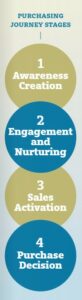
    The purchase journey stages, as I think of them, are as follows:

    1. Awareness Creation
    2. Engagement and Nurturing
    3. Sales Activation
    4. Purchase Decision

    Taking each in turn, if done well and consistently, brand building should achieve the following with your target clients:

    • Make them aware of your brand
    • Help them be aware of a business problem that they have
    • Make them understand that you have a solution to solve that problem
    Stage 1: Awareness Creation

    Brand-building activities that you can use at this stage include your website, social media such as LinkedIn, advertising, self-created PR, interviews in publications or journals or on podcasts, etc. I have seen small and micro qualitative firms use these activities to build their awareness. You may not need to execute all of them at once, but most can be done with lesser amounts of time or investment.

    For example, here in the U.K., there are regular webinars delivered to client-side networks and to industry bodies by solopreneurs and small qualitative firms. This is because the owners or leaders of these small firms have made a conscious decision to submit papers or ideas for presentation to these organizations. They are willing to invest time (not necessarily money!) in these activities. Often, the successful smaller qualitative firms are better at persuading clients to cowrite or present these webinars and papers than the bigger firms, where there is less of a personal relationship.

    Membership in one of the research industry associations (like QRCA) can be a great and relatively inexpensive way to build your industry profile, network, and learn from others. Certainly, here in the U.K., these associations are increasingly focused on attending conferences and building bridges to the client side. These are useful channels to explore to build your firm’s brand.

    Stage 2: Engagement and Nurturing

    Turning next to engagement, once a target client is aware of your brand, you need to take them through a nurturing or engagement process. Your brand-building activity for this stage should be about proving relevance, helping potential clients evaluate your offer and value proposition, and making sure you are top-of-mind.

    Crucially, this is also where you can start to use your brand building to gather and qualify leads. So, here, your brand-­building activity might include webinars, gated case studies and white papers, and newsletters—any activity that means there is a value exchange between you and the possible client—so they get the benefit of your wisdom and experience, and you get their email and contact details.

    Again, the necessary investment to do these sorts of activities can be small. There are free versions of customer relationship management (CRM) systems that small qualitative firms and solopreneurs use to generate and send out newsletters and email content. Let me reiterate; this is perfectly possible for the smallest of firms. It requires time and effort but virtually no money to use a CRM to create and disseminate a monthly newsletter.

    LinkedIn is an obvious platform to share and disseminate content you have created for free. Remember, the white paper you write, say, on how qualitative research and AI can combine to create deeper insights, can also be a series of LinkedIn posts, a blog on your website, and even a video thought piece you film on your phone when you are out walking the dog.

    Related to other non-written content, there are podcasting platforms that are free, which have very straightforward editing and publishing capabilities. Several individuals and small qualitative firms I’m aware of are starting to experiment with this as an engagement tool.

    Another engagement activity that small firms and solopreneurs can use is awards submissions. Making an award submission with a client is a terrific way to generate materials for your website and circulate them to prospective clients. If you are a member of the Insights Consultants Group, for example, you can submit for an award that is presented at the Market Research Society Awards on an annual basis.

    Obviously, this ability to contact a potential client is key when we move further down the purchase path to sales activation. When you are actively communicating with potential clients to see if they would be willing to meet with you, your brand building plays an important role in reinforcing this—it gives you content to use in outreach campaigns; it provides context and credibility. Sales activation without brand building, without that investment in awareness and engagement, is far less effective and efficient.

    Stage 3: Sales Activation

    With sales activation, you might wish to do this yourself. I have seen small qualitative firms (including one-person firms) very successfully use LinkedIn as a sales activation tool. Again, it is an investment of time by the owner of the firm or the solopreneur, but it does not necessarily need to cost money. As already mentioned, a free CRM platform can enable you to send out email campaigns. Equally, I have small agency clients that invest in sales using a fractional business development agency, say once or twice a year; they use partners or individuals who are specialists in the research and insights world.

    Stage 4: Purchase Decision

    Finally, brand building has a crucial role to play in the purchase decision process. The business insight consultancy Gartner (www.gartner.com/en) talks about “decision confidence,” which is your client’s desire to believe and affirm that they are making the best decision about whom to work with. Having decision confidence not only increases the likelihood of securing the sale in a competitive pitch, but it can increase the value of the sale. Your brand building, if done well, will contribute to decision confidence and can help you get over the line and secure that valuable commission.

    Some smaller firms ensure they are reinforcing this “decision confidence” and continue to build their brand salience through attendance at events (virtual or in-person), offers to present proposals in person (or at least online), and sending relevant content and articles to their prospective clients during the pitch process and afterward, even if they have been unsuccessful.

    Call to Action

    To summarize and suggest a call to action: how ironic is it that, as an industry, we have clients that spend considerable sums of money with us, as qualitative research firms, to help them grow their brand equity and salience? At the same time, most of us practice so little of what is savvy brand building. Yet, the path to sustainable and long-term growth, based on empirical evidence, as well as good marketing and sales sense (I would argue), is about creating and investing in your firm’s brand.

    It is not easy. It does require planning, investment of time (definitely) and money (maybe), and good execution capabilities. But in this market and the conditions we work in, as the leader or owner of a qualitative research firm, building your firm’s brand salience with existing clients and potential new ones is the key to achieving growth and commercial success, in the medium- to long-term.


  • RECORDING: Secure Your Small Business: Easy Wins for Information Security Peace of Mind

    RECORDING: Secure Your Small Business: Easy Wins for Information Security Peace of Mind

    This webinar has been sponsored by Indeemo


    Supply chain attacks are on the rise.  Small and medium sized businesses are often targeted by attackers to either gain access into larger companies systems, or access information.  End clients know this and therefore carry out extensive procurement activities on their suppliers (including research agencies).  There is also an expectation for agencies to carry similar checks on their suppliers (e.g. freelancers, fieldwork providers) – this is to ensure client commercial and participant personal information is secured wherever it exists down the supply chain.

    During this session we will cover some basic security hygiene items which you can apply to your devices and cloud services to help minimize risks when you are custodians of this information.  We’ll also show you what to look out for from a risk perspective when selecting, suggesting and using cloud services (including AI tools) to assist you in your projects.

    We will also be looking at a few examples of common attacks and what to do to help prevent a security breach.

    Attendees can expect to leave the session with added knowledge on how to protect digital information on systems and devices as well as feeling empowered to confidently respond to client security questions and questionnaires.

    Our presenter – John Rickets

    John Ricketts has been working in the market research agency since 1997 – he now has grey hair.  In that time he delivered technical and security support services to research agencies, freelancers, CATI centres, and viewing studios. John left the industry for 3 years to develop his cyber security skills further by assisting Enterprise and Government organizations with security governance , risk and compliance activities.


    He came back to the insights industry in 2018 to establish InfoShelter Ltd – a company formed with the aim of helping market research businesses traverse the cyber threat landscape and meet client and regulatory requirements in information security, privacy, and now, AI Governance.


    Web: https://www.infoshelter.co.uk

    Company LinkedIn: https://www.linkedin.com/company/infoshelter-ltd/

    John R LinkedIn: https://www.linkedin.com/in/john-ricketts/

    Watch this session here 

  • RECORDING: A Whistlestop Tour of Canva

    RECORDING: A Whistlestop Tour of Canva

    This Knowledge Share will be presented by ICG member Ramona Daniel and is generously sponsored by AddMaple


    Ready to see what all the Canva fuss is about? This session is perfect if you’ve been curious about whether it’s worth making the switch from PowerPoint, or if you want to create better-looking social content without needing a design degree.

    Ramona will walk you through creating presentations in Canva and show you how it stacks up against PowerPoint. Spoiler alert! There are some genuine advantages worth knowing about.

    We’ll also explore how to knock up social media content quickly, create simple videos, and use whiteboards for coaching and brainstorming sessions. Plus I’ll cover the different ways to export and share your work.

    It’s not a deep-dive tutorial, more of a “here’s what Canva can actually do for you” overview that should give you enough to decide if it’s worth exploring further.

    By the end, you’ll have a good sense of where to start if you want to give it a go.

    Ramona Daniel


    I’m a cultural insights and research strategy consultant with over 25 years of experience at leading global agencies including Ipsos, Kantar, and across the WPP network. I now work independently, partnering with organisations that need senior-level expertise on a flexible, freelance basis. Clients value my ability to step into complex projects quickly. My work bridges strategic thinking and hands-on delivery, from designing multi-market research programmes to translating data into compelling cultural narratives. I specialise in helping businesses decode cultural shifts, optimise research processes for greater efficiencies, and upskill teams – particularly at the intersection of traditional research methodologies and AI-driven analytics tools.

    https://www.linkedin.com/in/ramonadaniel/

    https://www.23insights.co.uk/

    Watch this session here 

  • DEVELOP: Sustaining Momentum for Long-Term Growth

    DEVELOP: Sustaining Momentum for Long-Term Growth

    Article by ICG members Jeff Deighton and Lara Meyer.

    In our last article, Learn, Lara and I explored how reflection and realignment help create clarity and awareness to make smart, timely decisions, and to foster a culture of purposeful reflection to support performance. But sustainable growth requires more than periodic check-ins, it demands a commitment to continuous evolution.


    That’s where the final stage of the B.U.I.L.D.® framework comes in: Develop.

    This phase focuses on future-proofing progress by strengthening leadership, refreshing strategy, and embedding a culture of learning, innovation, and adaptability.

    Why Develop Matters

    Most change initiatives run out of steam because they were designed to end.

    In the Develop phase, we help you continue a conscious shift from “project mode” to continuous growth mode where learning loops, leadership evolution, and strategic thinking become part of the day-to-day DNA.

    This isn’t about adding more complexity. It’s about keeping your attitude, systems, and people fit for the future.

    “We didn’t want to fall into the trap of business as usual. With this phase, we finally had the space to future-proof what we’d started.”

    What Development Looks Like in Practice

    At this stage of B.U.I.L.D.®, we help leaders and teams promote a mindset and operational model that fuels long-term success:

    Ongoing Leadership Development
     We provide on-going 1:1 and group coaching to reinforce positive mindset shifts, reduce conflict spirals, strengthen strategic decision-making, and elevate leadership presence over time.

    “I started seeing myself as a real leader, not just a manager trying to stay afloat.”

    Product & Proposition Development Workshops
    We facilitate innovation sessions to bring new creativity that help teams apply their enhanced mindset to product strategy and market positioning

    Strategic Growth Planning & Mentoring
     We work with leadership teams to shape the next phase of growth. This includes advisory support and mentoring around recruitment, team structures, and external positioning.

    Re-establishing the Baseline
    The end of the B.U.I.L.D.® cycle is also the beginning of the next. With each iteration, a return to the Baseline with deeper awareness, more data, and a stronger foundation for even bolder progress, encourages progress and adaptability.

    Develop in Action: Future-Proofing a Leadership Team

    One client’s leadership team had just come off the back of a high-growth year. But with growth came new challenges: burnout risk, role confusion, and an unclear path forward.

    Over six months, through quarterly coaching, mindset refreshers, and facilitated planning, we helped them:

    • Build a “Mind the Gap” 2-year roadmap
    • Define a new set of shared values
    • Rework their internal comms and decision-making structure
    • Embrace courageous conversations with greater ease

    “We were so used to firefighting. Now we make better decisions, faster—and we actually enjoy working together again.”

    The biggest shift? Less fear. More foresight. And a renewed sense of identity and purpose.

    For Individuals: Becoming the Leader You’re Meant to Be

    Personal development doesn’t end with insight, it accelerates with action. At this stage, we help professionals:
    ✔ Stay aligned with their long-term goals
    ✔ Strengthen habits that support confidence, clarity, and impact for themselves and colleagues
    ✔ Build thought leadership, influence, or new career chapters

    “I stopped just ‘managing the day’ and started designing my career.”

    For Teams: Growth That’s Cultural, Not Just Tactical

    High-performing teams that invest in ongoing development report higher levels of:

    • Psychological safety
    • Cross-functional collaboration
    • Creativity and innovation
    • Employee engagement and retention

    Because when growth becomes a way of being, not a one-off event, organisational change is no longer a struggle. It becomes a shared ambition.

    B.U.I.L.D.® in Full Circle

    Develop is the phase where transformation becomes self-sustaining.
    And just like that, the cycle restarts, stronger, deeper, and more intentional.

    That’s the power of the B.U.I.L.D.® framework:
    A repeatable, human-centred approach to mindset-driven growth, at the personal, team, and organisational level.

    “We didn’t need another strategy. We needed a system to keep growing. That’s what this gave us.”

    Ready to evolve?

    Whether you’re coming to the end of a growth initiative or just starting to think bigger, the Develop phase is where leaders step up and businesses scale wisely.

    Download the B.U.I.L.D.® info pack or book a call here with fellow ICGers Jeff (Deighton) or Lara (Meyer)

  • Upskill: Strengthening the Mindset Muscles That Help You Thrive

    Upskill: Strengthening the Mindset Muscles That Help You Thrive

    Article by ICG member Lara Meyer

    As independent researchers, we wear many hats in addition to researcher! Often we are also project lead, strategist, salesperson, finance director, marketing manager and more. And while technical skills matter, what really sustains success is how we manage pressure, bounce back from setbacks, and stay clear-headed when things get tough.

    That’s where Upskill, the second stage of our B.U.I.L.D.® framework, comes in. Because when self-doubt creeps in, collaboration stalls, or you find yourself hesitating to take bold action, it’s rarely a skills gap, it’s a mindset gap.

    Using tools from the Positive Intelligence (PQ) system, we help you build the resilience, emotional agility and self-command needed to lead yourself and your business with more confidence and ease.

    You learn to spot your saboteurs (like perfectionism, overworking or avoidance) and build new habits that enable clearer decisions, stronger boundaries & greater creativity.

    Whether you’re aiming to grow, pivot or simply enjoy your work more, strengthening your mental fitness is an investment that pays off.

    Want to hear what some of our recent clients who have just completed the Upskill step have told us?

    “All the changes in the industry were overwhelming, I was feeling lost and unsure of myself… and now I’m actually feeling quite excited and happy. It’s been a big transformation and that’s down to our work together.”


    “It has been the best investment I have ever made in myself, far better than any technical courses. I’m feeling so much more confident to take the leap and put myself out there more, in order  to grow my business”

    “Each week, I really looked forward to our sessions… I loved doing all of the PQ sessions and all the rest of it, but I really valued our time together. You’ve made such a difference.”

    You can read the full story here: bit.ly/43hQmzK

    If you’d like to explore working with us, please email (and quote ICG membership to access an exclusive 15% discount on 1:1 support)

    Lara Meyer – lara@lara-meyer.com
    Jeff Deighton – jeff.deighton@insight-engineers.com

    #MRX #UpskillYourMindset #Resilience #IndependentConsultants #MentalFitness #BUILDframework #PerformanceDevelopment

  • The Power of a Clear Baseline: Identifying What You Truly Need to Change

    The Power of a Clear Baseline: Identifying What You Truly Need to Change

    By ICG members Lara Meyer and Jeff Deighton.


    As independent researchers, we’re often asked to deliver fast solutions—both for clients and ourselves. But when business slows, confidence dips, or change feels inevitable, it’s vital to pause and understand what’s really going on.

    That’s where Baseline, the first step in our B.U.I.L.D.© framework, comes in. Just as we’d never evaluate campaign performance without a baseline metric, we shouldn’t attempt career, business, or mindset transformation without first diagnosing the root cause.

    Sometimes, what feels like a skills gap is really a mindset issue. Or what seems like a client’s indecision may be your own hesitancy showing up in the process.

    Through personal assessments, reflection, and strengths mapping, Baseline helps you uncover the hidden blockers—like self-sabotage, perfectionism, or lack of clarity—that can quietly hold your business back.

    In times of uncertainty, surface-level fixes don’t stick. Deep insight does.

    Download the B.U.I.L.D.©  Info Pack or get in touch with Lara and Jeff:

    Lara Meyer – lara@lara-meyer.com
    Jeff Deighton – jeff.deighton@insight-engineers.com

    (Ensure you mention you are an ICG member to access an exclusive 15% reduction on our 1:1 services)

     Read the full story here

    #MRX #GrowthMindset #BusinessTransformation #PerformanceDevelopment #BUILDframework #Baseline


  • B.U.I.L.D.©: A New Framework for Embedding a Growth Mindset in Insights & Business

    B.U.I.L.D.©: A New Framework for Embedding a Growth Mindset in Insights & Business

    A recent ICG webinar on Growth Mindset led by ICG member Lara Meyer sparked more than just discussion—it led to a powerful new collaboration. Lara’s insights on how mindset shifts can drive resilience and performance resonated deeply with fellow ICG member Jeff Deighton, leading them to co-develop the B.U.I.L.D.© framework—a structured approach to embedding growth at every level of an organization.

    B.U.I.L.D.© bridges the gap between understanding growth mindset principles and applying them to drive real business impact. It guides teams through five key stages:

    • Baseline – Understanding where you are today
    • Upskill – Equipping teams with the right tools
    • Implement – Turning insights into action
    • Learn – Measuring progress and refining strategies
    • Develop – Embedding long-term growth

    By combining Lara’s expertise in mindset coaching with Jeff’s focus on tracking progress and business transformation, LMI Ltd. and insight engineers are helping teams build resilience, take smarter risks, and achieve tangible success.

    Want to explore how a growth mindset can accelerate performance in your organisation? Get in touch with Lara and Jeff:

    Lara Meyer – lara@lara-meyer.com
    Jeff Deighton – jeff.deighton@insight-engineers.com

     Read the full story here

    #MRX #GrowthMindset #BusinessTransformation #PerformanceDevelopment #BUILDframework

  • How To Unlock Your Hidden Potential

    How To Unlock Your Hidden Potential

    By Rachael Fraser, Leadership Coach and ICG member

    Do you ever feel like there’s more inside you – untapped abilities, unseen strengths, or a greater version of yourself just waiting to emerge? We’re all capable of more than we realise, but in the rush of everyday life, it’s easy to stay stuck in the familiar.

    That’s where Hidden Potential, the latest book by Adam Grant, comes in. Grant, a powerhouse in professional development and organisational psychology, explores how we can unlock our latent abilities and break through barriers to success. Malcolm Gladwell calls it “his finest work… it will inspire you to bigger dreams.”

    But let’s be honest, we don’t always have time to read every brilliant book out there. That’s why I’m bringing you three powerful insights from Hidden Potential that you can use right now.

    1. Potential Is Not Fixed – It’s Built

    Many of us grow up believing that talent is something you either have or you don’t. You’re naturally good at something, or you’re not. But Grant dismantles this myth, showing that potential isn’t about where you start, it’s about how you grow. He draws on research to prove that ability isn’t static; it’s shaped by our habits, environments, and the effort we put in. One of his most compelling arguments is that people often underestimate the role of persistence and overestimate the role of natural talent. Those who succeed are usually not the most naturally gifted but rather the ones who keep showing up, learning, and improving over time.

    How to Apply This Insight:
    • Shift your focus from talent to effort. Instead of saying, “I’m just not good at this,” start asking, “How can I get better?”
    • Develop a practice routine that emphasises continuous improvement, whether it’s in your career, fitness, or personal development.
    • Surround yourself with people who challenge you and encourage growth, rather than those who reinforce limiting beliefs.

    2. Embrace Discomfort – It’s Where Growth Happens

    One of the reasons many people never unlock their full potential is because they avoid discomfort. It’s human nature to seek ease and familiarity, but Grant argues that the most successful individuals deliberately put themselves in challenging situations that force them to grow.
    Take, for example, world-class performers. They don’t just practice what they’re already good at; they intentionally push into areas where they struggle. This is known as “deliberate practice,” a concept made famous by psychologist Anders Ericsson. Instead of reinforcing existing strengths, deliberate practice focuses on improving weaknesses through targeted effort and constructive feedback.

    How to Apply This Insight:
    • Seek challenges instead of avoiding them. If something feels difficult, it’s probably a sign that you’re growing.
    • Ask for feedback from mentors, colleagues, or coaches—even when it’s uncomfortable. Growth happens when we address our blind spots.
    • Try something new that pushes you outside your comfort zone, whether it’s public speaking, leadership, or a new skill you’ve been avoiding.

    3. Success Is a Team Sport

    We often celebrate individual achievement, but Grant emphasizes that success is rarely a solo endeavour. The most successful people don’t just focus on their own growth, they build strong networks, learn from others, and surround themselves with supportive communities (being an active member of the ICG is perfect!).
    He highlights research showing that mentorship, collaboration, and diverse perspectives accelerate personal and professional growth. People who actively engage in learning communities – whether through mastermind groups, mentorship programs, or structured book clubs – tend to achieve more than those who go it alone.

    How to Apply This Insight:
    • Build a circle of people who challenge and support you. Seek out mentors, accountability partners, or learning communities.
    • Contribute to others’ growth. Teaching, mentoring, or sharing your knowledge will deepen your own learning.
    • Engage in professional development groups or book clubs to stay inspired and expand your perspective.

    This is just a taste of the incredible insights from this book! If you enjoyed reading this and want more…
    Join My Accelerated Book Club!

    If you love personal development books but struggle to find time to read—or if you read them but forget key insights and never implement them—I’ve got you covered.

    The Accelerated Book Club is not your typical book club. I do the hard work for you, distilling the most valuable lessons from top professional development books and guiding you through interactive exercises to embed the learning. You’ll receive a journal to complete as we go, and by the end of each session, you’ll have a personalised action plan you can apply immediately.

    And the best part? It all happens in your lunch hour.

    We usually have 5 to 15 participants per session, with time at the end for discussion and Q&A.

    Next Session: Thursday 5th June @ 12 PM

    Hidden Potential by Adam Grant
    ✨50% discount for ICG members who are new to ABC! Use code: ICG ✨
    Book Your Spot Here 

    NB: Future sessions cost just £29 (+ booking fee) with no ongoing commitment—you can join whenever a book sparks your interest.
    Stay in the loop! Sign up for my monthly newsletter here.

  • RECORDING: B2B Market Research, Simplified

    RECORDING: B2B Market Research, Simplified

    You know how expert network interviews and B2B surveys are a pain to coordinate?

    Instead of endless email threads and opaque “credit” pricing, we’ve combined the power of 20+ expert networks and survey firms in one platform.

    This lets you access all experts faster, pay-per-use, and without the donkey work.

    We call it Inex One.

    About the platform:

    Inex One is a digital platform where market research professionals, investors, and strategy consultants engage the best expert networks and survey providers worldwide. Trusted by more than 7,500 clients globally, Inex One makes it easy and affordable to get B2B insights.

    Max Friberg

    Max Friberg is the CEO and co-founder of Inex One, the marketplace for expert networks and B2B survey providers.

    In his previous career at McKinsey & Company, Max did extensive B2B market research, including commercial due diligence, competitive landscape mapping and voice-of-the-customer studies.

    Max is a CEMS MIM graduate from the Stockholm School of Economics and Indian Institute of Management Calcutta (IIMC).

    You are welcome to reach him on max@inex.one

    www.inex.one

    Max Friberg | LinkedIn

    Watch the recording here 

    Meeting summary transcript (AI Generated) here

    Max introduced Inex One, a B2B market research platform that aggregates expert networks and survey providers, and discussed its pricing and capabilities. The platform focuses on high-end B2B respondents and C-suite executives, offers access to vetted experts through various partner networks worldwide, and operates on a pay-per-use model. The group also discussed the pricing and capabilities of Max’s recruitment marketplace platform, which can handle various recruitment needs including online communities and typically takes only hours to get initial profiles.

  • Recording: How to Use LinkedIn Sales Navigator as a Tool to Get More Contacts and Sales Leads

    Recording: How to Use LinkedIn Sales Navigator as a Tool to Get More Contacts and Sales Leads

    This Knowledge Share was sponsored by Norstat

    Finding the right contacts and people to talk to in client businesses is a tough job. But you need to do it, if you are to engage with them about how you can help them, and win them as clients.

    In this Knowledge Share webinar, Paul Griffiths and Richard Barron share tips and tricks for using LinkedIn Sales Navigator – the contact and lead-finding tool that sits as an “add-on” to LinkedIn. Understand why LSN is such a useful tool for finding the right people, in the right companies, that you want to want to talk to. See how you can use LSN as a way of identifying and then starting to engage and build relationships with the people you want to target. Ask questions about how to use the tool and to search for your ideal contacts.

    Paul and Richard both use LSN in their respective businesses. They are both convinced that it is a highly effective tool in finding new contacts and sales leads. And they think it could help you too!

    Paul Griffiths 

    I help owners of Market Research and Insight Agencies to grow revenues by implementing proven growth strategies.

    For more than 20 years I’ve helped grow research and insight agencies. In that time, I’ve sold research projects, managed clients and spoken to many Heads of Insight. I understand the challenge of growing a research business while also being a practitioner within it.

    I know what great client growth strategies look like and how to implement them in a way that is both effective and efficient. I’ve seen what works, what doesn’t, and how to engage with your clients and market to win work. I can help you grow your research business more effectively and more quickly.

    https://www.linkedin.com/in/paulneilgriffiths/

    Richard Barron

    Passionate about uncovering hidden `truths’ driving human behaviour enabling organisations to make better decisions, products and services that meet real needs.

    With over 30 years of professional experience, my core competencies lie in marketing communications, and strategic planning, all of which I bring to my current role at Aspect MR. My mission is to provide insightful market analysis that empowers businesses to make informed decisions. I am dedicated to fostering a culture that values data-driven strategies and innovative solutions, ensuring that our team’s diverse perspectives lead to superior market understanding.

    At Aspect Market Research, I’ve been pioneering methods that enhance our understanding of consumer behavior and market trends. This has involved integrating my skills in strategy and marketing communications to lead our organization in delivering actionable insights. My tenure at Saatchi & Saatchi as a Global Planning Consultant, managing accounts like Toyota and Abbott Pharmaceuticals, has been instrumental in honing these abilities, allowing us to excel in multi-country projects and global product launches.

    (1) Richard Barron | LinkedIn

    Watch this session here