Topic: Running your Business

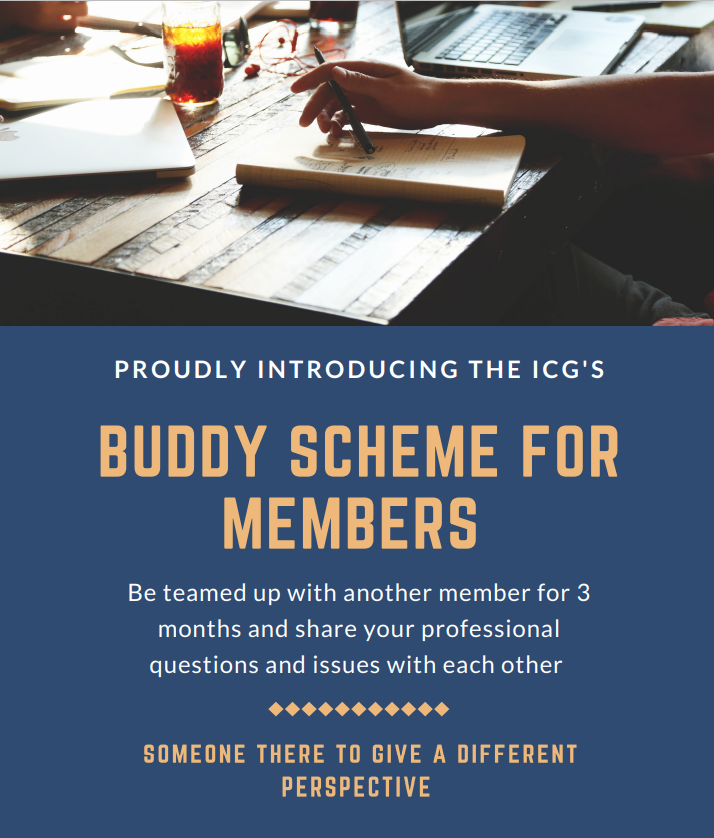
  • ICG Buddy Scheme – Now Open for Registrations May-July ’24 (Inc)

    ICG Buddy Scheme – Now Open for Registrations May-July ’24 (Inc)

    An opportunity for ICG members to meet and exchange ideas/opinions with other members. Members are paired up for 3 months, after which the pairings change. No huge commitment needed, just a willingness to (probably virtually) meet up with your ‘buddy’ at agreed times and agree to share work issues/concerns/questions with each other.

    Rewarding on a number of levels – learnt loads and worked with buddies since

    I met great people and with one of them started a really nice and inspiring and successful collaboration

    You get to know other MR consultants better, give each other tips, potential for new business and collaboration

    To sign up to our next Buddy scheme, register here

    (Registrations open until end of 3 May –  buddies will be sent to you by email early w’c 6th May).

  • Off the Beaten Path: Leaving the Agency World

    Off the Beaten Path: Leaving the Agency World

    Jess Jorgensen, formerly of Bamm and now a freelance insights consultant and ICG member, shares her experience of leaving a full-time career to pursue her mushroom passion. Article first published in Research Live. 

    In 2023, I quit my job to run with mushrooms. For 16 years, I worked in cultural and consumer insights before leaving a director-level agency position to run with a passion project: exploring the culture of mushrooms and psychedelics.

    Leaving the agency world and a full-time salary behind has been terrifying, enlightening, and rewarding. Mushrooms – both my subject matter and matter of admiration – have been key to navigating this new path.

    Colleagues and peers have supported but also questioned this choice, and I’m sure they secretly thought it was mad. Why would one quit a perfectly good job, without an income stream, to explore a weird niche? The decision was driven by three things: wellbeing, morality, and motivation.

    READ THE FULL ARTICLE HERE 


    https://www.linkedin.com/in/jessjorgensen/

    https://www.linkedin.com/company/running-with-mushrooms/


  • RECORDING: Webinar: Financial Planning – A Conversation (with Victor Sacks)

    RECORDING: Webinar: Financial Planning – A Conversation (with Victor Sacks)

    We welcome IFA Victor Sacks, VS Associates,  to talk about some key areas of financial planning relevant to micro-business owners, and answer your questions about this.

    Specific areas to be covered include:

    • retirement planning
    • financial investments
    • employee responsibilities.

    This webinar is designed to give you some food for thought, rather than individual advice, and will give you a chance to share thoughts with other attendees.

    LISTEN HERE 

    Contact Victor Sacks on <victor@vsassociates.co.uk>


  • How to Harness ‘Micro Power’!

    How to Harness ‘Micro Power’!

    ICG member Nick Bonney shares his thoughts about the value smaller businesses can bring.


    I have a guilty secret. I love The Repair Shop. I appreciate this means that I’m clearly embracing my 50s and am probably – even more worryingly – only a few episodes away from Cash in the Attic and turning into my dad, but there is something so awe-inspiring about watching experts in their craft at work.

    Why would I be talking about Jay, Dom, Kirsten and the repair crew in a post about market research? For me, it’s probably the best metaphor I’ve found to describe the incredible independent researcher community (ICG) I stepped into just over five years ago.

    My only experience with the ICG, prior to starting out on my own, had been a presentation I’d given as a client many moons ago. Since then, I’ve been blown away by the level of know-how that exists in the group and just how generous people are with their time and advice. Just like The Repair Shop barn, it doesn’t seem to matter how niche the problem is that comes through the door, there is someone who will have come across it before or, more likely than not, be a recognised expert in that subject. And just like the much-loved BBC show, the best work is often created through collaboration and co-operation between these individual experts.

    It was amazing, therefore, to see such widespread recognition for these micro research businesses at the annual MRS Awards at the end of last year. Whilst there is a dedicated award category for independent consultants (massive congrats to Untapped Innovation and PS Research for their win and commendation, respectively)  it was fantastic to see independents popping up on the list of finalists all over the place with Hush Research & Strategy, Field Notes, The Outsiders, House 51 and ourselves, Deep Blue Thinking, picking up awards on the night.

    It was particularly telling that many smaller businesses had entered award categories as a partnership or consortium, reflecting what I’ve seen to be one of the key benefits of this segment of the market; the ability to bring together a dedicated team of experts to meet the precise requirements of a client brief.

    The annual Research Live League Tables published this week showed promising growth for the sector but, in recognition of the increasing importance of the boutique end of the market, it was fantastic that the MRS also took the time to highlight the perspective of small independent researchers. All those interviewed highlighted the benefits of experience, flexibility and personal service that working with an independent can bring.

    Yet, as I know from my two decades the other side of the fence, there are still many client organisations who are nervous about bringing in smaller suppliers. Konrad Collao from Craft referenced the ‘nobody gets fired for using IBM quote’ and corporate procurement policies can reinforced this mindset.

    AURA is to be applauded for promoting smaller vendors through its ‘The Best Agencies You’ve (Probably) Never Heard Of’ event but it’s worth remembering the research buyer is often just one cog in the corporate machine. Often it can be other parts of the business that place barriers in the way of working effectively with sole traders or micro businesses.

    Fixed rosters typically encourage larger brands to stick to working with the big guys; after all, if you’re restricted to 8 or 10 vendors on a roster, do you want to allocate one of those to a small, boutique outfit who might not be right for every single brief? This was a persistent challenge during my two decades client-side. The barriers to working with a new smaller vendor were often too challenging to overcome even when we could see there was undoubted expertise we could benefit from.

    It would be all too easy though to place the burden of responsibility with finance or procurement functions. However, if research buyers want to tap into the talent in this part of the market, it’s important they help set the right conditions for success. Acting as an advocate for smaller businesses will ensure they’re able to benefit from a diverse supplier base.

    Championing reasonable payment terms, minimising irrelevant administration forms and ensuring prompt payment are just a few of the things that research buyers can do which mean independents can focus on delivering great work rather than being bogged down in the corporate machine. Sadly, whilst we’ve seen recent high profile announcements from the chancellor on late payments, it remains a persistent issue for most small businesses I speak to and a quick glance at the published data (https://www.gov.uk/check-when-businesses-pay-invoices) reveals some fairly well-known names remain serial offenders for late payment.

    My hope is that we’ll continue to see more smaller businesses coming to the fore with increasingly creative partnerships and consortia coming together to help clients truly access the best the market has to offer. However, as we enter a new year, it’s a great time for research teams to consider how they can advocate for smaller businesses to enable them both to thrive in an effective partnership – after all, there’s a whole wealth of expertise waiting behind the barn door!

    Nick Bonney <nick.bonney@deepbluethinking.co.uk>

    https://www.deepbluethinking.co.uk/

    https://www.linkedin.com/company/deep-blue-thinking/about/

  • RECORDING: Knowledge Share: Making Introversion Work

    RECORDING: Knowledge Share: Making Introversion Work

    This Knowledge Share has been generously sponsored by Opinion Hub

    This Knowledge Share will be presented by Carol Raithatha, Carol Raithatha Ltd. 

    Introverts as compared to be extroverts can be defined as people who are more reflective, prefer calm and quiet environments, and get their energy from spending time alone. They may also be shy or reserved. This is at odds with our business environment which focuses on action, speed, networking, and self-promotion. Being an introvert and a consultant can be difficult. But introverts have much to offer.

    This Knowledge Share session will discuss a few typical ‘troubling’ type situations for introverts and suggest tips for working through those, both from the point of view of an introverted person and from someone who is collaborating with introverts. We will finish off the session with a brief look at how tailored coaching can help introverts flourish at work.

    Carol Raithatha 

    Carol is the Director of Carol Raithatha Limited, a consultancy specialising in food and drink research, sensory evaluation, qualitative and desk research, and B2B approaches. In addition, Carol Raithatha Limited offers coaching to research and related professionals. Carol is a strategic thinker with a pragmatic mindset. Carol holds an ILM Certificate in Effective Coaching and Mentoring, an MBA, and is a Certified Member of the MRS and a member of the ICG and AQR.

    Carol Raithatha Limited

    www.carolraithatha.co.uk

    RECORDING HERE

  • RECORDING: The 5 Ways to Grow Your Business’s Profits

    RECORDING: The 5 Ways to Grow Your Business’s Profits

    This webinar has been generously sponsored by Perspective Research Services.

    Many business owners work hard to improve their profits but miss an opportunity to make significant gains to the bottom line by leveraging 5 often overlooked inputs; the ‘5 Ways’.

    This simple but effective approach will give you clarity on how to grow your business and actionable steps that you can implement immediately.

    Justin will demonstrate how focusing on 5 areas of your business can deliver a 50% increase in revenue and a 60% growth in gross profit using proven strategies and tactics.

    Justin Charlton-Jones

    Justin is an experienced business leader and public speaker who has successfully led and grown 5 small businesses in the UK.  His passion is working with small businesses to help them grow.  He now leads a business coaching company, but previously worked in the research and insight sector where he managed and grew a number of independent consultancies as well as running a UK division of an international agency.

    https://www.linkedin.com/in/justin-charlton-jones/

    WATCH THE RECORDING HERE 

  • Recording: Introduction to Amsr – a Free Resource for Storytelling and Bringing Context to Research and Insights

    Recording: Introduction to Amsr – a Free Resource for Storytelling and Bringing Context to Research and Insights

    Please join ICG member Judith Staig for this webinar.

    Tim Harford advises that, when we see a number, we should ask ‘is that a big number?’ One of the ways we can answer that question is to look at recent history. For example, is the interest rate high? Only when compared with the last few years – back in November 1979, it was 17%.

    This webinar will introduce you to the AMSR – a fantastic free resource for researchers. The AMSR curates post-war market research projects, papers, and publications and is full of nuggets of gold that will help you put context around today’s markets, find data to spin stories around and bring your insights to life.

    The webinar uses the three recent AMSR publications to showcase stories about key issues of our time such as women at work, sustainability, diversity and inclusion, inflation and referendums, as well as to report on the changes and developments we have seen in our industry. Link to publications here

    What will I learn? You will know how to use the AMSR for your own research and also what you can do to become involved with what is one of the foremost and most valuable charitable endeavours in our industry.

    Judith Staig

    Judith is a writer and content strategist working in the research and insights sector. She helps AMSR with marcomms as a volunteer.

    https://www.linkedin.com/in/judith-staig-993153/


    AMSR home

    WATCH THIS WEBINAR HERE

  • RECORDING: Designing and Delivering Hybrid Events

    RECORDING: Designing and Delivering Hybrid Events

    This webinar provides some ‘frames’ for tackling the complexity of hybrid (both face to face and online) events, including

    • a glimpse of our approach to designing and facilitating hybrid events
      •  negotiating with clients 
      • designing for engagement
      • Insights from case studies of hybrid events we’ve run.

    Orla Cronin

    Orla is a research psychologist, facilitator, trainer and consultant  – her clients are mainly NGOs and other civil society organisations.  She was an active member of the ICG for several years until the focus of her business changed. In fact,  she is still in touch with some of you! 

    In over twenty years of facilitating, Orla has developed a broad toolkit of live and virtual facilitation methods.  She has been providing training in both face to face and virtual facilitation since 2015. Her first hybrid workshop took place in 2017 and since then, with some talented colleagues – Una McAlinden and Kim Roth Howe –  she’s been refining her experience and approach to these unusually challenging gatherings. they’ve delivered their latest Zoom and Miro based training in Designing and Delivering Hybrid Events  to several hundred individuals and organisations across the US, UK and Europe, including to the National Council for Voluntary Organisations, Great Britain China Centre, the Soil Association, University of Durham and NHS Health and Care Research Wales.

    Special offer to ICG members:

    If you are interested in attending our training, we have a short (2.5 hour) ‘bootcamp’ running on October 18th (https://hybridmeetingbootcamp2023.eventbrite.co.uk) , and a 3 session ‘deep dive’ masterclass scheduled for September 12th, 13th and 14th (https://hybridmeetingmasterclassSept2023.eventbrite.co.uk) . Use the discount code ICG23 to get 15% off either course. 

    Orla Cronin also runs other training options – see here for more info: Facilitation training OCR ICG 2023


    RECORDING OF WEBINAR HERE


  • Best Practice for Hiring Independent Market Researchers

    Best Practice for Hiring Independent Market Researchers

    The guidelines 

    These guidelines have been developed by the ICG (Independent Consultants Group) in collaboration with 242 market research professionals.  The guidelines’ purpose is to help nurture happier and more productive working relationships between independent consultants and the companies that hire them.   

    In our study, we identified that most issues in the relationship occur because the terms of engagement are unclear and their expectations differ.  To avoid any misunderstanding, independent market research consultants and the companies that hire them should ideally, do the following: 
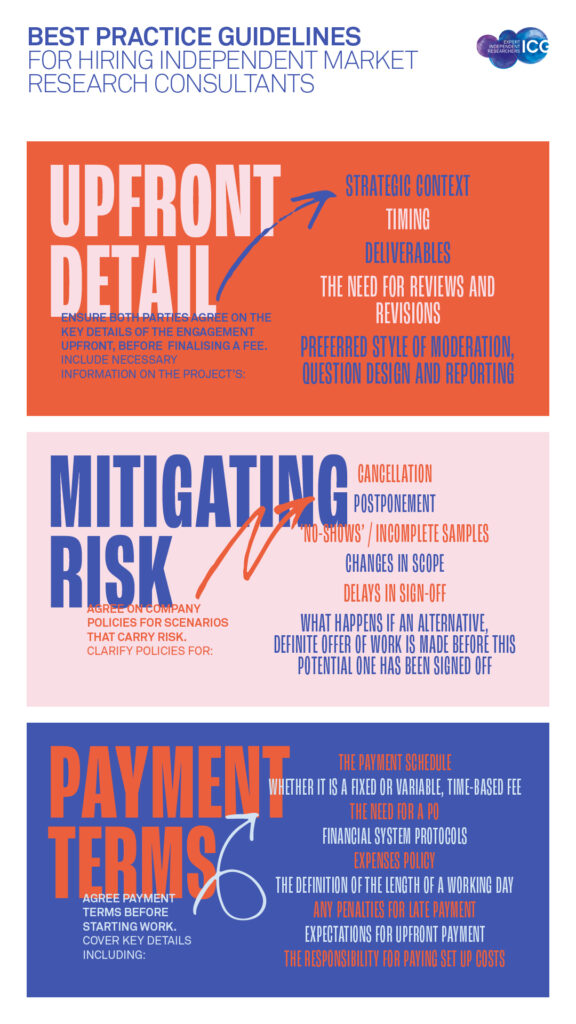
    DOWNLOAD THE GUIDELINES HERE

    What is this initiative? 

    The Independent Consultants Group (ICG) is a network of over 400 independent market research consultants. Most are UK based but we have members worldwide.  We support one another with professional advice, resources and contacts.  

    Our members have come together to define what we believe best practice means, in the context of hiring independent market research consultants. The purpose of this is to help nurture happier and more productive working relationships between independent consultants and the companies that hire them.   

    What did we discover in our study on best practice in hiring independent researchers? 

    In our industry survey of over 242 independent researchers and hirers, we discovered that often there is insufficient detail agreed upfront, which can destablise relationships between hirers and freelancers. 

    • The biggest risks from independent consultants’ perspective when working with new hirers includes: 
        1. An underestimation of the actual scope of work (according to 60% of consultants) 
        2. Not receiving receiving enough strategic context in client briefings (55%) 
        3. Late payment (40%) 
        4. Not being paid more, despite doing more work than was originally agreed (30%)  
    • All of these risks point towards a central issue:   Insufficient detail is agreed upfront between hirers and independent consultants 
      1. Only 51% of independent consultants agree payment terms upfront 
      2. Only 36% of independent consultants use a signed, statement of work including terms and conditions, before starting work 
      3. Only 23% of independent consultants agree on the hours expected to be worked 
      4. Only 15% state on what is billable if there’s a cancellation 
      5. Only 8% state what will happen if a definite project comes up before a tentative one has been confirmed 
      6. Only 7% agree what is billable if there are no shows (in qualitative research)

    In conclusion, based on the experiences of both hirers and independent consultants and our industry survey, we have identified a clear guiding policy to nurture happier and more productive working relationships:   independent consultants and their hirers need to agree on more detail upfront 

    How did we develop these guidelines? 

    This initiative has been spearheaded by ICG member Tom Woodnutt, founder of online qualitative research specialists – Feeling Mutual.  Over the last 12 months, Tom has co-developed  these guidelines through close collaboration with the market research industry, ICG members, our sponsor Further (who kindly funded the infographics, shared their online qual platform, Together™ for free along with their expertise on the subject). 

    There has been three phases to the development of these best practice guidelines:  

    1. a) Online qualitative research with ICG members and Further, to help define the challenge
    2. b) Crowdsourced ideation with ICG members to generate solutions 
    3. c) Industry survey (with hirers and independent consultants) to validate the best practice guidelines (conducted by Nik Harta of Yolo Comms). 
    • Phase 1: Defining the challenge 

    In November 2020, an online qualitative research forum hosted by Further, was carried out with six hirers and six independent research consultants.   

    The discussion covered the key dimensions in the working relationship from both hirers’ and consultants’ perspectives.  The topics discussed included: risks and rewards from working together, how they feel about the relationship, what determines success, areas of tension, misunderstanding and reactions to an early set of best practice guidelines. 

    This allowed us to develop a draft set of guidelines and hypotheses on both the factors that threaten to destabilize working relationships and those that help enhance them. 

    • Phase 2: Developing solutions 

    In April 2021, 25 ICG members joined a group brainstorm via webcam in which the findings from the previous stage were scrutinised and the draft guidelines were developed further.

    • Phase 3, Validating best practice 

    Between July to September 2021, 242 independent consultants and hirers took part in an online survey.  This measured their experiences and perceptions of the working relationship and what they believed best practice to mean. 

    This allowed us to measure the relative importance of various guidelines and validate our understanding of the context that shapes the relationship.  


  • RECORDING OF: Knowledge Share: Understanding More About Linktree

    RECORDING OF: Knowledge Share: Understanding More About Linktree

    This Knowledge Share has been generously sponsored by E-Tabs, bringing cutting edge automated charting for your projects in PowerPoint & Google Slides

    This Knowledge Share will be presented by ICG member Alexander Tan, AT Research.

    We all need to market our businesses, right?

    In this knowledge share Alex  will talk about his experience of using websites and other tools for promoting his business.

    Recently there has been much talk of using sites such as Linktree as either an alternative to a traditional website, or alongside one when social media, or short talks, might benefit from a single ‘all on a page’ set of links.

    Alex will talk about using Linktree for the first time, some of its features (as a free subscriber and a paid-subscriber), and how it might apply to a small business. Please note that he is not promoting them or sponsored by them .

    He hopes that the session will open up a discussion about how Linktree compares to its competitors and what we can learn from this market overall.

    .

    https://www.linkedin.com/in/atresearch21/

    LISTEN TO THIS KNOWLEDGE SHARE HERE